Having recently visited various heritage lines , Watercress, bluebell, EOR & K&ESR I have to say the trains on the watercress line seem to motor along compared to the other lines , now of course it could be just a false sensation, however does the watercress line have some kind of exemption for a higher speed limit instead of the 25 MPH allowed in heritage lines

-
Our new ticketing site is now live! Using either this or the original site (both powered by TrainSplit) helps support the running of the forum with every ticket purchase! Find out more and ask any questions/give us feedback in this thread!
You are using an out of date browser. It may not display this or other websites correctly.
You should upgrade or use an alternative browser.
You should upgrade or use an alternative browser.
Speeds on heritage railways.
- Thread starter Gooner18
- Start date
- Status
- Not open for further replies.
Sponsor Post - registered members do not see these adverts; click here to register, or click here to log in
R
RailUK Forums

duffield
Established Member
I'm sure that for passenger services, there are no exemptions to the 25mph limit. There are some specific exemptions on some railways for non-passenger services to exceed this limit.
In theory a heritage railway could run passenger services at higher speeds but I believe that would required central door locking or door stewards as per mainline heritage stock, and possibly TPWS. Then there's the whole issue of level crossings. As far as I know no heritage line has attempted to fufill the requirements for running actual passenger services above 25mph.
Edit: Of course it's possible, particularly given the lack of speedometers on steam locos, that they may sometimes slightly exceed the limit for a short time - but they won't be timetabled on that basis. I've certainly read that exceeding the speed limit was common back in the days before anyone with GPS could potentially spot the transgression, but given that GPS is ubiquitous now I'm sure it would soon get out if any lines were breaking the rules by any significant margin. I don't expect the regulator would be interested in reports of 26mph average for three minutes though given the margins of error involved.
In theory a heritage railway could run passenger services at higher speeds but I believe that would required central door locking or door stewards as per mainline heritage stock, and possibly TPWS. Then there's the whole issue of level crossings. As far as I know no heritage line has attempted to fufill the requirements for running actual passenger services above 25mph.
Edit: Of course it's possible, particularly given the lack of speedometers on steam locos, that they may sometimes slightly exceed the limit for a short time - but they won't be timetabled on that basis. I've certainly read that exceeding the speed limit was common back in the days before anyone with GPS could potentially spot the transgression, but given that GPS is ubiquitous now I'm sure it would soon get out if any lines were breaking the rules by any significant margin. I don't expect the regulator would be interested in reports of 26mph average for three minutes though given the margins of error involved.
Last edited:
Looking at the current timetable, the fastest services are scheduled for 33 minutes for Alton to Alresford including a minute at Medstead and three minutes at Ropley. The line's ten miles, which seems consistent with a maximum of 25 mph.

UP13
Member
- Joined
- 27 Jul 2018
- Messages
- 510
I have a vague feeling that Britannia or Bittern might have been allowed to go either 45 or 60 15 years ago as part of testing on the Watercress, but that would be behind closed doors as such. Of course the Great Central can do 45 for the demonstration TPOs and can do 60 for tears, famously Tornado in 2008.
I think the reason you felt it went faster on the Watercress is because it has very steep gradients, particularly between Alton and Medstead & Four Marks (the Alps) and thus the locomotive has to work extra hard and generates extra noise etc.
I think the reason you felt it went faster on the Watercress is because it has very steep gradients, particularly between Alton and Medstead & Four Marks (the Alps) and thus the locomotive has to work extra hard and generates extra noise etc.
Bishopstone
Established Member
Another factor in perception of speed, I find, is the consistency of 25mph running, versus those lines where temporary speed restrictions, crossings, track layout etc force frequent slowing to (eg) 10mph.
From memory, the Watercress is relatively free of such restrictions whereas the Spa Valley, for example, had lots of crawling speed limits to adhere to when I had a driver experience session there!
From memory, the Watercress is relatively free of such restrictions whereas the Spa Valley, for example, had lots of crawling speed limits to adhere to when I had a driver experience session there!
The key factor is the gradient profile: the steeper the gradient, the harder the locomotive has to work to maintain 25 mph. Medstead and Four Marks is the summit of the Watercress Line and is 652 feet/199 metres above sea level (there is a sign just off the platform at the Alton end), and with a ruling gradient of 1 in 60. From both Alresford and Alton the climbs to Medstead and Four Marks are mostly at 1 in 60. In contrast, the Epping and Ongar Railway summit is in the cutting a bit east of North Weald, and is only about 100 metres above sea level. I don't know the ruling gradient but it is not as steep as 1 in 60. I'm not very familiar with the Bluebell Line, maybe someone can enlighten us on the location of the summit and the ruling gradient.Having recently visited various heritage lines , Watercress, bluebell, EOR & K&ESR I have to say the trains on the watercress line seem to motor along compared to the other lines , now of course it could be just a false sensation, however does the watercress line have some kind of exemption for a higher speed limit instead of the 25 MPH allowed in heritage lines
Last edited:
YorkshireBear
Established Member
- Joined
- 23 Jul 2010
- Messages
- 9,664
I always note that when you get an engine with a Speedo it feels a lot faster, which indicates that when they don't have Speedos many are the correct side of the 25 limit.
timj
Member
ride on miniature railways instead, it always feels faster and you get more / more interesting trackwork in the same area
zwk500
Veteran Member
Bluebell railway have their gradient profile here: https://www.bluebell-railway.co.uk/bluebell/map_grad.htmlThe key factor is the gradient profile: the steeper the gradient, the harder the locomotive has to work to maintain 25 mph. Medstead and Four Marks is the summit of the Watercress Line and is 652 feet/199 metres above sea level (there is a sign just off the platform at the Alton end), and with a ruling gradient of 1 in 60. From both Alresford and Alton the climbs to Medstead and Four Marks are mostly at 1 in 60. In contrast, the Epping and Ongar Railway summit is in the cutting a bit east of North Weald, and is only about 100 metres above sea level. I don't know the ruling gradient but it is not as steep as 1 in 60. I'm not very familiar with the Bluebell Line, maybe someone can enlighten us on the location of the summit and the ruling gradient.
The summit is a short way south of Imberhorne Viaduct. The line generally climbs northbound up the Sussex Weald, at a normal maximum gradient of 1:75 but there are several sections of 1:60, and the climb from Kingscote up to the summit is 1:55. I think the Summit and steepest sections are not the original profile, but the result of having to dig out an infilled cutting that couldn't be completely emptied in the funding or time (or both!) available. I could be slightly wrong on that though.
Compare the bridge in this photo: https://www.bluebell-railway.co.uk/bluebell/ext/extprog.html
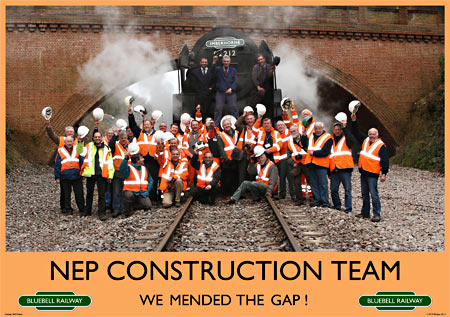
WIth this one: https://sremg.org.uk/location/egrin.shtml
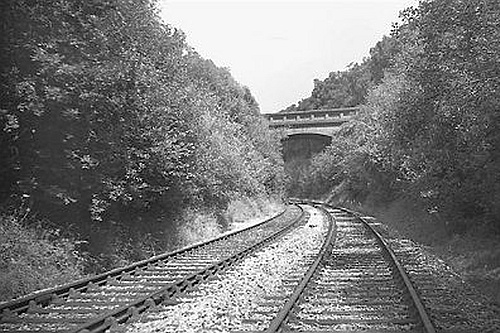
(I think they're different bridges but are ones at either end of the cutting so give a sense of how much was not eventually dug out).
Last edited:

Some railways can be slightly more flexible in terms of the 25 limit - obviously not timetabled to be in excess of that but certain services and drivers do tend to have a reputation for not hanging around!Having recently visited various heritage lines , Watercress, bluebell, EOR & K&ESR I have to say the trains on the watercress line seem to motor along compared to the other lines , now of course it could be just a false sensation, however does the watercress line have some kind of exemption for a higher speed limit instead of the 25 MPH allowed in heritage lines
The key factor is the gradient profile: the steeper the gradient, the harder the locomotive has to work to maintain 25 mph. Medstead and Four Marks is the summit of the Watercress Line and is 652 feet/199 metres above sea level (there is a sign just off the platform at the Alton end), and with a ruling gradient of 1 in 60. From both Alresford and Alton the climbs to Medstead and Four Marks are mostly at 1 in 60. In contrast, the Epping and Ongar Railway summit is in the cutting a bit east of North Weald, and is only about 100 metres above sea level. I don't know the ruling gradient but it is not as steep as 1 in 60. I'm not very familiar with the Bluebell Line, maybe someone can enlighten us on the location of the summit and the ruling gradient.
The ruling grade for the Bluebell is indeed 1/75, with the steepest section being 1/55 from Hazelden Farm to the summit in Imberhorne Cutting, where it levels out and then immediately drops down to 1/61. I will add the gradient profile for this section of line is not entirely accurate, as the profile of some sections proved to be steeper or shallower than expected.Bluebell railway have their gradient profile here: https://www.bluebell-railway.co.uk/bluebell/map_grad.html
The summit is a short way south of Imberhorne Viaduct. The line generally climbs northbound up the Sussex Weald, at a normal maximum gradient of 1:75 but there are several sections of 1:60, and the climb from Kingscote up to the summit is 1:55. I think the Summit and steepest sections are not the original profile, but the result of having to dig out an infilled cutting that couldn't be completely emptied in the funding or time (or both!) available. I could be slightly wrong on that though.
Compare the bridge in this photo: https://www.bluebell-railway.co.uk/bluebell/ext/extprog.html
WIth this one: https://sremg.org.uk/location/egrin.shtml
(I think they're different bridges but are ones at either end of the cutting so give a sense of how much was not eventually dug out).
The trackbed through the cutting is higher than the original line, which necessitated the very steep gradients north of Kingscote to the new housing estate in East Grinstead. I believe that was (as stated above) due to cost, and as the cutting did not need to be dug fully out why waste money on it?
But in answer to the original question I agree that the gradient of the line will play a part in feeling like you’re going faster than you are - a hard working engine feels a lot faster than a coasting one!
This thread reminds me of a story I was told some years ago, about two chaps from the the Office of The Rail Regulator (or whoever was responsible for ensuring heritage railways complied with regulations) deciding to have a busmans holiday and visit a diesel gala on their day off.
However, the visiting locos were driven by their owners who had an interesting interpretation of the 25mph limit.
After their first trip was over, they went and found the person in charge, introduced themselves and announced, in no uncertain terms, they were now very much on duty and anyone found breaking the speed limit would be dealt with. Severely.
However, the visiting locos were driven by their owners who had an interesting interpretation of the 25mph limit.
After their first trip was over, they went and found the person in charge, introduced themselves and announced, in no uncertain terms, they were now very much on duty and anyone found breaking the speed limit would be dealt with. Severely.

LittleRedTrain
Member
There may also be an element of feeling faster if you're closer to lineside vegetation, structures, etc.
The Watercress Line, particularly between Medstead and Alton, is quite hemmed in with fairly narrow and deep cuttings, which might give the impression of higher speeds compared to a train passing through wide open fields.
If you want the true sensation of speed, try the Romney Hythe and Dymchurch. The proximity to the ground and small stock makes 25mph feel like you are really rocketing along!
The Watercress Line, particularly between Medstead and Alton, is quite hemmed in with fairly narrow and deep cuttings, which might give the impression of higher speeds compared to a train passing through wide open fields.
If you want the true sensation of speed, try the Romney Hythe and Dymchurch. The proximity to the ground and small stock makes 25mph feel like you are really rocketing along!

hexagon789
Veteran Member
I remember reading, that as it's 1/3rd scale, 25mph on the RH&DR is effectively the equivalent of 75mph on the mainline!If you want the true sensation of speed, try the Romney Hythe and Dymchurch. The proximity to the ground and small stock makes 25mph feel like you are really rocketing along!
Or so they claim at least...

Belperpete
Established Member
- Joined
- 17 Aug 2018
- Messages
- 3,592
Were any of the lines you visited driving more cautiously due to the high risk of fires that we have had recently?
It’s a shame I can’t get the video that I took to upload , although having watched it several times i think all the above points made probably explains why it felt quicker
== Doublepost prevention - post automatically merged: ==
== Doublepost prevention - post automatically merged: ==
Nope not that I noticed all pretty much running as normalWere any of the lines you visited driving more cautiously due to the high risk of fires that we have had recently?

I can confirm that effect is true for the RHDR from when I have been on it, that 25mph does feel like 75mph because of the 1/3 scale effect. Other best part about that line is the double track element for most of it, so even when another train passes, it gets the same wind gush effect as if its on the National rail network.I remember reading, that as it's 1/3rd scale, 25mph on the RH&DR is effectively the equivalent of 75mph on the mainline!
Or so they claim at least...
Its certainly not called Kent's mainline in miniature for nothing
 .
.
hexagon789
Veteran Member
Very nice!I can confirm that effect is true for the RHDR from when I have been on it, that 25mph does feel like 75mph because of the 1/3 scale effect. Other best part about that line is the double track element for most of it, so even when another train passes, it gets the same wind gush effect as if its on the National rail network.
Its certainly not called Kent's mainline in miniature for nothing
It's been on my list for years too, I really must make the effort
It is well worth coming down to see. 13 miles of 15inch gauge track, with the famous Henry Greenly locos. A lot of the locos whistles are from former mainline locos so there is A4 chime whistles, Stanier hooters, etc which adds to the fun of it.Very nice!
It's been on my list for years too, I really must make the effort
Granted there are dull parts, it does sometimes get called the backgarden railway, as so many gardens back onto it. However, even taking that factor out there is still a lot to see from the train with the Royal military canal, the Romney marshes, and Dungeness 'Britains desert' at the end of it. You aren't short of places to look around along the line, and many enthusiasts down here in Kent will have a different opinion on which Fish and Chip shop is worth going to along the line.
Recommend coming down in 2027 for its centenary. If you go check out any of their previous gala lineups on YouTube, I can only imagine what the cavalcade would look like for that centenary event.
D Mylchreest
Member
Preserved railways usually operate under a light railway order so speeds are limited to 25mph. I have a memory of the GCR operating at 45 because of the better condition of the track, but don't know if that is still true
hexagon789
Veteran Member
Not since 1992 as I understand it, this came up in a thread or two a couple of years ago, the legislation in resoect of heritage railways having been superceded by Transport Works Orders under the Transport and Works Act 1992.Preserved railways usually operate under a light railway order so speeds are limited to 25mph. I have a memory of the GCR operating at 45 because of the better condition of the track, but don't know if that is still true
Furthernore, the usually referred to Light Railways Act of 1896 did not actually specify a 25mph limit.
A 25mph limit was specified in relation to Light Railways under the 1868 Regulation of Railways Act, but any Light Railways opened under the 1896 legislation were not restricted to a specific maximum speed by law.
The Heart of Wales is operated under a Light Railway Order of the 1896 Act and it has a linespeed of 55/60mph for example.
zwk500
Veteran Member
The 25mph limit is relevant for the Railways Safety Regulations 1999:Not since 1992 as I understand it, this came up in a thread or two a couple of years ago, the legislation in resoect of heritage railways having been superceded by Transport Works Orders under the Transport and Works Act 1992.
Furthernore, the usually referred to Light Railways Act of 1896 did not actually specify a 25mph limit.
A 25mph limit was specified in relation to Light Railways under the 1868 Regulation of Railways Act, but any Light Railways opened under the 1896 legislation were not restricted to a specific maximum speed by law.
The Heart of Wales is operated under a Light Railway Order of the 1896 Act and it has a linespeed of 55/60mph for example.
Who we work with | Office of Rail and Road
As safety and economic regulator of the rail industry and monitor of National Highways, we work with rail infrastructure companies, safety organisations and the British, Scottish and Welsh governments.
Railway operators who operate on systems that have a line speed not exceeding 25mph (40kph) are exempted from the Railway Safety Regulations 1999. Minor and heritage railway systems can also apply to be exempt from certain mainline safety requirements, such as train driver licensing.
Railway Safety Regulations 1999 | Office of Rail and Road
The application of the Railway Safety Regulations 1999.
So if you go beyond 25mph you need a train protection system, which ORR guidance https://www.orr.gov.uk/sites/default/files/2024-05/train-protection-systems-guidance-on-rsr-1999.pdf defines as:Under RSR99:
- A train operator must not operate a train without installing a train protection system for that train;
- An infrastructure manager must not permit the operation of any train without a train protection system for the relevant railway.
While plenty of heritage vehicles have been fitted with AWS and TPWS, to operate and maintain these systems on a railway does incur an extra continuous cost which a heritage organisation is unlikely to be able to bear. I don't know if the GCR has a specific exemption for speeds above 25mph given it has double-track or if it's just fitted AWS/TPWS.The definition of a train protection system requires, as a minimum, that the system should provide automatic braking if a train passes certain stop signals without authority, or travels at excessive speed on the approach to certain signals, buffer stops, and speed restrictions.
Solent&Wessex
Established Member
- Joined
- 9 Jul 2009
- Messages
- 2,745
Whilst all Heritage Railways will generally have the same maximum permitted speed of 25mph, it does not mean that they will run at that speed.
Many heritage railways, especially shorter ones, or those without many stations or stops en route, do not regularly get to 25mph and trundle along at a lower speed - I assume to pad the journey and experience out - especially if also running on train catering experiences.
I know I have visited many heritage railways and noted the GPS on my phone showing 17 - 18 mph running speed, then visiting another heritage railway and showing 24 - 25 mph and it seeming a lot faster. Combine that with the other effects mentioned above such as cuttings, trees, tunnels, gradient then it can feel a lot faster at 25 mph than 18 mph.
You can even get the same sensations on the same railway. Some drivers will tootle along at 17mph whilst others will open it up and go at 25mph making more noise in the process. This has often resulted in some people saying "Driver X is speeding" when in fact Driver X is not speeding - everyone is so used to other drivers tootling along well below the speed limit that when someone does open it up and make a lot more noise and go faster (but still at the actual speed limit) then it gives the appearance that Driver X is "speeding".
Many heritage railways, especially shorter ones, or those without many stations or stops en route, do not regularly get to 25mph and trundle along at a lower speed - I assume to pad the journey and experience out - especially if also running on train catering experiences.
I know I have visited many heritage railways and noted the GPS on my phone showing 17 - 18 mph running speed, then visiting another heritage railway and showing 24 - 25 mph and it seeming a lot faster. Combine that with the other effects mentioned above such as cuttings, trees, tunnels, gradient then it can feel a lot faster at 25 mph than 18 mph.
You can even get the same sensations on the same railway. Some drivers will tootle along at 17mph whilst others will open it up and go at 25mph making more noise in the process. This has often resulted in some people saying "Driver X is speeding" when in fact Driver X is not speeding - everyone is so used to other drivers tootling along well below the speed limit that when someone does open it up and make a lot more noise and go faster (but still at the actual speed limit) then it gives the appearance that Driver X is "speeding".
martin butler
Member
- Joined
- 9 Oct 2018
- Messages
- 850
The ORR, also do carry out unannounced visits, and have been known to carry speed recording devices, So, it's very much in the interest of the railway to ensure their drivers, or the person who is the RO is observing the speed limit.

DanNCL
Established Member
Exactly this. Any one of the passengers could be from the ORR, it’s not worth the risk.The ORR, also do carry out unannounced visits, and have been known to carry speed recording devices, So, it's very much in the interest of the railway to ensure their drivers, or the person who is the RO is observing the speed limit.
duffield
Established Member
I'd say that's a little exaggerated, it feels subjectively like about 50mph to me, but still pretty impressive particularly with the "open" carriages.I remember reading, that as it's 1/3rd scale, 25mph on the RH&DR is effectively the equivalent of 75mph on the mainline!
Or so they claim at least...

778
Member
I have read on another forum that one of the heritage railways wanted to increase the 25 mph speed limit and asked the Railway Inspector. The Railway Inspector said that the speed limit would not be increased, but he was happy for some railways to occasionally run at 40 mph as long as thier track and bridges were in good condition. The reason he did not want to raise the speed limit raised was that if it was increased to 40 mph, some railways would occasionally go at 60 mph which would not be acceptable. I agree with that, because sometimes common sense is more important than the letter of the law.

43096
On Moderation
- Joined
- 23 Nov 2015
- Messages
- 18,741
Sorry, that is just utter nonsense. No-one at the ORR is going to authorise greater than 25mph running in such a slapdash way. Indeed the ORR's own guidance (https://www.orr.gov.uk/sites/defaul...idance-for-minor-and-heritage-railways-v1.pdf) says:I have read on another forum that one of the heritage railways wanted to increase the 25 mph speed limit and asked the Railway Inspector. The Railway Inspector said that the speed limit would not be increased, but he was happy for some railways to occasionally run at 40 mph as long as thier track and bridges were in good condition. The reason he did not want to raise the speed limit raised was that if it was increased to 40 mph, some railways would occasionally go at 60 mph which would not be acceptable. I agree with that, because sometimes common sense is more important than the letter of the law.
Most minor and heritage railways operate solely on their own infrastructure at speeds up to 25mph (40km/h). However, some may wish to operate at higher speeds. If your organisation is the infrastructure manager for a railway that wants to operate at speeds greater than 25mph (40km/h) then you will require a safety authorisation or an exemption.
In addition to the requirements of ROGS, if you intend to operate at speeds above 25mph (40km/h) you must consider the requirements of the Railway Safety Regulations 1999.
778
Member
I know running over 25mph would not be accepted today, this was a long time ago (1980s?).Sorry, that is just utter nonsense. No-one at the ORR is going to authorise greater than 25mph running in such a slapdash way. Indeed the ORR's own guidance (https://www.orr.gov.uk/sites/defaul...idance-for-minor-and-heritage-railways-v1.pdf) says:
Sorry, that is just utter nonsense. No-one at the ORR is going to authorise greater than 25mph running in such a slapdash way. Indeed the ORR's own guidance (https://www.orr.gov.uk/sites/defaul...idance-for-minor-and-heritage-railways-v1.pdf) says:
I know running over 25mph would not be accepted today, this was a long time ago (1980s?).
It’s not nonsense at all. It was Major Oliver who said that.
This of course predates the ORR and their guidance and goes back to the LRO days. He didn’t mind the occasional overspeed although it was different times back then.
- Status
- Not open for further replies.