• Our new ticketing site is now live! Using either this or the original site (both powered by TrainSplit) helps support the running of the forum with every ticket purchase! Find out more and ask any questions/give us feedback in this thread!

'Speed Whiskers' on Type AM3 (Later class 303) Electric Multiple Units.

Status
Not open for further replies.

D6130

Established Member
Joined
12 Jan 2021
Messages
9,134
Location
West Yorkshire/Tuscany
For my eponymous post (D6130's 6,130th post) I would like to make an enquiry regarding the early liveries of these units.

A couple of weeks ago, I was having a discussion in a Glasgow pub with a couple of rail enthusiast ex-school friends regarding these units, of which all three of us have fond childhood and teenage memories.

As originally delivered in 1960, these units carried the striking Caledonian blue livery with a narrow black and gold waistline. From about 1962 onwards, yellow warning panels started to appear on the lower part of the cab ends, below the windscreens and waistline....together with the first painting of the unit numbers - in three digit format - below the drivers' windscreens.

However one of my friends (looking at you @McRhu !) was adamant that he had seen a black & white photograph of one of these units in original livery....but with DMU-style cream or yellow 'speed whiskers' prior to the painting of the yellow warning panels. Can anyone shed any light on this please?
 
Sponsor Post - registered members do not see these adverts; click here to register, or click here to log in
R

RailUK Forums

Albaman

Member
Joined
16 Sep 2018
Messages
135
For my eponymous post (D6130's 6,130th post) I would like to make an enquiry regarding the early liveries of these units.

A couple of weeks ago, I was having a discussion in a Glasgow pub with a couple of rail enthusiast ex-school friends regarding these units, of which all three of us have fond childhood and teenage memories.

As originally delivered in 1960, these units carried the striking Caledonian blue livery with a narrow black and gold waistline. From about 1962 onwards, yellow warning panels started to appear on the lower part of the cab ends, below the windscreens and waistline....together with the first painting of the unit numbers - in three digit format - below the drivers' windscreens.

However one of my friends (looking at you @McRhu !) was adamant that he had seen a black & white photograph of one of these units in original livery....but with DMU-style cream or yellow 'speed whiskers' prior to the painting of the yellow warning panels. Can anyone shed any light on this please?
Congratulations on your eponymous post.

I have no recollection of seeing one of these units with the " speed whiskers " but ( and I may be totally wrong here ) , I vaguely recall seeing one unit with the " wasp " type of warning panel ,similar to that applied to diesel shunters, below the windscreens.

Regarding the unit numbers, I seem to recall they were applied before the yellow warning panels , but I readily acknowledge, this didn't happen yesterday !
 

Buzby

Established Member
Joined
14 Apr 2023
Messages
1,697
Location
Glasgow, Scotland
Not much help Andy, I know but i don’t recall seeing ‘speed whiskers’ on any of the AM3’s either on the North Side electrics (between Queen St LL and Jordanhill) and South Side (from Central to Gilmour Street) this was my daily commute for over 8 years and I would have noticed. Even after the front profile redesign (with removal of the wrap-round front cab windows) it was always the yellow front panel.

I did recall seeing the wasp type once or twice but this appeared to be a one-off (trial). I did see the whiskers on DMU’s on the East Kilbride line but cannot remember for how long!
 

Falcon1200

Established Member
Joined
14 Jun 2021
Messages
6,611
Location
Neilston, East Renfrewshire
Had a look at (my former colleague) Colin Howat's book 'Glasgow Blue Trains' (Amberley, 2023) and there are no photos of any Speed-Whiskered units.

Also, congratulations on 6130 posts @D6130 ....Perhaps fortunate that those locos never received TOPS Numbers!
 

D6130

Established Member
Joined
12 Jan 2021
Messages
9,134
Location
West Yorkshire/Tuscany
Congratulations on your eponymous post.

I have no recollection of seeing one of these units with the " speed whiskers " but ( and I may be totally wrong here ) , I vaguely recall seeing one unit with the " wasp " type of warning panel ,similar to that applied to diesel shunters, below the windscreens.

Regarding the unit numbers, I seem to recall they were applied before the yellow warning panels , but I readily acknowledge, this didn't happen yesterday !
Thanks. I wonder if the 'wasp' stripes were what my friend was thinking about? Now I come to think about it, I do recall seeing some units carrying their numbers in white digits before the application of yellow warning panels.
Had a look at (my former colleague) Colin Howat's book 'Glasgow Blue Trains' (Amberley, 2023) and there are no photos of any Speed-Whiskered units.

Also, congratulations on 6130 posts @D6130 ....Perhaps fortunate that those locos never received TOPS Numbers!
Thanks. 29 017 doesn't quite have the same historical ring about it, does it?

I shall have to get hold of a copy of Colin's book (secretly....because the wife has strictly forbidden me to buy any more railway books and I'm unlikely to find a copy in a public library down here in Yorkshire!)

== Doublepost prevention - post automatically merged: ==

Not much help Andy, I know but i don’t recall seeing ‘speed whiskers’ on any of the AM3’s either on the North Side electrics (between Queen St LL and Jordanhill) and South Side (from Central to Gilmour Street) this was my daily commute for over 8 years and I would have noticed. Even after the front profile redesign (with removal of the wrap-round front cab windows) it was always the yellow front panel.

I did recall seeing the wasp type once or twice but this appeared to be a one-off (trial). I did see the whiskers on DMU’s on the East Kilbride line but cannot remember for how long!
Many thanks @Buzby . As far as I can recall, all the DMUs in Scotland - with the exception of the Gloucester RC&W Co. class 100s had 'speed whiskers' as part of their original livery....but, as always, I'm open to correction.
 
Last edited:

McRhu

Member
Joined
14 Oct 2015
Messages
667
Location
Lanark
Wasp stripes (or stripe singular) - yes, that was it: quite angular and not in keeping with the rounded form of the bodywork. And it's in the back of my mind now (the same mind that is getting increasingly 'senior' that I came across a picture of the unit not too long ago, although who knows where).

Congrats on your very apposite posting milestone D6130.
 

D6130

Established Member
Joined
12 Jan 2021
Messages
9,134
Location
West Yorkshire/Tuscany
Wasp stripes (or stripe singular) - yes, that was it: quite angular and not in keeping with the rounded form of the bodywork. And it's in the back of my mind now (the same mind that is getting increasingly 'senior' that I came across a picture of the unit not too long ago, although who knows where).

Congrats on your very apposite posting milestone D6130.
Thanks @McRhu . Shame I couldn't think of a suitable question about class 29 locos! ;)
 

Helvellyn

Established Member
Joined
28 Aug 2009
Messages
2,587
This thread at RMWeb states it was 021 that had the wasp stripes.

post-188-0-43960000-1520520502.jpg

https://content-eu.invisioncic.com/y320084/monthly_03_2018/post-188-0-43960000-1520520502.jpg
 

McRhu

Member
Joined
14 Oct 2015
Messages
667
Location
Lanark
Fantastic - I was remembering it wrongly, but that's it, yes. Great to get confirmation that I'm not entirely away with it... yet!
 

Helvellyn

Established Member
Joined
28 Aug 2009
Messages
2,587
I suppose the way the stripes have been applied could be said to be like a moustache (or whiskers) if the central windscreen is seen as a nose.
 

Taunton

Veteran Member
Joined
1 Aug 2013
Messages
12,332
These stripes, which (simplistically) are the opposite orientation to 'Speed Whiskers', are at least somewhat clear of all the gubbins on the front of the 303s. Big mu receptacles, positioned under the windscreens like those on yellow diamond dmus. Two character route indicator on the front. Two big air hoses either side of this, which regularly hung across the route indicator and part obscured it.

I wonder why they didn't do the whole rectangular panel. Or the entire front of the unit (where the yellow paint eventually went).
 

d9009alycidon

Member
Joined
22 Jun 2011
Messages
985
Location
Eaglesham
Speed Whiskers were never applied to 303s. There were three units selected for panel trials, 021 had the yellow/Black stripes, one had a small white panel and one had a small yellow panel, after a short period the small yellow panel was selected for fleet wide application. I have seen only one photo of the white panel and the number isn't clear. There was also some variation on the unit number, initially no unit numbers were applied, then white unit numbers were applied, being moved above the yellow panel once applied, later the black numbers on the yellow panel became standard.
311s were delivered in rail blue with full yellow ends, including the drivers door.
 

Buzby

Established Member
Joined
14 Apr 2023
Messages
1,697
Location
Glasgow, Scotland
311s were delivered in rail blue with full yellow ends, including the drivers door.
The only drivers door colours I ever saw were the original blue (the yellow front stopped just before the hinge). Once the Trans-Clyde livery was implemented The drivers doors became orange to match the side livery - again the yellow stopped at the door hinges.
 

d9009alycidon

Member
Joined
22 Jun 2011
Messages
985
Location
Eaglesham
The only drivers door colours I ever saw were the original blue (the yellow front stopped just before the hinge). Once the Trans-Clyde livery was implemented The drivers doors became orange to match the side livery - again the yellow stopped at the door hinges.

Here is an example, cant quite make out the unit number
FB_IMG_1722869630436.jpg
 

Buzby

Established Member
Joined
14 Apr 2023
Messages
1,697
Location
Glasgow, Scotland
Interesting - must have been part of the ‘yellow end’ experiment - it certainly didn’t make it across the whole fleet as standatd. You might find this video entertaining!


d9009alycidon

Member
Joined
22 Jun 2011
Messages
985
Location
Eaglesham
Interesting - must have been part of the ‘yellow end’ experiment - it certainly didn’t make it across the whole fleet as standatd. You might find this video entertaining!


From what I have researched, all 311s were delivered with the yellow cab door, some 303s were initially repainted rail blue with full yellow ends including cab door, here is 040 at Motherwell


Not sure how many 303s were given yellow cab doors before standardising on blue. Some ER and LMR units also received yellow cab doors initially.
 

TheHovisKid

Member
Joined
9 Sep 2008
Messages
313
Location
Heysham
From what I have researched, all 311s were delivered with the yellow cab door, some 303s were initially repainted rail blue with full yellow ends including cab door, here is 040 at Motherwell


Not sure how many 303s were given yellow cab doors before standardising on blue. Some ER and LMR units also received yellow cab doors initially.
Looks like it: https://www.flickr.com/photos/96859208@N07/10559683153/
 

Strathclyder

Established Member
Joined
12 Jun 2013
Messages
3,840
Location
Clydebank
Here is an example, cant quite make out the unit number
View attachment 163045
Was trying to figure out where this was taken, took me a couple seconds to realize that it was on the Inverclyde line for a start (River Clyde in the middle-ground). Have narrowed it down to this spot, between Langbank and Bishopton. The M8's westernmost stretch/terminus (known as the Bishopton Bypass; terminating at Junc. 31 with Greenock Rd/the A8) didn't open until November 1975; indeed, there's a total lack of construction works visible. So it's pretty safe to assume this was taken between September 1967 and November 1975.
 

McRhu

Member
Joined
14 Oct 2015
Messages
667
Location
Lanark
Was trying to figure out where this was taken, took me a couple seconds to realize that it was on the Inverclyde line for a start (River Clyde in the middle-ground). Have narrowed it down to this spot, between Langbank and Bishopton. The M8's westernmost stretch/terminus (known as the Bishopton Bypass; terminating at Junc. 31 with Greenock Rd/the A8) didn't open until November 1975; indeed, there's a total lack of construction works visible. So it's pretty safe to assume this was taken between September 1967 and November 1975.
BR MK2 OLE - Only line in Britain with it.
 

Strathclyder

Established Member
Joined
12 Jun 2013
Messages
3,840
Location
Clydebank
BR MK2 OLE - Only line in Britain with it.
Ah yes of course, seem to recall the Inverclyde is a real mixture of OLE types (I may be getting that confused with the Ayrshire Coast though). The scenery in the background though is what helped clue me in as to where that picture was taken lol
 

danielnez1

Member
Joined
14 May 2012
Messages
311
Location
Seghill
Ah yes of course, seem to recall the Inverclyde is a real mixture of OLE types (I may be getting that confused with the Ayrshire Coast though). The scenery in the background though is what helped clue me in as to where that picture was taken lol
History seems to be repeating its self with mixing of OLE types - York to Church Fenton seems to be using a different type than other electrification projects. I think Inverclyde eventually standardised with Mk1 equipment, though IIRC Siemens equipment has been used for more recent upgrades.
 

d9009alycidon

Member
Joined
22 Jun 2011
Messages
985
Location
Eaglesham
History seems to be repeating its self with mixing of OLE types - York to Church Fenton seems to be using a different type than other electrification projects. I think Inverclyde eventually standardised with Mk1 equipment, though IIRC Siemens equipment has been used for more recent upgrades.

Surely the most nonstandard OHLE masts are on the Neilston branch with its German style concrete masts!
 

Railsigns

Established Member
Joined
15 Feb 2010
Messages
2,754
Surely the most nonstandard OHLE masts are on the Neilston branch with its German style concrete masts!
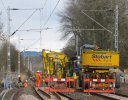
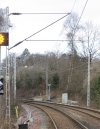
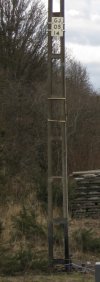
I've attached a few photos of these OLE masts. They look too slender and angular to be made of concrete. It's pretty clear from the close-up image that they're fabricated from steel.
 

Attachments

  • Neilston OLE 2.jpg
    Neilston OLE 2.jpg
    438 KB · Views: 30
  • Neilston OLE 3.jpg
    Neilston OLE 3.jpg
    261.9 KB · Views: 30
  • Neilston OLE 4.jpg
    Neilston OLE 4.jpg
    195.8 KB · Views: 30
Status
Not open for further replies.

Top