Our new ticketing site is now live! Using either this or the original site (both powered by TrainSplit) helps support the running of the forum with every ticket purchase! Find out more and ask any questions/give us feedback in this thread!
I think the Southern Electric Group used to publish detailed booklets on unit formations - depending on what era you're looking for, such things may turn up second hand on online auction websites and so on.
'The 4 Sub Story' (Rayner/Brown) was one such. Although only dealing with class 405 essentially, it demonstrates what a minefield the subject was. The RCTS also published book(s) on 'The coaching stock of BR' (which includes all SR units/formations at the time). I have the 1978 edition, no idea how many years were covered, although I have a feeling it wasn't too many, possibly because it was too mammoth a task to keep up with all the changes year on year?
Many of the vehicles forming the Rep/TC's were also conversions from Mk 1 loco hauled stock.
Do you mean the renumbering (ie Vep's) from their original 77xx/78xx numbers (as I remember them) to the later 34xx/35xx series? Pretty certain these changes will be documented in the various Ian Allan/Plat 5 books of the time.
In 1968, due to a shortage of suitable stock for the Bournemouth electrification scheme, BR formed an eight-carriage unit classified as 8-VAB and numbered 8001. The unit was formed of carriages from three standard 4-VEP sets, nos. 7739/41/42, plus a conventional locomotive-hauled buffet...
Those RCTS books that show individual unit coach numbers exist from at least from 1976 and 1978 (I've got those two, but I think there was at least one earlier edition), and later they were published jointly with Ian Allen in I think 1980-84+.
It's a massive area to research. The inter-compatibility of much of the stock of that era meant they could chop and change unit formations with stuff from other classes. Some driving trailers from 2-EPB EMUs ended up in DEMUs, first in the 3-R Tadpoles and then as centre coaches in 3-H units! Motor coaches from SR-design 2-HAPs ended up in 4-EPBs working with converted 4-SUB trailers. There were EPBs with coaches of both SR and BR design, and some 4-BIG/CIG got a coach from a 4-VEP.
See Blood and Custard for more details than you could realistically swallow at one sitting.
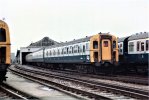
And here's a Vep, 7700, with a MBS (Motor Brake Second) from a Cig. Taken, in the course of my work, at Fratton depot in 1985. Operationally this would have remained as a Vep on paper, as there was only a reduction of 2 seats overall, a Cig MBS having 56 and a Vep, 58.
As built the first batch of CEPs and BEPs didn’t ride that well, so the later ones were fitted with cast Commonwealth bogies. During the refurbishment the earlier ones gained commonwealth bogies from withdrawn mk1 hauled stock (the motor bogies were unchanged))
The Gatwick units to replace the VEG units were converted from mk2 air conditioned hauled stock (and the driving luggage van from withdrawn 2HAPs)
But many of the earlier Southern EMUs were partial rebuilds, many EPBs had SE&CR bogies, some 4SUB trailers were old steam compartment bodies mounted on new frames etc.
Do you mean the renumbering (ie Vep's) from their original 77xx/78xx numbers (as I remember them) to the later 34xx/35xx series? Pretty certain these changes will be documented in the various Ian Allan/Plat 5 books of the time.
Not forgetting the intermediate 30xx/31xx numbering from the late 80s, before they were refurbished. Essentially the new number was the old number minus 4700, so 7701 became 3001, etc.
Didn't last so long; the first refurbished VEP I saw was at Clapham Junction in summer 1988 (oddly I recall the number: 3421), while the 30xx/31xx numbering came in during (IIRC) 1987.
As for CIGs, these were originally numbered 7301-7438(I think).
There was an older series 7301-36, introduced in the mid-60s and with HAP-style older seat covers, based solely on the Central Division. 7337 onwards were introduced from 1970 and had the newer-style seat covers and a more modern interior.
In the 80s, the older series became 11xx while the newer series became 12xx, again a simple renumbering, 7301-36 became 1101-36 (with caveats below) while 7337-7399 became 1237-1299 and 7400-7436 1200-1236 (again with caveats).
The caveats were that the CIGs started being refurbished before the renumbering, the older series became 17xx and the newer series 18xx. This started in the mid-80s and completed perhaps around 1990, uncertain of exact date.
The CEPs were refurbished very early in the 80s, into the 15xx/16xx series (originally 71xx/72xx). I never remember an unrefurbished CEP.
In all three classes, there was no simple mathematical relation between the refurbished and unrefurbished numbers. I believe the refurbished numbers were simply done in the order of refurbishment.
== Doublepost prevention - post automatically merged: ==
And here's a Vep, 7700, with a MBS (Motor Brake Second) from a Cig. Taken, in the course of my work, at Fratton depot in 1985. Operationally this would have remained as a Vep on paper, as there was only a reduction of 2 seats overall, a Cig MBS having 56 and a Vep, 58.
I wonder if the tabular info on bloodandcustard could be converted into a searchable form (ie spreadsheet)? If so, would it be worth contacting the site owner Colin Watts to see if he would cooperate/welcome that?
That was because the first 20 units still had asbestos which aobviously also required dealing with; as the motor vehicles were being switched between units during refurbishment ( because they took longer to do ) a decision was made to treat the first 20 units separately in order to keep all their vehicles together within those 20 units and avoid the potential risk of anything with asbestos "escaping" into the general fleet without being treated.
That was because the first 20 units still had asbestos which aobviously also required dealing with; as the motor vehicles were being switched between units during refurbishment ( because they took longer to do ) a decision was made to treat the first 20 units separately in order to keep all their vehicles together within those 20 units and avoid the potential risk of anything with asbestos "escaping" into the general fleet without being treated.
Based on what is said on Blood & Custard (https://www.bloodandcustard.com/BR-4VEP.html) it was the DTC vehicles that had asbestos in them (which was stripped out during the 1980s), so they were kept in units 3001-20 (3401-20 after refurbishment). With the MBS vehicles taking longer to refurb and not having the asbestos issue, they were swapped between sets during refurbishment. This explains why unit 3441 (one DTC condemned after the Purley accident) was renumbered 3404 when it gained a DTC vehicle from 3004 (other three vehicles of this set written off in the Clapham disaster).
That was because the first 20 units still had asbestos which aobviously also required dealing with; as the motor vehicles were being switched between units during refurbishment ( because they took longer to do ) a decision was made to treat the first 20 units separately in order to keep all their vehicles together within those 20 units and avoid the potential risk of anything with asbestos "escaping" into the general fleet without being treated.
Ah ok, thanks. I think I just assumed at the time that 3401-20 were over on the South Eastern and hence would not be seen at either Clapham Junction or the SWD as a whole.
We are aware of an issue with emails from the Forum to Microsoft-based email accounts (hotmail/outlook/live.com email addresses). This is being looked into currently, thanks for your patience meanwhile.