Our new ticketing site is now live! Using either this or the original site (both powered by TrainSplit) helps support the running of the forum with every ticket purchase! Find out more and ask any questions/give us feedback in this thread!
I notice that Crwys Road station is still shown on the works diagram but this seems to have gone very quiet, has this been pushed into 2024 now along with the rest of the Rhymney line projects?
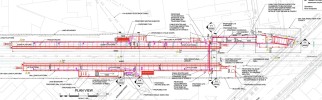
A prior approval application (PRAP/22/00046/MJR) has been submitted to Cardiff council and is available on their website. No mention of dates, but does include plans for the station (plus several strongly-worded objections from neighbours).
Interesting/unfortunate that there’s only lift access to one platform – they’re still negotiating with the owner of the adjacent land to allow for a lift on the other side.
EDIT: might have answered my own question here, because I now realise there’s no date given for OLE energisation on the Treherbert route. So it seems likely that Treherbert will retain existing signalling (and diesel trains) during 2023, and get upgraded later.
Makes sense given it has seemed like most of the engineering work closures so far have mainly been for the line south of Pontypridd and for the Aberdare and Merthyr branches.
To the best of my knowledge, that's not yet funded. It's certainly not in the scope of the first stage of the metro scheme, unlike Crwys Road. The new Gabalfa station appears on the metro works map, but is in orange, indicating that it's funded from a different scheme. But there's no Ely Mill station shown, presumably because it's still a way off yet.
To the best of my knowledge, that's not yet funded. It's certainly not in the scope of the first stage of the metro scheme, unlike Crwys Road. The new Gabalfa station appears on the metro works map, but is in orange, indicating that it's funded from a different scheme. But there's no Ely Mill station shown, presumably because it's still a way off yet.
Ken Skates - previous Transport Minister at Welsh Government - said that it was a priority along with St.Clears in west Wales. Perhaps nobody wants to pay for a new footbridge over the main line - which would surely be needed to provide a decent link to Cowbridge Road? The new Ely Mill housing is almost cut off from Cowbridge Road because they will not/have not opened the underpass under the City Line at the location for the new station.
A prior approval application (PRAP/22/00046/MJR) has been submitted to Cardiff council and is available on their website. No mention of dates, but does include plans for the station (plus several strongly-worded objections from neighbours).
Interesting/unfortunate that there’s only lift access to one platform – they’re still negotiating with the owner of the adjacent land to allow for a lift on the other side.
It's hard not to have some sympathy for those objecting: the main pedestrian routes seem to be via the surrounding residential streets, rather than from Crwys Rd itself. I realise the idea is that there will be lifts to Crwys Rd, but I suspect many won't use those - and judging by many of the unstaffed stations I am familiar with, lifts aren't always that that reliable in service.
If I have read the plans correctly, users will have to go via different streets when accessing the up/down platforms. While that is the case in a lot of places, neither of the roads actually leads to Crwys Road directly: there are rather narrow existing steps to Crwys Road from Moy Road, but in the case of Alexander Street it's not an intuitive route at all to/from Crwys Road. The arrangement looks very confusing.
A prior approval application (PRAP/22/00046/MJR) has been submitted to Cardiff council and is available on their website. No mention of dates, but does include plans for the station (plus several strongly-worded objections from neighbours).
Interesting/unfortunate that there’s only lift access to one platform – they’re still negotiating with the owner of the adjacent land to allow for a lift on the other side.
Interesting article on Wales Online by Prof. Mark Barry, who originally proposed the Metro project. He rightly asserts that leaving the Coryton & City lines at 2tph is not going to entice people out of their cars. Frustratingly, a passing loop and extra platform at Rhiwbina were de-scoped from the Coryton line, which would not have cost a lot in the grand scheme of things and would have allowed an increased frequency.
Anyone who knows just a little about transport planning, passenger behaviours and the geography of Cardiff, will quickly spot that offering a service every 30 minutes for trips of probably less than 20 minutes, is not going to attract passengers. Whilst people are generally happier to wait longer for longer trips - so 30 minutes for a journey of an hour or more - they are less inclined to do so for shorter trips.
This reality will apply to all the stations on the Coryton and City lines in Cardiff, that will, as far as the passenger is concerned, see no meaningful improvement in services when Metro is operating compared with today - so at Danescourt, Fairwater, Waungron, Ninian Park, Birchgrove, Rhiwbina, Whitchurch, Coryton, Ty Glas, etc). It also makes no sense to be offering 2tph at these station whilst at the same time operating 10tph through Llandaff and Cathays to Queen Street....
The WalesOnline article is a shorter version of the Metro Moans for 2023 post on his blog, and in the interest of balance, worth also reading his Metro Hopes for 2023 which is a bit more optimistic!
I’m normally pretty positive and optimistic…and have talked and written at length about Metros in Wales in such a manner, even with some small measure of critique […] However, I am going to start 2023 with a collection of moans that really need to be dealt with […]
The moans cover:
#1 The lack of Metro services proposed by TfW for Cardiff on the City and Coryton Lines
#2 Bus delays and need for bus lanes
#2 The missed opportunity at Cathays station for Cardiff University
#4 No point extending a 2tph Coryton Line 600M to the new Velindre Hospital
#5 Has Merthyr missed a major Metro regeneration opportunity?
[…] but to provide balance I have also set out below, some Metro Hopes for 2023. They should be read together!
The hopes cover:
#1 Next phase of Metro in Cardiff and of a “Cardiff Crossrail”
#2 First phase of a Swansea Metro
#3 Upgrade of The Borderlands line between Wrexham and Liverpool
#4 Need for UK Gov commitment to SWML upgrade and new stations
#5 Devolution of rail powers/funding and Barnettisation of HS2, etc
As this is a progress updates thread in the infrastructure section, can I ask that we stick to actual updates please.
If there is some authoritative news that something might happen, that simple fact can be posted here (with a link and quote), but any further debate regarding anything that is not yet decide does need to be posted in the Speculative Discussion section please.
Interesting article on Wales Online by Prof. Mark Barry, who originally proposed the Metro project. He rightly asserts that leaving the Coryton & City lines at 2tph is not going to entice people out of their cars. Frustratingly, a passing loop and extra platform at Rhiwbina were de-scoped from...
www.railforums.co.uk
If anyone has any questions please contact us directly, thanks
500 million+ members | Manage your professional identity. Build and engage with your professional network. Access knowledge, insights and opportunities.
Have a look at the PDF map attached at the bottom of my earlier post: on the Cathays branch they’ll start in Gabalfa, on the Rhymney line they’ll start just before the junction for the Coryton line.
Have a look at the PDF map attached at the bottom of my earlier post: on the Cathays branch they’ll start in Gabalfa, on the Rhymney line they’ll start just before the junction for the Coryton line.
Have a look at the PDF map attached at the bottom of my earlier post: on the Cathays branch they’ll start in Gabalfa, on the Rhymney line they’ll start just before the junction for the Coryton line.
I am confused about the limit of the electrification on the Valley Lines so perhaps you can clarify this please. On the PDF map it shows that there will be no electrification south of Ninian Park and through to Cardiff Central, this is shown in black, but there are pictures of loads of steelwork going up in Cardiff Canton depot as shown on this thread. Also the main maintenance depot is to be at Taff's Well, so what role will Cardiff Canton play?
Have a look at the PDF map attached at the bottom of my earlier post: on the Cathays branch they’ll start in Gabalfa, on the Rhymney line they’ll start just before the junction for the Coryton line.
Exactly. And the depots are getting overhead line (strictly it'll be rigid overhead) in the stabling sidings to ensure that the units go out of the depot with their batteries fully charged. Both depots are "islands" of electrification - in the case of Taff's Well there's no wiring in the line connecting the depot to the main line, and in the case of Canton there'll be no wiring between Canton and Cardiff Central or Ninian Park. The FLIRTs have diesel engines but I'm pretty sure TfW are trying to minimise use of diesel in urban areas, and particularly in stations.
== Doublepost prevention - post automatically merged: ==
No. The Class 398 trains on the Aberdare, Merthyr and Treherbert lines don't have diesel engines, but they do have batteries. The Class 756s have both diesel engines and batteries, but should have sufficient battery power to avoid using diesel through the city centre (and possibly further - some people have suggested they could reach Penarth and even Barry on diesel). If you watch the video from the PWI the presenters explain how they planned the network to provide overhead power only where it was necessary and easy to install, because the trains using the route all have onboard batteries.
== Doublepost prevention - post automatically merged: ==
The trains will actually switch between overhead and battery power pretty frequently - if you look at the map (PDF file at the bottom of this post) only the lines shown in blue on a white background are live overhead. The blue on a yellow background means permanently earthed sections (i.e. there's a wire there, so the trains' pantograph remains up, but it's earthed and delivers no power), and the black lines mean no wires at all. So a train leaving Queen St for Pontypridd would run on battery to Gabalfa, put the pantograph up and pick up some power, use battery to negotiate earthed sections around Llandaff, stay on power to just beyond Radyr, then lower the pantograph and run on battery to just beyond Taff's Well, then pan up as far as Treforest, then pan down again to Pontypridd. The pantograph actuators are certainly going to get plenty of work! No doubt there will be some teething problems. It's also worth noting that stations that stable trains overnight and don't have overhead (Queen St, Central, Pontypridd, Merthyr, for example) will have shore supplies so a train can be "plugged in" overnight and start its shift with a full battery.
Exactly. And the depots are getting overhead line (strictly it'll be rigid overhead) in the stabling sidings to ensure that the units go out of the depot with their batteries fully charged. Both depots are "islands" of electrification - in the case of Taff's Well there's no wiring in the line connecting the depot to the main line, and in the case of Canton there'll be no wiring between Canton and Cardiff Central or Ninian Park. The FLIRTs have diesel engines but I'm pretty sure TfW are trying to minimise use of diesel in urban areas, and particularly in stations.
== Doublepost prevention - post automatically merged: ==
No. The Class 398 trains on the Aberdare, Merthyr and Treherbert lines don't have diesel engines, but they do have batteries. The Class 756s have both diesel engines and batteries, but should have sufficient battery power to avoid using diesel through the city centre (and possibly further - some people have suggested they could reach Penarth and even Barry on diesel). If you watch the video from the PWI the presenters explain how they planned the network to provide overhead power only where it was necessary and easy to install, because the trains using the route all have onboard batteries.
== Doublepost prevention - post automatically merged: ==
The trains will actually switch between overhead and battery power pretty frequently - if you look at the map (PDF file at the bottom of this post) only the lines shown in blue on a white background are live overhead. The blue on a yellow background means permanently earthed sections (i.e. there's a wire there, so the trains' pantograph remains up, but it's earthed and delivers no power), and the black lines mean no wires at all. So a train leaving Queen St for Pontypridd would run on battery to Gabalfa, put the pantograph up and pick up some power, use battery to negotiate earthed sections around Llandaff, stay on power to just beyond Radyr, then lower the pantograph and run on battery to just beyond Taff's Well, then pan up as far as Treforest, then pan down again to Pontypridd. The pantograph actuators are certainly going to get plenty of work! No doubt there will be some teething problems. It's also worth noting that stations that stable trains overnight and don't have overhead (Queen St, Central, Pontypridd, Merthyr, for example) will have shore supplies so a train can be "plugged in" overnight and start its shift with a full battery.
Part of the reason (and I've had this confirmed from both sides, as it were - the PWI video explains it from TfW's side, and I've heard it from a colleague at Cardiff Uni too) is that there's sensitive instrumentation in Cardiff Uni's new Sbarc/Spark building next to the railway line and the scientists who run it were very concerned about electromagnetic interference from the railway. So TfW have avoided wiring through Cathays at all. There is something going on at Cathays though as there's blue safety fencing up along the trackside next to the Student Union building, I noticed it today. Might be preparatory works for the new footbridge, I guess?
Part of the reason (and I've had this confirmed from both sides, as it were - the PWI video explains it from TfW's side, and I've heard it from a colleague at Cardiff Uni too) is that there's sensitive instrumentation in Cardiff Uni's new Sbarc/Spark building next to the railway line and the scientists who run it were very concerned about electromagnetic interference from the railway. So TfW have avoided wiring through Cathays at all. There is something going on at Cathays though as there's blue safety fencing up along the trackside next to the Student Union building, I noticed it today. Might be preparatory works for the new footbridge, I guess?
Part of the reason (and I've had this confirmed from both sides, as it were - the PWI video explains it from TfW's side, and I've heard it from a colleague at Cardiff Uni too) is that there's sensitive instrumentation in Cardiff Uni's new Sbarc/Spark building next to the railway line and the scientists who run it were very concerned about electromagnetic interference from the railway. So TfW have avoided wiring through Cathays at all. There is something going on at Cathays though as there's blue safety fencing up along the trackside next to the Student Union building, I noticed it today. Might be preparatory works for the new footbridge, I guess?
It's caused by the motors or the electronics that drive them, but it's propagated by the OLE. Anything that isn't caught by the filters is flowing round the circuit formed by the OLE, rails and any return conductor, which crudely speaking acts like a giant aerial to generate electromagnetic fields. The electronics can avoid critical signalling frequencies but any sparking at the pan/OLE interface causes an electromagnetic spike across much of the spectrum.
Hence EM interference is a lot less of a worry for self-powered vehicles, or for bimodes running in self-powered mode.
This conjures up a picture of the scientists collaring Prof. Mark Barry in the Senior Common Room.
"Look Mark, this Metro of yours sounds great - climate change, easier for the students to get here and all that. We'll probably have a ride ourselves when it starts. But those electromagnetic fields aren't going to help our experiments"
"Oh I see. Understood. I'll speak to the electrification planners. One more gap past your building won't make much difference."
We are aware of an issue with emails from the Forum to Microsoft-based email accounts (hotmail/outlook/live.com email addresses). This is being looked into currently, thanks for your patience meanwhile.