
-
Our new ticketing site is now live! Using either this or the original site (both powered by TrainSplit) helps support the running of the forum with every ticket purchase! Find out more and ask any questions/give us feedback in this thread!
You are using an out of date browser. It may not display this or other websites correctly.
You should upgrade or use an alternative browser.
You should upgrade or use an alternative browser.
Snow ploughs
- Thread starter ninjazx6r
- Start date
- Status
- Not open for further replies.
Sponsor Post - registered members do not see these adverts; click here to register, or click here to log in
R
RailUK Forums

theironroad
Established Member
- Joined
- 21 Nov 2014
- Messages
- 3,717
Not in action , but noticed a couple at Inverness last week though if not sure if they were attached to a loco.

DarloRich
Veteran Member
Has anyone seen one is use yet during the present bad weather, railwayones that is?
Not deep enough for full ploughs yet. Most youd see would be miniture plowed locos
they will be ready but the snow wont be deep enough just yet. The mini snow plough fitted locos are getting some use. I think they are good for about 18 inches.
There is lots of information here: https://www.networkrail.co.uk/runni...t-machines-vehicles/seasonal-track-treatment/
Network Rail said:Mini snow ploughs (MSPs) – owned by freight operating companies (FOC) – clip on to the front of locos that are operated under contract to us, and as the name suggests, they’re the smallest of the ploughs. Their blade can be adjusted for snow depth but can’t usually cope with more than 18 inches..

pacenotes
Member
- Joined
- 4 Mar 2017
- Messages
- 106
I think Scotland need them to be called into action.

theironroad
Established Member
- Joined
- 21 Nov 2014
- Messages
- 3,717
I think Scotland need them to be called into action.
Nice! Is that today? Which station?
Nice! Is that today? Which station?
I believe that it is Cardross Station. The Snow is very bad in the Central Belt of Scotland.

I think you should try wellies first Rob.How deep does it need to be for full ploughs? What is the cut off point? It's up to my shins today.
View attachment 43303
Agreed. My wellies were in the car that I was walking towards. But once I was in the car I didn’t need them.I think you should try wellies first Rob.
I might make some MSPs for my boots later.Agreed. My wellies were in the car that I was walking towards. But once I was in the car I didn’t need them.

Ash Bridge
Established Member
Does anyone know if those two old ploughs parked at Doncaster Station alongside the old works still see occasional service, the ones that appear to be based on steam locomotive tenders?

Silver Cobra
Member
VTEC tweeted a video of a pair of 66s with the mini snow ploughs attached making their way towards Newcastle:
https://twitter.com/Virgin_TrainsEC/status/969185591559680002
(Can't add the video directly to this post unfortunately)
https://twitter.com/Virgin_TrainsEC/status/969185591559680002
https://twitter.com/jonospursThank you to @NetworkRail for sending this machine through past York to the affected area north of Newcastle! #Snowmageddon
Video credit: @jonospurs
(Can't add the video directly to this post unfortunately)
I think Scotland need them to be called into action.
Wouldn't ploughing there just make the platform even worse?
Ploughing doesn't make the snow vanish! It just moves it elsewhere.

ac6000cw
Established Member
Ploughing doesn't make the snow vanish! It just moves it elsewhere.
Exactly - and serious ploughing is a skilled job which requires a lot of experience to do efficiently and safely - packed snow can be pretty solid stuff.
As an aside - the line over Donner Pass in California gets an average of 30 feet of snow each winter at the summit - when it's bad they have to plough the line continuously to stop it building up in cuttings and on ledges to the point where it can't be ploughed through. Most winters they don't need them, but when the packed snow gets too high, out come some serious rotary ploughs (click on the photos to get a larger view):
 Roseville Snowfighting equipment by ac6044cw, on Flickr
Rotary ploughs on the left, specially modified 'snow duty' GP38s on the right used to push the normal ploughs, complete with rotary 'clear view' cab windows (as used on ships) and 'ice breaker' frames on the cab roofs (which can raised to break off icicles inside tunnels and snow-sheds). The rotary plough blades were originally steam powered, then converted to electric power from a 1500 hp diesel engine. In use they need 2-3 big (3000-4500hp) locos to push them into the snow - it just gives you an idea how hard it is to (re)move packed snow...
A close up of one of the rotary ploughs at a musuem:
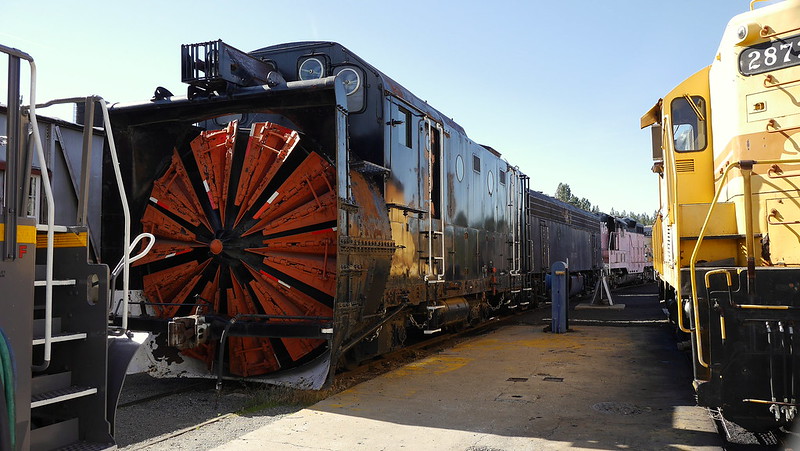 SP rotary snowplough by ac6044cw, on Flickr
goblinuser
Member
- Joined
- 12 May 2017
- Messages
- 292
Wouldn't like to be standing on a platform if that were sent down the North London Line.Exactly - and serious ploughing is a skilled job which requires a lot of experience to do efficiently and safely - packed snow can be pretty solid stuff.
As an aside - the line over Donner Pass in California gets an average of 30 feet of snow each winter at the summit - when it's bad they have to plough the line continuously to stop it building up in cuttings and on ledges to the point where it can't be ploughed through. Most winters they don't need them, but when the packed snow gets too high, out come some serious rotary ploughs (click on the photos to get a larger view):
Rotary ploughs on the left, specially modified 'snow duty' GP38s on the right used to push the normal ploughs, complete with rotary 'clear view' cab windows (as used on ships) and 'ice breaker' frames on the cab roofs (which can raised to break off icicles inside tunnels and snow-sheds). The rotary plough blades were originally steam powered, then converted to electric power from a 1500 hp diesel engine. In use they need 2-3 big (3000-4500hp) locos to push them into the snow - it just gives you an idea how hard it is to (re)move packed snow...
A close up of one of the rotary ploughs at a musuem:

Highlandspring
Established Member
- Joined
- 14 Oct 2017
- Messages
- 2,777
The Motherwell Independents are heading down towards Carstairs to plough some 5ft+ drifts towards Beattock.
Highlandspring
Established Member
- Joined
- 14 Oct 2017
- Messages
- 2,777
Those are Beilhack patrol ploughs not Miniature Snow Ploughs.VTEC tweeted a video of a pair of 66s with the mini snow ploughs attached making their way towards Newcastle:
https://twitter.com/Virgin_TrainsEC/status/969185591559680002

Peter Mugridge
Veteran Member
Does anyone know if those two old ploughs parked at Doncaster Station alongside the old works still see occasional service, the ones that appear to be based on steam locomotive tenders?
If that's these, they are former class 40 bogies with a weight on top of them. The steam locomotive tender conversions are rather taller and have a sharply angled front end with wasp stripes painted on.

Ash Bridge
Established Member
I'm sure those are the ones Peter, thanks very much for that, can see where the pony wheels were located now, they even appear to have retained the original buffers too.
Very interesting. Thanks for that.Exactly - and serious ploughing is a skilled job which requires a lot of experience to do efficiently and safely - packed snow can be pretty solid stuff.
As an aside - the line over Donner Pass in California gets an average of 30 feet of snow each winter at the summit - when it's bad they have to plough the line continuously to stop it building up in cuttings and on ledges to the point where it can't be ploughed through. Most winters they don't need them, but when the packed snow gets too high, out come some serious rotary ploughs (click on the photos to get a larger view):
Rotary ploughs on the left, specially modified 'snow duty' GP38s on the right used to push the normal ploughs, complete with rotary 'clear view' cab windows (as used on ships) and 'ice breaker' frames on the cab roofs (which can raised to break off icicles inside tunnels and snow-sheds). The rotary plough blades were originally steam powered, then converted to electric power from a 1500 hp diesel engine. In use they need 2-3 big (3000-4500hp) locos to push them into the snow - it just gives you an idea how hard it is to (re)move packed snow...
A close up of one of the rotary ploughs at a musuem:
VTEC tweeted a video of a pair of 66s with the mini snow ploughs attached making their way towards Newcastle:
https://twitter.com/Virgin_TrainsEC/status/969185591559680002
(Can't add the video directly to this post unfortunately)
Mini snow ploughs are the little ones you find in front of the bogies, on, for example, some class 37s - they're part of the loco.
Silver Cobra
Member
Mini snow ploughs are the little ones you find in front of the bogies, on, for example, some class 37s - they're part of the loco.
Ah, my bad. Thanks for explaining. I recall seeing bigger ploughs at Doncaster Yard/York, so assumed these were the 'miniature' ploughs. You know what they say about assuming things

If that's these, they are former class 40 bogies with a weight on top of them. The steam locomotive tender conversions are rather taller and have a sharply angled front end with wasp stripes painted on.
Huh! Have seen both types, but never realised that both had non-snowplough origins. Thanks

ChiefPlanner
Established Member
Even some class 150's have mini ploughs - but they lack the power of a good plough fitted 37 ...........
Pretty serious out there - the MML has the up fast blocked with drifts at Market Harborough and are using a bi-directional line , and a friend in Wivenhoe posted some shots (which I cannot regrettably send on) of some Greater Anglia staff and a 321 facing up to some serious (for a coastal location) drift ....
Anyway - some of the old generation ploughs were converted from class 40 and 46 bogies ....
Pretty serious out there - the MML has the up fast blocked with drifts at Market Harborough and are using a bi-directional line , and a friend in Wivenhoe posted some shots (which I cannot regrettably send on) of some Greater Anglia staff and a 321 facing up to some serious (for a coastal location) drift ....
Anyway - some of the old generation ploughs were converted from class 40 and 46 bogies ....
Ploughman
Established Member
Taken a few years back on the NYMR.

ChiefPlanner
Established Member
Out of interest, does anyone know whether a steam loco has ever been used for snow clearing duties (fitted plough/propelling a plough) on the UK main line since the end of main line steam?
Not snow clearing - but there was a case of bad salt contamination in / around 1996 on the WCML north of Weaver Junction - and a Black 5 (I think) was hired from Carnforth to help clear it using steam lances , powered by the loco of course....(salt came from a leaking freight train cargo) ........
ac6000cw
Established Member
Anyway - some of the old generation ploughs were converted from class 40 and 46 bogies ....
It's interesting just how old some snowploughs are - the original class 40/46 bogies must be around 60 years old (rebuilt into ploughs in the late-BR period?), and the old steam loco tender based ones even older (in origins).
Those American rotaries I mentioned above were originally built around 1927, so they're now about 90 years old! (rebuilt from steam to diesel-electric power in the late 1950s, and rebuilt again quite recently).
A taster of them in action here (not my video):
Last edited:
- Status
- Not open for further replies.