• Our new ticketing site is now live! Using either this or the original site (both powered by TrainSplit) helps support the running of the forum with every ticket purchase! Find out more and ask any questions/give us feedback in this thread!

Snow on rails

Status
Not open for further replies.

blue sabre

Member
Joined
6 Jun 2010
Messages
205
Over the past few days with all of the snow we have had up here I've noticed that lines are completely buried under the snow - is there a special bit of kit they use to clear this, or does the first driver of the day get to have all the fun?
 
Sponsor Post - registered members do not see these adverts; click here to register, or click here to log in
R

RailUK Forums

O L Leigh

Established Member
Joined
20 Jan 2006
Messages
5,609
Location
In the cab with the paper
is there a special bit of kit they use to clear this?

Yes. It's called a snowplough. ;)

Actually a bit of snow on the rails is nothing to worry about. In fact you can have as much as 200mm of snow over the railhead and trains can still run normally. Between 200mm and 300mm above the rail trains can still be authorised to run and those with miniature snowploughs can run normally, although when it gets between 300mm and 450mm above the rail even these trains have to be specially authorised to run. If you get more than 450mm of snow above the rail you need to run independent snowploughs.

O L Leigh
 

TDK

Established Member
Joined
19 Apr 2008
Messages
4,164
Location
Crewe
In Kent (and therefore 3rd rail land) Southeastern run ghost trains, ECS movements to try and keep the rails clear and the points in operation.

Also do that on the South Central network with 4 x 456's as there are more shoes on that formation, used to do that a lot and travelled most of the time with no line light in the leading cab
 

route101

Veteran Member
Joined
16 May 2010
Messages
12,264
Was interesting to see the snow untouched on the rails west of haymarket with the edinburgh sub .So no trains running on that today.
 

SouthEastern-465

Established Member
Joined
24 May 2009
Messages
1,660
Location
Greater London
Southeastern are currnently affected quite badly today, it was last night too but this was not helped by a fatality in the Greenwich area either.
 

DaveNewcastle

Established Member
Joined
21 Dec 2007
Messages
7,387
Location
Newcastle (unless I'm out)
Edinburgh's isn't affected since it hasn't been used for a couple of years.
Could you just remind us why it hasn't been used? Wasn't it to make way for a newer, better, replacement system which by now must obviously be running around the City every day taking thousands of passengers all over town quickly and in comfort? Tell us again, What is this great new system?
 

Eng274

Member
Joined
19 Aug 2010
Messages
796
Could you just remind us why it hasn't been used? Wasn't it to make way for a newer, better, replacement system which by now must obviously be running around the City every day taking thousands of passengers all over town quickly and in comfort? Tell us again, What is this great new system?

Dont get me started on that particular T-word...

Twenty-Two! <(
 

tbtc

Veteran Member
Joined
16 Dec 2008
Messages
18,052
Location
Reston City Centre
Edinburgh's isn't affected since it hasn't been used for a couple of years.

Another £4m wasted, you couldn't make it up.

How?

It was always intended as a short term busway, built on infrastructure that would become part of the tram.

One of the benefits of a guided busway is that it can then be upgraded to tram-line - the Edinburgh scheme was always intended to be like this
 

90019

Established Member
Joined
29 May 2008
Messages
6,890
Location
Featherstone, West Yorkshire
How?

It was always intended as a short term busway, built on infrastructure that would become part of the tram.

One of the benefits of a guided busway is that it can then be upgraded to tram-line - the Edinburgh scheme was always intended to be like this

Except it was extremely badly made and done on the cheap (to be expected, I guess), so the conrete had to be relaid at least once within it's short life because the ride got so bad on it (can't remember if it had to be relaid a second time or not), they also had to fit buses with the guide wheels, which was a waste of time and money, I think most if not all have now had them removed.

Just the usual though. Do it on the cheap then have to keep paying for it to be repaired. Seems to be the Edinburgh Council way.
 

Eng274

Member
Joined
19 Aug 2010
Messages
796
How?

It was always intended as a short term busway, built on infrastructure that would become part of the tram.

One of the benefits of a guided busway is that it can then be upgraded to tram-line - the Edinburgh scheme was always intended to be like this

Maybe so, that doesn't detract from the fact it was a total farce - closed for repairs not long after it was opened and had an awful ride quality. The three-bus pile up in 2008 rendered it useless as well, just as useless as the tram line that may one day run over it.

AFAIK although it was designed to be part of a future light rail system, it did still come before the tram's planning stage ever was; whether incorporating this section of route was a benefit or a hindrance to the tram route planners is unknown, since it crosses over the railway lines at Carrick knowe, and crosses them again at Hermiston Gait/Edinburgh Park.

If this busway was intended for long-term multi purpose use without needing extensive rebuilding and modification, a proper job would have been done on it first time round. It doesn't take a lib dem to work that one out.

To highlight the other transport planning cock-ups Edinburgh council has embarked on - remember when they buggered about with bollards on George street, and "remodelled" the West End?
--- old post above --- --- new post below ---
Except it was extremely badly made and done on the cheap (to be expected, I guess), so the conrete had to be relaid at least once within it's short life because the ride got so bad on it (can't remember if it had to be relaid a second time or not), they also had to fit buses with the guide wheels, which was a waste of time and money, I think most if not all have now had them removed.
Just the usual though. Do it on the cheap then have to keep paying for it to be repaired. Seems to be the Edinburgh Council way.

I haven't seen any buses which still have the guide wheels remaining. Most of the newer buses seem to have small arms protruding ahead of the front wheels, where the guide wheels would be mounted. Unless this is standard fit on the chassis, it seems Lothian had plans to fit guide wheels to more buses.
 

90019

Established Member
Joined
29 May 2008
Messages
6,890
Location
Featherstone, West Yorkshire
I haven't seen any buses which still have the guide wheels remaining. Most of the newer buses seem to have small arms protruding ahead of the front wheels, where the guide wheels would be mounted. Unless this is standard fit on the chassis, it seems Lothian had plans to fit guide wheels to more buses.

I know that a lot of buses had them fitted (at least some or all Geminis, Urbans, Presidents and Pointers had guide wheels). I don't know if the Geimini and Urban 2s had them fitted or not. I'll check when I'm back in Edinburgh at the weekend.

I would assume that all of the buses that were bought between the guideway being built and closed would have the arms for the wheels, but I'll ask one of my friends about that, as he knows a bit more about it than I do.
 

Eng274

Member
Joined
19 Aug 2010
Messages
796
I know that a lot of buses had them fitted (at least some or all Geminis, Urbans, Presidents and Pointers had guide wheels). I don't know if the Geimini and Urban 2s had them fitted or not. I'll check when I'm back in Edinburgh at the weekend.

I would assume that all of the buses that were bought between the guideway being built and closed would have the arms for the wheels, but I'll ask one of my friends about that, as he knows a bit more about it than I do.

I don't know about the Urban 2s, but some of the facelift (or surely 'arselift') geminis delivered in 2007 definitely had guide wheels fitted for a while.
 

Failed Unit

Established Member
Joined
26 Jan 2009
Messages
9,761
Location
Central Belt
Back to snow and rails. Does the snow trigger track circuits and cause track circuit failures? Is the main cause of infrastructure failures down to snow in the points.
 

turbo mick

Member
Joined
17 Aug 2005
Messages
184
Location
reading
Snow dosent normally cause TC failures trains normally have to run at reduced speed and plenty of running brake tests .All juction points have heaters when the temperature gets really cold thats when problems occur at the moment in the thames valley we have had hardly any snow we had it bad early in the year all the hsts and dmu kept running unlike the electric boys
 

b0b

Established Member
Joined
25 Jan 2010
Messages
1,371
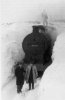
This is how you keep the rails snow free :D

http://www.flickr.com/photos/akagoldfish/4347043819/

4347043819_30dbaa726b_z.jpg
 

GB

Established Member
Joined
16 Nov 2008
Messages
6,553
Location
Somewhere
...Is the main cause of infrastructure failures down to snow in the points.

Most mainline points have heaters, however if these fail or have not been turned on then the points usually fail pretty quickly. Even if they are working, they can all too often get overrun with constant snow.
 

Old Timer

Established Member
Joined
24 Aug 2009
Messages
3,702
Location
On a plane somewhere at 35,000
Back to snow and rails. Does the snow trigger track circuits and cause track circuit failures? Is the main cause of infrastructure failures down to snow in the points.
Snow itself is a poor conductor and thus will not cause the track circuit to fail. Thawing snow, which produces water, and situations when water freezes can lead to scenarios where track circuit current can leak to earth, or in much rarer cases, cause a track circuit failure. During very heavy rainstorms it is not unusual for track circuits to fail when the water causes a temporary short circuit.

Turning now to points, it is not the snow that is the principal cause of points failures. What happens is this.

Snow falls and lies on the closed switch rail. The points are operated Reverse and detection is normally obtained because the point heater has kept the flangeway clear. In the interim, the snow that laid on top of the closed switch rail, which of course is now the open switch rail, will have fallen into the flangeway. If the points are then normalised, the snow is compacted, turns to ice which then by hydraulic properties prevents the switch rail from closing up again. Normal detection is now lost until the ice is removed or evaporates under the warmth from the point heater, UNLESS this occurs towards the heel of the switch where there is no heater and a very narrow flangeway clearance.

In the worst scenario, whilst motoring from Normal to Reverse, snow falls into the gap between the stock rail and the open (now closing) switch rail thus preventing the points going Reverse. The Signalman then cannot obtain Normal for the same reasons as posted above when he tries to Normalise them. Hey presto, points flashing OOC both ways and everything at a stand.

The old BR adage was that unless you have snowmen at a junction you set it up and left it straight., points heaters or no points heaters.

Keeping remotely located running junctions operating perfectly can be done - I proved this in the winter of 1984/85 - provided that the points are motored regularly and there are snowmen at them to continually clear up the large build up of snow on the closed rails. This however takes time and effort something that many people seem unable to want to exercise these days.

 

daikilo

Established Member
Joined
2 Feb 2010
Messages
1,623
For those of you who want to understand how British Rail worked, when the grind came, we contibuted, and when 4+ foot of snow was there to be removed, we removed it. Nature rarely got in our way for more than a few hours. That said, a radiant fire helped.

http://www.youtube.com/watch?v=cl4pJwcE7JI
 

EM2

Established Member
Joined
16 Nov 2008
Messages
7,522
Location
The home of the concrete cow
No problems here, or even earlier this year. In fact, when nothing ventured out south of the river it was one of OUR trains that made the BBC News footage running as normal.

Certainly a few 'issues' when I got to Forest Gate today at 11:15. The next up service was due at 11:22. The only problem was that it was *meant* to be there at 10:34...
 
Status
Not open for further replies.

Top