• Our new ticketing site is now live! Using either this or the original site (both powered by TrainSplit) helps support the running of the forum with every ticket purchase! Find out more and ask any questions/give us feedback in this thread!

Should someone be taking a grip on new train procurement?

Status
Not open for further replies.

Grumpy

Established Member
Joined
8 Nov 2010
Messages
1,314
Reading these forums and railway magazines it is clear that several TOCs are going through the procurement process.
This could presumably end up with a plethora of different designs from different manufacturers. Continuing the mess privatisation has left.
I would suggest this is undesirable and the need can be met by one standard design, or two at most. The class 170 for example has been used throughout the UK giving economies of scale in acquisition and flexibility in use. One standard design reduces the need (and cost) for staff training, parts storage etc.
Should procurement be taken out of the hands of the TOCs and centralised on one body?
 
Sponsor Post - registered members do not see these adverts; click here to register, or click here to log in
R

RailUK Forums

Joined
21 May 2014
Messages
964
"One or two" types seems extremely ambitious - or unrealistic - considering the plethora of different traction options, electrification methods, signalling system types, use cases, local factors, etc. etc. etc. ad infinitum.
 

Clarence Yard

Established Member
Joined
18 Dec 2014
Messages
3,263
Effectively the DfT are in charge now and just doing it via the TOCs, although it is unclear if there really is any money to procure new stock. In future GBR will be doing it but it will need Government sign off, just like BR had to get.
 

Zomboid

Established Member
Joined
2 Apr 2025
Messages
2,243
Location
Oxford
So long as each order is big enough to be worthwhile I don't see much issue with the current system.
Given the focus on these things over the years, it's maybe a bit ironic that rolling stock provision is one of the few areas in the rail industry where there is actually some element of competition.
 

HSTEd

Veteran Member
Joined
14 Jul 2011
Messages
20,281
"One or two" types seems extremely ambitious - or unrealistic - considering the plethora of different traction options, electrification methods, signalling system types, use cases, local factors, etc. etc. etc. ad infinitum.
Well the TGV-M has the claimed ability to completely replace the interior fittings inside 48 hours.

I would argue with the advances in traction electronics in the last few decades we can now build a electrodeisel or battery-electric EMU that can pretty much "do it all".
A 110mph multiple unit that can accelerate like a tube train is within reach.

Ordering a huge production run of identical units would lead to a major reduction in training burden and ease timetabling.

Indeed if the 48 hour interior replacement thing really is true it would be the most flexible railway vehicle in existence.

== Doublepost prevention - post automatically merged: ==

So long as each order is big enough to be worthwhile I don't see much issue with the current system.
Given the focus on these things over the years, it's maybe a bit ironic that rolling stock provision is one of the few areas in the rail industry where there is actually some element of competition.
I'd argue there is not much meaningful competition.
We have several suppliers, yes.

However, the suppliers often obtain orders by threatening a politically damaging closure of a train manufacturing plant unless the government coughs up.

Orders are distributed based on threats of negative headlines, not based on merit.
We only need a few hundred vehicles per year on average, we only really have enough work for a single factory.
Maybe two at a push, I believe we now have four.

The UK market is not large enough for meaningful rolling stock competition, and I think it would be better if we admit it.
 
Last edited:

35B

Established Member
Joined
19 Dec 2011
Messages
5,380
Reading these forums and railway magazines it is clear that several TOCs are going through the procurement process.
This could presumably end up with a plethora of different designs from different manufacturers. Continuing the mess privatisation has left.
I would suggest this is undesirable and the need can be met by one standard design, or two at most. The class 170 for example has been used throughout the UK giving economies of scale in acquisition and flexibility in use. One standard design reduces the need (and cost) for staff training, parts storage etc.
Should procurement be taken out of the hands of the TOCs and centralised on one body?
The 170 provided that despite being ordered by a variety of operators, at different times, and to a variety of specs. In other words, a decent product sold well because it fitted a niche, not because it was the chosen "standard" product.
 

Peter Mugridge

Veteran Member
Joined
8 Apr 2010
Messages
17,803
Location
Epsom
It's not having a variety of different types which is the problem.

A lot of the issues could be removed at a stroke if there was a standard type of coupling specified ( so that anything could rescue anything else more easily than can be done at the moment ) and if there was a specified standard for cab layout and dimensions so that type conversion training would be much simpler and would be more about the performance differences between stock and less about the layout of the cab*. Obviously any such standard should have allowance for developments in technology to be adopted so that we don't end up "freezing" development.

*Within each method of traction, of course.
 

Grumpy

Established Member
Joined
8 Nov 2010
Messages
1,314
The 170 provided that despite being ordered by a variety of operators, at different times, and to a variety of specs. In other words, a decent product sold well because it fitted a niche, not because it was the chosen "standard" product.
Indeed-by accident. But meanwhile someone was procuring the 175/180 which have been less satisfactory

== Doublepost prevention - post automatically merged: ==

It's not having a variety of different types which is the problem.

A lot of the issues could be removed at a stroke if there was a standard type of coupling specified ( so that anything could rescue anything else more easily than can be done at the moment ) and if there was a specified standard for cab layout and dimensions so that type conversion training would be much simpler and would be more about the performance differences between stock and less about the layout of the cab*. Obviously any such standard should have allowance for developments in technology to be adopted so that we don't end up "freezing" development.

*Within each method of traction, of course.
I am sure your points are valid but relate to operational matters. I was also thinking about standardising the bits under the floorboards and obtaining financial benefits of a long production run eg design etc costs spread over a larger number of vehicles

== Doublepost prevention - post automatically merged: ==

So long as each order is big enough to be worthwhile I don't see much issue with the current system.
With the current system you end up with small fleets of second rate trains eg 397's on ECML
 
Last edited:

Zomboid

Established Member
Joined
2 Apr 2025
Messages
2,243
Location
Oxford
Indeed-by accident. But meanwhile someone was procuring the 175/180 which have been less satisfactory
This is the thing - if someone had decided on a "standard new DMU" and gone with the Alstom products (which they might have) we'd have loads of them kicking around, rather than many, many Turbo- and Electro-stars.

The Adtranz/ Bombardier trains weren't declared the standard product and they achieved success because relatively small orders proved successful, whilst the Alstom products didn't get follow-on orders because they weren't as successful.

As a result there are some small and not hugely successful fleets around, but that's the way to avoid a repeat of the Class 17.
 

35B

Established Member
Joined
19 Dec 2011
Messages
5,380
Indeed-by accident. But meanwhile someone was procuring the 175/180 which have been less satisfactory
They did. But who is to say that a consolidated procurement would have chosen the 170s over the 175s? Or that the weaknesses in the 180s would not have been properly dealt with if they'd been the major fleet and not the 22x?

The old story of the actress suggesting George Bernard Shaw father her children applies - "imagine what a child with your brains, and my looks, could do" He replied, "But imagine if the child had your brains and my looks?"
 

HSTEd

Veteran Member
Joined
14 Jul 2011
Messages
20,281
This is the thing - if someone had decided on a "standard new DMU" and gone with the Alstom products (which they might have) we'd have loads of them kicking around, rather than many, many Turbo- and Electro-stars.

I really don't think an order for anything other than Class 170 is plausible.

The turbostar had a huge advantage, it's a Networker Turbo. It (mostly) had backwards compatibility with all the second generation BR DMUs.

I don't think Alstom has a chance of beating it in a large competition. The current model has produced a zoo of incompatible trains, creating major operational and stock allocation issues for the railway today.
 

JonathanH

Veteran Member
Joined
29 May 2011
Messages
23,279
This is the thing - if someone had decided on a "standard new DMU" and gone with the Alstom products (which they might have) we'd have loads of them kicking around, rather than many, many Turbo- and Electro-stars.
Indeed, one could argue that the 444 and 450 fleets (and subsequently the 350s) are somewhat better than the 458, which similarly failed.

It is also clear that Mark 1 fleet replacement on the Southern Region couldn't gave been completed in the desired timeframe if all of the units needed had needed to be built in Derby.

I don't think Alstom has a chance of beating it in a large competition.
SWT would presumably have had a large build of 458s if they had worked 'out of the box'. The fact they didn't led them to look elsewhere.
 

HSTEd

Veteran Member
Joined
14 Jul 2011
Messages
20,281
It is also clear that Mark 1 fleet replacement on the Southern Region couldn't gave been completed in the desired timeframe if all of the units needed had needed to be built in Derby.
Well the Networker and Sprinter programmes demonstrated that largely intercompatible rolling stock could be built by multiple manufacturers.
Those trains were built at several facilities but managed to form a somewhat coherent and interchangeable rolling stock fleet - certainly
SWT would presumably have had a large build of 458s if they had worked 'out of the box'. The fact they didn't led them to look elsewhere.
Would SWT even have been given the option to go for the 458 if there was a coherent rolling stock programme?

We probably end up with Electrostars (or Electrostar clones) everywhere just by default if that happens (Early models were at least somewhat backwards compatible with everything back to the PEPs)

EDIT: Turns out the withdrawn document I use for coupling interconnectors (GMGN2590 Iss 1) terminates before the Class 357 so I don't have a multiple working spec for that. But I mean we get a quasi Electrostar as "warmed over Networker", by default.
 
Last edited:

Zomboid

Established Member
Joined
2 Apr 2025
Messages
2,243
Location
Oxford
I really don't think an order for anything other than Class 170 is plausible.

The turbostar had a huge advantage, it's a Networker Turbo. It (mostly) had backwards compatibility with all the second generation BR DMUs.

I don't think Alstom has a chance of beating it in a large competition. The current model has produced a zoo of incompatible trains, creating major operational and stock allocation issues for the railway today.
In which case we're fortunate that it was Adtranz/ Bombardier who had the technology to allow backwards compatibility, and that the Turbostar wasn't a complete lemon of a train.

There's another argument about having standard communication protocols and couplers that would allow anything to work with anything else, and it is an indictment of the rolling stock industry that we don't don't have one. But that's a separate discussion.
 

HSTEd

Veteran Member
Joined
14 Jul 2011
Messages
20,281
In which case we're fortunate that it was Adtranz/ Bombardier who had the technology to allow backwards compatibility, and that the Turbostar wasn't a complete lemon of a train.
Well Turbostar was unlikely to be a lemon, because its a Networker Turbo, which is a Sprinter.

It had way lower developmental risks than anyone else.
There's another argument about having standard communication protocols and couplers that would allow anything to work with anything else, and it is an indictment of the rolling stock industry that we don't don't have one. But that's a separate discussion.
The lack of a standard is pretty much inevitable in the system we have though. THe government is desperate to cut the ribbon on train factories and never have one close. This means the manufacturers have the government over a barrel and can insist on maximum lock-in.
 

JonathanH

Veteran Member
Joined
29 May 2011
Messages
23,279
There's another argument about having standard communication protocols and couplers that would allow anything to work with anything else, and it is an indictment of the rolling stock industry that we don't don't have one.
Eventually though you have to have a step change in standards. The industry seems to have moved on from Tightlock / BSI to Dellner couplers, presumably because they are better. That change has to happen at some point.

On the Juniper / Electrostar following Networker, both Alstom and Adtranz built Networkers to slightly different specifications. History appears to imply that it was better to play safe with evolution of Networker to Electrostar, than develop a new model, but that might not have been the case.

Eventually something needs to change that units are not backward compatible. Is it really feasible and appropriate for trains being built now to be compatible with a Class 150 or 323?

How feasible is it in the modern era for the railway to specify the design of rolling stock and multiple manufacturers to build that design? Is it realistic?
 

Zomboid

Established Member
Joined
2 Apr 2025
Messages
2,243
Location
Oxford
How feasible is it in the modern era for the railway to specify the design of rolling stock and multiple manufacturers to build that design? Is it realistic?
It's not about specifying the design so much as the mechanism for one system to exchange information with another and the information which is to be shared. Things like the Internet work on that principle.

Obviously technology does move on and you can't have a permanent freeze, but having a mechanism to decide that at rail industry level would at least avoid some of the nonsense that's been permitted since the first privatized train orders were made.
 

HSTEd

Veteran Member
Joined
14 Jul 2011
Messages
20,281
Eventually though you have to have a step change in standards. The industry seems to have moved on from Tightlock / BSI to Dellner couplers, presumably because they are better. That change has to happen at some point.
The argument of Tightlock versus Dellner is enough to fill a dozen threads by itself!

However, conceptually the change in mechanical coupling mechanism does not fundamentally break compatibility. After all a bunch of units were converted on Southeastern. If you don't fundamentally change the electrical standard then the mechanical standard is not a dealbreaker in my view.
Eventually something needs to change that units are not backward compatible. Is it really feasible and appropriate for trains being built now to be compatible with a Class 150 or 323?
On the other hand, the most succesful railfreight operations in the world tend to use the AAR multiple unit specification (at least electrically!), which has existed more or less unchanged since WW2.

I'm not really convinced multiple working technology has really advanced sufficiently to justify a total break with the past.
Unless we are going for electronically controlled pneumatic (ECP) braking in freight operations, at which point I'd suggest pushing for a universal coupling for all rolling stock. However in the absence of that!
How feasible is it in the modern era for the railway to specify the design of rolling stock and multiple manufacturers to build that design? Is it realistic?
I'd argue it is feasible, but manufactures won't want to because proprietary solutions are substantially more profitable for them. To see how far they will sometimes go, see the recent incident in Poland where a train manufacturer is alleged to have resorted to outright sabotage to retain control of the maintenance contract.
 
Last edited:

JamesT

Established Member
Joined
25 Feb 2015
Messages
4,836
It's not about specifying the design so much as the mechanism for one system to exchange information with another and the information which is to be shared. Things like the Internet work on that principle.

Obviously technology does move on and you can't have a permanent freeze, but having a mechanism to decide that at rail industry level would at least avoid some of the nonsense that's been permitted since the first privatized train orders were made.
The question is whether you can usefully abstract the details of the individual units. e.g some units you select a 'notch' for speed, others are a continuous range.

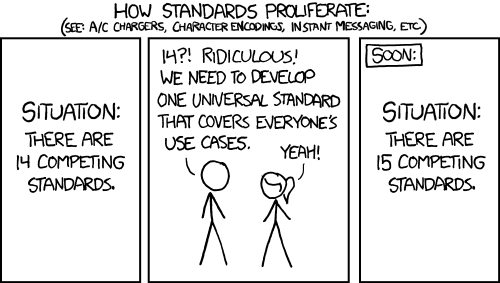
It's never a bad time to wheel out this XKCD:

standards.png
 

Zomboid

Established Member
Joined
2 Apr 2025
Messages
2,243
Location
Oxford
The question is whether you can usefully abstract the details of the individual units. e.g some units you select a 'notch' for speed, others are a continuous range.

It's never a bad time to wheel out this XKCD:

standards.png
I suppose the question is how many notches? If there's 8, would 12.5% steps on the fully variable type result in unacceptable performance? I'd suspect not, but I'm just waving crayons around in saying that.

It's the kind of thing that can be achieved if there's a will to do so. And there wouldn't need to be 100 competing standards if the customer were saying "no, I want this one".
 

The exile

Established Member
Joined
31 Mar 2010
Messages
9,333
Location
Somerset
Eventually something needs to change that units are not backward compatible. Is it really feasible and appropriate for trains being built now to be compatible with a Class 150 or 323
For one-off rescue without the need to detrain passengers, yes - for day to day operations , agreed there comes a point where something may be too dinosaur-like.
 

eldomtom2

On Moderation
Joined
6 Oct 2018
Messages
2,365
There is talk that more standardisation is happening. From a post by Mike_Walker on a RMWeb thread about battery-powered trains:
It is hoped [230001] will be in passenger service later this year but it will remain a one-off. Despite GWR (on behalf of the DfT) having famously acquired a large number of redundant D stock cars in what Mark Hopwood described to me as the "mother of all bog-off deals" there are no plans to rebuild any of those into 230s although the three ex-Marston Vale units (which GWR also now 'own') may be converted from diesel-electric to battery electric operation. The design, mounting either the engine/alternators or battery modules on compatible underfloor rafts, makes this comparatively straight forward.

What will emerge going forward is the use of this rapid charge battery technology in the next generation of multiple units currently being designed. Led initially by GWR to replace their BR-era DMUs and now also being adopted by other TOCs facing the same issue, these will be a highly standardised design on a common platform accommodating a choice of multi-modal propulsion systems - diesel/battery, electric/battery - capable of easy updating at a later date. For example, diesel engines can be removed and replaced by electric traction packages as electrification, continuous or infill, spreads. The driving cabs will be universal reducing the amount of training required and competency issues. For passengers, there will be alternative body styles employing both double doors at 1/3 and 2/3 of the bodyside or single doors at the body ends depending on what they are intended to be used for. As I understand it, the initial design work has been completed and the DfT have finally accepted that it makes more sense to build new, purpose designed trains with a potential life of 40+ years than to continue trying (unsuccessfully) to rebuild old units which have at best a 10-20 year life left after rebuild. All that stands in the way at the moment is the approval of HM Treasury and as we are constantly being told, the country is broke.

Something has to be done as the remaining ex-BR DMUs have between 5 and 10 years life left in them in their present form. Recent serious rebuilds of badly corroded Class 150s have actually cost more than building replacements but to the Treasury, rebuilds come under 'maintenance' which is necessary whilst new builds would be a capital expenditure. As is often said, there are those that know the cost of everything but the value of nothing.
 

Snow1964

Established Member
Joined
7 Oct 2019
Messages
11,054
Location
West Wiltshire
A new article has been published, and it highlights how inconsistent UK rail procurement has been.

Includes a number of graphs of the varying level of orders by year, and how costs have risen by (lack of) strategy, and start-stop policies rather than smooth investment rates.

I found this section particularly telling
One manufacturer built trains for six TOCs based on the same vehicle platform and assumed that 80% of parts would be common. Due to differences in individual tender specifications, that number was only 20%, dramatically increasing costs. Having reviewed requirements for current tenders, one large manufacturer found no opportunity to reuse any of its existing designs and no mechanism in the tender process to flag this.
Effectively no one wanted a standard train, instead opting for a more expensive non-standard one. Which suggests the procurement is all wrong being vanity driven (with specific specs) rather than cost and efficiency driven (with basic list of specs that need to be met, so variant of existing proven design can be used)


The exile

Established Member
Joined
31 Mar 2010
Messages
9,333
Location
Somerset
A new article has been published, and it highlights how inconsistent UK rail procurement has been.

Includes a number of graphs of the varying level of orders by year, and how costs have risen by (lack of) strategy, and start-stop policies rather than smooth investment rates.

I found this section particularly telling

Effectively no one wanted a standard train, instead opting for a more expensive non-standard one. Which suggests the procurement is all wrong being vanity driven (with specific specs) rather than cost and efficiency driven (with basic list of specs that need to be met, so variant of existing proven design can be used)

Not necessarily vanity driven - just driven by the kind of short-term compartmentalised thinking that pervades our culture (and legislation) than come. Rather than come together and come up with a design that satisfies 80% of everyone’s requirements (and can be customised at surface level to satisfy a bit more), everyone insists on 99-100% at vastly higher expense because “I can only claim to have won if I get 100% of what I wanted and am visibly grinding everyone else’s faces in the dust”.
 

stuu

Established Member
Joined
2 Sep 2011
Messages
3,763
The problem with a "standard" type is that by the time it exists everywhere the oldest ones will need replacing. Do you keep to the standard or do you upgrade to something incorporating the newest standards? The Southern Region was still building slam-door stock decades after automatic doors were a thing. Was that a good idea?
 

Brubulus

Member
Joined
13 Oct 2022
Messages
974
Location
Cambridge
The problem with a "standard" type is that by the time it exists everywhere the oldest ones will need replacing. Do you keep to the standard or do you upgrade to something incorporating the newest standards? The Southern Region was still building slam-door stock decades after automatic doors were a thing. Was that a good idea?
For example the 80x has been selected as a relatively standard type for intercity trains. Newer units could be fitted with a battery pack instead of a GU and engines and interior fittings can evolve over time to reflect lessons and improvements. Nobody is arguing that they should all be exactly the same for decades, but an evolutionary approach is required, instead of a revolutionary one. (EMR should have just ordered 9 car 805s). The 805 appears to have been a pretty good example of a successful evolution of a trainset.
 

mike57

Established Member
Joined
13 Mar 2015
Messages
2,372
Location
East coast of Yorkshire
Looking at the types of stock I see 3 main requirements:

75-90mph capable Metro units, designed for quick accelatation, plenty of doors, maybe a rural line variation with a different layout (less doors, more seats) but the same underlying design
100-110mph Regional or outer Suburban, doors at 3rd, better seating.
125mph Intercity doors in end vestibules, pretty much 8xx but with a better interior

Power will be electric, diesel or battery or some combination of. The different power requirements could be delivered by different modules which can be switched at build and if a major refurb is required. Basic cab layout will be the same within the 'class' whatever power is used, there will be differences in displays and performance depending on power source(s) available, but once the basic cab layout is learnt differences will be in the details and performance. Maybe a simplified 'limp mode' to allow any driver to move any unit at very reduced speed in an emergency.

In emergency any unit can couple with any unit with sufficent functionality to be able to proceed, again at reduced speed.

Multiple working capabilities across sub types will be as wide as possible, to cover both short term issues, and longer term redeployment. Where multiple working includes units with different top speeds lowest top speed is enforced.

Is this such a problem given the current tendancy for everything to be software based? One could even see a situation where two suppliers are building to the same spec, with interoperability written in and proved at testing.

As much commonality of parts as possible.

I could see that initial costs maybe higher but surely lifetime costs would be lower and the ease of reployment would get away from the current mess of incompatible units and would introduce flexibility.
 

LNW-GW Joint

Veteran Member
Joined
22 Feb 2011
Messages
21,902
Location
Mold, Clwyd
Effectively no one wanted a standard train, instead opting for a more expensive non-standard one. Which suggests the procurement is all wrong being vanity driven (with specific specs) rather than cost and efficiency driven (with basic list of specs that need to be met, so variant of existing proven design can be used)
Presumably that is the tale of Aventra procurement, a not-quite-standard train, still bedevilled by the class 701 saga.

Maybe forgotten in all the standardisation talk is the rapid development of new technology, meaning the "standard" train you bought 5 years ago is now largely obsolete.
The demand is now for ETCS-ready bi/tri-mode trains with all the options available, not standardised DMUs/EMUs.
GBR integration also encourages GB silo-thinking, while no global manufacturer can afford to dedicate its output to the GB market.

BR also left us with two/three designs of Networker and Sprinter, and had three designs of inter-city train (four if you include Eurostar).
 

Zomboid

Established Member
Joined
2 Apr 2025
Messages
2,243
Location
Oxford
You'll never get down to one design for everything, but things like the tiny fleet of 12 397s ought to have been avoided, and interoperability between manufacturers should be prioritised.
 
Status
Not open for further replies.

Top