• Our new ticketing site is now live! Using either this or the original site (both powered by TrainSplit) helps support the running of the forum with every ticket purchase! Find out more and ask any questions/give us feedback in this thread!

Should Semaphore signals become listed structures?

Status
Not open for further replies.

cambsy

On Moderation
Joined
6 Oct 2011
Messages
1,110
Having just travelled on the Worcester to Hereford line, with its semaphore signals and lovely old station buildings, I got to thinking, should the semaphore signals become listed like buildings do, so we keep this heritage on the network?

I know there are semaphores signals on preserved railways, and that there are obviously reasons why Network Rail needs to modernise the network.

To me, the semaphore signals help make this line's lovely character, and it would be shame to lose this character and feel, with modern signals.
 
Last edited by a moderator:
Sponsor Post - registered members do not see these adverts; click here to register, or click here to log in
R

RailUK Forums

The Planner

Veteran Member
Joined
15 Apr 2008
Messages
19,666
Having just travelled on the Worcester to Hereford line, with its semaphore signals and lovely old station buildings, I got to thinking, should the semaphore signals Become listed like buildings do? so we keep this heritage on the network? I know there semaphores signals on preserved railways, and that’s there obviously reasons why Network Rail needs to modernise network. To me the semaphores signals, help make this lines lovely character, and it would be shame lose this character and feel with modern signals.
So you would have decommisioned semaphores littering the network? No, its barking mad.
 

Magdalia

Established Member
Joined
1 Jan 2022
Messages
7,372
Location
The Fens
I think it is an interesting question.

The railway already has lots of listed structures that it has to work with, or retain as operationally redundant assets. These include stations, bridges, viaducts and tunnels. In particular it includes signal boxes, such as Birmingham New Street.

Signals are not so small that they could not be listed. The Holme Fen posts, which are near the ECML but not visible from the train, are listed, see here:


Heritage Category:Listed Building
Grade:II
List Entry Number:1288011
Date first listed:10-Aug-1988
List Entry Name:TWO MARKER POSTS SITUATED ON THE SOUTH EAST SIDE OF HOLME LODE
Statutory Address:TWO MARKER POSTS SITUATED ON THE SOUTH EAST SIDE OF HOLME LODE, HOLME FEN NATURE RESERVE

60 years ago the railway demolished the Euston Arch and retaining St Pancras was widely regarded as "barking mad".
 

eldomtom2

On Moderation
Joined
6 Oct 2018
Messages
2,370
What we really need is something similar to listing but for artefacts, not structures.
 

3RDGEN

Member
Joined
6 Mar 2023
Messages
599
Location
Hull
To some degree they are, for example the Falsgrave signal gantry was listed "https://historicengland.org.uk/listing/the-list/list-entry/1272758" so when it was decommissioned NR removing it, shorten it and donated it to the NYMR, "https://britishlistedbuildings.co.uk/101272758-former-falsgrave-signal-gantry-grosmont". I think NR installed the gantry at Grosmont and then NYMR fitted the signals they required, it is not as per its service condition but a good example of what can be done which looks like it's always been there. Not many persevered railways have the need for such a large-scale gantry.
 

cslusarc

Member
Joined
27 Jan 2011
Messages
167
Personally, I think redundant semaphore signals should be removed and donated to a museum or other entity for preservation and not preserved in situ.
 

alxndr

Established Member
Joined
3 Apr 2015
Messages
1,680
if left in-situ they will need either the arm removing (which somewhat defeats the purpose of trying to preserve it) or a cross attatched to the front of the arm (also not particularly in keeping), and ongoing maintenance checks.

Better to remove them and resite them somewhere they can be better appreciated and aren't causing issues.
 

eldomtom2

On Moderation
Joined
6 Oct 2018
Messages
2,370
if left in-situ they will need either the arm removing (which somewhat defeats the purpose of trying to preserve it) or a cross attatched to the front of the arm (also not particularly in keeping), and ongoing maintenance checks.

Better to remove them and resite them somewhere they can be better appreciated and aren't causing issues.
Of course then you get academics saying that resiting buildings misses the point...
 

bramling

Veteran Member
Joined
5 Mar 2012
Messages
20,360
Location
Hertfordshire / Teesdale
Having just travelled on the Worcester to Hereford line, with its semaphore signals and lovely old station buildings, I got to thinking, should the semaphore signals become listed like buildings do, so we keep this heritage on the network?

I know there are semaphores signals on preserved railways, and that there are obviously reasons why Network Rail needs to modernise the network.

To me, the semaphore signals help make this line's lovely character, and it would be shame to lose this character and feel, with modern signals.

I’ve always had half a feeling that there are a few places where semaphores should be retained permanently as the method of signalling. Shrewsbury and Worcester just wouldn’t be the same without, and in both cases the arrangements seem to cope satisfactorily with the amount of traffic handled. Cornwall is the other place, it all seems to go well with the slower pace of life that is part of Cornwall’s charm. It’s sad to have lost Truro, Par and Lostwithiel, but losing St Erth will be heartbreaking.
 

HSTEd

Veteran Member
Joined
14 Jul 2011
Messages
20,296
The ultimate choice is on the purpose of the railway. Are we running a transport system or a museum?
 

bramling

Veteran Member
Joined
5 Mar 2012
Messages
20,360
Location
Hertfordshire / Teesdale
The ultimate choice is on the purpose of the railway. Are we running a transport system or a museum?

What is to say that one or two parts of that system shouldn’t be a working museum? Surely at least a proportion of St Ives visitors, for example, will appreciate the atmosphere when changing trains at St Erth?
 

Sun Chariot

Established Member
Joined
16 Mar 2009
Messages
6,588
Location
2 miles and 50 years away from the Longmoor Milita
To me, the semaphore signals help make this line's lovely character, and it would be shame to lose this character and feel, with modern sisignals.
I think railway infrastructure needs to be protected where it's appropriate to; and I think, really, that sits with heritage sites.

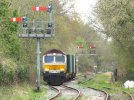
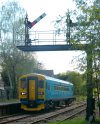
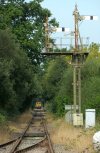
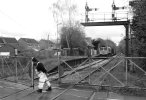
Semaphore signals added during British Railways days, were not ornate like those installed during Pre Grouping and Big 4.
Take these examples at Marchwood (former Fawley branch, near Southampton). I don't think they merit a Listed status - two brackets have ex-SR posts and finials mounted on later, plain, gantries; the one by 66734 is entirely of a later design.

However, I'd advocate Listed status for an LMS, LNER, LT&S era Searchlight colour light signal, due to its influence in the story of British signalling.
 

Attachments

  • 66734_Marchwood_1_.JPG
    66734_Marchwood_1_.JPG
    5.4 MB · Views: 50
  • 153376_Marchwood_.jpg
    153376_Marchwood_.jpg
    5.2 MB · Views: 49
  • 66762_Marchwood_1.JPG
    66762_Marchwood_1.JPG
    5.6 MB · Views: 47
  • Marchwood_2_.jpg
    Marchwood_2_.jpg
    4.3 MB · Views: 41
Last edited:

Irascible

Established Member
Joined
21 Apr 2020
Messages
2,233
Location
Dyfneint
What is to say that one or two parts of that system shouldn’t be a working museum? Surely at least a proportion of St Ives visitors, for example, will appreciate the atmosphere when changing trains at St Erth?

You don't have to list anything to do that, though - at some point the railway might have to upgrade anyway, and as a resident of a listed building I can appreciate why they wouldn't appreciate the extra hassle... but if the line's paying for the maintenance and there's no need for different infrastructure there's no need to change it anyway.

Otherwise... start listing heritage railway infrastructure - they're literal museums & the protection is probably a good thing there - not the working railway. I mean, you can't anyway - as people have mentioned - unless you want semaphore signalling in perpetuity, because an out of use signal has to be modified & it's already not in original as working condition.
 

30907

Veteran Member
Joined
30 Sep 2012
Messages
21,941
Location
Airedale
What, exactly, would we be listing?

It can't be semaphores as such - there are loads of them on heritage lines.

Is it particular configurations of semaphores? There's nothing really distinctive about Shrewsbury or Worcester (apart from those giant discs at Shrub Hill), other than that they have survived?

Is it a particular photographic location (akin to the sycamore on Hadrian's Wall that was chopped down)? If so, I reckon Exeter West or the down gantry at Sothampton are probably more photographed?

John Minnis of English Heritage did an excellent job on listing signal boxes a decade ago (I disagree with some of his omissions, but everyone has their preferences) but wisely didn't tackle signals themselves. He does mention the Settle and Carlisle as a complete surviving sequence, and I could see a case for retaining those on a line that sees large numbers of heritage trains.
Semaphore signals added during Brutish Railways days, were not ornate like those installed during Pre Grouping & Big Four.
Take these examples at Marchwood (near Southampton). I don't think they merit a Listed status.
One of those is a classic SR rail-built design and might even date from the line's opening.
 

zwk500

Veteran Member
Joined
20 Jan 2020
Messages
18,510
Location
Northampton
However, I'd advocate Listed status for an LMS, LNER, LT&S era Searchlight colour light signal, due to its influence in the story of British signalling.
The correct place for these would be a museum or heritage railway, not the operational railway. At some point (in theory) even colour-light signals will be obsolete and only block markers will be required. It is the way of all things.

== Doublepost prevention - post automatically merged: ==

Yes, the one protecting the gated crossing from the north.
I believe very similar brackets already exist at the Bluebell Railway.
The Bluebell Railway's SR-style brackets at Horsted Keynes are, to the best of my knowledge, reproductions. The Webpage tracking the re-signalling had some good detail.
 

Sun Chariot

Established Member
Joined
16 Mar 2009
Messages
6,588
Location
2 miles and 50 years away from the Longmoor Milita
The correct place for these would be a museum or heritage railway, not the operational railway.
I absolutely agree. What I had in mind, was a means to fully protect such artefacts at a heritage site (e.g. to avoid risk of a heritage site electing to destroy said artefacts at a future point in time).

== Doublepost prevention - post automatically merged: ==

The Bluebell Railway's SR-style brackets at Horsted Keynes are, to the best of my knowledge, rereproductionl.
The scoundrels had me fooled! :D
I must get myself over to the semaphores at Bognor Regis & Littlehampton, before those disappear.
 

Railsigns

Established Member
Joined
15 Feb 2010
Messages
2,754
Railway Heritage Designation Advisory Board

The Railway Heritage Designation Advisory Board (RHDAB) ensures a future for railway heritage by designating railway-related items. Locomotives, paintings, archives, furniture and more are all in scope for designation. The Board chooses items important to British railway heritage and agrees which institution (such as a museum or heritage centre) shall receive items when no longer required by the railway business that owns them.
 

John Webb

Established Member
Joined
5 Jun 2010
Messages
3,757
Location
St Albans
An interesting discussion! I agree that the preservation of signals is best done off the national network - that needs to cope with modern trains using modern signalling systems. Not that we can offer much more display space at St Albans South, as we now have working examples of signals from the Midland Railway, North Eastern Railway, LNER/BR and several different ground signals + 1970s colour lights, recent LED signals, and are presently preparing a L&NWR signal for erection! But I am uncertain about actually listing such structures once in a museum. Museums are expected to have disposal rules for an object if they consider it is no longer required by them. Indeed, several of our exhibits have come from the NRM at York because they carried out their disposal properly and we were able to acquire them as a result.
 

eldomtom2

On Moderation
Joined
6 Oct 2018
Messages
2,370
Part of the problem, as I've said, is that academics in architectural preservation generally see buildings as inseparable from their location. To quote the 1964 Venice Charter, considered a defining text though definitely not without its critics:
Article 7.
A monument is inseparable from the history to which it bears witness and from the setting in which it occurs. The moving of all or part of a monument cannot be allowed except where the safeguarding of that monument demands it or where it is justified by national or international interest of paramount importance.
 

Matt P

Member
Joined
15 Jun 2018
Messages
153
I’ve always had half a feeling that there are a few places where semaphores should be retained permanently as the method of signalling. Shrewsbury and Worcester just wouldn’t be the same without, and in both cases the arrangements seem to cope satisfactorily with the amount of traffic handled. Cornwall is the other place, it all seems to go well with the slower pace of life that is part of Cornwall’s charm. It’s sad to have lost Truro, Par and Lostwithiel, but losing St Erth will be heartbreaking.
The purpose of the national rail network is to move passengers and freight. It isn't to be a glorified museum. That's what heritage railways are for. Where semaphores have been replaced by colour lights it has often been in conjunction with the elimination of several manual signal boxes with control passing to larger centralised facilities, ultimately to make operating the railways more cost effective to run (basically fewer signalling staff). We're actually now moving towards an era of trackside signalling disappearing altogether, with systems that promise a range of operating benefits, including capacity. This has to be the future. If the rail network is seen as a museum then it will ultimately become one.

I'd be surprised if many semaphores are that old they warrant listing in any case. Some of Shrewsbury's are less than 20 years old (albeit replacing earlier signals on a like for like basis). Elsewhere I suspect remaining semaphores are akin to Trigger's Broom in terms of their real age. In fact even semaphores at places like Bewdley on actual heritage railways that passed straight from BR into private ownership with their signaling intact have been replaced over the years.
 

infobleep

On Moderation
Joined
27 Feb 2011
Messages
13,451
If one wants to list signals, what about telegraph poles? I appreciate none remain in England and Wales. I can't remember about Scotland.

I'm not advocating this in reality, just taking the argument further as a theory.
 

bramling

Veteran Member
Joined
5 Mar 2012
Messages
20,360
Location
Hertfordshire / Teesdale
The purpose of the national rail network is to move passengers and freight. It isn't to be a glorified museum.

But my point is, why shouldn’t some parts of it be a glorified museum? Providing it isn’t imposing constraints on what can run, what’s the problem? As regards cost, it’s no different to listed buildings costing more to manage and maintain - the extra cost in considered worthwhile.


I'd be surprised if many semaphores are that old they warrant listing in any case. Some of Shrewsbury's are less than 20 years old (albeit replacing earlier signals on a like for like basis). Elsewhere I suspect remaining semaphores are akin to Trigger's Broom in terms of their real age. In fact even semaphores at places like Bewdley on actual heritage railways that passed straight from BR into private ownership with their signaling intact have been replaced over the years.

It isn’t so much the semaphores themselves, but the whole way of working. In the case of Shrewsbury in particular there seems to be little appetite to try and design a modern scheme.

I wouldn’t advocate keeping old methods of working on large amounts of the network, but in a few particular locations it’s hardly a major hindrance. Cornwall would have been my first choice, perhaps the S&C another. Grantham to Skegness perhaps.
 

HSTEd

Veteran Member
Joined
14 Jul 2011
Messages
20,296
What is to say that one or two parts of that system shouldn’t be a working museum? Surely at least a proportion of St Ives visitors, for example, will appreciate the atmosphere when changing trains at St Erth?
Perhaps, although I imagine the atmosphere is probably already spoiled by the modern-ish trains that are operating from there!

Maintaining semaphores forever will have a definite cost though, especially if St Erth is expected to keep its manual signal box forever.
 

Irascible

Established Member
Joined
21 Apr 2020
Messages
2,233
Location
Dyfneint
Perhaps, although I imagine the atmosphere is probably already spoiled by the modern-ish trains that are operating from there!

Given the number of semaphores in Cornwall it's also not a particularily historic atmosphere :p

That also brings up another point ( and also why I'm not much interested in main line stuff operating on preserved branch lines ) - the ideal listed piece of railway infrastucture would be not just a signal but an entire installation in an area, complete with original trackwork & period rollingstock on period operations. If some of that is missing then it's already out of it's environment anyway, so the signal infrastructure might as well be moved somewhere else.

Give it 15-20 years and we will probably be able to stick a VR or AR device on our heads & have something provide us with a generated historical view of either wherever we are or some film, so historical artifacts are going to be more about engineering & ways of construction than operations.
 
Status
Not open for further replies.

Top