having read that Virgin Trains are unhappy with the infrastructure on the WCML,and are languishing near bottom of punctuality table,that would it be good idea if Network Raill was disbanded and the infrastructure handed over to the Toc's,my possible idea is re create the big four,LMS,LNER,SOUTHERN,GREAT WESTERN,and offer the current Toc's the opportunity to form super franchises along lines of a co-operative,so that they all share in the revenue etc and benefit if everyone performs well,i think it would lead to better accountability and less fragmentation,so that when things go wrong it would be lot easier to deal with than now,connections would be better kept as all incumbents would feed in to out of each others services,and would be more powerful to get things done,just my thoughts,i know it probably would never happen,but is it good idea?

-
Our new ticketing site is now live! Using either this or the original site (both powered by TrainSplit) helps support the running of the forum with every ticket purchase! Find out more and ask any questions/give us feedback in this thread!
You are using an out of date browser. It may not display this or other websites correctly.
You should upgrade or use an alternative browser.
You should upgrade or use an alternative browser.
Should Network Rail be disbanded and the infrastructure given over to the Toc's
- Thread starter cambsy
- Start date
- Status
- Not open for further replies.
Sponsor Post - registered members do not see these adverts; click here to register, or click here to log in
R
RailUK Forums

HSTEd
Veteran Member
- Joined
- 14 Jul 2011
- Messages
- 20,378
Less fragmentation?
Take away the single opereator and give it to multiple infrastructure operators and expecting TOCs to grant trackage rights and so on, and then enforcing the current pathing system to prevent rival companies express trains being "accidentally" on purpose stuck behind a stopper?
It would be a disaster, and not to mention that this would effectively be reprivatisation and we all know how well Railtrack managed.
Take away the single opereator and give it to multiple infrastructure operators and expecting TOCs to grant trackage rights and so on, and then enforcing the current pathing system to prevent rival companies express trains being "accidentally" on purpose stuck behind a stopper?
It would be a disaster, and not to mention that this would effectively be reprivatisation and we all know how well Railtrack managed.

Tim R-T-C
Established Member
- Joined
- 23 May 2011
- Messages
- 2,143
I don't know why people see this as a panacea - there are very few lines with single operators and anywhere else it would quickly lead to disputes over access.
As best it would make no difference as all of the maintenance work would be carried out by the same sub-contractors anyway.
As best it would make no difference as all of the maintenance work would be carried out by the same sub-contractors anyway.
hairyhandedfool
Established Member
- Joined
- 14 Apr 2008
- Messages
- 8,837
having read that Virgin Trains are unhappy with the infrastructure on the WCML,and are languishing near bottom of punctuality table,that would it be good idea if Network Raill was disbanded and the infrastructure handed over to the Toc's,my possible idea is re create the big four,LMS,LNER,SOUTHERN,GREAT WESTERN,...
How would you account for XC, TPE and FCC? How would OAOs fit in? And what of charter operators? Would they have to discuss pathing and access with two, three or even four companies in pace of the one they currently deal with? How much extra would that cost?
....and offer the current Toc's the opportunity to form super franchises along lines of a co-operative,so that they all share in the revenue etc and benefit if everyone performs well,...
And if they don't perform well?
....i think it would lead to better accountability and less fragmentation,so that when things go wrong it would be lot easier to deal with than now,....
It might be easier for trains completely on the WCML, or the ECML, etc, but what about Liverpool-Leeds? or Plymouth-Newcastle? or even Brighton-Bedford?
....connections would be better kept as all incumbents would feed in to out of each others services,and would be more powerful to get things done,...
If you get rid of fines for late running it might solve that problem, but those that are timetabled to be longer are unlikely to be solved or will simply move the issue somewhere else. If you keep the fines in place not much would change.
....just my thoughts,i know it probably would never happen,but is it good idea?
I can't see it happening, atleast not until we end up with one company running everything and owning everything.

Hydro
Established Member
- Joined
- 5 Mar 2007
- Messages
- 2,204
What of the parts of Network Rail not beholden to any geographical part of the network? Who gets those? I work nationally, for example.
It's a bad idea for the entire network. Suitable only for self contained, one operator areas. Merseyrail stood a chance and didn't take it. Island Line already operates under this arrangement.
A full merger of regional TOCs would have to occur first before this idea could realistically work.
It's a bad idea for the entire network. Suitable only for self contained, one operator areas. Merseyrail stood a chance and didn't take it. Island Line already operates under this arrangement.
A full merger of regional TOCs would have to occur first before this idea could realistically work.

No matter which company run by the government or private could sort out the UK's railway infrastructure to please everybody.
The infrastructure is to old in most places and failures in all aspects of the railway are ALWAYS going to happen.
This site everyday is full of incidents,and delays to TOC's and the paying public.
I work in the industry and am sick of telling people that you will never sort out the UK railway.
What do Virgin want a perfect railway that never goes wrong, it can NEVER happen, they should be content with counting the money it gets from Network Rail when failures do happen, and stop pretending that they actually care.
The infrastructure is to old in most places and failures in all aspects of the railway are ALWAYS going to happen.
This site everyday is full of incidents,and delays to TOC's and the paying public.
I work in the industry and am sick of telling people that you will never sort out the UK railway.
What do Virgin want a perfect railway that never goes wrong, it can NEVER happen, they should be content with counting the money it gets from Network Rail when failures do happen, and stop pretending that they actually care.

Nym
Established Member
Brilliant idea, remove the economies of scale from maintenance so it's even more expensive!
lyndhurst25
Established Member
- Joined
- 26 Nov 2010
- Messages
- 1,592
"Should Network Rail be disbanded and the infrastructure given over to the Toc's"
No. The TOCs should be disbanded and the trains given to Network (British) Rail.
No. The TOCs should be disbanded and the trains given to Network (British) Rail.

Old Timer
Established Member
So how do you think the Railway managed up to 1948 ?Less fragmentation?
Take away the single opereator and give it to multiple infrastructure operators and expecting TOCs to grant trackage rights and so on, and then enforcing the current pathing system to prevent rival companies express trains being "accidentally" on purpose stuck behind a stopper?
It would be a disaster, and not to mention that this would effectively be reprivatisation and we all know how well Railtrack managed.
As for Railtrack I doubt you are in a position to comment, however from an Infrastructure point of view it was much better than what we have now.
Railtrack's problem was the performance regime and the power of the TOC/FOCs who would just not co-operate in giving the Infrastructure Engineers access to the track.
I can give you case after case where both Railtrack and the Infrastructure Engineers were in despair because the TOC/FOCs insisted on penalty payments for non-availabilty - even when there were no trains booked - or wanted multiple penalty payments when a route was already blocked for a blockade and extra engineering work was to be implemented for efficiency.
In particular I recall one occasion when a whole route was taken out of use for a week and trains diverted simply because one the TOCs wanted a massive additional sum because we wanted to bring work forward and relay a complete junction during a total route blockade. The line was already blocked, the bus services planned and there woulod have been absolutely NO effect on the TOC, but under the performance regime, they were allowed to claim a very large sum of money for any engineering work introduced within the 37 week timescale. This original had been intended for disruptive work but whilst several other TOC/FOCs agreed with us that it was beneficial and waived any compensation payments, one main line operator who made a lot of money from delay compensation would not play ball. The amount they wanted was far greater than the efficiencies to be gained so it was finacial more efficient for us to leave the route closed for another week.
There are no economies of scale. Network Rail man mark and micro-manage Infrastructure Contractors so that in many cases there are more tiers of NR staff involved in "managing" than there are Contractors staff involved in actually doing the work.Brilliant idea, remove the economies of scale from maintenance so it's even more expensive!
These NR staff are also very much into "preferential engineering" and insist on things being done in the way THEY say when many times over it is simpler, cheaper and more efficienmt for the Contractor to come up with a solution as they will have seen this elsewhere.
Please note that the Infrastructure Contractor orgainisations still have a fair number of ex-BR engineers and managers who know far more about the work than those who are procuring and managing on the NR side.
These are much different from the various Labour Agencies who supply staff to Network Rail.
Last edited:
Hydro
Established Member
- Joined
- 5 Mar 2007
- Messages
- 2,204
A Big Four (with maybe a couple more companies?) style arrangement would probably be a worthwhile study, maybe with XC services run as a traditional "joint" venture? This would allow integration of infrastructure and trains on a more than piecemeal level, and keeping a privatised system with some competition.
NR is already dividing into more or less self contained routes. Division a s is currently happening, then merger of several adjoining routes could be the way to achieve this.
The national aspects of NR could then be consolidated as a central national spine, Railtrack style to ensure compliance and standards.
NR is already dividing into more or less self contained routes. Division a s is currently happening, then merger of several adjoining routes could be the way to achieve this.
The national aspects of NR could then be consolidated as a central national spine, Railtrack style to ensure compliance and standards.
Old Timer
Established Member
There was discussion about this prior to the GE, however there was a feeling that this would have been too controversial to run with at the time.A Big Four (with maybe a couple more companies?) style arrangement would probably be a worthwhile study, maybe with XC services run as a traditional "joint" venture? This would allow integration of infrastructure and trains on a more than piecemeal level, and keeping a privatised system with some competition.
NR is already dividing into more or less self contained routes. Division a s is currently happening, then merger of several adjoining routes could be the way to achieve this.
The national aspects of NR could then be consolidated as a central national spine, Railtrack style to ensure compliance and standards.
Take a look at how things have subtlely changed since 2010, because the view held is that regionally owned vertical units would work much better by removing the various interfaces that now occur, and would allow the train operations and infrastucture engineers to work together in solving the access issues.
This works a treat in the foreign railways that I work on.
Why ?If this site had a like button you would get one!!.
This country needs a nationlised railway to keep up with demand
Other systems worldwide operate much better with privatised systems. For example South America has a considerable amount of money being spent on Railway systems by private money, and some of the busiest Cities in the World have privately run rail systems.
Operation of the Railway is not synonymous with Nationalisation, as I mentioned earlier the Golden Age of Railways was actually under private ownership. Nationalisation brought few benefits and was done only because the Government had run the Railways into the ground during the War, paid no compensation to the Companies for this and then left them to pick up the bill afterwards. This of course was not possible.
I agree that there needs to be a central directing mind at Government level, and I would propose a system along the lines of the NTSB and FRA to set Standards and oversee Safety, however operation by Government is not undesirable as the Railways always become a tool used to implement Government economics, and when not being used in this way are always competing against the public sector for scarce financial resources. The Hospital will always win in any competition for money - you know that as well as I do.
Last edited:
The Informer
Member
A Big Four (with maybe a couple more companies?) style arrangement would probably be a worthwhile study, maybe with XC services run as a traditional "joint" venture? This would allow integration of infrastructure and trains on a more than piecemeal level, and keeping a privatised system with some competition.
NR is already dividing into more or less self contained routes. Division a s is currently happening, then merger of several adjoining routes could be the way to achieve this.
The national aspects of NR could then be consolidated as a central national spine, Railtrack style to ensure compliance and standards.
I was going to say its already being split up into individual routes. Ours (wales) went live on Nov 14th along with LNW.
Old Timer
Established Member
Partly.I was going to say its already being split up into individual routes. Ours (wales) went live on Nov 14th along with LNW.
This re-organisation is meant to align geographical areas with the main TOCs but will still not result in the full benefits to be gained from true vertical integration, however it is the first step along this road which is very welcome.
There would be a variety of issues were NR to be fully vertically integrated at this time which is why this route is being explored.
Alteran Ancient
Member
This is a question potentially with no answer.
The argument for Yes: Leave investment to the private companies and allow them to make their own improvements as they see fit. Save the government a bit of money.
The argument for No: Could cause conflict between multiple TOCs and any other service (Freight, etc.) that might want to share a line. Could have a negative effect on maintenance.
Even with the highest fares compared to any other country in Europe, our rail system still bleeds money. Combine high fares with a system that is over capacity - that's theoretically a lot of money. Where does it go? National Rail doesn't profit from it. The TOCs don't really make a significant profit from it either. You have to keep this in mind - that passenger operations were privatised and handed over to the highest bidder in order to cut the costs associated with British Rail, which wasn't a "for-profit" venture, if I'm not mistaken. It's for exactly the same reasons that the government wants to privatise whatever's left of Royal Mail - it's an outrageously outdated and neglected system that operates on a loss.
Some of you say that TOCs are a bad thing and that British Rail should make a return. In my opinion, this would be a mistake - especially in the current economic climate. Private organisations have the funds, potential and a reason to invest in their assets - the upkeep of their stations, their staff and their rolling stock - other kinds of innovation. There should always be some kind of regulator on hand, though, to slap wrists and issue fines where operations aren't satisfactory.
Just my 5 pence here - I don't know. I could be talking absolute gibberish! I always aim to educate and be educated.
The argument for Yes: Leave investment to the private companies and allow them to make their own improvements as they see fit. Save the government a bit of money.
The argument for No: Could cause conflict between multiple TOCs and any other service (Freight, etc.) that might want to share a line. Could have a negative effect on maintenance.
Even with the highest fares compared to any other country in Europe, our rail system still bleeds money. Combine high fares with a system that is over capacity - that's theoretically a lot of money. Where does it go? National Rail doesn't profit from it. The TOCs don't really make a significant profit from it either. You have to keep this in mind - that passenger operations were privatised and handed over to the highest bidder in order to cut the costs associated with British Rail, which wasn't a "for-profit" venture, if I'm not mistaken. It's for exactly the same reasons that the government wants to privatise whatever's left of Royal Mail - it's an outrageously outdated and neglected system that operates on a loss.
Some of you say that TOCs are a bad thing and that British Rail should make a return. In my opinion, this would be a mistake - especially in the current economic climate. Private organisations have the funds, potential and a reason to invest in their assets - the upkeep of their stations, their staff and their rolling stock - other kinds of innovation. There should always be some kind of regulator on hand, though, to slap wrists and issue fines where operations aren't satisfactory.
Just my 5 pence here - I don't know. I could be talking absolute gibberish! I always aim to educate and be educated.

ObservationCar
Member
Surely the decision makers should get some credit as the combining of the 3 Anglia Operators, East Midland, LondonMidland and 3 Great Western Franchises etc.. has created less operators using London Termini, which improves signalling priorities and maintenece shedules, as its easier to allow the commuter stations to take the hit for maintaining express services in times of difficulties.
Aligning Network Rail's Regional operations with the one operator for that area surely provides many efficiencies. This has been the case since 1996 in Scotland by coinsidence as the ScotRail Office in Cowcaddens was the same as the RailTrack Operation at the time, this assisted ScotRail's performance in the early stages of privatisation as the operator and maintenence firm worked so closely. The Chiltern opperation also benefitted from this early on because of the close working and longterm franchise allows planning for the future with the Infrastructure Company
Aligning Network Rail's Regional operations with the one operator for that area surely provides many efficiencies. This has been the case since 1996 in Scotland by coinsidence as the ScotRail Office in Cowcaddens was the same as the RailTrack Operation at the time, this assisted ScotRail's performance in the early stages of privatisation as the operator and maintenence firm worked so closely. The Chiltern opperation also benefitted from this early on because of the close working and longterm franchise allows planning for the future with the Infrastructure Company
Old Timer
Established Member
That was OK when the structure included Railtrack, which awarded Contracts and pretty much left the Maintenance and Renewals Contractors alone to deliver against the Contract, in the same way as every other body in the Corporate world operates.Surely the decision makers should get some credit as the combining of the 3 Anglia Operators, East Midland, LondonMidland and 3 Great Western Franchises etc.. has created less operators using London Termini, which improves signalling priorities and maintenece shedules, as its easier to allow the commuter stations to take the hit for maintaining express services in times of difficulties.
Aligning Network Rail's Regional operations with the one operator for that area surely provides many efficiencies. This has been the case since 1996 in Scotland by coinsidence as the ScotRail Office in Cowcaddens was the same as the RailTrack Operation at the time, this assisted ScotRail's performance in the early stages of privatisation as the operator and maintenence firm worked so closely. The Chiltern opperation also benefitted from this early on because of the close working and longterm franchise allows planning for the future with the Infrastructure Company
Network Rail however not only have to interfere at every stage, but they now man-mark and micro-manage everything that the Contractor does, which double the costs of manpower, and creates a whole raft of problems not least the fact that under the CDM Regulations, the Client is not allowed to interfere with the Principal Contractor's responsibilities.

that passenger operations were privatised and handed over to the highest bidder in order to cut the costs associated with British Rail, which wasn't a "for-profit" venture, if I'm not mistaken. It's for exactly the same reasons that the government wants to privatise whatever's left of Royal Mail - it's an outrageously outdated and neglected system that operates on a loss.
And they failed spectacularly in that aim. The Royal Mail privatisation will also fail for similar reasons, only rather than have the same system operate at greatly increased cost to the taxpayer as happened with the railway, the universal postal service is likely to be priced out of existance.
Personally I think it is too much of a conflict of interest (as well as the headache of involving multiple operators on most lines), how can the TOCS and FOCS be trusted to do required or urgent maintenance when it will negatively affect their own services.
umontu
Member
I posted a similar idea a few months back.
The key issue that stumbles this plan is that businesses would have to provide access to each others lines.
Businesses by their very nature seem to constantly try to screw each other over as much as possible. That would happen with this idea, they could provide competitors with access but then charge fares through the roof and put them behind an all stopper.
This would put companies off running services over their lines and kill off competition.
I think the monopoly's commission may have something to say about that.
The key issue that stumbles this plan is that businesses would have to provide access to each others lines.
Businesses by their very nature seem to constantly try to screw each other over as much as possible. That would happen with this idea, they could provide competitors with access but then charge fares through the roof and put them behind an all stopper.
This would put companies off running services over their lines and kill off competition.
I think the monopoly's commission may have something to say about that.
Hydro
Established Member
- Joined
- 5 Mar 2007
- Messages
- 2,204
Personally I think it is too much of a conflict of interest (as well as the headache of involving multiple operators on most lines), how can the TOCS and FOCS be trusted to do required or urgent maintenance when it will negatively affect their own services.
I would say that the appointment of a Rail Regulator with some serious teeth may go some way to ensuring that happens.
Maybe give the ORR (or whatever body may be created) control of the test trains, frequent maintenance audits, make the system so tight it's just not worth skimping on maintenance. Hit them where it hurts, in the pocket, if standards are not met.
You ask where the money goes.... Even with the highest fares compared to any other country in Europe, our rail system still bleeds money. Combine high fares with a system that is over capacity - that's theoretically a lot of money. Where does it go? National Rail doesn't profit from it. The TOCs don't really make a significant profit from it either. ...
I always aim to educate and be educated.
It surely doesn't go into the pockets of the working stiffs who do the day to day stuff on the ground and on the rails.
At a macroscopic level it is clear where the money goes, this government's and travellers' money that is many times what it was under BR.
It mostly goes to the lenders, to those who put up money needed to keep the system going and to make it go faster. Middlemen make a little through administering leases and franchises and so forth.
Pretty much all the first world is owned by those who own the banks, it is to them that the money goes.
You did ask where all the money goes. It goes to those who already have all the money.

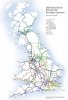
My proposals for just such a system last year, but with a bit of modification. The basis is as near as possible to the pre-1922 companies (you can combine them into a Big Four if you wish). Jointly-owned lines are shown as two solid lines, a dashed line represents running powers over someone else's route. This would be an interim phase until certain links are rebuilt, enabling more competion. For instance, the the LNER gets what was Northern Spirit until the former LNER routes around Sheffield are linked up again, enabling the Midland to "recapture" its former routes. The old North Midland Railway would be rebuilt in its entirity, allowing the Midland access to Leeds, and thus Carlisle.
For XC, Thameslink and freight (mustn't forget freight) there are two possible ways to handle it. One would be to form an Amtrak-style corporation and operate using running powers (effectively an open access arrangement). The other would be to form a joint corporation and run services with a joint operator, handing over at every changeover point (changing engines with freight, crew change with passengers).
For XC, Thameslink and freight (mustn't forget freight) there are two possible ways to handle it. One would be to form an Amtrak-style corporation and operate using running powers (effectively an open access arrangement). The other would be to form a joint corporation and run services with a joint operator, handing over at every changeover point (changing engines with freight, crew change with passengers).
Attachments
I would say that the appointment of a Rail Regulator with some serious teeth may go some way to ensuring that happens.
Maybe give the ORR (or whatever body may be created) control of the test trains, frequent maintenance audits, make the system so tight it's just not worth skimping on maintenance. Hit them where it hurts, in the pocket, if standards are not met.
You'd also need a new Railway Clearing House to handle through-ticketing, meaning that nobody would hog the revenue from their stations at the expense of someone else.
Taking the TOCs only....you'd end up with a two-tier railway -- companies like Virgin and Arriva who have massive companies and/or regional assembly subsidies behind them with money to...well, maybe not burn, but certainly singe... would be able to invest more in track maintenance than other, smaller companies. The smaller companies would be forced to choose maintenance of track vs maintenance of trains, provision of services, pay of staff etc.... there'd be conflict of interest, temptation to cut corners and at the first sign of any incident there'd be ructions.
EDIT: Also - who would run the RHTTs etc? Would each TOC be responsible for their own "patch"?
EDIT: Also - who would run the RHTTs etc? Would each TOC be responsible for their own "patch"?
Can you really see any TOC investing there own money in the infrastructure, because i can't.
TOC's are only in it for the money, you'd have to give them 20/30 year franchises with clauses added by the government insisting on upgrades.
Have a look at how much it costs to upgrade a modern railway these days!!!!.
Who would be responsible for looking after the TOC's routes?
TOC's are only in it for the money, you'd have to give them 20/30 year franchises with clauses added by the government insisting on upgrades.
Have a look at how much it costs to upgrade a modern railway these days!!!!.
Who would be responsible for looking after the TOC's routes?
Can you really see any TOC investing there own money in the infrastructure, because i can't.
TOC's are only in it for the money, you'd have to give them 20/30 year franchises with clauses added by the government insisting on upgrades.
Have a look at how much it costs to upgrade a modern railway these days!!!!.
Who would be responsible for looking after the TOC's routes?
The plan would be to abandon the franchising system altogether and allow the TOCs to buy the infrastructure. This would mean that they would stand or fall by their railway. There is always the danger that a railway might end up in the hands of an asset-stripped, but that could be said of any company. Ideally, forget the TOCs and make the different railways independent PLCs, in the hope that they function as independent companies.
Incidentally, not only do they maintain the infrastructure, they also buy the rolling stock and maintainance companies (the LNER-equivalent would buy Doncaster Plant for instance). That presents a problem with companies like the GWR-equivalent, because Swindon has closed, but there must be some way to allow the companies to maintain (or even build) their own stock as well as permanent way.
Are you being serious?.
You'd give the running of a modern railway over to a bunch of money grabbing fat cats!!.
What happens when something goes wrong and costs the company millions?.
Who regulates these TOC's?
Who decides what renewals/upgrades happen?
Buy the rolling stock, how much money have these people got? do you think the ROSCO's are going to let there stock go for nowt!!
You'd give the running of a modern railway over to a bunch of money grabbing fat cats!!.
What happens when something goes wrong and costs the company millions?.
Who regulates these TOC's?
Who decides what renewals/upgrades happen?
Buy the rolling stock, how much money have these people got? do you think the ROSCO's are going to let there stock go for nowt!!
Are you being serious?.
You'd give the running of a modern railway over to a bunch of money grabbing fat cats!!.
What happens when something goes wrong and costs the company millions?.
Who regulates these TOC's?
Who decides what renewals/upgrades happen?
Buy the rolling stock, how much money have these people got? do you think the ROSCO's are going to let there stock go for nowt!!
Yes!
Ideally, no, but there might not be much choice.
They go bust, the government buys the assets then sells them to someone else (or nationalises them to turn them around before the resale).
A beefed-up ORR (and they're called railway companies).
The railway companies, reacting to the market, plus any government initiatives if they decide to stump up the cash (which is how it worked up to 1948).
The government does a compulsory purchase of the ROSCOs, folds them up, then sells the stock. Otherwise, keep them for a bit, but allow the companies themselves to buy new stock, with the ROSCOs going out of business when their trains are too old to maintiain economically.
Can we repeal the Railways Act, 1997 and start all over again from a nationalised BR? Even better, repeal the Transport Act, 1947 and pretend that BR never existed at all. (Maybe this really is Cloud-Cookoo Land
 )
)Ha Ha Ha, they go bust and the government sells it to another company!! How long would that be acceptable for?.
What happens to the staff?
Force the ROSCO's to sell there stock!! do you know who these Rosco's are?.
Seriously are you being real?
What happens to the staff?
Force the ROSCO's to sell there stock!! do you know who these Rosco's are?.
Seriously are you being real?
Last edited:
- Status
- Not open for further replies.