Our new ticketing site is now live! Using either this or the original site (both powered by TrainSplit) helps support the running of the forum with every ticket purchase! Find out more and ask any questions/give us feedback in this thread!
Not sure if this is the right place or not but seems most relevant.
I'm starting as a shunter soon and trying to get an idea of how hand points work. I understand in the facing direction, gap to the left= route set for left and gap to right= right side route set.
How does this work in the trailing direction? My depot used to run through points but this is no longer allowed and as a shunter I will need to set trailing points.
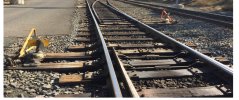
From the above image which "side" would the gap need to be for me to set them in the trailing direction? I'm guessing right hand side?
Trailing only occurs when the lines converge together and only allow the train to traverse in one direction. In the picture, should the train go over the points towards us regardless of the blades' position, the train can only go in one direction. Now most TOC/FOCs require you to always set the points to the direction of travel, regardless of whether you're facing or trailing. In you're example, the points are set straight ahead, so should a train come from the right track towards us, not only would it be considered trailing as the points are converging to one line but also set against the train and would need to be switched.
Not sure if this is the right place or not but seems most relevant.
I'm starting as a shunter soon and trying to get an idea of how hand points work. I understand in the facing direction, gap to the left= route set for left and gap to right= right side route set.
How does this work in the trailing direction? My depot used to run through points but this is no longer allowed and as a shunter I will need to set trailing points.
That would depend entirely on which direction the train movement is approaching the trailing points from. Facing points need to be set towards where you want the train to go. Trailing points need to be set to where the train is coming from.
I believe you're making it much more complicated than it needs to be. You just need to ensure you can see the route is set both from and to the correct location, ie the rails form an unbroken path for the full extent of the required train movement. It's as simple as that.
You do what you are taught to do where you are. There used to be "trailable points" which trains could run through, but if a set is not trailable and is run through it gets broken!
Wait to see what the local rules are! You will be told what you need to know.
You do what you are taught to do where you are. There used to be "trailable points" which trains could run through, but if a set is not trailable and is run through it gets broken!
Wait to see what the local rules are! You will be told what you need to know.
You’ve got the job so don’t worry about what’s to come.
Believe it or not the guys training you will tell you what you need to know.
All the guys that I know of from my course that tried to study ahead ended up being smart ar**s that were constantly jumping the gun and annoying the rest of the group.
Congrats on the job, now chill and be ready to soak up what those qualified to teach will tell you.
The most important thing to understand is that there are different types, designs and makes of point operating equipment.
You will be trained on the equipment that you will be using. And in all the terminology used.
If you find yourself in a situation where you encounter equipment that you have not been trained on, immediately escalate this to your manager.
However, as a previous poster has already mentioned it, it is worthwhile being very clear: points operated from a ground frame (a local control point, typically with the controls released by a signaller) whether mechanical (operated by levers) or power operated, or points controlled by a signal box (including power operated) will be damaged if run through. Hence these are always set to the required position before a movement is authorised.
You’ve got the job so don’t worry about what’s to come.
Believe it or not the guys training you will tell you what you need to know.
All the guys that I know of from my course that tried to study ahead ended up being smart ar**s that were constantly jumping the gun and annoying the rest of the group.
Congrats on the job, now chill and be ready to soak up what those qualified to teach will tell you.
Agree with the smart ar**s comment. With 40 years experience, the best Signallers are the ones that will learn to listen to those teaching them and not think they know it all because they have just passed a signalling course. The learning starts at the first signal box and continues through till the day of retirement. The job is continually changing and evolving, so whether a trainee or an experienced Signaller, learn to look, listen, and learn.
Agree with the smart ar**s comment. With 40 years experience, the best Signallers are the ones that will learn to listen to those teaching them and not think they know it all because they have just passed a signalling course. The learning starts at the first signal box and continues through till the day of retirement. The job is continually changing and evolving, so whether a trainee or an experienced Signaller, learn to look, listen, and learn.
This, 100%.
I'm project engineering by background (track specilisation), and reasonably senior now. However, I fully agree that I started learning the day I started asking questions, learned a lot more on formal training, am still learning loads over 20 years into my railway career, and will continue learning until the day I retire or even later (or run away screaming!)
The industry is a great place but you'll also find it full of "It always works like this, except for here and for this type, where you have to do it differently..."
There's a whole variety of types of pointwork. Some you can drive through in the trailing direction whether they are set for you or not, and they will be fine. The majority these days, you cannot, and this will damage them. Some have detection, some don't. Some are hand operated, some spring loaded, some local panel controlled, signal box controlled, local released but interlocked, etc etc etc.
Lots of variety to learn about. Relax and don't be afraid to ask those around you wherever you are to be working. Most people like to share their knowledge! But be careful about assuming that what you learn in place A will apply to place B. There's a good chance there will be some difference somewhere...
== Doublepost prevention - post automatically merged: ==
Don't be put off - we're not saying don't ask questions, not at all. This forum is great for sharing knowledge and info, and it's great that you're keen. It really is. Just be aware of the complexity that you're getting into and accept that you will never reach a day when you know everything. Be open to those around you, above, equal and below you on the payscale and seniority scales, and don;t be afraid to ask the silly questions. I make it a habit in my meetings to stop and say "What does that acronym stand for please?" or "Could you explain breifly what that system you have referred to there is please?"
Sometimes I already know the answer, but I'm all too aware of how many people around me often just assume they are the only ones who didn't understand that, or worse still make an assumption and carry on. It's interesting how often others will then say "Yes, I didn't understand that part either" when I do ask those questions.
Gosh, only in rail would you get such negativity for asking a question to confirm understanding. Admittedly, there's probably better places to ask than on here (of the people who actually answer your question, be prepared to see the same thing worded in so many different ways it just confuses you more... then about 10 different varieties of how it used to be, how it might be, and how it is done differently at various other locations to the one you're employed at).
...oh and then the people name calling for reaching out.
Whilst it may be really puzzling right now, I'd strongly suggest asking colleagues or trainers for guidance, as they will know the location far far better than we all do and be able to provide more specific guidance.
None the less, in the simplest terms, a trailing movement is the opposite to a facing movement. You set the points in order that the trains wheels don't push the points across.
Best of luck with the training and congrats on the job.
Gosh, only in rail would you get such negativity for asking a question to confirm understanding. Admittedly, there's probably better places to ask than on here (of the people who actually answer your question, be prepared to see the same thing worded in so many different ways it just confuses you more... then about 10 different varieties of how it used to be, how it might be, and how it is done differently at various other locations to the one you're employed at).
...oh and then the people name calling for reaching out.
Whilst it may be really puzzling right now, I'd strongly suggest asking colleagues or trainers for guidance, as they will know the location far far better than we all do and be able to provide more specific guidance.
None the less, in the simplest terms, a trailing movement is the opposite to a facing movement. You set the points in order that the trains wheels don't push the points across.
Best of luck with the training and congrats on the job.
We are aware of an issue with emails from the Forum to Microsoft-based email accounts (hotmail/outlook/live.com email addresses). This is being looked into currently, thanks for your patience meanwhile.