TheGrandWazoo
Veteran Member
O license just says two vehicles on Ingleton Industrial Estate (but that could include Bibbys?)The building on the A65 appears to have been sold. Could they be stabled overnight at Bibbys Coaches?

O license just says two vehicles on Ingleton Industrial Estate (but that could include Bibbys?)The building on the A65 appears to have been sold. Could they be stabled overnight at Bibbys Coaches?
I’m not sure that was the case?Joint operation was outlawed under deregulation
I’m not sure that was the case?
To the best of my knowledge it was, the new regulations regarding joint operations as anti-competitive unless they were specifically sanctioned; there are scores of cases where joint operation came to an abrupt end. Ribble and Pennine had always enjoyed an especially close relationship but all that was put to one side after October 1986.I’m not sure that was the case?
Southport Corporation would have been delighted that you weren't aware of Ribble in the town. On childhood visits to Southport I always thought how nice it was that Ribble services from the Preston direction turned off the main road and entered the town from the seafront. It wasn't until years later that I learned that the Corporation insisted on a clause in Ribble licences forbidding the approach from Lord Street.There is indeed now a Travelodge in the Lord Street frontage and a new block behind it, which I gather would have been on the site of the former station and Ribble garage. The Morrisons store is behind the left-hand side of that frontage and starts at roughly the end of the Travelodge's new block, so would presumably also be on part of the site? For a town I used to visit a lot with my parents, the Ribble presence seems to completely escape my memory!
The entrance to Morrison's large car park is from the seaward side (either Esplanade or Victoria Way) so I assume this is the area that was used as a coach park after its railway use was over?
To the best of my knowledge it was, the new regulations regarding joint operations as anti-competitive unless they were specifically sanctioned; there are scores of cases where joint operation came to an abrupt end. Ribble and Pennine had always enjoyed an especially close relationship but all that was put to one side after October 1986.
The street plan shows the Morrisons address as "Winter Gardens" which had been the site of the original bus station whilst the CLC line into Southport was still open. With the railway going the site outside of the station building was redeveloped for coach parking and there was also a Model Village. It's a nice touch that the clock tower still stands - I assume that the frontage to the station has listed status.


Fascinating stuff and great pictures thanks!Just to confirm some of the above regarding Southport, here's a picture from June 1987, inside the combined bus station / depot at Southport, clearly showing it's railway station heritage.
View attachment 79665
The frontage is indeed listed. Part of it is named 'Ribble Buildings' (visible behind the lower photo), and you can just see the start of the 'Travelodge' logo to the extreme right. The photo shows Stagecoach 15566 (PX59CUJ), appropriately enough in heritage Ribble 'Timesaver' livery, in August 2019.
View attachment 79666
The tower and clock is marked 'SCLER' (Southport & Cheshire Lines Extension Railway), but bears the date 1993, from when it was heavily refurbished. Photo 18 December 2010.
View attachment 79667

Fascinating stuff and great pictures thanks!
The redevelopment of the site was, along with various other schemes in Southport at the time, subjected to a lot of stop/start interruptions as developers went bust and/or money ran out. In Harry Foster's "Southport - a History", there is a picture of the frontage clad in scaffolding when it had been intended to build a shopping mall arcade alongside the station in what had been used as the vehicle entry lane. That was one casualty of this uncertain time. Another factor would have been that Morrisons had acquired Safeway who had a store further along Lord street so I imagine that the final phase of the new store took into account the need to accommodate a larger footfall. No doubt someone somewhere has access to the plans and it would be interesting to see what changed from the original to the final. He also touches on the fact that Southport had been quite sniffy about being absorbed into a Greater Merseyside until it dawned that Southport would be entitled to a slice of Merseyside's EU Objective One funding, and no doubt that helped to kickstart some of the schemes which had lain idle.
... The left hand side of the frontage is not an original part of the old station, but in Ribble days was where the buses entered after swinging round from the Promenade via Duke Street. ...


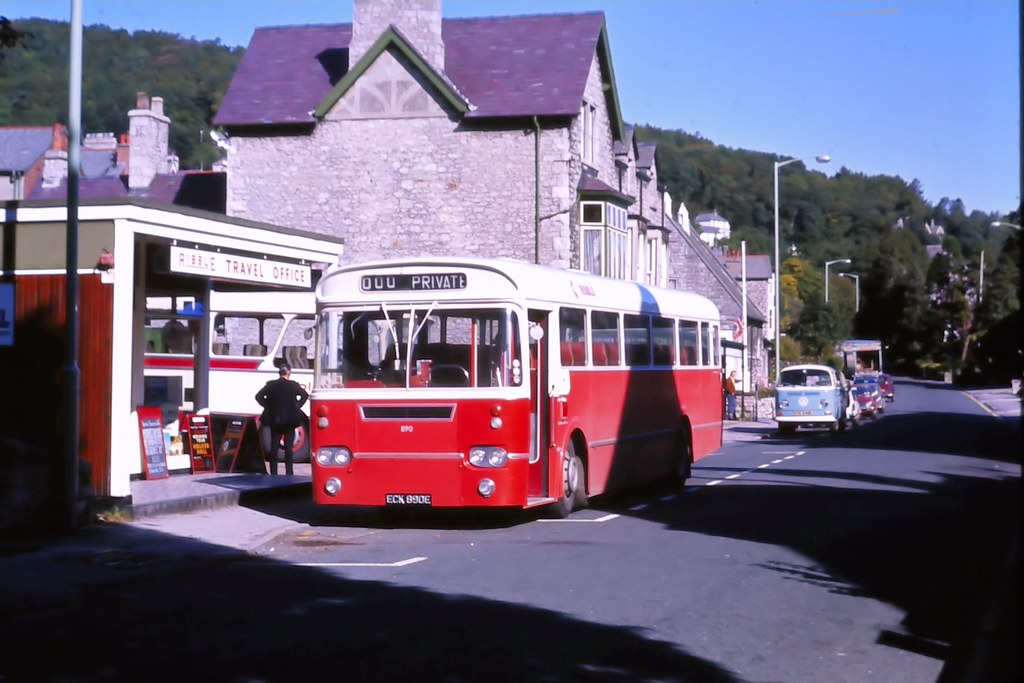
I am sure there was a Ribble depot in Grange-over-Sands - now housing I think.
 www.flickr.com
Indeed. Here's a picture of Leopard 905 on that entry road in 1976, long before the 'matching' part of the building was put up. Note that the Cleveland Cafe is still there to this day (just visible in the middle and lower pictures of my post #37 above).
View attachment 79679
Nice - many thanks for posting.A half decent flickr shot (not mine) of the other end of the passage https://www.flickr.com/photos/57425...5-9z7f9U-8zbB38-26HoEfD-DxRxb8-4YJq78-SoPGNG/
Actually, that's one that has proven a bit of a mystery. It was listed but I never discovered where it may have been.
There were two depots in Grange over Sands reflecting the fact that Ribble acquired the bus and coach operating arms of Grange Motor and Cycle Company in two stages - buses at Hampsfell Road and coaches at Albert Road which became the main garage seven years later. It ran as two distinct operations under the care of an Inspector in Charge. The buses were rotated on a maintenance basis with Kendal whereas the coaches (including the two famous ex Michelin Leopards) were a specific allocation with dedicated coach drivers. All sadly long gone and no doubt sold for redevelopment. The excursions and tours booking office with its off-road stance in Kents Bank Road later became a Co op Travel Office.I am sure there was a Ribble depot in Grange-over-Sands - now housing I think.
The Ian Allan 'abc' publication 'British Bus Fleets 16 (no obvious publication date, but I would assume 1963, as it includes vehicles up to 1850 - TCK850, delivered in 1963 - and talks about further vehicles due in 1963 and 1964) - makes reference to three sites in Grange-over-Sands:
Under 'List of Garages' it includes:
Grange - Albert Road
Under 'Booking and Enquiry Offices' it includes:
Grange, "Lymehurst," Kents Bank Road
Grange, Crown Hill (summer only)
Hope this helps.
There were two depots in Grange over Sands reflecting the fact that Ribble acquired the bus and coach operating arms of Grange Motor and Cycle Company in two stages - buses at Hampsfell Road and coaches at Albert Road which became the main garage seven years later. It ran as two distinct operations under the care of an Inspector in Charge. The buses were rotated on a maintenance basis with Kendal whereas the coaches (including the two famous ex Michelin Leopards) were a specific allocation with dedicated coach drivers. All sadly long gone and no doubt sold for redevelopment. The excursions and tours booking office with its off-road stance in Kents Bank Road later became a Co op Travel Office.
If you can access a copy of Mike Rhodes' "Ribble Under Nationalisation" - Venture 2017, highly recommended - there's a picture of a Leopard saloon outside Albert Road garage and one of an ex Michelin Leopard on the excursion stance in Kents Bank Road.That's interesting. Certainly had no idea there were two depots. A cursory glance on streetview shows a late 80s/early 90s era development on Albert Road (a short road) so suspect it was there?
Depots were often neglected by bus photographers but I suspect they'll be photos of them somewhere.
If you can access a copy of Mike Rhodes' "Ribble Under Nationalisation" - Venture 2017, highly recommended - there's a picture of a Leopard saloon outside Albert Road garage and one of an ex Michelin Leopard on the excursion stance in Kents Bank Road.
The interior of the vehicle is cleaned by vacuurn—a British Vacuum Cleaner and Engineering Co., Ltd., ticket and litter removal installation. This method ensures that no dust is raised to settle on seats and window ledges, and gives improved working conditions for the cleaners themselves.
The plant used for this operation is housed in a room situated between the ,servicing bay and the workshop, and consists of a large turbo exhauster driven by a 15 h.p. electric motor.
The vacuum created is used, via flexible hoses, to remove all dust, used tickets, and other refuse from the bus floor_ staircase and, platform, one cleaner working in the upper saloon and one in the lower saloon. The vacuum hoses are also used for emptying used ticket boxes and for cleaning drivers' cabs.
Between the suction hoses and the turbo exhauster are two large receivers. The first one separates by gravity the heavier particles of dirt, whilst the second is equipped with a number of bags, sitnilar in principle to those in a domestic vacuum cleaner, which filter the smaller particles of dirt from the air passing through.
In spite of using it quite often in the 1960s, I had not realised that Skelhorne Street Bus Station in Liverpool also had maintenance facilities. According to this article the bus station opened in 1960 and the servicing bay a year later. The allocation at the time was 18 buses and 17 coaches.
It had a new-fangled cleaning system which got a detailed description:
I assume Keswick was a Cumberland depot, although they may have looked after the Ribble coaches overnight.
The power of Flickr - the reverse of the shot in Commercial Motor https://www.flickr.com/photos/44435...BDk6-5TWbij-dpyYMo-wiJez-81TBdL-xZf8A-5mimkB/
Before my time so assume the bus and coach station was on Skelhorne Street with the passenger entrance on Bolton Street but the small maintenance running shed was out the back.
Keswick was a Cumberland depot (very lucrative site for Mr Souter....eventually) but it was a border town in terms of both firms and there was a Ribble inspector based there IIRC. EDIT: @David Verity beat me to it
The listing evidently didn't prevent the canopies being removed between the 2010 and 2019 photos.Just to confirm some of the above regarding Southport, here's a picture from June 1987, inside the combined bus station / depot at Southport, clearly showing it's railway station heritage.
View attachment 79665
The frontage is indeed listed. Part of it is named 'Ribble Buildings' (visible behind the lower photo), and you can just see the start of the 'Travelodge' logo to the extreme right. The photo shows Stagecoach 15566 (PX59CUJ), appropriately enough in heritage Ribble 'Timesaver' livery, in August 2019.
View attachment 79666
The tower and clock is marked 'SCLER' (Southport & Cheshire Lines Extension Railway), but bears the date 1993, from when it was heavily refurbished. Photo 18 December 2010.
View attachment 79667
Skelhorne Street bus and coach station was on two levels. Downstairs (vehicular and passenger entrance/exits from Bolton Street) was the 'short distance' stage carriage stuff - services to Crosby, Ormskirk, Southport, Skelmersdale etc; Upstairs (vehicular entrance and exits officially, but no-one minded about the Health and Safety aspects very much, so tended to be equally used by passengers) access from Hilbre Street. Express services went from here, including some limited stop runs such as Ribble's X27 (later 727) to/from Southport, Preston and East Lancashire towns. When Crosville's X7 (Liverpool - Ellesmere Port - Chester) service started in November 1984, it too ran from here.The power of Flickr - the reverse of the shot in Commercial Motor https://www.flickr.com/photos/44435...BDk6-5TWbij-dpyYMo-wiJez-81TBdL-xZf8A-5mimkB/
Before my time so assume the bus and coach station was on Skelhorne Street with the passenger entrance on Bolton Street but the small maintenance running shed was out the back.