• Our new ticketing site is now live! Using either this or the original site (both powered by TrainSplit) helps support the running of the forum with every ticket purchase! Find out more and ask any questions/give us feedback in this thread!

Restrictions on Multiple Working Length

Status
Not open for further replies.

Deepgreen

Established Member
Joined
12 Jun 2013
Messages
7,461
Location
Gomshall, Surrey
It was, and the train even got up to line speed. Not sure where or how fast (I doubt it got up to the 100mph line speed to the east of Tonbridge for example) but I suspect it got to line speed very slowly!
Hmm, thanks. How did you obtain your facts on this move? Given the train's initial acceleration from rest to about 15mph, I would put a lot of money on far more than 3 of the 23 cars providing power - a unit(s) may have lost some or all shoes but that doesn't necessarily mean they can't provide power when taking current from attached units. Also, as it was heading WEST (not east) when it left, where did it go? Given its slow exit after the rapid start, I suspect it went into the west yard at Tonbridge (supported by the squealing flanges over the points), unless it's known for certain to have travelled further. To do so would, for a start, involve the five miles climb at around 1 in 100 to Sevenoaks which would strain the abilities of a three car unit even further! It would not be a natural choice for a crippled train such as this to be allowed along a main line for any further than absolutely necessary. BTW, the rear unit is a four car and it's clearly to be heard providing power at the end of the video, so that would make a minimum of seven cars under power, and I suspect many more than that. Edit - the power output of a 375/3 is 1,300hp. That will probably not power a 23-car train at anything above about 30mph on the level and would certainly not make it to the top of Hildenborough bank.
 
Last edited:
Sponsor Post - registered members do not see these adverts; click here to register, or click here to log in
R

RailUK Forums

ComUtoR

Established Member
Joined
13 Dec 2013
Messages
9,562
Location
UK
- a unit(s) may have lost some or all shoes but that doesn't necessarily mean they can't provide power when taking current from attached units.

I don't believe that Electrostars provide power between units. Each power unit line is independent and there is no power connection via the coupler
 
Last edited:

edwin_m

Veteran Member
Joined
21 Apr 2013
Messages
28,610
Location
Nottingham
I don't believe that Electrostars provide power between units. Each power unit line is independent and there is now power connection via the coupler
Correct. However, there are bus cables within each unit so a unit could still have power if some (but not all) of its shoes were missing.
 

Doomotron

Established Member
Joined
25 Jun 2018
Messages
1,423
Location
Kent
Hmm, thanks. How did you obtain your facts on this move? Given the train's initial acceleration from rest to about 15mph, I would put a lot of money on far more than 3 of the 23 cars providing power - a unit(s) may have lost some or all shoes but that doesn't necessarily mean they can't provide power when taking current from attached units. Also, as it was heading WEST (not east) when it left, where did it go? Given its slow exit after the rapid start, I suspect it went into the west yard at Tonbridge (supported by the squealing flanges over the points), unless it's known for certain to have travelled further. To do so would, for a start, involve the five miles climb at around 1 in 100 to Sevenoaks which would strain the abilities of a three car unit even further! It would not be a natural choice for a crippled train such as this to be allowed along a main line for any further than absolutely necessary. BTW, the rear unit is a four car and it's clearly to be heard providing power at the end of the video, so that would make a minimum of seven cars under power, and I suspect many more than that. Edit - the power output of a 375/3 is 1,300hp. That will probably not power a 23-car train at anything above about 30mph on the level and would certainly not make it to the top of Hildenborough bank.
I'm just going on what the uploader said, when that video was recorded I didn't even live in the UK so I couldn't provide any alternate takes of my own. Also in the video you can hear only the last coaches making any traction motor noise.
 

SC318250

Member
Joined
4 Jun 2011
Messages
797
Remember years ago the Class 303/318 were limited to 9 cars with pans up, if it was a 12 car then one pan was isolated prior to coupling up
 

themiller

Established Member
Joined
4 Dec 2011
Messages
1,380
Location
Cumbria, UK

Sean Emmett

Member
Joined
9 Mar 2015
Messages
522
IIRC when the 158s were introduced there was a 12 car special for a staff outing. Pic in Modern Railways. But it was stressed this was a one-off.
 

Wyrleybart

Established Member
Joined
29 Mar 2020
Messages
2,605
Location
South Staffordshire
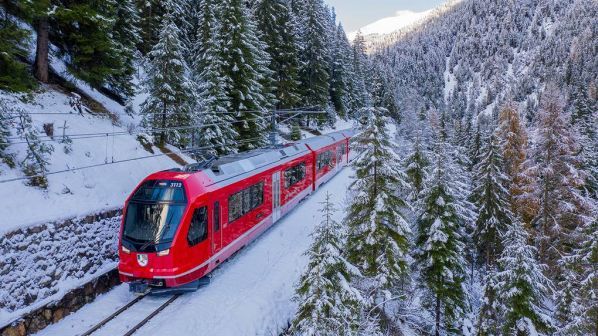
This record breaking run was performed using 25 4-car Capricorn units of the RhB and was controlled by 7 drivers.
With respect those hundred vehicles were not all in multiple as it took seven drivers to work it. Divide the 7 drivers by the 25 four car units and you get less than four units in multi with each other. Nevertheless quite a stunt ands amazing to see.
 

py_megapixel

Established Member
Joined
5 Nov 2018
Messages
7,451
Location
Northern England
With respect those hundred vehicles were not all in multiple as it took seven drivers to work it. Divide the 7 drivers by the 25 four car units and you get less than four units in multi with each other. Nevertheless quite a stunt ands amazing to see.
Perhaps they were connected mechanically but not electrically?
 

XAM2175

Established Member
Joined
8 Jun 2016
Messages
3,471
Location
Glasgow
Perhaps they were connected mechanically but not electrically?
Yes, they were mechanically coupled together, but the entire point of the topic is electrical and electronic restrictions on multiple working so the example is irrelevant other than showing that said restrictions do exist for those units.
 

themiller

Established Member
Joined
4 Dec 2011
Messages
1,380
Location
Cumbria, UK
With respect those hundred vehicles were not all in multiple as it took seven drivers to work it. Divide the 7 drivers by the 25 four car units and you get less than four units in multi with each other. Nevertheless quite a stunt ands amazing to see.
By simple mathematics, some drivers must have been controlling 4 units with the others controlling 3. The link below states that they can be controlled in a maximum of 4 units which makes 16 vehicles in normal service. I don’t know if that was the case in this evolution but it’s likely.
 

Deepgreen

Established Member
Joined
12 Jun 2013
Messages
7,461
Location
Gomshall, Surrey
This record breaking run was performed using 25 4-car Capricorn units of the RhB and was controlled by 7 drivers.
Yes, and rather sad to see a reference to drivers of a train 'steering' it!
 

800301

Member
Joined
29 Dec 2022
Messages
525
Location
Essex
When browsing Wikipedia and other sources I often find that multiple working is limited by a number of units, e.g. a Class 755 can only work in multiple with three total units.

I’m curious as to what the reason is for this restriction - does signal strength weaken between units? Is it a case of not being tested due to the unlikelihood of longer formations running?

On a somewhat frivolous note, theoretically would it be possible to have every single sprinter, pacer and turbo star in operation couple together and it work just fine?

Pretty sure on modern trains it’s down to software limitations to work properly or pan restrictions with a 387 for example can only be 12 car max, any longer and a pan had to be dropped,

I’ve seen a 755 dragging a 745 and there is a video of it on YouTube I’m pretty sure it was in service too.

The restriction is from the manufacturer but I know of exceptions being made such as a 18 car IET, where the normal restriction is 15 car
 

CDM

Member
Joined
18 Apr 2012
Messages
72
Mind explaining what pan bounce is?
A pantograph exerts upward force onto the contact wire in order to maintain contact.
Because the contact wire hangs under its own weight (supported from above, but not supported from below) it moves up, at the point the pantograph head is touching it. The wire then lowers again under its own weight behind the pantograph due to its own weight.

But it's not a simple 'one up/one down' movement, because the contact wire is hanging free, which means you get a 'bounce' on the contact wire which takes a while to settle back to steady state (not bouncing) after the pantograph has passed.

The more times you repeat that in short succession (the more pantographs that pass under close together) the worse the bounce gets.

There's a limit to how quickly each pantograph can react (deliberately by design, as well as just by natural physics).

If the wire is bouncing up/down more quickly than the following the pantograph can react, then you end up with a gap between the wire and the pantograph head. This means instead of proper contact between the head and wire allowing electrical current to flow direct from the wire to the pantograph, it instead draws an electrical arc (like lightening) between the two, as the current 'jumps' the air gap.

That arc causes damage (spot melting/erosion of varying degrees) to both the contract wire and the pantograph, which can lead to premature failure (e.g. contact wire parting, or head failure). The arc also causes nasty dynamics to the current flowing through the overhead wire system, that can either be picked up as 'faults' by the control equipment on the train, or the overhead power control system - causing things to trip or fail, or in extreme cases, it can result in things like voltage drops big enough that cause wider implications to the power grid.

Hope that makes sense?

I’m assuming fewer cars in service is due to increased power load due to stuff like air conditioning, passenger cabin lighting, etc, right?
That does come into play yes, but (I'm talking BR Era EMU here still) it was more to do with ensuring there wasn't excessive voltage drop on critical train wires to maintain passenger safety. You could override those to keep a train moving in emergency/when empty, but can't if the train is still in service.

(There are also other operational limitations like platform length and whether the train is walk-through etc etc but these vary by route/operator, so I'm just talking technical reasons here!)
 
Status
Not open for further replies.

Top