Justin Smith
Established Member
A quick update, the renovation of my layout is pretty well finished now, thanks for everyone's your help.
I have reused most of the points, almost all the Peco ones were still fine even after 40 odd years ( ! ) though some of the other types had fared less well, and some points needed replacing because they weren't Insulfrog.
As for the track I have replaced maybe a quarter of it (with Peco) flexi track, plus I had some spare track sections from the 70s. Almost all of the track has been reused though much of it is now in a different place from where it was before. The basic track layout is pretty much the same, other than mild improving of many of the alignments, one or two extra sidings and two new chords. Relaid track was pinned straight to the board with nothing more than grey paint to simulate ballast.
Pretty much all my locos and rolling stock can go round in either direction (on either loop or on the chords) at high speed without derailing, though that is not how trains on model railways should be operated, I actually get far more satisfaction out of seeing the trains going slowly because that proves the track and locos are decent......
Removing and replacing track sections is a bit of a pain but not as bad as I'd worried, once those aforementioned corroded pins had been removed ! Only some of the old pins were really hard to get out, most weren't too bad.
I am becoming a bit of an expert ( ! ) at curing derailing track, the most common cause for me seems to be track getting out of gauge and (having checked which side is too big or small) a twist of the rail joint with a pair of pliers seems to cure it.
I have been surprised how well the electrical current gets through even with old rail joiners and 40 year old points. I am using Relcos but it seems fine even without really. As insurance I have put a few parallel jumper wires (below the board) in.
The biggest upgrade has been to add about 15 isolators using these micro toggle switches helpfully recommended on here. A 5.5mm hole is drilled in the chipboard and then just screw them in (so only the top 5mm or so of the toggle is showing above) is easy and neat and doesn't look too bad. The isolated sections really do make the layout far more usable and interesting to operate, they are well worth it.
I have deliberately left quite a bit of the layout in its original rather crude state so as to keep faith with its origins, track excepted (because I want reliable running) apart from one section - which runs fine anyway - just to remind me what it was like.
My original Lima locos aren't that good, poor pickup and low traction. Even so I do want to persist with at least the Class 31 as it is "original" off my layout, though it will need a new motor as the armature windings have become OC, snapped off at the point they are soldered on. Not sure how that happened as it was working when I first got the layout down !
Have got hooked on buying more locos and rolling stock, which is unfortunate whilst the price of secondhand N gauge stuff (esp locos) is so ridiculously high ! Got one bargain though, an old Grafar "Hall" off E Bay (for £40 incl P&P) which looked scabby up close but is fine on the layout and runs brilliantly, good pick up and traction plus it rarely derails. A Farish Black 5 cost more and is not so good on either. My old Grafar Pannier tank has good traction but as its only an 0-6-0 poor pick up. All the Farish "diesel" locos I have bought run very well both on traction and pick up.
The Lima coaches are great, they hardly ever derail (better than the Grafar ones in that respect), though they are slightly the wrong gauge (too small) really. In fact I have bought a load more Lima coaches as I think they run really well and are cheap(er).
I have spent far too much on it (about £400 odd on everything from points to paint and switches to sheep) but have actually quite liked doing it. This time I was not having to do everything on the cheap, I had better tools, a better working environment, more help (off model railway forums) and slightly more patience !
The £500 plus I have spent on extra rolling stock and locos (mainly off E Bay) cannot really be considered in the same way as what I spent on the layout because I could probably sell it again for more or less what I bought it for, or that's what I keep telling myself !
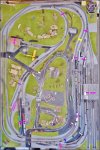
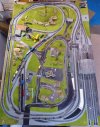
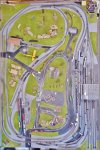
It is not quite finished yet, note the loose fences and (so far) unpainted platform extensions in the pic ! The isolating micro switches can just be made out, e.g. four (one per track) at the line ends of the terminal platforms.
I have reused most of the points, almost all the Peco ones were still fine even after 40 odd years ( ! ) though some of the other types had fared less well, and some points needed replacing because they weren't Insulfrog.
As for the track I have replaced maybe a quarter of it (with Peco) flexi track, plus I had some spare track sections from the 70s. Almost all of the track has been reused though much of it is now in a different place from where it was before. The basic track layout is pretty much the same, other than mild improving of many of the alignments, one or two extra sidings and two new chords. Relaid track was pinned straight to the board with nothing more than grey paint to simulate ballast.
Pretty much all my locos and rolling stock can go round in either direction (on either loop or on the chords) at high speed without derailing, though that is not how trains on model railways should be operated, I actually get far more satisfaction out of seeing the trains going slowly because that proves the track and locos are decent......
Removing and replacing track sections is a bit of a pain but not as bad as I'd worried, once those aforementioned corroded pins had been removed ! Only some of the old pins were really hard to get out, most weren't too bad.
I am becoming a bit of an expert ( ! ) at curing derailing track, the most common cause for me seems to be track getting out of gauge and (having checked which side is too big or small) a twist of the rail joint with a pair of pliers seems to cure it.
I have been surprised how well the electrical current gets through even with old rail joiners and 40 year old points. I am using Relcos but it seems fine even without really. As insurance I have put a few parallel jumper wires (below the board) in.
The biggest upgrade has been to add about 15 isolators using these micro toggle switches helpfully recommended on here. A 5.5mm hole is drilled in the chipboard and then just screw them in (so only the top 5mm or so of the toggle is showing above) is easy and neat and doesn't look too bad. The isolated sections really do make the layout far more usable and interesting to operate, they are well worth it.
I have deliberately left quite a bit of the layout in its original rather crude state so as to keep faith with its origins, track excepted (because I want reliable running) apart from one section - which runs fine anyway - just to remind me what it was like.
My original Lima locos aren't that good, poor pickup and low traction. Even so I do want to persist with at least the Class 31 as it is "original" off my layout, though it will need a new motor as the armature windings have become OC, snapped off at the point they are soldered on. Not sure how that happened as it was working when I first got the layout down !
Have got hooked on buying more locos and rolling stock, which is unfortunate whilst the price of secondhand N gauge stuff (esp locos) is so ridiculously high ! Got one bargain though, an old Grafar "Hall" off E Bay (for £40 incl P&P) which looked scabby up close but is fine on the layout and runs brilliantly, good pick up and traction plus it rarely derails. A Farish Black 5 cost more and is not so good on either. My old Grafar Pannier tank has good traction but as its only an 0-6-0 poor pick up. All the Farish "diesel" locos I have bought run very well both on traction and pick up.
The Lima coaches are great, they hardly ever derail (better than the Grafar ones in that respect), though they are slightly the wrong gauge (too small) really. In fact I have bought a load more Lima coaches as I think they run really well and are cheap(er).
I have spent far too much on it (about £400 odd on everything from points to paint and switches to sheep) but have actually quite liked doing it. This time I was not having to do everything on the cheap, I had better tools, a better working environment, more help (off model railway forums) and slightly more patience !
The £500 plus I have spent on extra rolling stock and locos (mainly off E Bay) cannot really be considered in the same way as what I spent on the layout because I could probably sell it again for more or less what I bought it for, or that's what I keep telling myself !
It is not quite finished yet, note the loose fences and (so far) unpainted platform extensions in the pic ! The isolating micro switches can just be made out, e.g. four (one per track) at the line ends of the terminal platforms.
Attachments
Last edited:

 . Is he still enjoying it?