
-
Our new ticketing site is now live! Using either this or the original site (both powered by TrainSplit) helps support the running of the forum with every ticket purchase! Find out more and ask any questions/give us feedback in this thread!
You are using an out of date browser. It may not display this or other websites correctly.
You should upgrade or use an alternative browser.
You should upgrade or use an alternative browser.
Rail renationalisation- do you support it?
- Thread starter Harbornite
- Start date
- Status
- Not open for further replies.
Sponsor Post - registered members do not see these adverts; click here to register, or click here to log in
R
RailUK Forums

Does that encompass the same things in 2015 as it did in 1992 or are there things on the books now that weren't on the books then? For example, there's a billion or so that's due to Crossrail.Total government support to the rail industry...
absolutelymilk
Established Member
- Joined
- 18 Jul 2015
- Messages
- 1,612
Does that encompass the same things in 2015 as it did in 1992 or are there things on the books now that weren't on the books then? For example, there's a billion or so that's due to Crossrail.
Indeed, strip out Crossrail and Thameslink, and you are left with a similar figure for 2015 as pre-privatisation, despite more than doubled passenger numbers.
The 2015-16 figures are due out in October, so we will see if the recent decrease in subsidy continues.
Been playing with Excel - if you strip out 'Direct rail support' (which I'm assuming prior to Network Rail coming into existence was classed as capital spending and came directly out of the treasury) then the picture doesn't look as bad as the headline numbers.Indeed, strip out Crossrail and Thameslink, and you are left with a similar figure for 2015 as pre-privatisation, despite more than doubled passenger numbers.

Railsigns
Established Member
- Joined
- 15 Feb 2010
- Messages
- 2,754
Been playing with Excel - if you strip out 'Direct rail support' (which I'm assuming prior to Network Rail coming into existence was classed as capital spending and came directly out of the treasury) then the picture doesn't look as bad as the headline numbers.
Yeah? Well, the last time I farted, I held my nose and it didn't smell so bad.
The point I'm making is that there's a huge stonking wad of money that apparently wasn't being spent prior to 2001/02 - what changed in that financial year? Did the railway suddenly start spending a billion+ pounds that they didn't before, or was that money always being spent but hidden in another account?Yeah? Well, the last time I farted, I held my nose and it didn't smell so bad.
--- old post above --- --- new post below ---
Courtesy of Wikipedia, here's an interesting chart showing the subsidy per passenger journey. In light of the comparisons being made between BR days and post-privatisation I'll let the start and end points of the chart do the talking.
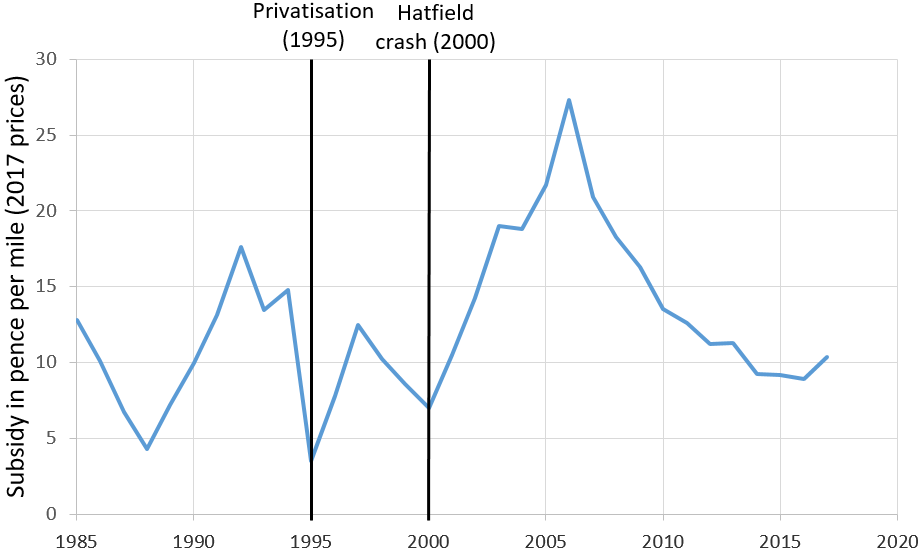
(From the article on Network Rail).
Last edited:
Says a lot that graph, we're at lower subsidy per passenger now, than in 1982, when the film I posted earlier on in the thread was made
http://player.bfi.org.uk/film/watch-anglia-reports-railways-transport-special-1982/
This was a time when serious network reduction was being talked about, now we're expanding.
The low spending in late 1980s was all to do with the Lawson boom in the city, after the 1983 'big bang'. More passengers commuting to London. 1992 crash once again meant less spending/commuting.
Spike in early 2000s was increased spending in safety and new track after Railtrack collapse, late 1990s accidents.
It's fair to say lifestyle changes have meant more people commuting by rail since then, lot of younger people in particular cannot afford cars (fall in some wages and higher rents/mortgages) or they would rather spend money on travel abroad rather than buying one. Congestion has helped the railways too, plus the internet (wifi, online ordering so car not required). It's not all down to privatisation.
http://player.bfi.org.uk/film/watch-anglia-reports-railways-transport-special-1982/
This was a time when serious network reduction was being talked about, now we're expanding.
The low spending in late 1980s was all to do with the Lawson boom in the city, after the 1983 'big bang'. More passengers commuting to London. 1992 crash once again meant less spending/commuting.
Spike in early 2000s was increased spending in safety and new track after Railtrack collapse, late 1990s accidents.
It's fair to say lifestyle changes have meant more people commuting by rail since then, lot of younger people in particular cannot afford cars (fall in some wages and higher rents/mortgages) or they would rather spend money on travel abroad rather than buying one. Congestion has helped the railways too, plus the internet (wifi, online ordering so car not required). It's not all down to privatisation.
Last edited:

Lankyline
Member
Putting the debts held by the British Railways Board (BRB) created after the 1962 transport act into context verses the current govt payment/debt/subsidy, call it what you will, was as follows
£400m written off (approx £16b now)
£400m in a govt loan(as above)
£705m (nearly £30b now) sidelined into a govt a/c hopefully to be forgotten about !
And last but not least approx £100m pa in charges
Makes the current £3-5b look cheap !
£400m written off (approx £16b now)
£400m in a govt loan(as above)
£705m (nearly £30b now) sidelined into a govt a/c hopefully to be forgotten about !
And last but not least approx £100m pa in charges
Makes the current £3-5b look cheap !
Railsigns
Established Member
- Joined
- 15 Feb 2010
- Messages
- 2,754
Putting the debts held by the British Railways Board (BRB) created after the 1962 transport act into context verses [sic] the current govt payment/debt/subsidy, call it what you will, was as follows
£400m written off (approx £16b now)
£400m in a govt loan(as above)
£705m (nearly £30b now) sidelined into a govt a/c hopefully to be forgotten about !
And last but not least approx £100m pa in charges
Makes the current £3-5b look cheap !
Very good. Now try comparing like with like, i.e. overall annual subsidy, not one-off costs from the most untypical year you could find.
See post #638.Very good. Now try comparing like with like, i.e. overall annual subsidy, not one-off costs from the most untypical year you could find.
Railsigns
Established Member
- Joined
- 15 Feb 2010
- Messages
- 2,754
What about it? There's a big graph that shows that the lowest subsidy per passenger journey in recent years was achieved by British Rail c.1988 and has yet to be equalled by the privatised railway.
I suspect that journeys which involve more than one TOC are counted as more than one journey, which would make the post-privatisation figure lower than it really should be. Like with like?
Oh my. I really respect you, and I'm a huge fan of your website from which I've learned a lot so I must say that I'm surprised at how strongly you are sticking to an idea and ignoring any evidence that is contrary to your view.What about it? There's a big graph that shows that the lowest subsidy per passenger journey in recent years was achieved by British Rail c.1988 and has yet to be equalled by the privatised railway.
You said yourself that pre-privatisation BR was seriously starved of resources, was in a downward spiral and had to 'make do and mend'. Whereas the privatised railway is carrying nearly a billion more passengers per year, is in the middle of the longest and largest period of renewals and upgrades in the last fifty-plus years and yet only requires something like 15% more subsidy per passenger than BR did, and that subsidy is on a decade-long downward trajectory.
Edit: Oh, and I'm also impressed by your strop at Lankyline for cherry-picking a year that suited his argument, yet you've chosen the lowest year of BR's years, conveniently ignoring all the other years where their subsidy was much higher. Including the immediate pre-privatisation years when you said that BR was being run into the ground by lack of investment.
Last edited:
Lankyline
Member
Incorrect. Total government support to the rail industry at 2014-15 prices has risen from about £2 billion to about £5 billion a year. [source]
Very good. Now try comparing like with like, i.e. overall annual subsidy, not one-off costs from the most untypical year you could find.
First they were not one off costs as you say but reflect the losses made at the time, plus if you actually read my post properly you will realise the date is actually significant as it was the start of BRB.
You obviously have no idea of the different formulas that different govts have used to calculate costs/subsidies and as a consequence twist those to suit their own political agendas, if you had you would realise there is no such thing as a direct comparison to the past, particularly when it comes to passenger costs per rail mile.
The point is in case you missed it, is that nationalised railways as a profit making business overall failed, even when they returned a gross profit it was wiped out by operating costs, interest etc, that's why i quoted the deficit figs
But since you haven't bothered to put any sort of reasoned argument together to support whatever your actual view is, you just counter with more questions and no details.

Muttley
Member
- Joined
- 17 Jul 2007
- Messages
- 247
...is that nationalised railways as a profit making business overall failed...
Bingo, you've got it at last. Just like we've been trying to tell you.
What about it? There's a big graph that shows that the lowest subsidy per passenger journey in recent years was achieved by British Rail c.1988 and has yet to be equalled by the privatised railway.
I suspect that journeys which involve more than one TOC are counted as more than one journey, which would make the post-privatisation figure lower than it really should be. Like with like?
Try looking at staff wages, £115 quid a week for a class B signalman in the early 90s, 180 quid for a Driver. BR just couldn't get staff any grade. Don't forget BR ran long maintenance holidays on many lines, most of the stations were terrible, cut services to a minimum. Look at the investment in signalling and new trains, crossrail, HS1 now.

Gareth Marston
Established Member
Try looking at staff wages, £115 quid a week for a class B signalman in the early 90s, 180 quid for a Driver. BR just couldn't get staff any grade. Don't forget BR ran long maintenance holidays on many lines, most of the stations were terrible, cut services to a minimum. Look at the investment in signalling and new trains, crossrail, HS1 now.
Government underfunds nationalised railways except that isn't true about continental railways.

Harbornite
Established Member
- Joined
- 7 May 2016
- Messages
- 3,627
Government underfunds nationalised railways except that isn't true about continental railways.
I'm not so sure. Both PKP and DB have had to make cutbacks, as well as SNCF. It's not all rosy over there.
It wasn't so much about government underfunding BR, it just constantly lost traffic apart from one or two years. Had a terrible image and everyone was always on strike. Despite the best efforts of the more talented management, it was an uphill struggle. That's not down to the government, that was down to the product on offer. Travelling by BR was a pretty run down experience in general in later years, apart from one or two main lines.
https://www.youtube.com/watch?v=J-XvcsfsgAI
https://www.youtube.com/watch?v=H1XIrHcV6dA
https://www.youtube.com/watch?v=J-XvcsfsgAI
https://www.youtube.com/watch?v=H1XIrHcV6dA
Harbornite
Established Member
- Joined
- 7 May 2016
- Messages
- 3,627
It wasn't so much about government underfunding BR, it just constantly lost traffic apart from one or two years. Had a terrible image and everyone was always on strike. Despite the best efforts of the more talented management, it was an uphill struggle. That's not down to the government, that was down to the product on offer. Travelling by BR was a pretty run down experience in general in later years, apart from one or two main lines.
https://www.youtube.com/watch?v=J-XvcsfsgAI
https://www.youtube.com/watch?v=H1XIrHcV6dA
What didn't help were crappy advertising slogans like "we're getting there". Absolute crap, it's a shame because BR had some genuinely good achievements like the HST and the Intercity brand, these both take some beating.

The thing is that while BR did have a number of good points at various times, with particular success (on occasion) on the Engineering front, it would not be the same today if privatisation hadn't happened at that time. We'd probably have PPPs, rolling stock being built abroad, legislation to prevent national rail strikes, wage freezes, budget cuts and everything else that goes with being a nationalised industry under the Tories.
Be careful what you wish for...
Be careful what you wish for...
Railsigns
Established Member
- Joined
- 15 Feb 2010
- Messages
- 2,754
Oh my. I really respect you, and I'm a huge fan of your website from which I've learned a lot
Thank you...
so I must say that I'm surprised at how strongly you are sticking to an idea and ignoring any evidence that is contrary to your view.
You shouldn't be surprised. After all, my views on renationalisation are shared by a majority of the population, so I don't feel under any pressure to change them. What surprises me is that those with an opposing view are apparently so readily willing to be taken in by the spin and lies peddled by the Tory government and ATOC, both of whom have a vested interest in maintaining the status quo. They're the ones who should be questioning themselves.
Lankyline
Member
Bingo, you've got it at last. Just like we've been trying to tell you.
I "got it" a long time ago, its just I usually make up own mind thanks
Like many views shared by 'the majority' it really does depend on the question that's asked. I doubt that one in ten of the population actually understands how the railway works today, so while they support 'renationalisation' they may not actually know what that entails.You shouldn't be surprised. After all, my views on renationalisation are shared by a majority of the population, so I don't feel under any pressure to change them.
I can't speak for anyone else, but my view is based on published statistics and personal observation rather than the spin put out by either side. Politically, I am centrist so I'm not wedded to the concept of the privatised railway, nor am I opposed to renationalisation - I just don't think it will make nearly the difference that you do. The operational costs will still be the same, the maintenance and upgrade will still need to be done, at the operational level the same people will still be doing the same jobs for the same salaries.What surprises me is that those with an opposing view are apparently so readily willing to be taken in by the spin and lies peddled by the Tory government and ATOC, both of whom have a vested interest in maintaining the status quo.
There will be some reduction in overheads due to a reduction in duplication, and potentially there will be the benefits of scale as I alluded to in an earlier post. There would be the potential for more 'joined up thinking', but that's already starting to happen (look at Scotland for an example with NR and Scotrail working closely together). The 3p in a pound that currently goes to shareholders will be kept in the railway.
But the DfT will still be running things, the railway will still be running close to capacity, passenger numbers will continue to grow, old rolling stock and equipment will still be old, the challenges of moving to ROCs and ERTMS will still be there and things will still have been better 'back in the old days'.
Bletchleyite
Veteran Member
But the DfT will still be running things, the railway will still be running close to capacity, passenger numbers will continue to grow, old rolling stock and equipment will still be old, the challenges of moving to ROCs and ERTMS will still be there and things will still have been better 'back in the old days'.
One of the problems is that people don't remember just how bleak latter-day BR actually was. Fortunately I'm just about old enough that I do, and it was pretty bad. Perhaps interesting for enthusiasts, but certainly not better for the passenger who just wants to get there unless on a very tight budget.
Just watch Victoria Wood's Great Railway Journey, it's depressing, and prior to the IC/RR/NSE era it was *even more* depressing than that. It was all about cuts, not about the massive growth we are having at the moment, with each franchise renewal at the moment seeming to propose massive improvements over what went before.
Lankyline
Member
The thing is that while BR did have a number of good points at various times, with particular success (on occasion) on the Engineering front, it would not be the same today if privatisation hadn't happened at that time. We'd probably have PPPs, rolling stock being built abroad, legislation to prevent national rail strikes, wage freezes, budget cuts and everything else that goes with being a nationalised industry under the Tories.
Be careful what you wish for...
God forbid another Labour govt, who in case you forgot nationalised the railways in the first place, cut budgets, failed to invest and did nothing to tackle the restrictive labour practices of its paymasters, the unions, who effectively shot themselves in the foot through their short term outlook and failed to see the bigger picture coming, that was Beeching's report.
Did the unions protest, call for strikes against the cuts, yes they did, but the NUR & ASLEF couldn't agree as the planned strike fell during ASLEF's annual assembly !
I agree that BR did a number of things well, but you can't use the Tories as as the sole example of "mismanaging" a nationalised industry, Labour's track record is less than spectacular !
Thank you...
You shouldn't be surprised. After all, my views on renationalisation are shared by a majority of the population, so I don't feel under any pressure to change them. What surprises me is that those with an opposing view are apparently so readily willing to be taken in by the spin and lies peddled by the Tory government and ATOC, both of whom have a vested interest in maintaining the status quo. They're the ones who should be questioning themselves.
If you say so, the elephant in the room is still the nationalised Network Rail that takes the majority of any public cash that's put in. 8 train operations didn't even pay dividends in the last financial year, ask the public and they think:
1. Rail is the most unreliable method of transport.
2. Rail is very expensive.
3. The cost of the train fare is high because of profit making
All the above is demonstrably untrue, and just depends what agenda you have. The media distorts the public discourse and the rail industry is poor at PR.
The nationalisation debate is mostly driven by the trade unions, who are politically motivated. Even though their members have done very well out of it. Rightly so, because the railways were underpaid for years, the sort of place careers advisors would direct people if they failed at everything else, along with the post office. Though just ask NR people how much the company has tightened belts since the magic credit card was torn up...
The public also think the energy companies should be nationalised too.
Britain is no longer a net energy exporter and is far more subject to world demand due to increased living standards and a bigger world population. There is also far more green legislation about, meaning cheaper coal is less favoured.
There's no magic wand with many of these things and there's little or nothing politicians can do at times. It just amazes me there are so many naive people that will vote for the likes of Corbyn, who is a leftist fantasist that thinks you can make friends with the IRA and ISIS by making them a nice cup of tea, we can afford to favour middle class students by giving them free education, and all the railway problems can be solved by nationalisation/throwing more money at it, instead of more productivity and intelligent problem solving.
Last edited:
Railsigns
Established Member
- Joined
- 15 Feb 2010
- Messages
- 2,754
The elephant in the room is still the nationalised Network Rail that takes the majority of any public cash that's put in.
Trying to portray Network Rail as an inefficient state body because it takes the majority of the public subsidy, while those oh-so-efficient private sector TOCs either take tiny subsidies or throw premium payments at the government, is completely bogus.
Firstly, NR has a national rail network to maintain: track, signalling and structures don't come cheap. The TOCs do little more than operate trains and check tickets, each within a limited geographical area. Comparing like with like?
Secondly, and this is the important bit, the relative costs of subsidising NR versus the TOCs can be - and are - manipulated by adjusting the level of track access charges paid to NR. Even though the TOCs are making greater use of the infrastructure, track access charges have been reduced, meaning they are paying less. The TOCs therefore need less of a subsidy, while NR is given more to compensate. It creates an illusion that the TOCs are lowering their costs and becoming more efficient, while NR gobbles up all the public money, but it's completely false. It's an example of the sort of tricks the government pulls to try to skew public perception. It looks like they've pulled the wool over your eyes, anyway.
Last edited:
No because I mentioned it a few posts back, if you care to check.
You are ideologically tied to things and there are many holes in your arguments.
And before you point out that I love the private sector and am therefore a Tory, If you care you check as well, I pointed out I don't care who owns it. I'm interested in what works.
My firm belief is innovation, new ideas, competition and productivity will solve a lot more than setting up a protectionist movement.
You are ideologically tied to things and there are many holes in your arguments.
And before you point out that I love the private sector and am therefore a Tory, If you care you check as well, I pointed out I don't care who owns it. I'm interested in what works.
My firm belief is innovation, new ideas, competition and productivity will solve a lot more than setting up a protectionist movement.
Last edited:
It just amazes me there are so many naive people that will vote for the likes of Corbyn, who is a leftist fantasist that thinks you can make friends with the IRA by making them a nice cup of tea
What you actually meant to say is he believes that dialogue would deliver a better outcome then the usual methods. He is wrong in the case of isis admittidly but that doesn't make such a statement incorrect over all. different situations call for different solutions.
My firm belief is innovation, new ideas, competition and productivity will solve a lot more than setting up a protectionist movement.
Nobody is planning to set up a "protectionist movement" . competition on the railway is so small it's not enough to justify the current system. The only thing that justifies the current system is one believeing in not rocking the boat
- Status
- Not open for further replies.