
• Our new ticketing site is now live! Using either this or the original site (both powered by TrainSplit) helps support the running of the forum with every ticket purchase! Find out more and ask any questions/give us feedback in this thread!

RAIB: Collision at Stainforth Road level crossing

Status
Not open for further replies.

alxndr

Established Member
Joined
3 Apr 2015
Messages
1,688
The report doesn't mention when the southbound driver passed, or how long it took for the message to be passed onto Route Control from the Police. I'm guessing that had the collision not taken place a message would have been passed by Route Control to the signaller, and then from the signaller to the train driver. Had the message been received sooner could it have been possible for the train to have been moved clear of the crossing?

If the message being received sooner could have made a difference should more be done to make the public aware of the presence of telephones at automatic level crossings, their purpose, and who they connect to? In this case it took an ex-railway employee to realise it was the better option.

Paragraph 22
While the train was at a stand, a car driver approached the crossing in the southbound direction. He stated that, as he did so, the road was in darkness and that the crossing’s warning equipment was not activated. As he got to the crossing and drove over it, he could see that the rear of a stationary train was blocking the opposite side of the carriageway. The southbound car driver did not feel that it was safe to stop because he was on an unlit single-carriageway road. He therefore drove on to Barnby Dun, where there was street lighting, and from there called the police to report the matter. This call was received by South Yorkshire Police, who in turn called Network Rail’s Route Control at York.

Genuine question: is this a realistic safety concern? Particularly as this particular road appears straight, largely flat, and there looks to be the odd field entrance that someone could pull into. I feel that in a similar situation I'd pull over and make the call ASAP and wonder if I'd be in the wrong for that. Although the 600 yards or so to a streetlight is unlikely to make much difference.
 
Sponsor Post - registered members do not see these adverts; click here to register, or click here to log in
R

RailUK Forums

GB

Established Member
Joined
16 Nov 2008
Messages
6,557
Location
Somewhere
Genuine question: is this a realistic safety concern? Particularly as this particular road appears straight, largely flat, and there looks to be the odd field entrance that someone could pull into. I feel that in a similar situation I'd pull over and make the call ASAP and wonder if I'd be in the wrong for that. Although the 600 yards or so to a streetlight is unlikely to make much difference.

Impossible for any of us to answer what someone else might have perceived...but logically, surely the better option would have to remained at the crossing with hazard lights on and headlights illuminating the wagon.
 

whhistle

Established Member
Joined
30 Dec 2010
Messages
2,636
What's the definition of excessive speed? I occasionally drive over the level crossing on the A1133 near Collingham during the hours of darkness at ~100km/h and cannot see any reason to not do so.
Excessive: more than is necessary, normal, or desirable; immoderate.

I'd never travel over a crossing at 60mph... more so for the sake of potentially damaging the car suspension.

While it's completely Network Rail's fault here, the car driver should learn to slow down when approaching a crossing, because as this event has proved, you can't rely on another party for your own safety.


One surely does not have to expect that part of a wagon will be in the road.
Perhaps they should though.
Just because it doesn't happen very often, it doesn't mean people shouldn't expect it.


Should we all slow down to, say, 20 mph at every green traffic light on a dual-carriageway in case someone else passes a red light and thus obstructs our path?
No, but that's a completely different scenario and thus uncomparable.


I'd also question where the first driver was.
If they passed the crossing, knowing the danger, did the driver "flash" a warning to the northbound driver? Or were they already in the built up area calling the police?
 

edwin_m

Veteran Member
Joined
21 Apr 2013
Messages
28,648
Location
Nottingham
If the message being received sooner could have made a difference should more be done to make the public aware of the presence of telephones at automatic level crossings, their purpose, and who they connect to? In this case it took an ex-railway employee to realise it was the better option.

Genuine question: is this a realistic safety concern? Particularly as this particular road appears straight, largely flat, and there looks to be the odd field entrance that someone could pull into. I feel that in a similar situation I'd pull over and make the call ASAP and wonder if I'd be in the wrong for that. Although the 600 yards or so to a streetlight is unlikely to make much difference.
It says later in the report that another driver stopped just after the accident and called the police, who were still on the phone to Route Control at the time following the previous call. The train was stopped for 1min 50s, the time needed to reset the DSD and re-charge the brakes, and there was no reason for the driver to hang around longer than necessary. So even if someone had noticed it immediately and reported via the crossing phone (the quickest route - used by another driver after the accident who was a former member of railway staff) it's unlikely the train could have been moved any earlier. Nor could the barriers have been lowered without someone on site to put the crossing into local control.

I do agree stopping with hazard lights and flashing headlights at the approaching driver would most likely have averted this accident, but it's difficult to attach any blame to the first car driver as without railway knowledge they would be unlikely to realise this.
 

YorkshireBear

Established Member
Joined
23 Jul 2010
Messages
9,666
I do agree stopping with hazard lights and flashing headlights at the approaching driver would most likely have averted this accident, but it's difficult to attach any blame to the first car driver as without railway knowledge they would be unlikely to realise this.

If i had come across that incident I would have stopped with my hazards at the stop line on the clear side of the crossing. But that does not remove the initial problem!
 

AlterEgo

Verified Rep - Wingin' It! Paul Lucas
Joined
30 Dec 2008
Messages
29,392
Location
LBK
Genuine question: is this a realistic safety concern? Particularly as this particular road appears straight, largely flat, and there looks to be the odd field entrance that someone could pull into. I feel that in a similar situation I'd pull over and make the call ASAP and wonder if I'd be in the wrong for that. Although the 600 yards or so to a streetlight is unlikely to make much difference.

You'd cover 600 yards in about 30 seconds at the speed on that road. I don't think it would make much difference and it is difficult to criticise the first driver for heading to a streetlight.


To speak more generally,

The causes of this accident were:

- the design of the level crossing in allowing a stopped train of a certain length to be foul of the road: "The control circuits had not been modified to incorporate later features which prove that trains are clear of a crossing before it re-opens." (note that this explicitly rebuts an incorrect assertion clearly made earlier in this thread by a poster)

- the lack of illumination of the level crossing to show any obstruction.

The report does not place any blame on the car driver, despite an assertion earlier in this thread that she had a "cavalier attitude".

The car was travelling at an appropriate speed for the conditions, below the national speed limit, and it is easy to imagine why, on an unlit road at night with a crescent moon, she saw the outline of the level crossing, the barriers up, no warning lights showing, and quite reasonably would have interpreted that as the crossing being clear.
 

alxndr

Established Member
Joined
3 Apr 2015
Messages
1,688
The train was stopped for 1min 50s, the time needed to reset the DSD and re-charge the brakes, and there was no reason for the driver to hang around longer than necessary. So even if someone had noticed it immediately and reported via the crossing phone (the quickest route - used by another driver after the accident who was a former member of railway staff) it's unlikely the train could have been moved any earlier. Nor could the barriers have been lowered without someone on site to put the crossing into local control.

Thanks for pointing out the timings, I couldn't work out how long it would have taken. Sounds like the driver was exceedingly unlucky to pass at during that very short window where the wagon was foul of the crossing. Being unaware of the process for resetting the brakes I was picturing it having been there for a longer period of time and the signaller possibly being able to ask the driver to "get a wriggle on."

You'd cover 600 yards in about 30 seconds at the speed on that road. I don't think it would make much difference and it is difficult to criticise the first driver for heading to a streetlight.

Admittedly the time saved in this situation was very minor, and if the driver knew/could see the lights very close it's a sensible course of action. It just made me think as I feel I'd pull over ASAP, and whether it would actually be wrong to do so or not.

(Not trying to apportion any blame to the other car driver here, just curious about the "what if"s and how I might have reacted in that situation. The blame lies solely with the design of the barrier circuitry.)
 

edwin_m

Veteran Member
Joined
21 Apr 2013
Messages
28,648
Location
Nottingham
Sounds like the driver was exceedingly unlucky to pass at during that very short window where the wagon was foul of the crossing.
I would have thought the probability of a car passing during a 1min 50s period on a fairly important road was quite high - after all one also passed in the opposite direction during the same period. The accident was early morning but in the winter the same situation could have arisen from early evening onwards, when road traffic would be heavier.
 

Taunton

Veteran Member
Joined
1 Aug 2013
Messages
12,262
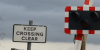
RAIB seem to have made one of their subtle points in their selection of the cover page photograph, with a message to Network Rail ... by Network Rail.

upload_2018-7-21_21-2-52.png
 

Attachments

  • upload_2018-7-21_21-2-37.png
    upload_2018-7-21_21-2-37.png
    88.8 KB · Views: 16
Status
Not open for further replies.

Top