• Our new ticketing site is now live! Using either this or the original site (both powered by TrainSplit) helps support the running of the forum with every ticket purchase! Find out more and ask any questions/give us feedback in this thread!

Potential electrification in National Parks

Status
Not open for further replies.

northwichcat

Veteran Member
Joined
23 Jan 2009
Messages
32,692
Location
Northwich
With today's announcement that electricity pylons will be removed from 4 areas of outstanding national beauty in the Peak District, Snowdonia, Dorset AONB and the New Forest where does that leave rail electrification with regards to National Parks? Will discontinuous electrification or 3rd rail be considered as an alternative to continuous overhead masts?
 
Sponsor Post - registered members do not see these adverts; click here to register, or click here to log in
R

RailUK Forums

crehld

Established Member
Joined
1 Nov 2014
Messages
1,994
Location
Norfolk
OHLE seems to have no adverse visual impact in, say, the Swiss alps. Besides the fact the railway exists means the landscape is no longer natural. Indeed all UK national parks are category V meaning there is plenty of scope for development, inlcuding the installation of OHLE which maybe favoured by national park authorities who want to reduce air pollution.
--- old post above --- --- new post below ---
Also third rail really wouldn't work round my way... too much snow.
 
Last edited:

northwichcat

Veteran Member
Joined
23 Jan 2009
Messages
32,692
Location
Northwich
OHLE seems to have no adverse visual impact in, say, the Swiss alps. Besides the fact the railway exists means the landscape is no longer natural. Indeed all UK national parks are category V meaning there is plenty of scope for development, inlcuding the installation of OHLE which maybe favoured by national park authorities who want to reduce air pollution.

Well Switzerland's gone for 100% electrification, which isn't likely to happen in Britain during our lifetimes.

There's also noise pollution. Currently in Marsden you've got 10tph which are 185s passing through and another 2tph which are Pacers and Sprinters. However, noise and air pollution benefits can be achieved using other forms of electrification or IPEMUs.
 

Philip Phlopp

Established Member
Joined
31 May 2015
Messages
3,003
Well Switzerland's gone for 100% electrification, which isn't likely to happen in Britain during our lifetimes.

There's also noise pollution. Currently in Marsden you've got 10tph which are 185s passing through and another 2tph which are Pacers and Sprinters. However, noise and air pollution benefits can be achieved using other forms of electrification or IPEMUs.

The visual impact of 25kV AC overhead electrification is considerably less than that of the 400kV National Grid network.

The team that worked on the Forth Bridge World Heritage Site listing have already planned and secured outline agreement with UNESCO for electrification over the Forth Bridge, for example, and we don't anticipate any significant issues with electrification through national parks or areas of outstanding natural beauty.

As I've said previously (and many others before me) what we will look at is mitigation for masts and catenary, such as COR-TEN weathering steel instead of bright galvanised masts, where appropriate, and on relevant routes, the provision of twin track cantilevers where appropriate and suitable to hide the bulk of the electrification system behind trees or outcrops of rock.

We've also looked at the pre-cast concrete cladding systems, to produce natural looking structures to place round feeder and autotransformer stations, so you could have something which looks like a derelict cottage from a distance, but up close, it's actually an electrical equipment compound.
 

alex17595

Member
Joined
15 Mar 2013
Messages
1,160
Location
Burton on Trent
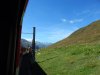
We could always go with wooden Stanchions. There is some on the Matterhorn Gotthard Bahn in Switzerland.
 

Attachments

  • DSCN3762.jpg
    DSCN3762.jpg
    137.8 KB · Views: 90

Blamethrower

Member
Joined
13 Oct 2014
Messages
384
Location
Bedfordshire
The visual impact of 25kV AC overhead electrification is considerably less than that of the 400kV National Grid network.

The team that worked on the Forth Bridge World Heritage Site listing have already planned and secured outline agreement with UNESCO for electrification over the Forth Bridge, for example, and we don't anticipate any significant issues with electrification through national parks or areas of outstanding natural beauty.

As I've said previously (and many others before me) what we will look at is mitigation for masts and catenary, such as COR-TEN weathering steel instead of bright galvanised masts, where appropriate, and on relevant routes, the provision of twin track cantilevers where appropriate and suitable to hide the bulk of the electrification system behind trees or outcrops of rock.

We've also looked at the pre-cast concrete cladding systems, to produce natural looking structures to place round feeder and autotransformer stations, so you could have something which looks like a derelict cottage from a distance, but up close, it's actually an electrical equipment compound.

As someone who appears in the know in this area, are different stanchion designs ever considered?

Standard is bright galvanised steel, seemingly straight off the factory production line.

Could different colours be used like say green? brown? so that they blend in with the landscape. Or is there a specific directive to make them as ugly and visible as possible?
 

Bletchleyite

Veteran Member
Joined
20 Oct 2014
Messages
113,580
Location
"Marston Vale mafia"
With today's announcement that electricity pylons will be removed from 4 areas of outstanding national beauty in the Peak District, Snowdonia, Dorset AONB and the New Forest where does that leave rail electrification with regards to National Parks? Will discontinuous electrification or 3rd rail be considered as an alternative to continuous overhead masts?

I saw that and thought what a waste of money. Unless, as is more likely, it's because these are relatively inhospitable places, and so burying the cables will save money.
 

Philip Phlopp

Established Member
Joined
31 May 2015
Messages
3,003
As someone who appears in the know in this area, are different stanchion designs ever considered?

Standard is bright galvanised steel, seemingly straight off the factory production line.

Could different colours be used like say green? brown? so that they blend in with the landscape. Or is there a specific directive to make them as ugly and visible as possible?

Different mast designs have been considered several times, and there have been competitions run in the past to come up with new designs, but nothing works more effectively than the current designs.

Colour also comes up repeatedly, especially during consultations, but painting galvanised steel masts is an expensive business and the ongoing maintenance would be a significant headache, as you encounter access issues and need to add more possessions to the route. You would need to close the entire railway and switch off the overhead wires before you could safely paint the top parts of the mast, and you would need to be very careful masking off insulators, bolts, tensioners and so on.

There's a more prosaic issue with painting masts - in many areas, one colour will only blend in for a few weeks or months, the rest of the time, a painted mast could be more obvious than a normal galvanised mast. Do remember than a new galvanised mast will take a few months to weather and stop having that mirror finish.

And no, of course we don't make masts as conspicuous as possible, a lot of work has gone in to making the current electrification systems as unobtrusive as possible, and this is certainly true when the WCML south of Crewe is considered alongside the new GWML sections.
 

jopsuk

Veteran Member
Joined
13 May 2008
Messages
12,774
there's rather a difference between 40m of 400kV tower and the rather lower pylons (7m?) for OHLE.
 

northwichcat

Veteran Member
Joined
23 Jan 2009
Messages
32,692
Location
Northwich
there's rather a difference between 40m of 400kV tower and the rather lower pylons (7m?) for OHLE.

But sometimes the track is higher up than the electricity pylons, so masts for OHLE would be visible from further away despite being shorter.
 

RichardN

Member
Joined
29 Nov 2013
Messages
430
Do the national parks have any sort of veto on railway OHLE? Unless the National Parks Act contained something that limits the railways powers under the act of parliament that authorised the building, then it wouldn't, at least as far as the masts are concerned.
 

Philip Phlopp

Established Member
Joined
31 May 2015
Messages
3,003
Do the national parks have any sort of veto on railway OHLE? Unless the National Parks Act contained something that limits the railways powers under the act of parliament that authorised the building, then it wouldn't, at least as far as the masts are concerned.

It's complicated, and would need considered legal advice.

Masts and other conventional structures connected to the day to day operation of the railway don't generally need planning permission and the national park authority would be unable to prevent the catenary elements from being installed, however feeders and other electrical elements generally do require planning permission and that would need to be granted by the national park authority (assuming the feeder is within the national park boundary, of course).

None of that would stop Network Rail being responsible and working with the national park authority to deal with concerns and work with them as far as is possible to come up with an installation which keeps them as happy as is possible in the circumstances.

We've got wiring going in through Sydney Gardens in Bath, we will be wiring across the Forth Bridge, we've wired through many historically significant railway stations in the world, discreetly electrifying a railway through a national park will be relatively straightforward.
 

Philip Phlopp

Established Member
Joined
31 May 2015
Messages
3,003
But sometimes the track is higher up than the electricity pylons, so masts for OHLE would be visible from further away despite being shorter.

What height or type of electricity pylon are you thinking about ?

275kV or 400kV pylons for the National Grid average 50 metres in height and will have a minimum of 7 metres clearance under the lowest cables at their lowest point, 7 metres is about the same height as a standard single track single cantilever mast.

Are you thinking more about lower voltage 33kV wooden 'telegraph' poles ?
 

RichardN

Member
Joined
29 Nov 2013
Messages
430
It's complicated, and would need considered legal advice.

Masts and other conventional structures connected to the day to day operation of the railway don't generally need planning permission and the national park authority would be unable to prevent the catenary elements from being installed, however feeders and other electrical elements generally do require planning permission and that would need to be granted by the national park authority (assuming the feeder is within the national park boundary, of course).

None of that would stop Network Rail being responsible and working with the national park authority to deal with concerns and work with them as far as is possible to come up with an installation which keeps them as happy as is possible in the circumstances.

We've got wiring going in through Sydney Gardens in Bath, we will be wiring across the Forth Bridge, we've wired through many historically significant railway stations in the world, discreetly electrifying a railway through a national park will be relatively straightforward.

Do you find that you get objections to things that are within the planners remit, which are actually to do with things that the council etc. has no remit over?

e.g. objecting over masts on a listed bridge, but the problem is really Johnny councillor getting his ears bent over OHLE masts going up at the bottom on a tin foil hat wearing nutter's garden..
 

northwichcat

Veteran Member
Joined
23 Jan 2009
Messages
32,692
Location
Northwich
What height or type of electricity pylon are you thinking about ?

275kV or 400kV pylons for the National Grid average 50 metres in height and will have a minimum of 7 metres clearance under the lowest cables at their lowest point, 7 metres is about the same height as a standard single track single cantilever mast.

Are you thinking more about lower voltage 33kV wooden 'telegraph' poles ?

I'm not thinking of the height of the tower but the height of the ground where the tower is built.

If you look at TV transmitters (because figures are available) Emley Moor is 330m, which is 20m taller than Winter Hill, yet the top of Emley Moor is 594m above sea level and the top of Winter Hill is 778m above sea level meaning Winter Hill can be seen from further away despite being smaller.
 
Last edited by a moderator:

Philip Phlopp

Established Member
Joined
31 May 2015
Messages
3,003
Do you find that you get objections to things that are within the planners remit, which are actually to do with things that the council etc. has no remit over?

e.g. objecting over masts on a listed bridge, but the problem is really Johnny councillor getting his ears bent over OHLE masts going up at the bottom on a tin foil hat wearing nutter's garden..

Planning officers generally know their remit - there's a bit of uncertainty around the edges, where NR's permitted developments rights don't necessarily meet precisely with the planning permission system, but it doesn't cause too much trouble. That's not to say planners won't provide suggestions or ask for changes, and they tend to know the area best, so it often makes sense to incorporate their suggestions.

Councillors objecting is an issue, but they're generally kept well informed of the process and they tend to be used as the first line of the complaints process - they're told all about things like the permitted developments process and the typical scenarios where complaining is a waste of their constituent's time.
 

snowball

Established Member
Joined
4 Mar 2013
Messages
8,144
Location
Leeds
I saw that and thought what a waste of money. Unless, as is more likely, it's because these are relatively inhospitable places, and so burying the cables will save money.

On the contrary, burying high voltage cables is much more expensive than using pylons, even in remote areas, and in the cases announced today it has been stated that it's for aesthetic reasons.
 

LNW-GW Joint

Veteran Member
Joined
22 Feb 2011
Messages
21,924
Location
Mold, Clwyd
As I've said previously (and many others before me) what we will look at is mitigation for masts and catenary, such as COR-TEN weathering steel instead of bright galvanised masts, where appropriate, and on relevant routes, the provision of twin track cantilevers where appropriate and suitable to hide the bulk of the electrification system behind trees or outcrops of rock.

Standard is bright galvanised steel, seemingly straight off the factory production line.
Could different colours be used like say green? brown? so that they blend in with the landscape. Or is there a specific directive to make them as ugly and visible as possible?

I got to see plenty of Spanish OHLE last week on a tour round.
Here's a picture of an installation on a new (not yet operational) section of high-speed line near Zamora.
The masts (everywhere) are a dark green and are of a lattice structure, and blend in to the background quite well (though the colour of the Spanish meseta is mainly parched brown rather than our fresh green).
The registration gear is unpainted aluminium, and reflects a lot of light (and there's a lot of light!).
They also go in for pulley tensioning, the pulleys being large bicycle size wheels!
Edit: Oh, and all the bases are concrete (no metal piles). Seemingly a totally different design philosophy to the GW project, but good for 320kph.

In looking up some construction history I came across this ADIF (= Spanish Network Rail) video of new lines in Galicia (Vigo-Santiago-Ferrol).
It has some more pictures of their new OHLE. https://vimeo.com/49824845
At about 20 seconds in there is an aerial shot of the new line and its OHLE, plus more snippets later as they tour the line.
It shows some very impressive engineering on what is just a modest regional line (in the process of being connected to the Madrid high-speed line).

 

Attachments

  • IMG_1429-adif high speed ohle.jpg
    IMG_1429-adif high speed ohle.jpg
    142.7 KB · Views: 50
Last edited:

route:oxford

Established Member
Joined
1 Nov 2008
Messages
4,949
On the contrary, burying high voltage cables is much more expensive than using pylons, even in remote areas, and in the cases announced today it has been stated that it's for aesthetic reasons.

Indeed.

Won't this mean having to carve out a long and deep trench right through an AONB?

I can't imagine how many newts and sloths will be upset.
 

SeanG

Established Member
Joined
4 May 2013
Messages
1,377
remember that it wasn't too long ago since lines had telegraph poles and wires along them
 

ironstone11

Member
Joined
3 Jan 2013
Messages
217
Indeed.

Won't this mean having to carve out a long and deep trench right through an AONB?

Yes it will and depending on the ground conditions it could partly be in tunnels. Don't forget that the most recently constructed Woodhead rail tunnel is now used for just this purpose, having recently vacated one of the older rail tunnels.
 

HowardGWR

Established Member
Joined
30 Jan 2013
Messages
4,981
Yes it will and depending on the ground conditions it could partly be in tunnels. Don't forget that the most recently constructed Woodhead rail tunnel is now used for just this purpose, having recently vacated one of the older rail tunnels.

It has already been done in the Thames Valley in the AONB area recently discussed under the GWML electrification thread (goes through from Didcot to somewhere near Bramley IIRC). There is a difference between the ones that crawl over the tops of hills and the ones that hug the valleys, although they are all ugly, wherever they are. So were factory chimneys, and the worst one, if you know it, is the hospital chimney that sits on top of the highest hill in Bristol and disfigures just about every view in this fine city. We should remember, as others have pointed out, that NR is not subject to these scenic planning policies, for lineside equipment, as others are.
 

AM9

Veteran Member
Joined
13 May 2014
Messages
16,046
Location
St Albans
I'm not thinking of the height of the tower but the height of the ground where the tower is built.

If you look at TV transmitters (because figures are available) Emley Moor is 330m, which is 20m taller than Winter Hill, yet the top of Emley Moor is 594m above sea level and the top of Winter Hill is 778m above sea level meaning Winter Hill can be seen from further away despite being smaller.

Radio transmitters aren't just built as high as as can be afforded to get the signal as far as possible. All UHF channel allocations in Western Europe were agreed in the late '50s and early '60s. This was an EBU/ITU plan that not only defined the channel frequencies, but also where transmitters were to be located, what their antenna elevations were, the antenna gains and the transmitters' effective radiated powers (ERP). This was necessary to prevent interference between adjacent transmitters and in certain known abnormal radio signal propagation conditions, more distant sites.
The 386m high Emley moor mast blew down in a storm in 1969 and was replaced with the current one, some 53 metres shorter.The antennas were probably slightly higher gain if the reduced tower height couldn't provide the same antenna location height.
 

HSTEd

Veteran Member
Joined
14 Jul 2011
Messages
20,344
And no doubt this project will be used to justify another hike in electricity bills
 

edwin_m

Veteran Member
Joined
21 Apr 2013
Messages
28,692
Location
Nottingham
Removing the pylons at Dunford Bridge... does that mean they'll be burying the power lines under the trackbed? Another thing for reopening campaigners to worry about.
 

Trog

Established Member
Joined
30 Oct 2009
Messages
1,546
Location
In Retirement.
And no, of course we don't make masts as conspicuous as possible, a lot of work has gone in to making the current electrification systems as unobtrusive as possible, and this is certainly true when the WCML south of Crewe is considered alongside the new GWML sections.

Is it just me that thinks the lattice work masts of the WCML blend in to the background better than the heavy columns and beams used on the GWML?
 
Status
Not open for further replies.

Top