U-Bahnfreund
Member
Melbourne had an event like this. But considering the other elements of the story and logged phone calls, it doesn't seem like there's any procedure at all


The driver was focused on trying to regain control of the brakes and on contacting the signaller to ensure that his route ahead was clear of other trains. To do this, he made a GSM-R call to the signaller on the approach to Princes Street Gardens to alert him that the train’s brakes were not working and to request a clear route through Edinburgh Waverley station. The driver did not press the emergency button on his GSM-R unit, as he was aware that this would stop all trains in the station and possibly prevent the signallers from being able to set a clear route.

on LU this would be regarded as an emergency hand stop signal.I believe a green flag or lamp waved from side to side used to indicate that a train should keep going because there was a runaway following it.
That applies under Absolute Block for the front portion of a divided train where there is a risk of the rear portion colliding (i.e it's on a downward gradient), and said rear portion cannot be diverted to another line or siding somewhere in rear. It still requires line clear to be obtained from the box in advance (otherwise there might be another train in the way!). Not really applicable for runaway trains (right direction), or trains towards which they are running away.I believe a green flag or lamp waved from side to side used to indicate that a train should keep going because there was a runaway following it.
On Lines still retaining conventional signals, a stop signal is provided with a trainstop which will lower if acting as speed control signal, when the train speed has been reduced to the permitted limit.I'm not an expert on these things, but is there some kind of trip cock, if you go too fast through such sections, the train triggers it and comes to a halt?
A different era, but D L Smith tells numerous tales of signallers, drivers and guards on the switchback GSWR tackling breakaways (some of which chased their trains) and also escapes from banking engines which had got disorintated. IIRC on after least one occasion the signaller set the road to minimise the damage before retreating from the box to observe subsequent events from a place of safety!I believe a green flag or lamp waved from side to side used to indicate that a train should keep going because there was a runaway following it.


No procedure as such. I do remember a DC Line train seeing a derailed Freightliner coming towards it at Camden Jn and accelerating to try and miss it. @ChiefPlanner may remember more.
The driver of the freight train, Alan Bricker, observed the approaching HST and expected it to stop, but was alarmed by its speed and apparent brake application. He tried to accelerate his train out of its path of the HST, but to no avail
The train stopped just after the junction, the driver rang railtrack on the NRN. The next signal is beyond Winsford station.This reminds of the incident at Winsford some years ago. A class 142 was running empty to Newton Heath depot, and was put into Winsford loop for a down loco hauled express to pass. Unfortunately it ran out of the loop onto the Down Main, and the driver stopped at the next signal to report the matter. Not surprisingly, the 142 was promptly demolished by the express. It struck me, at the time, that the 142 driver should have gone as fast as he could to get out of the way of the express. His presence on the main should have activated the track circuit, and turned signals to red behind him.
I seem to recall with this one the loco had an ADD at a very unfortunate time.Similar to the Surbiton incident, the Caledonian sleeper had a fairly well-known incident in 2020 with the brakes not applying approaching Edinburgh where the normal procedure of pressing the Emergency button would have created potential hazards by stopping all trains immediately and instead the driver was able to make a normal call to the signaller and arrange for a safe route to be set through the station.
Report 05/2020: Loss of brake control on a sleeper train approaching Edinburgh
Loss of brake control on a sleeper train approaching Edinburgh, 1 August 2019.www.gov.uk

His most classic account is of one night in the 1890s when the wagons of a goods train that had been divided rolled away, ran down the gradient through Pinwherry station and up the bank on the other side where they came to a halt. They then rolled back again through the station at speed and up the bank on the other side. This was repeated five or six times as the train trundled backwards and forwards through the station leading a track inspector who was staying the night to exclaim it was “the busiest country station he had ever tried to sleep at – trains through the night every ten minutes!”A different era, but D L Smith tells numerous tales of signallers, drivers and guards on the switchback GSWR tackling breakaways
What overspeed brake application feature?I imagine the option of exceeding speed limits to out-run a runaway isn't available in many parts of the UK owing to the overspeed brake application feature.

What overspeed brake application feature?
TPWS overspeeds only exist on dead end lines e.g. bay platforms, at some signals (and are only active when the signal is at danger) and before some significant speed reductions. You can travel significant distances without encountering any of these.
TPWS is not used to monitor compliance with line speed.
Unless I'm missing something?
 www.railengineer.co.uk

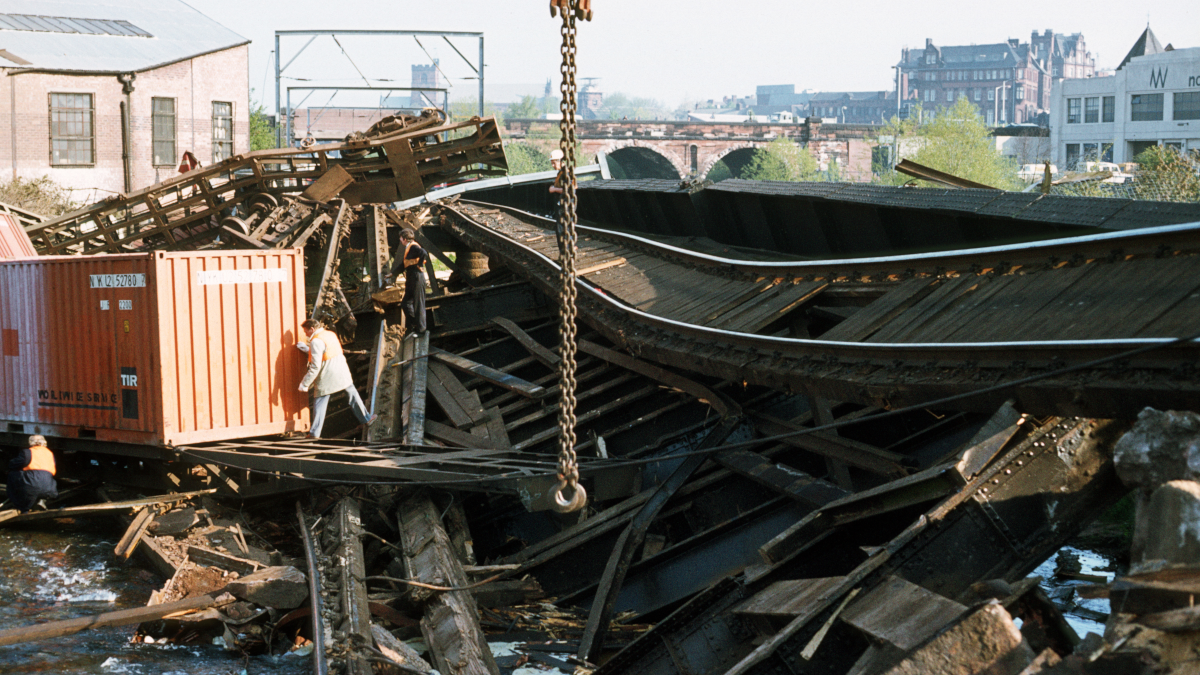
66308 "Signalman Willie Taylor"I was told about this incident last year - perfect example of the signaller taking ‘any other action’. Physical damage yes but no injuries and the main lines kept open.
Carlisle crash of 1984 - what can we learn? - Rail Engineer
Listen to this article Forty years ago, on Tuesday 1 May 1984 at 5.30 in the morning, Bill (Willie) Taylor, a signaller at Carlisle Power Signal Box (PSB) realised that 4S55, a Liverpool (Garston) to Glasgow (Gushetfaulds) freightliner train had become divided south of Carlisle and both portions...
I believe the signaller had a loco named after him last year.

What great film!! Some comedy genius in the chase scene. "Sir, the down train has now passed on the up line, Sir, the up train has now passed on the down line, Sir, I quit"All this reminds me of the St. Trinian's train robbery sequence (filmed at the Longmoor Military Railway).


On Lines still retaining conventional signals, a stop signal is provided with a trainstop which will lower if acting as speed control signal, when the train speed has been reduced to the permitted limit.
Most platforms do not have a speed control device, so the starting signal would be green if the line ahead is clear but the requirement is still to reduce speed.