I`ve just been looking at a website about the NYC subway system. One thing that seems to be unclear is this. Are all the cars on there driving/motor cars? They all seem to have a cab at each end and run in trains of around 8 - 10 cars. (so not really much longer than a London Underground train). Do they have any intermediate trailers a la Waterloo & City 1942 stock?
Just a question really. I might have to go have a holiday over there and investigate.
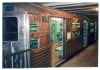
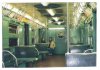
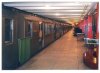
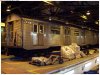
The New York Transit museum looks quite interesting too, just a load of restored cars just shunted into an old station and notice boards put by the doors.
I live in New York City, and used to work for NYCTA, so can answer your questions.
Yes, there are cab (driving) cars and trailers and these are most obvious on the latest model railcars, such as the R142, R143 and R160s. With these models, the cabs are full width across the front of the trains.
Because NYCTA persists in the archaic tradition (strong unions) of staffing with a conductor (guard) to open and close the doors on all main line services, the trainsets using the above model cars are arranged so that there are two cab cars located mid train for the conductor to operate from. Thus, an A Division (ex IRT) R142 trainset would be composed of an ABBBA + ABBBA configuration (where A = Cab Car, B = trailer). Generally speaking, current practice is to try and run each trainset as an intact unit to save wear and tear on the electric portion of the couplers and to save on staff time cutting and combining trains.
Trains are assigned to a specific barn (depot), and do not wander from one line to another on a daily basis as a prior poster suggested. From time to time, due to equipment retirements or the whims of management, cars may be reassigned from one depot to another.
Prior to the newer cars, the TA used to order cars configured in semi permanent married pair configurations, each with a cab at the out ends. Thus an A division train would consist of 5 x 2 married pairs. Most ex-IRT lines operate with 10 cars, but the Flushing Line (7 train) operates with 11 cars and the 3 Train with 9 cars.
Some cars such as the R62/62A were actually built as double ended units with a cab on both ends. This provided maximum flexibility in terms of train lengths, but each car also had that many more bits to maintain. During the late 1980's/early 90's, these cars were ganged up and linked permanently into predominantly 5 cars fixed consists, and the redundant equipment removed from the cabs no longer needed, thus creating an ABBBA configuration.
Alas, they did not remove the walls that surround the now empty cabs (corner cabs), and the A cars were converted from corner cabs to become full width cabs, so there has been a loss of customer standing space, and trainsets now haul empty telephone booth sized cabs (corner cabs) that could have been productively used for seats or standees. Boo!
The Transit Museum is worth a visit, but is not the same quality as the LT Museum. The upper level (mezzanine level) hosts various exhibits on rotation.