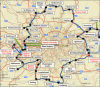
To take the OP's suggestion about new lines and not reworking the same old story about re-opening rural lines in the middle of nowhere I suggest the following:
1 Outer London orbital - roughly following the M25 with interchanges with all lines entering London to reduce the need for cross London journeys and open up new travel opportunities
1) Rail has a very high share of the travel into central London market... The London overground inner orbital service shows there is huge unmet demand for journeys that dont go into central London. The M25 supposedly carries more people a day than the whole national rail network - making journeys that are presently difficult to make by rail. A new outer orbital railway even if took only about 5% of journeys presently on the M25 would be one of the busiest in the country. It would also free up capacity on rail services into central London as those who presently travel into and out of London again would be diverted to it, reducing or delaying the need for very expensive capacity upgrades on these lines.
I thought Id look at some of the implications of an orbital railway round London, roughly following the route of the M25. Ill consider the north side because I know that area better.
There are 13 north side radial rail routes that the orbital route would cross:
1. GW Main Line
2. Chiltern via High Wycombe
3 Chiltern + LUL via Amersham
4. West Coast Main Line
5. Midland + Thameslink
6. East Coast Main Line
7. East Coast Hertford Loop
8. West Anglia to Cambridge via Southbury Loop
9. West Anglia to Cambridge via Waltham Cross
10. LUL Central Line to Epping
11. Great Eastern Main Line
12. LT&S direct line
13. LT&S via Tilbury
The only ones with which it would clearly be unnecessary to have interchange with the orbital line are one or other of the West Anglia routes, and the Central Line. You could perhaps do without the Tilbury route as well. That leaves 10 interchanges.
Where would you build the interchanges? From one point of view, you dont want an additional stop on the radial lines, so youd build the interchange at an existing station. But some of those existing stations are in built-up areas, where finding a route for the new orbital line would be difficult.
Should the interchange stations provide easy access for passengers coming by car? I think the answer is Yes, so as to encourage people to make use of the new orbital line. So the interchanges need substantial car parks. This makes it very likely that they will have to be built on new sites away from existing built-up areas.
That will have a big impact on the Green Belt. This orbital railway is supposed to be green, so we have an interesting conflict. The Green Belt will lose. Once we have an interchange at Denham, a new interchange somewhere north of Rickmansworth, another one just south of Potters Bar, another one near Broxbourne, there will be huge pressure for other residential and industrial developments around these stations, which will have superb public transport links. This will add to the economic pull of London and the South East.
So perhaps our first orbital line should be round a different city, like Leeds. That could be very helpful in developing the Northern Powerhouse and trying to change the balance between North and South.
But staying with the suggested London orbital railway, thered also be the expense of the links from the M25 and other main roads to each of the new interchange stations to take into account.
How many passengers might the London orbital railway get? A section of the M25 gets up to 150,000 vehicle movements a day. About 30% of them are goods vehicles, which leaves 105,000. Some of those are coaches, so lets say they amount to 5,000, which leaves me with a convenient 100,000 cars. The cars have an occupancy of 1.6 people, which amounts to 160,000. Ill come back to the coaches later.
That 160,000 is the number of people in cars passing a busy point on the western side of the M25 on a typical day. Many of them dont travel a great distance, and by the time you get to the Dartford Crossing the people there are almost entirely a different set from those who crossed the Thames near Staines. Deltic suggested that 5% of M25 users switching to orbital rail would amount to a useful change. So at any one point there might be 8,000 rail passengers a day. If trains ran for sixteen hours a day that would be 500 passengers an hour on average. With a train every 20 minutes and I think it should not be less frequent than that there will be 170 passengers per train.
I doubt if thats enough to justify the cost of an orbital railway. But it will probably attract some new passengers who can leave their cars at the interchange stations. Also, as
Deltic said, some passengers on the radial routes may switch to the orbital line and travel round London rather than go through it, which in turn will save money on capacity improvements into London on the radial lines. Im not sure how many, though, because the orbital route will have ten stops in about 60 miles on the north side, and probably a similar number on the south. It wont be fast. When Anglia Railways ran their service from Colchester and Chelmsford via the North London Line and eventually got to the SW Main Line their patronage was not great because the trip round London was slow and took a long time.
Will coach passengers switch to the orbital rail route? On the whole I think thats unlikely. Some people are going by coach because its cheaper than rail. Theyd have no reason to switch. Some are travelling on a hired coach from A to B which gives them convenience and avoids the changes that a public transport journey would require. They wont switch either. I suspect that the proportion of existing coach passengers who would switch to the orbital rail line is quite small.
Finally, lets think about the rolling stock. No, not Class 442s
.but how about the D Train? Rapid acceleration. No need for a high top speed with a station every six miles or so. Plenty of doors, plenty of space inside its the right train for the right line. David Cameron has announced that 2016 will be a game-changer, so I confidently look forward to seeing these trains on the new orbital route by 20XX.