• Our new ticketing site is now live! Using either this or the original site (both powered by TrainSplit) helps support the running of the forum with every ticket purchase! Find out more and ask any questions/give us feedback in this thread!

Multiple working shenanigans

Status
Not open for further replies.

zwk500

Veteran Member
Joined
20 Jan 2020
Messages
18,402
Location
Northampton
Not good news for ETCS, then?
ETCS uses wired connections through the train, it's only the connection between the train and the control centre that's radio.
What it's not good for is various suggestions of 'virtual coupling', as that would prevent physical connections between the vehicles themselves.
 
Sponsor Post - registered members do not see these adverts; click here to register, or click here to log in
R

RailUK Forums

Rob F

Member
Joined
17 Dec 2015
Messages
453
Location
Notts
I know how ETCS works (vaguely!), I was just pointing out that if we can so easily dismiss wireless technology for inter unit comms it seems strange that we are happy to accept it for the most safety critical application, signalling.
 
Last edited:

tfw756rider

On Moderation
Joined
30 Nov 2024
Messages
1,935
Location
Wales (sometimes in England), thanks for replying!
ETCS uses wired connections through the train, it's only the connection between the train and the control centre that's radio.
I now how ETCS works (vaguely!), I was just pointing out that if we can so easily dismiss wireless technology for inter unit comms it seems strange that we are happy to accept it for the most safety critical application, signalling.
I believe that for the ETCS signalling, connections between the signalling centre and the track are wired; and then wireless connections are made between the track and the underside of the train, and even then, the [radio signals] are very strong (in the National Railway Museum's video of a 700 at its depot, the presenter pointed out that he could only go under the unit because the ETCS [radio signals] were not in use, so it was safe to do so.)

To my knowledge, it's the GSM-R (communication radio) that uses "over-the-air" [radio signals].
 
Joined
20 Dec 2024
Messages
17
Location
Torquay
At a slight, but hopefully allowable, tangent, what is the problem that prevents classes 800 & 802 operating together in multiple?
 

Taunton

Veteran Member
Joined
1 Aug 2013
Messages
12,220
More modern units do this via a computer interface, and for obvious reasons there will be issues when, for instance, Siemens software tries to talk to CAF software.
I'll just point out that in the USA the AAR multiple unit interface is quite capable of connecting a brand new all-computerised loco to a 1950s all old relays one from a different manufacturer long out of business, and they will all work together from either cab. AAR is American Association of Railroads, a trade association of operators and builders, and they just determine each generation of control compatibility, something one wishes bodies like the RSSB would have done (otherwise why have 'Standards' in their name?). Not only USA manufacturers, but those from Asia (where nowadays much USA equipment seems to come from), and from Europe, the likes of Siemens etc, have to comply with AAR standards, otherwise nobody in the USA will buy them, and it extends to Australia etc. They can put their own software internally, but for MU connections it's all AAR. It's all completely up to date for modern stock. I understand it's a considerable task for AAR's own engineers, but they manage it. I believe Class 66 were certainly originally delivered with AAR MU, but some operators have modified it, for whatever reason.

 

zwk500

Veteran Member
Joined
20 Jan 2020
Messages
18,402
Location
Northampton
I'll just point out that in the USA the AAR multiple unit interface is quite capable of connecting a brand new all-computerised loco to a 1950s all old relays one from a different manufacturer long out of business, and they will all work together from either cab. AAR is American Association of Railroads, a trade association of operators and builders, and they just determine each generation of control compatibility, something one wishes bodies like the RSSB would have done (otherwise why have 'Standards' in their name?). Not only USA manufacturers, but those from Asia (where nowadays much USA equipment seems to come from), and from Europe, the likes of Siemens etc, have to comply with AAR standards, otherwise nobody in the USA will buy them, and it extends to Australia etc. They can put their own software internally, but for MU connections it's all AAR. It's all completely up to date for modern stock. I understand it's a considerable task for AAR's own engineers, but they manage it. I believe Class 66 were certainly originally delivered with AAR MU, but some operators have modified it, for whatever reason.
Don't 68s and 88s use AAR MU standards?
 
Joined
22 Jan 2024
Messages
588
Location
Yorkshire
I believe Class 66 were certainly originally delivered with AAR MU, but some operators have modified it, for whatever reason.

In what way? I've not seen mention of this, and 66s do sometimes work in multi with other AAR classes.

== Doublepost prevention - post automatically merged: ==

Don't 68s and 88s use AAR MU standards?

No - they use the train wire bus system common in Europe, as do 93s, Mk5a driving trailers and 99s (the latter have AAR as well).
 

ac6000cw

Established Member
Joined
10 May 2014
Messages
3,889
Location
Cambridge, UK
Yes and the control signal is not infrequently lost due to terrain and other issues, in which case depending on the set-up it will either attempt to reconnect itself or the crew can manually attempt a reconnect. The system is designed to do into a default mode if signal is lost, these days typically half (Notch 4) power, but a brake application would automatically cut traction power.

Not sure it's suitable for high density operations here, certainly not passenger trains.
Realistically, I doubt it is.

The North American de-facto standard Locotrol is more about supporting multiple sets of locos within one train - IIRC the current digital version of it supports up to eight individually controllable 'slave' sets, and the control links can be via various forms of radio or over train wires e.g. ECP (Electronically Controlled Pneumatic) brake connections.

Happened to see this article today: https://www.theregister.com/2025/07/14/train_brakes_flaw/

Describes how flaws in the protocol potentially allow miscreants to interfere with the communications.
That article is talking about radio-linked 'End-of-train' devices (EOT/EOTD, also known as FREDs), which replaced cabooses decades ago, and are completely separate from the remote control system for 'distributed power' locomotives.
 
Joined
22 Jan 2024
Messages
588
Location
Yorkshire
That article is talking about radio-linked 'End-of-train' devices (EOT/EOTD, also known as FREDs), which replaced cabooses decades ago, and are completely separate from the remote control system for 'distributed power' locomotives.

Yes, but it's an actual example of a vulnerability in a wireless system currently in use. There is no guarantee that other wireless systems don't also have vulnerabilities.
 

edwin_m

Veteran Member
Joined
21 Apr 2013
Messages
28,597
Location
Nottingham
I believe that for the ETCS signalling, connections between the signalling centre and the track are wired; and then wireless connections are made between the track and the underside of the train, and even then, the [radio signals] are very strong (in the National Railway Museum's video of a 700 at its depot, the presenter pointed out that he could only go under the unit because the ETCS [radio signals] were not in use, so it was safe to do so.)

To my knowledge, it's the GSM-R (communication radio) that uses "over-the-air" [radio signals].
ETCS level 2 (as fitted on the Cambrian and Thameslink and being fitted on the southern ECML) uses vital radio links to convey movement authorities to replace trackside signals. These go over GSM-R currently and will transition to whatever replaces it.

It also uses short-range radio communication to interrogate balises on the track as the train passes. These establish train position and clearly you would not want to be picking up spurious messages from one on an adjacent track, so it must be proveable that these are truly short range. A wireless coupling connection would have a similar range requirement and similar or lower integrity requirement (depending what was being communicated over it), so this example demonstrates that it is feasible in principle.
I'll just point out that in the USA the AAR multiple unit interface is quite capable of connecting a brand new all-computerised loco to a 1950s all old relays one from a different manufacturer long out of business, and they will all work together from either cab. AAR is American Association of Railroads, a trade association of operators and builders, and they just determine each generation of control compatibility, something one wishes bodies like the RSSB would have done (otherwise why have 'Standards' in their name?). Not only USA manufacturers, but those from Asia (where nowadays much USA equipment seems to come from), and from Europe, the likes of Siemens etc, have to comply with AAR standards, otherwise nobody in the USA will buy them, and it extends to Australia etc. They can put their own software internally, but for MU connections it's all AAR. It's all completely up to date for modern stock. I understand it's a considerable task for AAR's own engineers, but they manage it. I believe Class 66 were certainly originally delivered with AAR MU, but some operators have modified it, for whatever reason.
But does AAR cover passenger functions like information displays and alarms, or train management systems monitoring and controlling all sorts of equipment along a passenger train? These are much more complex than the functions needed for controlling locomotives in multiple.
 

800301

Member
Joined
29 Dec 2022
Messages
522
Location
Essex
At a slight, but hopefully allowable, tangent, what is the problem that prevents classes 800 & 802 operating together in multiple?

CCTV, but they are working on it apparently, everything else works fine and we can drive them ECS coupled
 

Taunton

Veteran Member
Joined
1 Aug 2013
Messages
12,220
The North American de-facto standard Locotrol is more about supporting multiple sets of locos within one train - IIRC the current digital version of it supports up to eight individually controllable 'slave' sets, and the control links can be via various forms of radio or over train wires e.g. ECP (Electronically Controlled Pneumatic) brake connections.


That article is talking about radio-linked 'End-of-train' devices (EOT/EOTD, also known as FREDs), which replaced cabooses decades ago, and are completely separate from the remote control system for 'distributed power' locomotives.
Just for clarity, Locotrol is not for multiple working, which remains AAR standard, but for linking sets of locomotive spread up and down a train, at intervals among the wagons. It does transmit the AAR MU signals, in its own format. North American trains have become of such a size that, over undulating gradients and curves, pulled couplings and mid-train derailments occurred with 'pusher' locomotives, which started being placed inside the formation rather than at the rear end, whilst still being conventionally driven, with crew commands over the radio, and have advanced from there to now often having single locos spread at intervals. The pioneer Locotrol setups used a separate unit placed in a redundant classic 1950s passenger streamliner 'B unit', one of the ones without a cab, but they did of course have their AAR multiple connections to transmit commands to the set of locos they were controlling. Later the necessary equipment was placed inside the locos. As well as radio control from the front they integrate this with strain gauges in the couplers.

ECP is about having actual wires through the freight wagons, which thus necessarily all have to be fitted with it, to give a far more managed control of wagon brakes than a conventional air brake pipe allows in such long trains. I used to call them EPB brakes, which US railroaders thought was me making a mistake but was of course acknowledgement of just what the Southern Region did in 1951 with their first EPB multiple units, which advanced from their previous SUB air brake units in a notably similar manner. Locotrol incidentally allows the 'mid-train pushers' to use their dynamic brakes, which often in the US are very substantial, as well as propulsion.

== Doublepost prevention - post automatically merged: ==

But does AAR cover passenger functions like information displays and alarms, or train management systems monitoring and controlling all sorts of equipment along a passenger train? These are much more complex than the functions needed for controlling locomotives in multiple.
It uses a multiplex transmission for these over a couple of the otherwise spare wires in the standard system
 

edwin_m

Veteran Member
Joined
21 Apr 2013
Messages
28,597
Location
Nottingham
It uses a multiplex transmission for these over a couple of the otherwise spare wires in the standard system
Does AAR define the comms protocol for these cables, to the extent that passenger multiple units so fitted can interwork without restriction?
 

tfw756rider

On Moderation
Joined
30 Nov 2024
Messages
1,935
Location
Wales (sometimes in England), thanks for replying!
ETCS level 2 (as fitted on the Cambrian and Thameslink and being fitted on the southern ECML) uses vital radio links to convey movement authorities to replace trackside signals. These go over GSM-R currently and will transition to whatever replaces it.

It also uses short-range radio communication to interrogate balises on the track as the train passes. These establish train position and clearly you would not want to be picking up spurious messages from one on an adjacent track, so it must be proveable that these are truly short range. A wireless coupling connection would have a similar range requirement and similar or lower integrity requirement (depending what was being communicated over it), so this example demonstrates that it is feasible in principle.
Thanks for the correction and information :)
 

Bikeman78

Established Member
Joined
26 Apr 2018
Messages
6,170
Transport for Wales 150+170 (February 2023 video on request)
I had a feeling that 150+170 combinations ran in Wales but I couldn't remember specifically. Thanks for the confirmation. I do recall 142/143+158 pairs running to Ebbw Vale sometimes.

== Doublepost prevention - post automatically merged: ==

At a slight, but hopefully allowable, tangent, what is the problem that prevents classes 800 & 802 from operating together in multiple?
I think it's down to software. There was a brief period when they could work together. I have travelled on a mixed pair. No idea why they became non-compatible again.
 
Last edited:

tfw756rider

On Moderation
Joined
30 Nov 2024
Messages
1,935
Location
Wales (sometimes in England), thanks for replying!
I had a feeling that 150+170 combinations ran in Wales but I couldn't remember specifically. Thanks for the confirmation. I do recall 142/143+158 pairs running to Ebbw Vale sometimes.
I can't remember if 150+170 (or anything+170) ran in passenger service in Wales, but the 170s' "legacy compatibility" was commonly used in 2021-2023 around mid-afternoon, to take the trains that had terminated at Cardiff Central from Fishguard and Ebbw Vale (I think) on Empty Coaching Stock moves from Cardiff Central to Canton depot as one train (clips merely "clipped" by me with YouTube's "clip" feature; all the videos they're from are by Sion's Train Videos:

153+153+170 coupling (2021):


153+153+170 departing (2021):


153+153+153+153+170 coupling (2022):


153+153+153+153+170 departing (2022):


150+170 departing (2023):


D365

Veteran Member
Joined
29 Jun 2012
Messages
13,157
(in the National Railway Museum's video of a 700 at its depot, the presenter pointed out that he could only go under the unit because the ETCS [radio signals] were not in use, so it was safe to do so.)
To be clear - ETCS needs to be fully isolated in all driving vehicles before the underframe can be accessed.
 

Rick1984

Member
Joined
23 Aug 2012
Messages
1,145
I've seen on here that different subclasses of class 730 can't work multiple. That's taking incompatibility to a new level!
 

stadler

Established Member
Joined
5 Jun 2023
Messages
3,304
Location
Horsley
I've seen on here that different subclasses of class 730 can't work multiple. That's taking incompatibility to a new level!
That is so ridiculous especially as they are brand new trains that were built at the same time. That is utter incompetence. I always thought that the only difference between the 730/0s and 730/2s was the amount of coaches and livery and seating. I wonder what exactly it is that prevents them from working together.

I believe that the 458s are similar. I have been told that the 458/4s and 458/5s are currently unable to work together. Similarly in the past i remember hearing that the 458/0s and 458/5s are unable to work together. Again i am not sure what exactly it is that prevents them from working together.
 

43096

On Moderation
Joined
23 Nov 2015
Messages
18,733
I believe that the 458s are similar. I have been told that the 458/4s and 458/5s are currently unable to work together. Similarly in the past i remember hearing that the 458/0s and 458/5s are unable to work together. Again i am not sure what exactly it is that prevents them from working together.
Between the 458/0 and 458/5 fleets the first problem was you couldn’t physically couple them. 458/0 had Tightlock couplers, 458/5 has Dellners.
 

stadler

Established Member
Joined
5 Jun 2023
Messages
3,304
Location
Horsley
Between the 458/0 and 458/5 fleets the first problem was you couldn’t physically couple them. 458/0 had Tightlock couplers, 458/5 has Dellners.
Oh i forgot they had changed the couplers during the 458/0 to 458/5 conversion. I wonder what the point of that was when they can not couple to any other classes and work entirely with themselves.

But with the 458/4 and 458/5 it should be easier to couple them as they have the same couplings as each other. I thought the refurbishment just involved removing one carriage and changing the seating. So i would be curious what prevents them working together. It would certainly add flexibility if they could.
 

43096

On Moderation
Joined
23 Nov 2015
Messages
18,733
Oh i forgot they had changed the couplers during the 458/0 to 458/5 conversion. I wonder what the point of that was when they can not couple to any other classes and work entirely with themselves.
The Tightlocks had to go to allow the level access through the gangway. The other benefit of Dellners is for emergency coupling to a Desiro to clear the line.
 

MCR247

Established Member
Joined
7 Nov 2008
Messages
10,290
Oh i forgot they had changed the couplers during the 458/0 to 458/5 conversion. I wonder what the point of that was when they can not couple to any other classes and work entirely with themselves.
Mostly surrounded by Desiros with Dellners though. The change was to allow them to couple for rescue purposes
 

AJDesiro

Member
Joined
10 May 2019
Messages
929
Location
Rugby
I've seen on here that different subclasses of class 730 can't work multiple. That's taking incompatibility to a new level!
That is so ridiculous especially as they are brand new trains that were built at the same time. That is utter incompetence. I always thought that the only difference between the 730/0s and 730/2s was the amount of coaches and livery and seating. I wonder what exactly it is that prevents them from working together.
This has changed now with the new TCMS update: https://www.railforums.co.uk/threads/class-730-lnr-wmr-delivery-test-updates.215134/post-7328684 (quoted below)
When all the TCMS updates are done they will be able to work in multiple. Likely only required for ECS, as the way they’ll be captive on different routes means it’s unlikely it’d ever happen.

One big plus of doing it this way round is a 730 is a 730 - there is (now) a combined course that covers both variants, and once trained a Driver or Guard can pick up either variant at any time.

There's a few other differences aside from number of coaches, livery and seating, they also have space saver toilets on the /2s whilst the /0s only have an accessible toilet. The /2s are 110mph whereas the /0s are 90mph.
 

Krystal

Member
Joined
12 Aug 2025
Messages
117
Location
Suburbia London
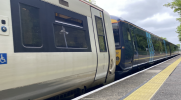
Yes indeed they can not either. However the 376 do not work on the same routes as the 375 and 377 so there is not really much need for them to be compatible. It would certainly help for flexibility but it is not really a major issue when they are used on completely different work.
About that...
 

Attachments

  • Screenshot 2025-08-18 15.01.54.png
    Screenshot 2025-08-18 15.01.54.png
    909.5 KB · Views: 115

stadler

Established Member
Joined
5 Jun 2023
Messages
3,304
Location
Horsley
About that...
Very rare spot. Not seen that happen for a long time. I know the 375s and 376s and 377s occasionally couple to each other on empty stock workings but it is certainly very rare. The last time i saw it was over five years ago.

Could you please advise what we are looking at in this photo? If nothing else, for those using screenreaders.
It is a 375 and a 376 coupled to each other on an empty stock working. Probably heading to or from one of the depots.
 
Status
Not open for further replies.

Top