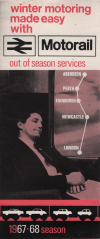
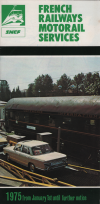
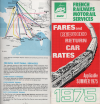
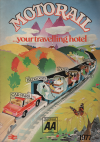
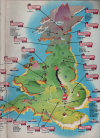
Having recently moved from Somerset to the Wirral, we (family plus car, Vauxhall Victor 101 new that year) went in 1966 in the "new" Motorail from Newton-le-Willows to Newton Abbot, for a family holiday in Cornwall. It ran via Shrewsbury and the Severn Tunnel, as indeed the principal day passenger service from Liverpool to the West Country did at the time.
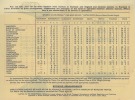
Departed around 0730, into Newton Abbot about 1330, return left 1500, into Newton-le-Willows about 2100. A Class 47 handled the train (almost) throughout there and back, presumably refuelling at Newton Abbot. I would guess the loco was a Western Region one which had run up light from Crewe, as at the time the WR, and probably the GWR long before, didn't allow locos without GWR-pattern AWS/ATC to run passenger services on its main lines [think Southall here]. The early start and late finish were a bit of a challenge, particularly for my mother for whom any train before about 11am would be described as "early" in a critical voice, but enabled those driving on to Cornwall to complete the journey reasonably.
I seem to recall it ran three days a week, on alternate days, and on the other alternate days the same rake ran from Newton-le-Willows to Stirling.
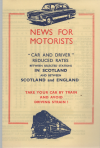
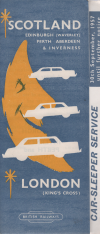
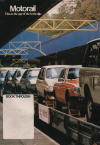
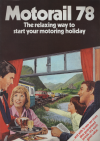
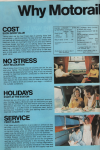
All Mk 1 FK stock, each car had a separate compartment, which much was made of (as well as being first class) in the publicity brochures. I later read that the open car carriers were onetime LMS coach frames, with the bodies stripped off and timber decking provided for the cars. There was a full restaurant car, which provided my first ever BR breakfast. Meals had to be paid for at normal BR prices. The family in the next compartment had brought along a substantial and impressive picnic in hampers instead.
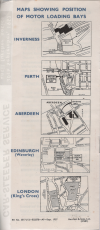
Loading/unloading of cars was done both ways by BR staff at Newton-le-Willows, while at Newton Abbot you did it yourself. I think maybe one had a platform alongside for the driver to step on and off, the other needed staff walking along the carflats.
At Newton-le-Willows the siding was on the north side, facing eastward, so cars loaded from an end ramp (seemingly the sole capital investment there for the service) facing east. Having deposited the car, we adjourned to the eastbound station platform where the Class 47 was just reversing the stock alongside, the restaurant car fully laid out and staffed forming a passing fascination. All aboard and ready to go, the coaches were drawn forward, reversed onto the carflats, and then pulled out towards Manchester. Now a Warrington Black 5 (this is 1966, remember), which had been alongside, attached to the rear, and pulled the whole formation, Class 47 and all, over the crossover and in reverse all along to Earlestown and beyond, where it was detached, and the train started forward over the sharp west curve onto the WCML. Cars had to face forwards; there had been some early journeys apparently where this was not done, and the less-stressed back windows of cars blew out at speed.
Is there anyone else on here whose family car was hauled by steam?
Passing through Taunton at speed my mother announced we should all crouch down beneath the windows to avoid being spotted by the older generation there who would want to know why we had passed through without visiting

.
At Newton Abbot, stopped and detrained onto the platform. The station pilot Class 08 then pulled the carflats back eastwards, and propelled them into the unloading siding on the north side, where we drove off.
Newton Abbot station announcer had been given a script welcoming and thanking etc the Motorail passengers, as well as telling them where to go. I'd never heard the station Tannoy be used for anything other than factual announcements before, it seemed quite strange.
When we returned, having driven onto the carflats we went to while away time at the station. At the east end of the Up platform there was a railway relics shop, like a miniature Collectors Corner. Picked up among others a couple of redundant single line tokens, doubtless provided by Exeter S&T from recent rationalisation, which I still have. There’s a nice brass Tyers tablet from the former Southern lines, which is occasionally polished up with Brasso by Mrs T – who at the time of this trip was not even born! But a disappointment was they also had, laying for much of the length of the floor, the old roofboards off the carriages of the Torbay Express. Probably about 15-20 feet long. However would anyone get them home? My suggestion that they could be laid on the carflat alongside the car and borne back to Newton-le-Willows alas fell on deaf ears.
The outward trip had run through Bristol Temple Meads station nonstop, itself a novelty, but on the return we went (for my only time) via the St Philips Marsh avoiding line, where there was a lengthy stop, probably for crew change, and then by the curves (including the Rhubarb one) onto the Stapleton Road line. Then, it was the time when there was a trial of double-headed Class 37 on selected accelerated Paddington to South Wales expresses, which I had read about in a magazine. We were stopped approaching Patchway Junction, all went quiet for several minutes, then one such express came round the curve from the Badminton line, passing grandly in front of us. A Cardiff to Bristol dmu was just restarting across the junction as well as we restarted, it was apparent who got the priority.
There must have been a meal served in the restaurant car on the return, but I don’t recall it. I think the stewards brought along coffee to the compartments, in the traditional tall silver jugs, as well.
After the trip I recall my parents having much trouble getting (presumably) thrown diesel fuel/brake dust off the car, particularly the windscreen, it lasted through several subsequent car washes. I later saw Motorails pass, including back at Taunton again, and each car was now fitted with a protective windscreen cover.