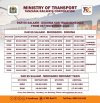
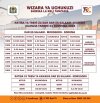
Swahili time is expressed very differently from standard time in other parts of the world. Instead of midnight and noon, Swahili time is based on sunset and sunrise. As most Swahili-speaking countries are located near the equator, sunset and sunrise are mostly constant year-round, and defined to be 6:00 P.M. and 6:00 A.M., respectively in standard time. Hence, 6:00 A.M. is the zero hour (0:00 or 12:00) in Swahili time, 7:00 A.M. is the first hour of the day (1:00 in the Morning) and so on. An easy translation to Swahili time is to subtract six hours from the standard clock time, which is how many natives adjust. For example, 11:30 A.M. in standard time is 5:30 in the morning in Swahili time. Instead of A.M. and P.M., Swahili time expresses the hour followed by the portion of the day.
- Alfajiri = early morning, before the sun has fully risen
- Asubuhi = morning, roughly between sunrise and noon
- Mchana = daytime, between sunrise 6:A.M. and sunset 6:00 P.M.
- Jioni = evening, between sunset 6:P.M. and sunrise 6:00 A.M.
- Usiku = night time, from sunset until early morning again