• Our new ticketing site is now live! Using either this or the original site (both powered by TrainSplit) helps support the running of the forum with every ticket purchase! Find out more and ask any questions/give us feedback in this thread!

Media Coverage of COVID -19

Status
Not open for further replies.

kristiang85

Established Member
Joined
23 Jan 2018
Messages
2,745
"The top symptoms being currently logged in the Zoe app are; headache, runny nose, sneezing, fatigue and sore throat, which for many will feel more like a common cold."

Well done SAGE, you've just 'discovered' hayfever.

When you read it like that, you just see how ridiculous any kind of restriction on our freedoms is for this.
 
Sponsor Post - registered members do not see these adverts; click here to register, or click here to log in
R

RailUK Forums

Darandio

Established Member
Joined
24 Feb 2007
Messages
11,145
Location
Redcar
I'm not sure why, but lots of local newspaper sites are reporting "The 21 Symptoms of Covid". This appears to be taken from a page published back in March on this Zoe site on what are and are not common symptoms of covid. An example from my local rag, but the stories are the usual cut & paste jobs elsewhere:

So it's basically a list of common symptoms for many mild conditions we all deal with every year. Also noticed that 'Horse Voice' was listed, there's neigh chance i'm taking a test or isolating because my hayfever is playing up.
 

yorksrob

Veteran Member
Joined
6 Aug 2009
Messages
44,432
Location
Yorks
When you read it like that, you just see how ridiculous any kind of restriction on our freedoms is for this.

When you start getting away from three fairly distinct symptoms towards the sort of list that covers most people most of the time anyway, it's time to call it a day.
 

DustyBin

Established Member
Joined
20 Sep 2020
Messages
3,927
Location
First Class
When you read it like that, you just see how ridiculous any kind of restriction on our freedoms is for this.

It really is ridiculous. With the vulnerable now vaccinated people need to ask themselves what is the likely consequence of catching covid and is it worth throwing away their freedom to avoid.... I think not!
 

Bantamzen

Established Member
Joined
4 Dec 2013
Messages
10,509
Location
Cheshire
I thought sneezing wasn't a symptom.
It generally isn't, and on the ZOE link it goes into detail why. Much of their data comes from their app, so records what people tell them when they report positive. It is possible, even probable that sneezing is nothing to do with covid. Interestingly ZOE do report that sneezing seems to be reported more from vaccinated people than unvaccinated. Quite why isn't clear, but as most people have been vaccinated during the hay fever season it is possibly skewing the data, especially as it is all self-reported.

So it's basically a list of common symptoms for many mild conditions we all deal with every year. Also noticed that 'Horse Voice' was listed, there's neigh chance i'm taking a test or isolating because my hayfever is playing up.
To be fair the ZOE pages do explain that it is all self-reported data, and that these symptoms may not be anything to do with covid. I was more bemused as to why local media networks are reporting on something that was published back in March. A cynical person might wonder if there's an agenda, what with a new Health Minister who is not as keen on lockdowns....

When you start getting away from three fairly distinct symptoms towards the sort of list that covers most people most of the time anyway, it's time to call it a day.
And I have. I was one of the people reporting covid data using the ZOE app, day after day as not positive, not tested, got vaccines. But this has convinced me that too much information can be a bad thing, the media cherry pick the bits they can "sell" and run with it, regardless of context. So I have deleted the app from my phone as the experts have more than enough data to play with for years to come, and I think it is time to wean them off any more in such proportion. The NHS will continue to give them plenty, they really don't need any more off people not ill, or at least not seriously ill.

What anybody else does is their choice, but I will not be undertaking any tests for covid (not that I have BTW), nor will I answer any questions on my health unless required by medical staff or for travelling to another country. And I would happily support anybody else not taking tests, supplying a constant stream of data etc etc.
 

35B

Established Member
Joined
19 Dec 2011
Messages
5,582
It generally isn't, and on the ZOE link it goes into detail why. Much of their data comes from their app, so records what people tell them when they report positive. It is possible, even probable that sneezing is nothing to do with covid. Interestingly ZOE do report that sneezing seems to be reported more from vaccinated people than unvaccinated. Quite why isn't clear, but as most people have been vaccinated during the hay fever season it is possibly skewing the data, especially as it is all self-reported.


To be fair the ZOE pages do explain that it is all self-reported data, and that these symptoms may not be anything to do with covid. I was more bemused as to why local media networks are reporting on something that was published back in March. A cynical person might wonder if there's an agenda, what with a new Health Minister who is not as keen on lockdowns....


And I have. I was one of the people reporting covid data using the ZOE app, day after day as not positive, not tested, got vaccines. But this has convinced me that too much information can be a bad thing, the media cherry pick the bits they can "sell" and run with it, regardless of context. So I have deleted the app from my phone as the experts have more than enough data to play with for years to come, and I think it is time to wean them off any more in such proportion. The NHS will continue to give them plenty, they really don't need any more off people not ill, or at least not seriously ill.

What anybody else does is their choice, but I will not be undertaking any tests for covid (not that I have BTW), nor will I answer any questions on my health unless required by medical staff or for travelling to another country. And I would happily support anybody else not taking tests, supplying a constant stream of data etc etc.
I use the Zoe app, and the way it's designed will lead to overreporting. I confirm my tests and vaccination position, and am then asked "How do you feel physically right now", with options of "I feel physically normal" or "I'm not feeling quite right". I get mild hay fever, so if I have mild sore eyes/runny nose/sneezes, I don't regard it as anything unusual, but just select "I feel physically normal". It'd be easy to go the other way, and many would - it depends on what "normal" is for that person.

But I draw the opposite conclusion about the app. Yes, the data may be leading them down a rabbithole, but that data is also something that's been good at providing insight into how Covid has been spreading, and giving clarity over what is happening. If this is a red herring, then better by far to have the data to query than remove that data.
 

quantinghome

Established Member
Joined
1 Jun 2013
Messages
2,916
It really is ridiculous. With the vulnerable now vaccinated people need to ask themselves what is the likely consequence of catching covid and is it worth throwing away their freedom to avoid.... I think not!
People certainly are asking that question. And the answer is ... we don't know yet, but we probably will in a few weeks. We know cases have gone up a lot, we can see hospital admissions and deaths increasing as well, but at a much lower level than previously. As the last few weeks' case numbers feed through into the hospitalisation and death stats, we will have a far better measure of the impact.
 

Bantamzen

Established Member
Joined
4 Dec 2013
Messages
10,509
Location
Cheshire
I use the Zoe app, and the way it's designed will lead to overreporting. I confirm my tests and vaccination position, and am then asked "How do you feel physically right now", with options of "I feel physically normal" or "I'm not feeling quite right". I get mild hay fever, so if I have mild sore eyes/runny nose/sneezes, I don't regard it as anything unusual, but just select "I feel physically normal". It'd be easy to go the other way, and many would - it depends on what "normal" is for that person.

But I draw the opposite conclusion about the app. Yes, the data may be leading them down a rabbithole, but that data is also something that's been good at providing insight into how Covid has been spreading, and giving clarity over what is happening. If this is a red herring, then better by far to have the data to query than remove that data.
Its not necessarily the data itself that is the problem, although I must admit I hadn't thought about the overreporting aspect of it. The problem I have is that all this data gets diluted in the media to such an extent that all context of what it is saying is lost. This is a good example of it, local media rushing to report that there are 21 symptoms of covid when what is actually being said is that there are 21 symptoms being reported by people with (or potentially with) the disease. And then the public response drives politicians, which drives policy, which in turn can drive what data they look for from experts.

And then there is the timing of the timing. I've just checked the ZOE site & there is nothing coming out today that would drive this story (although a top 5 list was published 5 days ago), so this is clearly something someone was sitting on. And with a new Minister in charge who is likely to push harder for relaxation, it certainly raises an eyebrow or two. It may be coincidence of course, but with the way this government shapes policy by leaks it does make me wonder.

Either way, we should be on the final leg now. The key metrics that should be the drivers are all showing a disconnect from the headline infection numbers, which was the aim all along, so its time to start rolling back all the testing & reporting, and get what data we need from the medical sector.
 

Darandio

Established Member
Joined
24 Feb 2007
Messages
11,145
Location
Redcar
People certainly are asking that question. And the answer is ... we don't know yet, but we probably will in a few weeks. We know cases have gone up a lot, we can see hospital admissions and deaths increasing as well, but at a much lower level than previously. As the last few weeks' case numbers feed through into the hospitalisation and death stats, we will have a far better measure of the impact.

We added India to the red list in April when the scary variant was arriving and they said we'll have more data in a few weeks. Cases and hospitalisations started rising in the North-West in early May and they said we'll have more data in a few weeks. Earlier this month a decision was made not to further ease restrictions and they said we'll have more data in a few weeks. Now it's the end of June and you say we don't know but we probably will in a few weeks?

We already pretty much know the data in terms of how this affects both the vaccinated and those who aren't, it's out there for all to see and the data pretty much matches that seen in the North-West in May. We cannot keep kicking the can down the road like this.

Meanwhile our great leader has been speaking again today to reiterate that restrictions are still likely to end on 19 July.

Boris Johnson has said 19 July will very likely remain the date for ending coronavirus restrictions following talks with his new Health Secretary Sajid Javid.

During a campaign visit to Batley, the prime minister tells broadcasters although there are some "encouraging signs", deaths and hospitalisations "are going up a bit" and we are seeing an increase in cases.

He says: "So we think it's sensible to stick to our plan to have a cautious but irreversible approach, use the next three weeks or so really to complete as much as we can of that vaccine rollout - another five million jabs we can get into people's arms by 19 July.

"And then with every day that goes by it's clearer to me and all our scientific advisers that we're very likely to be in a position on 19 July to say that really is the terminus and we can go back to life as it was before Covid as far as possible."

Johnson also defends the delay to Matt Hancock's resignation as health secretary, saying it was "about the right pace" during a pandemic.

He says: "I read the story on Friday and we've got a new health secretary in post on Saturday and I think that's about the right pace to proceed in a pandemic."
 
Last edited:

35B

Established Member
Joined
19 Dec 2011
Messages
5,582
Its not necessarily the data itself that is the problem, although I must admit I hadn't thought about the overreporting aspect of it. The problem I have is that all this data gets diluted in the media to such an extent that all context of what it is saying is lost. This is a good example of it, local media rushing to report that there are 21 symptoms of covid when what is actually being said is that there are 21 symptoms being reported by people with (or potentially with) the disease. And then the public response drives politicians, which drives policy, which in turn can drive what data they look for from experts.

And then there is the timing of the timing. I've just checked the ZOE site & there is nothing coming out today that would drive this story (although a top 5 list was published 5 days ago), so this is clearly something someone was sitting on. And with a new Minister in charge who is likely to push harder for relaxation, it certainly raises an eyebrow or two. It may be coincidence of course, but with the way this government shapes policy by leaks it does make me wonder.

Either way, we should be on the final leg now. The key metrics that should be the drivers are all showing a disconnect from the headline infection numbers, which was the aim all along, so its time to start rolling back all the testing & reporting, and get what data we need from the medical sector.
You'll be surprised to hear I agree with your conclusion; the data is increasingly supporting your case for what should happen from July 19th. As for the data, I think the mass participation data gathering of projects like Zoe is really important - the problem with how much we "know" in medicine is that it's actually based on very limited data.

As for why this report came out, and what agendas may or may not have driven it; who knows. But I'd be careful with your line of reasoning as the logical implication of it is that if we the public are told nothing, we can't ask or demand anything of our representatives. Transparency is the best disinfectant here, not further secrecy.
 

Bantamzen

Established Member
Joined
4 Dec 2013
Messages
10,509
Location
Cheshire
You'll be surprised to hear I agree with your conclusion; the data is increasingly supporting your case for what should happen from July 19th. As for the data, I think the mass participation data gathering of projects like Zoe is really important - the problem with how much we "know" in medicine is that it's actually based on very limited data.

As for why this report came out, and what agendas may or may not have driven it; who knows. But I'd be careful with your line of reasoning as the logical implication of it is that if we the public are told nothing, we can't ask or demand anything of our representatives. Transparency is the best disinfectant here, not further secrecy.
Its not a question of not telling the public nothing, I agree that is a scenario we don't want. However if you track through the length of the pandemic, you may notice how the headline statistics have changed. We started off with infection numbers, then it was the 'R' number, then infections per 100K, then back to actual numbers with a brief smattering of more 'R' in for good measure. None of this helps the public understanding, in some ways it blurs it further because the choice of headline stat has been very deliberate, i.e. the one most likely to get public compliance. That's not transparency, far from it in my opinion.

And whilst the media has been drip feeding the public the very worst of the data, and the worst case modelling results, they most certainly have not been asking questions of ministers and experts, quite the opposite. They have sat back and given them such an easy ride when such drastic measures have been in place, so much money spent. I would love to have trotted them all out into a room with a Jeremy Paxman for a royal roasting, that would have given us far more information about the situation than all the dashboards in the world. Once we do get across the line, hopefully 3 weeks from now, those sorts of questions will start to be asked of politicians, experts & the media themselves. I won't however be holding my breath.
 

kez19

Established Member
Joined
15 May 2020
Messages
2,205
Location
Dundee
You'll be surprised to hear I agree with your conclusion; the data is increasingly supporting your case for what should happen from July 19th. As for the data, I think the mass participation data gathering of projects like Zoe is really important - the problem with how much we "know" in medicine is that it's actually based on very limited data.

As for why this report came out, and what agendas may or may not have driven it; who knows. But I'd be careful with your line of reasoning as the logical implication of it is that if we the public are told nothing, we can't ask or demand anything of our representatives. Transparency is the best disinfectant here, not further secrecy.


Maybe I have picked you up wrong but just to pick up the part that stuck out with me...

As for why this report came out, and what agendas may or may not have driven it; who knows. But I'd be careful with your line of reasoning as the logical implication of it is that if we the public are told nothing, we can't ask or demand anything of our representatives.

Why can we not? They are responsible regardless of situation or do we just turn a blind eye to everything? Yet if its your normal pleb in the very same situation people would be demanding investigaton etc? For me if they are to represent "us" oh they do indeed need held to account.

I am tired of hearing politicians saying they didn't see things coming - in my mind they clearly did but twiddled their thumbs, so its OK for someone to take their eye off the ball because its a pandemic but in normal circumstances what would it be?

I'm tired of hearing/reading/watching the negativity by the media throughout this, but still I guess we can let this slide too?

I'm tired of hearing of those at SAGE/iSAGE telling us what to do or what claptrap they come away with but break the rules but I guess we let that slide too?

I'm just tired of it all in general but I think if you are happy to allow this to happen then I am afraid they themselves do have us over a barrel but like I say do carry on.

== Doublepost prevention - post automatically merged: ==

Its not a question of not telling the public nothing, I agree that is a scenario we don't want. However if you track through the length of the pandemic, you may notice how the headline statistics have changed. We started off with infection numbers, then it was the 'R' number, then infections per 100K, then back to actual numbers with a brief smattering of more 'R' in for good measure. None of this helps the public understanding, in some ways it blurs it further because the choice of headline stat has been very deliberate, i.e. the one most likely to get public compliance. That's not transparency, far from it in my opinion.

And whilst the media has been drip feeding the public the very worst of the data, and the worst case modelling results, they most certainly have not been asking questions of ministers and experts, quite the opposite. They have sat back and given them such an easy ride when such drastic measures have been in place, so much money spent. I would love to have trotted them all out into a room with a Jeremy Paxman for a royal roasting, that would have given us far more information about the situation than all the dashboards in the world. Once we do get across the line, hopefully 3 weeks from now, those sorts of questions will start to be asked of politicians, experts & the media themselves. I won't however be holding my breath.

I totally agree with your last part sums it quite perfectly, media have given them all an easy ride and has been a one sided approach, or for me at times it seems if the PM does wrong but yet Sturgeon does the same thing - its a pass, possibly digging too deep here but the media do feel tribal but still on the other why would they really question both sides properly? Is it possibly because the one side mostly highlighted can bring in the fear and push the boundaries with the headlines and worst case scenarios?

No wonder the media love this, they take a serious situation and blow it well out of proportion as what does it do? It drives in readership/viewers/listeners into some sort of "war of the worlds" type scenario or some soap drama. I said this before but I just find it a bit too coincedental that there isn't much reality tv on some channels at the moment but yet COVID comes along and it seems that type of show/programme but its done heavily in... the news.
 
Last edited:

DustyBin

Established Member
Joined
20 Sep 2020
Messages
3,927
Location
First Class
People certainly are asking that question. And the answer is ... we don't know yet, but we probably will in a few weeks. We know cases have gone up a lot, we can see hospital admissions and deaths increasing as well, but at a much lower level than previously. As the last few weeks' case numbers feed through into the hospitalisation and death stats, we will have a far better measure of the impact.

Personally I think we know enough. The problem I have with the hospitalisation and death figures is that they're potentially (I'd say probably) inaccurate and/or misleading at this stage. Covid is now endemic, that's the consensus. Meanwhile over a thousand people die everyday in the UK and on most days over the last few weeks between 0 and 20 of them have died within 28 days of testing positive. But did they die FROM covid? It's important we know. I also think the date of death is important. There are a significant number of deaths being included in the recent figures that actually occurred months ago. Again, when we're dealing with such small numbers this needs to be explained as it makes a big difference.
 

quantinghome

Established Member
Joined
1 Jun 2013
Messages
2,916
Personally I think we know enough. The problem I have with the hospitalisation and death figures is that they're potentially (I'd say probably) inaccurate and/or misleading at this stage. Covid is now endemic, that's the consensus. Meanwhile over a thousand people die everyday in the UK and on most days over the last few weeks between 0 and 20 of them have died within 28 days of testing positive.
Yes, it is endemic - I suspect our last chance to have an elimination strategy in the UK was last summer. The delta variant requires a very high level of overall vaccination to get R below one and reduce transmission to minimal levels (I've heard about 85% of the whole population would need to be vaccinated to do that). So we are left with the virus spreading throughout the population with consequent risk to (1) the older unvaccinated and (2) the 2-5% vaccinated for whom the vaccinations are ineffective. What is not clear yet is the extent to which the current wave of cases increases deaths - will it top out at (say) 50 per day, or go into the hundreds? If the latter there may be a more concerted push to vaccinate teenagers and older unvaccinated to get R < 1. And hope and pray that the current level of virus circulation doesn't lead to a further variant which escapes the vaccine.

But did they die FROM covid? It's important we know. I also think the date of death is important. There are a significant number of deaths being included in the recent figures that actually occurred months ago. Again, when we're dealing with such small numbers this needs to be explained as it makes a big difference.
The deaths recorded within 28 days of Covid diagnosis are consistent with death certificate data and deaths in excess of average. That's strong evidence that yes, they are reliable, although obviously when you have low numbers (as we have at present) day to day changes shouldn't be over-interpreted. Deaths by reported date and by date of death are pretty similar so I don't think the backdating issue is having a significant effect.
 

35B

Established Member
Joined
19 Dec 2011
Messages
5,582
Maybe I have picked you up wrong but just to pick up the part that stuck out with me...
As for why this report came out, and what agendas may or may not have driven it; who knows. But I'd be careful with your line of reasoning as the logical implication of it is that if we the public are told nothing, we can't ask or demand anything of our representatives. Transparency is the best disinfectant here, not further secrecy.
Why can we not? They are responsible regardless of situation or do we just turn a blind eye to everything? Yet if its your normal pleb in the very same situation people would be demanding investigaton etc? For me if they are to represent "us" oh they do indeed need held to account.
You do misread me. The point I was trying to make - and my apologies for not being clearer - is that if you stretch @Bantamzen's argument to it's limit, you get to a point where if there is no data, it becomes impossible to challenge effectively. It concentrates more power in the hands of the powerful, and allows them to set the terms of discussion and say what the facts are. I'm arguing that the data needs to be collected and available, so that the power is with the questioners, and they can get under the skin of the easy answers.

I therefore want data to be collected and gathered, because it's by having that data that we can start to understand more.
Its not a question of not telling the public nothing, I agree that is a scenario we don't want. However if you track through the length of the pandemic, you may notice how the headline statistics have changed. We started off with infection numbers, then it was the 'R' number, then infections per 100K, then back to actual numbers with a brief smattering of more 'R' in for good measure. None of this helps the public understanding, in some ways it blurs it further because the choice of headline stat has been very deliberate, i.e. the one most likely to get public compliance. That's not transparency, far from it in my opinion.

And whilst the media has been drip feeding the public the very worst of the data, and the worst case modelling results, they most certainly have not been asking questions of ministers and experts, quite the opposite. They have sat back and given them such an easy ride when such drastic measures have been in place, so much money spent. I would love to have trotted them all out into a room with a Jeremy Paxman for a royal roasting, that would have given us far more information about the situation than all the dashboards in the world. Once we do get across the line, hopefully 3 weeks from now, those sorts of questions will start to be asked of politicians, experts & the media themselves. I won't however be holding my breath.
I do notice how the headline variables have changed. Many moons ago, when I was a 6th former, I was taught two things about economic indicators. One was what they are, the other was that they will all, if relied on excessively, let you down. So I find both the R number and the others highly relevant - because it's the combination that actually tells us what's going on. Dashboards, limited as they are, can be really useful helping to draw out what matters from the data, rather than just relying on opinions.

Unfortunately, humans - and I include myself in this - have a tendency to like things kept simple. That means that we tend to focus on one thing over others, and to miss the complexity that might make it useful. In the last year, I've tended to focus on the number of cases as showing the current status, and R as helping show where we're going. At different times, one or the other has been more important. Commentators of all kinds have leaped on those numbers and used them to "prove" their particular hypothesis - from the Covid denialists all the way round to those who'd never allow restrictions to be eased "just in case".

The media have at times allowed ministers and officials an excessively easy ride - not least when they've used political correspondents for something they're not qualified to do. But, much as I sometimes enjoy the theatrics of a Paxman style inquisition, I'm not sure that is what we need. Those inquisitions assume the world is black and white, and reinforce the myth making of x right, y wrong; they also encourage people to game the process and focus on who "won" the interview, not the issues at hand. For example, we remember that Paxman asked asked Michael Howard the same question 14 times in one interview; how many of us remember what that question was or why it mattered? And, when it was over, what difference did it actually make? A proper inquiry, testing the decisions and the advice given to decision makers, and based on both the outcomes and the data available at the time of the decisions, would be far more useful - as we saw with the Arms to Iraq or Savile Enquiries.

== Doublepost prevention - post automatically merged: ==

There never was a chance, as Australia and New Zealand have proven.
An elimination strategy was only ever going to be viable as an interim measure. Our problem is that we never tried it; Australia's problem is that it's done diddley squat to prepare for what comes next.
 

quantinghome

Established Member
Joined
1 Jun 2013
Messages
2,916
An elimination strategy was only ever going to be viable as an interim measure.
Probably true - at least they got a year or so of being able to live their normal lives (albeit with international travel restricted).
Our problem is that we never tried it; Australia's problem is that it's done diddley squat to prepare for what comes next.
True on both counts.
 

Bantamzen

Established Member
Joined
4 Dec 2013
Messages
10,509
Location
Cheshire
I do notice how the headline variables have changed. Many moons ago, when I was a 6th former, I was taught two things about economic indicators. One was what they are, the other was that they will all, if relied on excessively, let you down. So I find both the R number and the others highly relevant - because it's the combination that actually tells us what's going on. Dashboards, limited as they are, can be really useful helping to draw out what matters from the data, rather than just relying on opinions.
Well the initial issue was that the 'R' value was only used in parts, usually when it was higher. But when 'R' didn't suit, then it was dropped for other measures.

Dashboards can be useful, but again they do need the users to have at least a basic understanding of what the data is actually telling you. And of course it also requires them to actually display meaningful information. To be fair the gov.uk dashboard isn't bad, you can drill into the data and download it for your own analysis, that I like. But the media cherry pick the bits they need to sell / generate clicks and ad revenue. Very few people I know, including people in the analytical community at my employer actually use it, relying on the aforementioned media to tell them what it is saying.

Unfortunately, humans - and I include myself in this - have a tendency to like things kept simple. That means that we tend to focus on one thing over others, and to miss the complexity that might make it useful. In the last year, I've tended to focus on the number of cases as showing the current status, and R as helping show where we're going. At different times, one or the other has been more important. Commentators of all kinds have leaped on those numbers and used them to "prove" their particular hypothesis - from the Covid denialists all the way round to those who'd never allow restrictions to be eased "just in case".
I will readily admit that at the launch of the dashboard, I like others focused almost solely on those headline figures. However during a quiet period earlier this year, I spent a while drilling into the data and have kept an eye on that ever since. And its clear that this current wave is acting very differently to others, especially around the key metrics of hospitalisations & deaths. If I were in charge of it's content, I would definitely want some metrics demonstrating how the vaccine is making a big difference, meaning that infection numbers & the 'R' value are no longer necessarily drivers for decision making. That is key, and needs to be out there to help people understand where we really are.

One other set of metrics that I really lament not being there is hospitalisations / deaths with covid where other conditions existed in the patients. This would help us better understand where the highest risks exist. I think there is that data buried in the PHE / ONS datasets, but it needs to be much more visible.

The media have at times allowed ministers and officials an excessively easy ride - not least when they've used political correspondents for something they're not qualified to do. But, much as I sometimes enjoy the theatrics of a Paxman style inquisition, I'm not sure that is what we need. Those inquisitions assume the world is black and white, and reinforce the myth making of x right, y wrong; they also encourage people to game the process and focus on who "won" the interview, not the issues at hand. For example, we remember that Paxman asked asked Michael Howard the same question 14 times in one interview; how many of us remember what that question was or why it mattered? And, when it was over, what difference did it actually make? A proper inquiry, testing the decisions and the advice given to decision makers, and based on both the outcomes and the data available at the time of the decisions, would be far more useful - as we saw with the Arms to Iraq or Savile Enquiries.
I don't think that a Paxman style approach would be a bad thing. As you say there are no back or white resolutions or outcomes, however what Paxman was good at was breaking down the facades that politicians like to hide behind & exposing where they were lying, or at least being economical with the truth. He'd have ripped through the Cummings scenario for sure, probably better exposed the appalling PPE procurements, and most of all put politicians on the spot for the ever changing lockdown & restriction policies.
 

quantinghome

Established Member
Joined
1 Jun 2013
Messages
2,916
Unfortunately not - Australia has had various local lockdowns whenever there is a small cluster of cases.
Bit of a difference on day to day life between a national lockdown going on for months and short, sharp, local lockdowns to squash clusters.
 

quantinghome

Established Member
Joined
1 Jun 2013
Messages
2,916
Didn't you say that a few weeks ago? We can't go on repeating this "few more weeks" every few weeks ad infinitum, it has to stop somewhere.
Sheesh. Let's not nitpick about phrasing eh? "Few" is not a fixed value. But if an actual number makes you feel better then how about 2-3 weeks from now? That will allow us to see how the current rise in cases feeds through to hospital admissions and deaths.
 

VauxhallandI

Established Member
Joined
26 Dec 2012
Messages
2,749
Location
Cheshunt
Sheesh. Let's not nitpick about phrasing eh? "Few" is not a fixed value. But if an actual number makes you feel better then how about 2-3 weeks from now? That will allow us to see how the current rise in cases feeds through to hospital admissions and deaths.
Turn the record over we've heard this tiny carrot too many times
 

DustyBin

Established Member
Joined
20 Sep 2020
Messages
3,927
Location
First Class
This is a revelation! Proper masks designed to filter out aerosols provide protection against covid whereas flimsy surgical masks (let alone pieces of cloth, scarves etc.) don’t:

The quality of face masks healthcare workers wear makes a huge difference to their risk of coronavirus infection, Cambridge University Hospitals NHS Foundation Trust research has found.

Wearing a high grade mask known as an FFP3 can provide up to 100% protection.
By contrast, there is a far greater chance of staff wearing standard issue surgical masks catching the virus.
Professional bodies have long campaigned for staff to be given better personal protective equipment.
The data was gathered during a programme of regular testing for Covid at the trust.
The results are published in a pre-print paper that has not been peer-reviewed.
For most of last year, the hospital followed national guidance which specifies that healthcare workers should wear surgical masks, except in a few limited situations.
Though fluid resistant, these masks are relatively flimsy and loose-fitting and are not meant to screen out infectious aerosols - tiny virus particles that can linger in the air and are now widely accepted as a source of coronavirus infection.
The study found that staff caring for Covid patients on "red" wards faced a risk that was up to 47 times higher than those on "green" or non-Covid wards.
Lead researcher Dr Mark Ferris, a specialist in occupational health at the hospital, said staff were getting Covid despite doing everything they were asked to in terms of infection control.
So as the second wave of the pandemic started to hit last December, managers in Cambridge made a local decision to upgrade the protection on red wards.
"The only thing left to try that could make a difference was FFP3 respirators, and they did," Dr Ferris said.
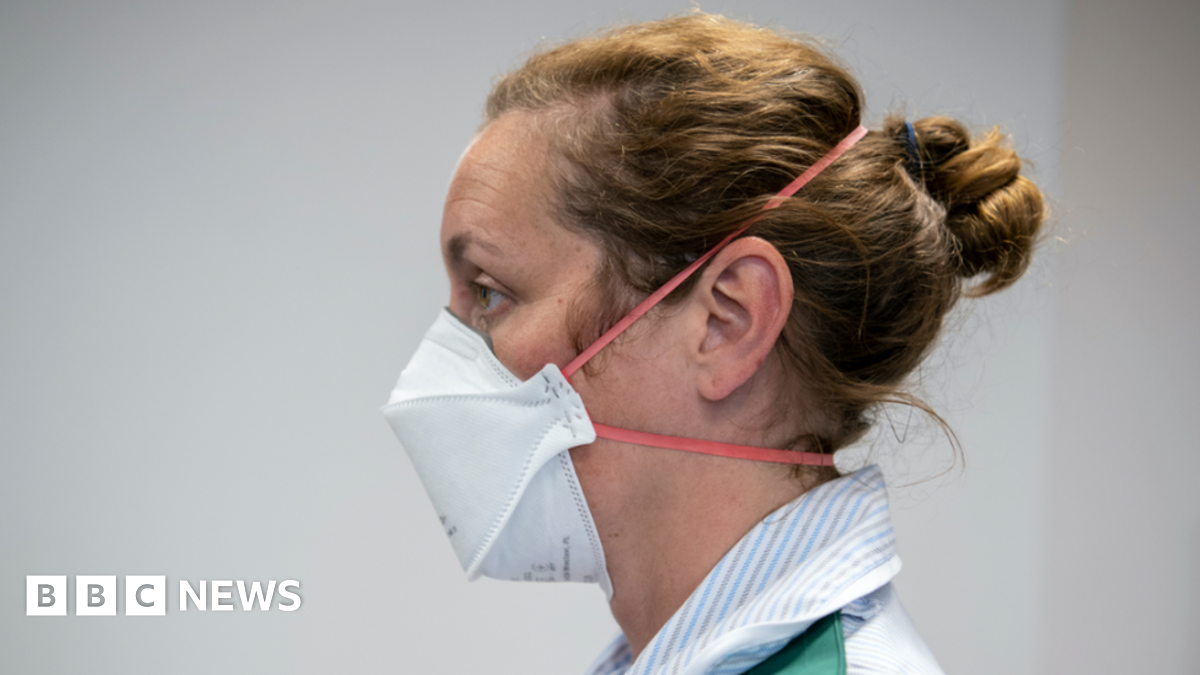
FFP3 masks have a close fit and are specifically designed to filter out aerosols.

Huge impact​

In the weeks following this move, the rate of infections among healthcare workers on red wards dropped spectacularly, quickly falling to the level experienced by staff on green wards where there were no Covid patients.
The study concludes that "cases attributed to ward-based exposure fell significantly, with FFP3 respirators providing 31-100% protection (and most likely 100%) against infection from patients with Covid-19".
Any remaining cases were likely to be caused by spread in the community, rather than in the hospital.
The paper says fluid-resistant surgical masks were "insufficient" to protect healthcare workers.
Dr Mike Weekes, of Cambridge University NHS Hospitals Foundation Trust, who also worked on the study, said the work gives "some real world evidence that FFP3 masks are actually effective and more effective than the surgical masks".
He added: "Clearly, it's a relatively small study in one trust and so we need to see these findings replicated elsewhere.
"But given the difference in the results that we've seen, as a sort of precautionary principle effect, what we should be thinking about is changing to use FFP3 masks for anyone caring for a patient with coronavirus."

Campaign intensifies​

The Cambridge trust is among 17 across the UK known to have decided to upgrade PPE regardless of national policy.
The call for FFP3 masks to be issued more widely is in line with a long-standing demand by the British Medical Association, the Royal College of Nursing (RCN) and many other professional bodies.
They have repeatedly appealed for higher standards of protection to face the threat of airborne spread of the disease, most recently in a high-level meeting with health officials earlier this month.
In an open letter to the new Health Secretary Sajid Javid, the Fresh Air NHS group of consultants and doctors says the new study provides yet more evidence of why the policy needs to change.
"This has important implications for healthcare worker protection as the UK copes with what is hopefully an 'exit wave', as well as trying to reduce the massive backlog of other work whilst coping with inevitable staff sickness and isolation," the group wrote.
It says supply chains have now been largely restored after the shortages of the early days of the pandemic, and that although FFP3 masks are less comfortable than surgical ones, surveys show staff generally prefer a higher level of protection.
Rose Gallagher, the RCN's lead for infection prevention and control, also welcomed the research, telling the BBC: "This important study adds even further weight to the RCN's continuing call for nursing staff to be better protected from Covid-19 and given routine access to the highest levels of respiratory protective equipment whenever they need it.
"We are still seeing cases of Covid-19, even from some who have been vaccinated, and it is vital staff are fully protected and there are no attempts to restrict or ease off on measures to further reduce the risk of infection."
A Department of Health and Social Care spokesperson said guidance on PPE standards was regularly updated to reflect the latest science.
"The safety of the NHS and social care staff has always been our top priority and we continue to work round the clock to deliver PPE to protect those on the frontline.
"Emerging evidence and data are continually monitored and reviewed and guidance will be amended accordingly if appropriate."

 
Status
Not open for further replies.

Top