Why have the railways on the eastern side of the Isle of Man survived whilst whichever ones existed on or to the west haven't, apart from Port Erin? Is it just an absence of (relatively) sizable towns apart from Peel? I suspect there's more and has historically been more traffic between the Isle of Man and northwest England than going towards Belfast or Dublin, but I'm still not entirely sure if that's the only reason why the Manx rail network is so heavily centered on the east.

-
Our new ticketing site is now live! Using either this or the original site (both powered by TrainSplit) helps support the running of the forum with every ticket purchase! Find out more and ask any questions/give us feedback in this thread!
You are using an out of date browser. It may not display this or other websites correctly.
You should upgrade or use an alternative browser.
You should upgrade or use an alternative browser.
Manx west coast railways
- Thread starter A S Leib
- Start date
- Status
- Not open for further replies.
Sponsor Post - registered members do not see these adverts; click here to register, or click here to log in
R
RailUK Forums
The railway route to Ramsey was slow and indirect compared to buses on the Laxey road, and the freight flows would have been patchy, mainly livestock and agricultural produce if anything. I have a feeling there were also one or two sections which were susceptible to ground movement.
The whole of that north-west area has a very different character to the east coast (my aunt married a Manxman and is buried at Kirk Andreas)- a scattering of small villages and very exposed to the weather conditions coming off the sea. My uncle used to have a collection of oil lamps in their house at Jurby and they served a practical function when the electricity went off in a storm!
The whole of that north-west area has a very different character to the east coast (my aunt married a Manxman and is buried at Kirk Andreas)- a scattering of small villages and very exposed to the weather conditions coming off the sea. My uncle used to have a collection of oil lamps in their house at Jurby and they served a practical function when the electricity went off in a storm!

John Luxton
Established Member
I did the Isle of Man Railways Closed Lines tour a few weeks ago which runs during Transport Gala Week.Why have the railways on the eastern side of the Isle of Man survived whilst whichever ones existed on or to the west haven't, apart from Port Erin? Is it just an absence of (relatively) sizable towns apart from Peel? I suspect there's more and has historically been more traffic between the Isle of Man and northwest England than going towards Belfast or Dublin, but I'm still not entirely sure if that's the only reason why the Manx rail network is so heavily centered on the east.
Obviously the remains of the West coast line featured in a number of stopping off points. Someone commented on the trip it was all about getting a rail route to Ramsey hence west coast route was developed first. The technology wasn't there in the 1870s to build it up the east coast direct due to gradients and curves needed. However nearly 20 years later technology had advanced and the new fangled Manx Electric Railway was extended from Laxey to Ramsey in 1898. After that with frequent, quicker and in those days hi-tec electric cars the original Manx Northern railway route would always play second fiddle to the direct MER, even before the motor bus appeared.
Yes, there is at least one section (something like a couple of hundred yards of embankment, if I remember rightly) that now forms part of the coastal footpath and has clearly subsided quite a lot since closure.I have a feeling there were also one or two sections which were susceptible to ground movement.
Thw Wikipedia age on the IoMR says 'Traffic was poor on the two northern lines, especially that to Ramsey, so after the end of the 1968 season, Ailsa decided to concentrate on passenger service on the South Line for three more seasons until he took the option to end his lease at the close of the 1971 season.' That doesn't have a citation, but it sounds plausible, and it might help explain why it was the Port Erin line that survived.
Sir Felix Pole
Established Member
Douglas to Peel (third largest town) was pretty direct, however, and always seemed to be the more obvious railway to retain. The route currently supports a half-hourly bus service.
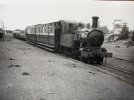
Here's a photo I took of No5 Mona approaching Ramsey in August 1968 a few weeks before the St Johns to Ramsey line unceremoniously closed. The train is a mixed one carrying fuel oil from Peel to Ramsey. A supporter of the railway had decided to use the railway and reduce freight traffic on the islands roads.Yes, there is at least one section (something like a couple of hundred yards of embankment, if I remember rightly) that now forms part of the coastal footpath and has clearly subsided quite a lot since closure.
Thw Wikipedia age on the IoMR says 'Traffic was poor on the two northern lines, especially that to Ramsey, so after the end of the 1968 season, Ailsa decided to concentrate on passenger service on the South Line for three more seasons until he took the option to end his lease at the close of the 1971 season.' That doesn't have a citation, but it sounds plausible, and it might help explain why it was the Port Erin line that survived.
Attachments
John Luxton
Established Member
And most of it remains a long distance path would be quite easy to reinstate. It always puzzled me when the IoMR was rationalised that this line was not retained, perhaps even in preference to Port Erin. Shorter, cheaper to maintain - had good commuter potential being an almost straight line route unlike the snaking Port Erin line.Douglas to Peel (third largest town) was pretty direct, however, and always seemed to be the more obvious railway to retain. The route currently supports a half-hourly bus service.

I suspect the tourist potential of Castletown, Port St Mary and Port Erin is greater than Peel's. Not to mention the occasional Airport passenger.And most of it remains a long distance path would be quite easy to reinstate. It always puzzled me when the IoMR was rationalised that this line was not retained, perhaps even in preference to Port Erin. Shorter, cheaper to maintain - had good commuter potential being an almost straight line route unlike the snaking Port Erin line.

Tetchytyke
Veteran Member
It was closed in the 60s because it didn't have the same traffic as the south line to Port Erin. Once it was closed and the line was lifted that was that. If it had limped on another five years we'd probably still have the Peel line though.Shorter, cheaper to maintain - had good commuter potential being an almost straight line route unlike the snaking Port Erin line.
The south line only survived by the skin of its teeth, it was cut to the section south of Castletown for a brief period. I always get the impression what really saved it was the rise of Manx national pride in the run up to the 1000th anniversary of Tynwald celebrations in 1979.
The line north of St Johns to Ramsey via Kirk Michael was always a basket case.
As for reinstatement, the trackbed is intact from Quarterbridge to Peel. But I'd vote against any MHK who seriously suggests it in their manifesto. It has more value as the footpath/cycle path than it ever did as a railway line.
The railways now are tourist attractions, they serve no purpose for commuting. But it's worth noting the buses to give you an idea of the market: it's 3bph from Douglas to Port Erin, 2bph from Douglas to Peel and Douglas to Ramsey via Laxey, but only 1bph from Peel to Ramsey via Kirk Michael.
We went on a family holiday to the IoM in 1967 (possibly 68) and I was keen to go on the steam railway as you can imagine. It ran at that time Douglas to Castletown and Peel, and a few to Ramsey. Boarding at Douglas for Castletown, a porter, in uniform, was keen to shepherd my mother plus us lot to an empty compartment, made sure it was clean of litter, etc, and treated her very deferentially, which was enjoyed and commented on - especially his "well brought up" accent. Enquiries later in the day revealed it was none other than the Marquis of Ailsa himself, acting as station platform staff! He might have been accompanied by Lord Strange, an equal supporter.The Wikipedia age on the IoMR says 'Traffic was poor on the two northern lines, especially that to Ramsey, so after the end of the 1968 season, Ailsa decided to concentrate on passenger service on the South Line for three more seasons until he took the option to end his lease at the close of the 1971 season.'
We later went to something like a wildlife park around Kirk Michael, and by chance while there one of the very occasional steam services to Ramsey passed by. Just a loco and two coaches. I seem to recall Lord Strange's property was along the Ramsey line, and he was its principal passenger.

Gostav
Member
- Joined
- 14 May 2016
- Messages
- 541
I think the main reason is that it is very uneconomical nature of using steam locomotives and heritage stocks, the same goes for the Manx Electric Railway, if they could bring in some modern fleet they might be able to do a faster and more frequent service.The railways now are tourist attractions, they serve no purpose for commuting. But it's worth noting the buses to give you an idea of the market: it's 3bph from Douglas to Port Erin, 2bph from Douglas to Peel and Douglas to Ramsey via Laxey, but only 1bph from Peel to Ramsey via Kirk Michael.
I'm curious what happened to the ex-Irish rail car and the new diesel-electric locomotive from North Carolina, it seems like they were supposed to help reduce the railway operating costs but it didn't happen.
Last edited:
Tetchytyke
Veteran Member
Faster and more frequent? Not without a huge investment, an investment that would be highly unlikely to ever be recouped.I think the main reason is the uneconomical nature of using steam locomotives and heritage stocks, the same goes for the Manx Electric Railway, if they could bring in some modern fleet they might be able to do a faster and more frequent service.
Using a diesel locomotive might let them run a winter service or run an out-and-back commuter service, but I'd not be convinced it'd be that popular. It'd be no quicker than the bus.
The ex-Donegal railcars are stored out of service and have been in that state since 1998.I'm curious what happened to the ex-Irish rail car and the new diesel-electric locomotive from North Carolina, it seems like they were supposed to help reduce the railway operating costs but it didn't happen.
The diesel locomotive is something of a sore point here. Known as "the cabbage", the thing has never worked properly and hasn't been used for five years because of all its defects. If an MHK is wanting to score cheap points about something they'll simply mention the cabbage as the ultimate symbol of government waste.
- Status
- Not open for further replies.