Our new ticketing site is now live! Using either this or the original site (both powered by TrainSplit) helps support the running of the forum with every ticket purchase! Find out more and ask any questions/give us feedback in this thread!
It appears to be in the timetable - for example https://www.realtimetrains.co.uk/service/gb-nr:C87824/2024-02-09/detailed#allox_id=0 for today's 1H66 11:33 Euston-Piccadilly - that the down Euston-Manchester services have switched to using platform 6 at Crewe whereas the up Manchester-Cardiff services have switched to using platform 5 at Crewe.
Is there any specific reason for this?
For many years these have run the other way round - Euston-Manchester using platform 5 in both directions and Manchester-Cardiff using platform 6 in both directions.
Is the change temporary or permanent?
I'm interested so that next time I'm at Crewe I make the right assumptions, until I noticed this I'd have made the wrong assumptions had I been there today.
It appears to be in the timetable - for example https://www.realtimetrains.co.uk/service/gb-nr:C87824/2024-02-09/detailed#allox_id=0 for today's 1H66 11:33 Euston-Piccadilly - that the down Euston-Manchester services have switched to using platform 6 at Crewe whereas the up Manchester-Cardiff services have switched to using platform 5 at Crewe.
Is there any specific reason for this?
For many years these have run the other way round - Euston-Manchester using platform 5 in both directions and Manchester-Cardiff using platform 6 in both directions.
Is the change temporary or permanent?
I'm interested so that next time I'm at Crewe I make the right assumptions, until I noticed this I'd have made the wrong assumptions had I been there today.
It's a permanent change, it's been in for a while now. I can't speak for Avanti but it's definitely been beneficial for TfW - it's much better to be waiting on the platform to get across the WCML than waiting outside the station.
It's a permanent change, it's been in for a while now. I can't speak for Avanti but it's definitely been beneficial for TfW - it's much better to be waiting on the platform to get across the WCML than waiting outside the station.
Thank you for that update.
I'd "kind of" noticed it a week or so ago, but only today did I make an effort to think about it.
My expectations are now reset appropriately!
== Doublepost prevention - post automatically merged: ==
The main delay I’ve often seen is (Euston-Manchester) waiting for platform 5 in the down direction, and the services are invariable a little late in Wilmslow when I use them into Manchester. So it will be interesting to see if using platform 6 at Crewe improves this.
This now
- perpetually delays the TfW by several minutes as the Avanti Manchester is usually several minutes late,
- this then delays the LNR London by 4-8minutes, subsequently misses all the connecting trains on the Trent,
- the Shrewsbury stopper is the bottom of the barrel and leaves last
- delaying the Avanti Liverpool which is also held outside.
Solution = 1x Bulldozer. Crewe is one of the highest accumulations (relative to the trains passing through it) of delay minutes in the UK.
This now
- perpetually delays the TfW by several minutes as the Avanti Manchester is usually several minutes late,
- this then delays the LNR London by 4-8minutes, subsequently misses all the connecting trains on the Trent,
- the Shrewsbury stopper is the bottom of the barrel and leaves last
- delaying the Avanti Liverpool which is also held outside.
Solution = 1x Bulldozer. Crewe is one of the highest accumulations (relative to the trains passing through it) of delay minutes in the UK.
Oh well, HS2 cancellation has put paid to anything at Crewe now shy of Basford Hall and the Independent line re-signaling.
In terms of them swapping platforms, its less onerous on approach control for the Avanti and it reduces the junction margins as well. Any train coming from Manchester should get a better run in now as the conditional double reds should have been removed.
This now
- perpetually delays the TfW by several minutes as the Avanti Manchester is usually several minutes late,
- this then delays the LNR London by 4-8minutes, subsequently misses all the connecting trains on the Trent,
- the Shrewsbury stopper is the bottom of the barrel and leaves last
- delaying the Avanti Liverpool which is also held outside.
Solution = 1x Bulldozer. Crewe is one of the highest accumulations (relative to the trains passing through it) of delay minutes in the UK.
In terms of them swapping platforms, its less onerous on approach control for the Avanti and it reduces the junction margins as well. Any train coming from Manchester should get a better run in now as the conditional double reds should have been removed.
That has made a massive difference alright. Between the faster rolling stock and the signalling changes, there's a lot more dwell time at Crewe now, which is handy given how many of the passengers (and crew) change over there.
Oh well, HS2 cancellation has put paid to anything at Crewe now shy of Basford Hall and the Independent line re-signaling.
In terms of them swapping platforms, its less onerous on approach control for the Avanti and it reduces the junction margins as well. Any train coming from Manchester should get a better run in now as the conditional double reds should have been removed.
HS2 cancellation needn't have meant no upgrades/targeted investment elsewhere, but that's the way it seems to be looking.
Presumably down Manchester are now faster into Crewe because it's a 50 turnout from the DFL to 6 whereas to get across to 5 you get approach control from that horrible 20 at the south end of 5 (which has always been severe enough to hinder up starts). But what routes do (did) the conditional double reds coming in from the north apply to? To 1, 5, UFL, and 6, or not to all? (The route to UFL always seemed very slow, with the up Manchester/down Manchester 20 crossover further north of the station than its predecessor — but then the Manchester junction was a big loser from the 1980s modernisation. Oh for the days of the early 60s when Crewe-Sydney Bridge was significantly faster than since 1985 (although then one did have the salt subsidence to hit the speed).
I'm thinking, but very much open to correction, that both CE154-CE148 (the route from the up Manchester line to platform 6 or the up fast) as well as CE154-CE150 (the route to platforms 5 and 1) have conditional double reds, meaning that if the second signal is red then the CE154 also needs to be red until some condition is satisfied.
The previous problem with TACL has been removed (https://www.railforums.co.uk/threads/approach-control-signalling-at-crewe.212702/), so if either CE148 or CE150 are clear then CE154 will also be clear, so I think this conditional double red only applies to slow down trains when the route isn't clear. And having the up Cardiff use platform 5 rather than platform 6 makes this less likely, because the route no longer has to cross the up and down fast lines to get into the platform, and so the double red is less likely.
But, as I say, some of this is guesswork and I'd be very happy to be corrected.
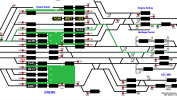
I have attached a diagram from Open Train Times (https://www.opentraintimes.com/maps/signalling/crewe) to help provide context to those unfamiliar with Crewe. By coincidence it shows 1V41 (11:30 Manchester Piccadilly to Carmarthen) ready to depart from platform 5. In the recent past this train would have used platform 6.
PS The conditional double red may only apply to the CE154-CE148 combination, but this doesn't alter the argument because this is the combination which used to apply to the Manchester-Cardiff trains going into platform 6.
== Doublepost prevention - post automatically merged: ==
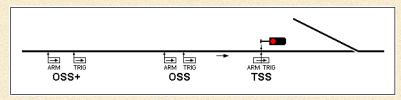
Standard TPWS, with OSS loops placed no more than 450 metres from the signal as described earlier, is generally capable of stopping a train travelling at up to 75 mph inside the safe overrun distance. By installing an extra OSS at a greater distance from the signal, the effectiveness of TPWS for higher-speed applications can be increased. This type of fitment was originally called 'TPWS+', and the additional OSS was termed an OSS+. The OSS+ trigger loop was normally placed 750 metres from the signal, with the arming loop originally placed a further 28.3 metres in rear, resulting in a set speed of 65 mph for passenger trains. The maximum distance for an OSS+ was later increased to 900 metres. The OSS+ can stop a train approaching at the maximum permissible speed, leaving the standard OSS only having to deal with trains approaching at a speed below the set speed of the OSS+. The terms TPWS+ and OSS+ are no longer used for new fitments requiring an OSS further than 450 metres from the signal.
Fig. 4: TPWS+.
Where TPWS+ would not give the desired protection, 'TPWS OS' (Outer Signal) may be fitted. With TPWS OS, no OSS+ is provided, but the next signal in rear is fitted with TPWS. When the junction protecting signal is at 'danger' and no forward route is set, the signal in rear will be held at red until the train has passed its OSS. This control is called 'conditional double red'. The outer signal's OSS was usually positioned at the maximum distance that was possible with standard TPWS (450 metres), to minimise delay to trains. The arming loop was 23 metres from the trigger loop, giving a set speed of 53 mph for passenger trains. A train travelling below that speed can be stopped inside the safe overrun distance by the TPWS fitted at the signal ahead.
I noticed the Balfour Beatty HS2 work site just north of the Crewe Arms hotel the other day, next to the Manchester junction.
It looked distinctly empty and forlorn. No doubt some careers have been cut short too.
Until the portacabins are removed, it's a visible sign of the destruction Sunak has caused.
I'm thinking, but very much open to correction, that both CE154-CE148 (the route from the up Manchester line to platform 6 or the up fast) as well as CE154-CE150 (the route to platforms 5 and 1) have conditional double reds, meaning that if the second signal is red then the CE154 also needs to be red until some condition is satisfied.
The previous problem with TACL has been removed (https://www.railforums.co.uk/threads/approach-control-signalling-at-crewe.212702/), so if either CE148 or CE150 are clear then CE154 will also be clear, so I think this conditional double red only applies to slow down trains when the route isn't clear. And having the up Cardiff use platform 5 rather than platform 6 makes this less likely, because the route no longer has to cross the up and down fast lines to get into the platform, and so the double red is less likely.
But, as I say, some of this is guesswork and I'd be very happy to be corrected.
I have attached a diagram from Open Train Times (https://www.opentraintimes.com/maps/signalling/crewe) to help provide context to those unfamiliar with Crewe. By coincidence it shows 1V41 (11:30 Manchester Piccadilly to Carmarthen) ready to depart from platform 5. In the recent past this train would have used platform 6.
View attachment 152004
PS The conditional double red may only apply to the CE154-CE148 combination, but this doesn't alter the argument because this is the combination which used to apply to the Manchester-Cardiff trains going into platform 6.
== Doublepost prevention - post automatically merged: ==
Standard TPWS, with OSS loops placed no more than 450 metres from the signal as described earlier, is generally capable of stopping a train travelling at up to 75 mph inside the safe overrun distance. By installing an extra OSS at a greater distance from the signal, the effectiveness of TPWS for higher-speed applications can be increased. This type of fitment was originally called 'TPWS+', and the additional OSS was termed an OSS+. The OSS+ trigger loop was normally placed 750 metres from the signal, with the arming loop originally placed a further 28.3 metres in rear, resulting in a set speed of 65 mph for passenger trains. The maximum distance for an OSS+ was later increased to 900 metres. The OSS+ can stop a train approaching at the maximum permissible speed, leaving the standard OSS only having to deal with trains approaching at a speed below the set speed of the OSS+. The terms TPWS+ and OSS+ are no longer used for new fitments requiring an OSS further than 450 metres from the signal.
Where TPWS+ would not give the desired protection, 'TPWS OS' (Outer Signal) may be fitted. With TPWS OS, no OSS+ is provided, but the next signal in rear is fitted with TPWS. When the junction protecting signal is at 'danger' and no forward route is set, the signal in rear will be held at red until the train has passed its OSS. This control is called 'conditional double red'. The outer signal's OSS was usually positioned at the maximum distance that was possible with standard TPWS (450 metres), to minimise delay to trains. The arming loop was 23 metres from the trigger loop, giving a set speed of 53 mph for passenger trains. A train travelling below that speed can be stopped inside the safe overrun distance by the TPWS fitted at the signal ahead.
I can't say anything about the technical side of things. All I know is that as a driver who signs the route, in the past CE154 was ALWAYS held at danger for an approaching Up train, regardless of whether or not a path all the way into the station via either the Up or Down line was available. If a path was available it would clear to double yellow on approach, but only when a train was in very close proximity, so all trains had to slow to a crawl.
Since the changes, if a path is available into the station via the Up or Down then CE154 will normally show a double yellow, and drivers only need to brake for the 20mph restriction that starts just before the facing crossover that brings trains over to the down.
I can't say anything about the technical side of things. All I know is that as a driver who signs the route, in the past CE154 was ALWAYS held at danger for an approaching Up train, regardless of whether or not a path all the way into the station via either the Up or Down line was available. If a path was available it would clear to double yellow on approach, but only when a train was in very close proximity, so all trains had to slow to a crawl.
Since the changes, if a path is available into the station via the Up or Down then CE154 will normally show a double yellow, and drivers only need to brake for the 20mph restriction that starts just before the facing crossover that brings trains over to the down.
We are aware of an issue with emails from the Forum to Microsoft-based email accounts (hotmail/outlook/live.com email addresses). This is being looked into currently, thanks for your patience meanwhile.