• Our new ticketing site is now live! Using either this or the original site (both powered by TrainSplit) helps support the running of the forum with every ticket purchase! Find out more and ask any questions/give us feedback in this thread!

Making top-contact third rail safer

Status
Not open for further replies.

JohnElliott

Member
Joined
15 Sep 2014
Messages
275
Do UK clearances make bottom contact third rail impossible?
The pickup shoes would extend outside the current loading gauge, so instead of rebuilding all the overbridges on a route to make space for wires you'd be rebuilding all the underbridge parapets and platforms (and point motors?) to make space for the shoes.

And if you were going to introduce a new system not compatible with anything currently running that needs thorough rebuilding of lineside structures, you might as well go for overhead DC rather than ankle-height DC.
 
Sponsor Post - registered members do not see these adverts; click here to register, or click here to log in
R

RailUK Forums

edwin_m

Veteran Member
Joined
21 Apr 2013
Messages
28,624
Location
Nottingham
The pickup shoes would extend outside the current loading gauge, so instead of rebuilding all the overbridges on a route to make space for wires you'd be rebuilding all the underbridge parapets and platforms (and point motors?) to make space for the shoes.

And if you were going to introduce a new system not compatible with anything currently running that needs thorough rebuilding of lineside structures, you might as well go for overhead DC rather than ankle-height DC.
Also the transition would be incredibly difficult, because you can't have top and bottom contact on the same track at the same time, and you probably can't on the same train unless you convert only some of the pickups with extra risk of gapping.
 

ExRes

Established Member
Joined
16 Dec 2012
Messages
8,330
Location
Back in Sussex
I assume that accurate figures exist somewhere so just how many people are killed or injured by 3rd rail each year? how many killed or injured by overheads each year? I signed 3rd rail routes for around 10 years and I only recollect one serious case when a driver tried to remove a shopping trolley from the track, just how much non existent money is there to mitigate against a danger which rarely injures anyone?
 

edwin_m

Veteran Member
Joined
21 Apr 2013
Messages
28,624
Location
Nottingham
I assume that accurate figures exist somewhere so just how many people are killed or injured by 3rd rail each year? how many killed or injured by overheads each year? I signed 3rd rail routes for around 10 years and I only recollect one serious case when a driver tried to remove a shopping trolley from the track, just how much non existent money is there to mitigate against a danger which rarely injures anyone?
I've looked in the past and not found anything. Perhaps buried somwhere in the members area of the RSSB website?
 

JamesT

Established Member
Joined
25 Feb 2015
Messages
4,842
I've looked in the past and not found anything. Perhaps buried somwhere in the members area of the RSSB website?
The oft quoted footnote from page 3 of the ORR’s policy https://www.orr.gov.uk/sites/default/files/om/dc-electrification-policy-statement.pdf
2 This is borne out by data from RSSB’s safety risk model – despite the legacy network being only half the size of the AC
network (4400km compared to 8200km), it contributes almost eight times more (in terms of fatalities and weighted
injuries per year) to overall risks on the railway. See FWI comparative data for OLE / conductor rail / non-electrified:
Network Rail Electrical Power Asset Policy December 2012 (Table 2.1, page 52).
I don't know where you would find said document to get the raw figures, or if there is a newer version available.
 

eldomtom2

On Moderation
Joined
6 Oct 2018
Messages
2,370
Also the transition would be incredibly difficult, because you can't have top and bottom contact on the same track at the same time, and you probably can't on the same train unless you convert only some of the pickups with extra risk of gapping.
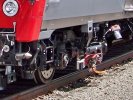
You absolutely can have pickups that support both top and bottom contact.
M8_railcar_-9101_contact_shoe,_September_2016.jpg
Pic: third rail contact shoe for New York M8 trains, capable of collecting current from both top-contact and bottom-contact third rails.
 

edwin_m

Veteran Member
Joined
21 Apr 2013
Messages
28,624
Location
Nottingham
The oft quoted footnote from page 3 of the ORR’s policy https://www.orr.gov.uk/sites/default/files/om/dc-electrification-policy-statement.pdf

I don't know where you would find said document to get the raw figures, or if there is a newer version available.
That's just a predicted figure from a risk model. I was referring to the actual accident data which gave rise to that figure.
You absolutely can have pickups that support both top and bottom contact.
View attachment 158012
Pic: third rail contact shoe for New York M8 trains, capable of collecting current from both top-contact and bottom-contact third rails.
Thanks for that - learning something every day.
 

Justin Smith

Established Member
Joined
14 Nov 2009
Messages
1,423
Location
Sheffield
It's also almost certainly the case that major modifications like a redesign of the whole concept would cost more than just wiring it, particularly if batteries allowed discontinuous wires for tunnels and bridges.

The cheapest way to change the system to be safe enough (for any sensible person) would be to switch to bottom-contact, but the problem is that (unlike the wires) that can't coexist with top-contact, so you'd need lengthy closures to do it.
It's safe enough for me now.
I am not a natural risk taker, I just have a proportionate attitude to risk, e.g. I try never to descend the stairs without having a free hand on the banister. But coming down the stairs is actually quite a risky thing to do, statistically. Third rail electrification is not, relatively speaking.

== Doublepost prevention - post automatically merged: ==

And how proportionate should this risk be?

Im guessing you're properly qualified to evaluate these risks and come to what you may 'think' is proportionate ?
"Risk", like "safe", is a relative word and anyone can look at risk probability statistics. There is a fascinating article on it by Frank Duckworth (one half of the pair who invented the Duckworth Lewis scoring system in cricket) which was originally printed in the Royal Statistical Society News (Oct 1998). I have a resume of it on my site, here.

== Doublepost prevention - post automatically merged: ==

I assume that accurate figures exist somewhere so just how many people are killed or injured by 3rd rail each year? how many killed or injured by overheads each year? I signed 3rd rail routes for around 10 years and I only recollect one serious case when a driver tried to remove a shopping trolley from the track, just how much non existent money is there to mitigate against a danger which rarely injures anyone?
This is what I would like to know, and have asked this question elsewhere on this forum, but not, had a figure quoted.
 
Last edited:

Bald Rick

Veteran Member
Joined
28 Sep 2010
Messages
35,711
I assume that accurate figures exist somewhere so just how many people are killed or injured by 3rd rail each year? how many killed or injured by overheads each year? I signed 3rd rail routes for around 10 years and I only recollect one serious case when a driver tried to remove a shopping trolley from the track, just how much non existent money is there to mitigate against a danger which rarely injures anyone?

On average, a few people each year are killed by electrocution from the con rail. I know of several cases in the past couple of years.
 

etr221

Established Member
Joined
10 Mar 2018
Messages
1,586
You absolutely can have pickups that support both top and bottom contact.
View attachment 158012
Pic: third rail contact shoe for New York M8 trains, capable of collecting current from both top-contact and bottom-contact third rails.
It's also the case that some of the New York area third rail electrification has top cover protection over the top-contact third rail - don't recall which bit. But it does require the horizontal blade style shoe illustrated. How practical any conversion of UK standard third rail to that style might be I've no idea.
 

edwin_m

Veteran Member
Joined
21 Apr 2013
Messages
28,624
Location
Nottingham
It's also the case that some of the New York area third rail electrification has top cover protection over the top-contact third rail - don't recall which bit. But it does require the horizontal blade style shoe illustrated. How practical any conversion of UK standard third rail to that style might be I've no idea.
In the UK the pickup shoe is usually underneath a beam between the two axle boxes, which probably isn't compatible with a top cover. A blade style would have to project between the wheels somehow, which may clash with the bogie frame. The retractable pickups used on some dual-voltage designs might be more suitable, although they might be unable to extend or retract anywhere with a top cover.
 

MarkyT

Established Member
Joined
20 May 2012
Messages
7,562
Location
Torbay
In the UK the pickup shoe is usually underneath a beam between the two axle boxes, which probably isn't compatible with a top cover. A blade style would have to project between the wheels somehow, which may clash with the bogie frame. The retractable pickups used on some dual-voltage designs might be more suitable, although they might be unable to extend or retract anywhere with a top cover.
In line with our other tight structure gauging dimensions, UK 3rd rail is significantly closer to the nearest running rail than on most other mainline and metro systems elsewhere. There's less space available for bottom or side contact with fancy folding shoes, protective boards etc. Railway Group Standard GL/RT1212, DC Conductor Rail Energy Subsystem and Interfaces to Rolling Stock Subsystem, gives dimensions as follows.
(Note 405mm is just under 16 inches):
1716468107832.png
Here's an interesting 1912 article in a specialist journal documenting a change from bottom to top contact on the Philadelphia & Western Railway in the USA. Accompanying diagrams suggest the corresponding distance on this particular transatlantic operation was/is about 26 inches, which I suspect is typical for the USA:
Electric Railway Journal

New York, NY, United States, Saturday, August 17, 1912
vol. 40, no. 7, p. 248-250, col. 1/2

New Third-Rail and Contact-Shoe System of Philadelphia & Western Railway

Details of an Economical Under-Contact Third-Rail System with a New Type of Automatic Shoe

The Philadelphia & Western Railway recently found itself confronted by the necessity either of rehabilitating the under-contact third-rail which had been originally installed and was of U shape or of using some other type. The decision had to be hastened because of the fact that the company was about to build 6 1/2 miles of double track as a final link of the system over which the trolley cars of the Norristown Transit Company and the Lehigh Valley Transit Company would enter Philadelphia, so that an exceptional opportunity was offered for changing over the entire line at the lowest ultimate cost. A decision was finally made in favor of the top-contact rail hereinafter described.
 

swt_passenger

Veteran Member
Joined
7 Apr 2010
Messages
34,259
In the UK the pickup shoe is usually underneath a beam between the two axle boxes, which probably isn't compatible with a top cover. A blade style would have to project between the wheels somehow, which may clash with the bogie frame. The retractable pickups used on some dual-voltage designs might be more suitable, although they might be unable to extend or retract anywhere with a top cover.
I think what are often referred to as “retractable”, eg in 377 and 350, should really be described as raisable, they move vertically*, the pick up arm being hinged at the inboard end. A top cover would not work with that design.

(“Vertically” meaning up and down but on a slight curve, the radius of the pickup arm length.)
 

zwk500

Veteran Member
Joined
20 Jan 2020
Messages
18,505
Location
Northampton
I think what are often referred to as “retractable”, eg in 377 and 350, should really be described as raisable, they move vertically*, the pick up arm being hinged at the inboard end. A top cover would not work with that design.

(“Vertically” meaning up and down but on a slight curve, the radius of the pickup arm length.)
But something like the 700 is a lot more feasible to design a top cover to work with. However, the endless problem of backwards compatibility needs to be considered in any cover project design.
 

Falcon1200

Established Member
Joined
14 Jun 2021
Messages
6,534
Location
Neilston, East Renfrewshire
On average, a few people each year are killed by electrocution from the con rail. I know of several cases in the past couple of years.

Presumably (and hopefully) none of those casualties were railway staff, so they somehow gained access to a part of the railway they were not supposed or allowed to be? Which takes us back to the question of how far the railway should go in protecting people from the consequences of their own deliberate actions.
 

Trainbike46

Established Member
Joined
18 Sep 2021
Messages
4,371
Location
belfast
Presumably (and hopefully) none of those casualties were railway staff, so they somehow gained access to a part of the railway they were not supposed or allowed to be? Which takes us back to the question of how far the railway should go in protecting people from the consequences of their own deliberate actions.
That's quite an assumption to make - as i understand it railway staff and contractors do get hurt by 3rd rail at times
 

zwk500

Veteran Member
Joined
20 Jan 2020
Messages
18,505
Location
Northampton
Which takes us back to the question of how far the railway should go in protecting people from the consequences of their own deliberate actions.
If you want this to change, it needs legislative change so your MP is the person fo complain to, not NR or the ORR
 

Bald Rick

Veteran Member
Joined
28 Sep 2010
Messages
35,711
Presumably (and hopefully) none of those casualties were railway staff, so they somehow gained access to a part of the railway they were not supposed or allowed to be? Which takes us back to the question of how far the railway should go in protecting people from the consequences of their own deliberate actions.

There have been a few serious injuries for staff in recent times.

Sadly, there was another fatality last night - a passenger who came into contact with the con rail. Very sad.
 

Falcon1200

Established Member
Joined
14 Jun 2021
Messages
6,534
Location
Neilston, East Renfrewshire
That's quite an assumption to make - as i understand it railway staff and contractors do get hurt by 3rd rail at times

More of a query, and concern, which @Bald Rick has replied to.

There have been a few serious injuries for staff in recent times.

Which is very concerning, but what would be really helpful is actual numbers, eg over the last 10 years say how many staff, passengers and trespassers have succumbed to the third rail. I don't recall such figures being quoted anywhere in this discussion.

Sadly, there was another fatality last night - a passenger who came into contact with the con rail. Very sad.

That is indeed very sad, but that can only have happened because the passenger went onto the track, where they should not have been, and, equally sadly, tragic incidents due to people going onto the line occur every day, on non-electrified lines.
 

MarkyT

Established Member
Joined
20 May 2012
Messages
7,562
Location
Torbay
That is indeed very sad, but that can only have happened because the passenger went onto the track, where they should not have been, and, equally sadly, tragic incidents due to people going onto the line occur every day, on non-electrified lines.
Was it a fall from a platform? That's the most common cause of passenger fatalities on the UK railway today, whether there's a train about or not. Yes the passenger 'shouldn't' be on the track and may have been careless, but usually such falls are accidental, not deliberate acts of trespass. The railway also has to be aware of very young children and others who aren't fully legally responsible for their actions. DB Cargo was fined heavily following an incident in 2014 where a 13-year-old boy suffered life-changing injuries after receiving an electric shock from 25kV OHLE at Tyne Yard in Gateshead. The company hadn't taken all reasonable measures to exclude members of the public from the site and kids were found to have been playing frequently in abandoned buildings and climbing on rolling stock. The prosecution was under The Health & Safety at Work Act 1974.
 

ainsworth74

Forum Staff
Staff Member
Global Moderator
Joined
16 Nov 2009
Messages
31,085
Location
Redcar
Having seen this discussion some time I go I thought some precise figures might actually make for interesting reading rather than just guesses and gut feelings! And so, with many thanks to the always helpful (and no doubt long suffering) FOI team at Network Rail, we do actually have some sort of quantification of how many people, staff and members of the public, are killed or injured by third-rail on the railway network. I feel that I should probably lead with the explanation of their methodology first and then I'll put the figures below:

We also thought it might be useful if we explained the methodology behind gathering this data – we don’t normally go into this much depth but in this case we think it relevant because the search process is complex and, while we’re satisfied that this is the most comprehensive means by which we can gather information, we recognise the methodology is by necessity imperfect and that, while we think it unlikely, there may be instances which fall outside the scope of our searches for the reasons explained below:

  • We have two SMIS databases – the first one runs from 1994 to 2017, while the more recent one runs from 2017 to the present.
  • Our expert’s searches for data in the old SMIS database started with finding entries that were entered as “electricity related injury”, which would provide details of both injuries and fatalities, and were then filtered further to any references of “conductor rail contact”, “conductor rail arc eye” and “other electric incident”. From the results found under “other electric incident”, a further search was conducted for the phrases “third rail”, “3 rd rail”, “con rail” and “conductor rail”. Any events that did not contain these references were then removed from the dataset. Finally, our expert used the “injury degree column” to identify fatalities – any other incidents that were not fatal were then labelled as injuries.
  • Our expert’s searches in the current SMIS database were collated using the “electric shock” domain, which contains incidents of electrocution. A filter was applied to the “electric shock source” category to locate results which included “conductor rail system (3rd or 4th)”, “lineside power”, “lineside power distribution equipment”, “traction power” and “traction power distribution equipment”. For “lineside power”, “lineside power distribution equipment”, “traction power” and “traction power distribution equipment” events, our expert reviewed each result to see whether they referenced the third rail and removed any events that did not. Fatalities were then identified using the “injuries summary” column.
  • Once our expert carried out these searches in the two SMIS databases, they combined the result and standardised the person type to either be “workforce” or “member of public” and then was able to sort the results accordingly.
  • One thing to be aware of is that if any events were entered using terminology our experts wouldn’t expect, used the incorrect form, or were just generally recorded incorrectly then it’s possible we wouldn’t have found it in these searches.

So with those necessary (but I think perfectly reasonable!) caveats in mind the data itself is below:

data table.png
*2024 is included in the figures for 2019 - 2023 as it's only a part year through to 9 May 2024.

(Table contains data from 1994 through to 9 May 2024. It shows, five year chunks that, on average, staff fatalities were approx one or two every five years (though, no fatalities have been recorded for 2019 - 2024) whilst for members of the public the average is twenty fatalities every five years. In total 124 member of the public have been killed and eight members of staff in the data range. In terms of injuries the data is presented on an annual basis and shows that, on average, six members of the public are injured and seven members of staff. In total 195 members of the public were injured and 221 member of staff in the date range).


I have to say the number of fatalities for members of the public took me by surprise. I would not have anticipated it being quite so high! 132 fatalities in twenty years feels like quite a high number of fatalities. It's perhaps also interesting that it was, seemingly, trending down from the early 00s before spiking over the last five years, which includes the pandemic years of course.

Personally, I do think that these figures give some explanation why the ORR are seemingly so leery of allowing new or extended third rail systems.

Anyway, hopefully others find these figures interesting and also provide useful context to discussions around the safety (or otherwise) of third rail!

 

Trainbike46

Established Member
Joined
18 Sep 2021
Messages
4,371
Location
belfast
Having seen this discussion some time I go I thought some precise figures might actually make for interesting reading rather than just guesses and gut feelings! And so, with many thanks to the always helpful (and no doubt long suffering) FOI team at Network Rail, we do actually have some sort of quantification of how many people, staff and members of the public, are killed or injured by third-rail on the railway network. I feel that I should probably lead with the explanation of their methodology first and then I'll put the figures below:


So with those necessary (but I think perfectly reasonable!) caveats in mind the data itself is below:

View attachment 159842
*2024 is included in the figures for 2019 - 2023 as it's only a part year through to 9 May 2024.

(Table contains data from 1994 through to 9 May 2024. It shows, five year chunks that, on average, staff fatalities were approx one or two every five years (though, no fatalities have been recorded for 2019 - 2024) whilst for members of the public the average is twenty fatalities every five years. In total 124 member of the public have been killed and eight members of staff in the data range. In terms of injuries the data is presented on an annual basis and shows that, on average, six members of the public are injured and seven members of staff. In total 195 members of the public were injured and 221 member of staff in the date range).


I have to say the number of fatalities for members of the public took me by surprise. I would not have anticipated it being quite so high! 132 fatalities in twenty years feels like quite a high number of fatalities. It's perhaps also interesting that it was, seemingly, trending down from the early 00s before spiking over the last five years, which includes the pandemic years of course.

Personally, I do think that these figures give some explanation why the ORR are seemingly so leery of allowing new or extended third rail systems.

Anyway, hopefully others find these figures interesting and also provide useful context to discussions around the safety (or otherwise) of third rail!
That's some very relevant context, thank you. That's a lot of fatalities and injuries
 

NoRoute

Member
Joined
25 Nov 2020
Messages
504
Location
Midlands
Going back to the original question, before we get to the solution of shielding the third rail, wouldn't the first, relatively simple and low cost solution, be to ensure anyone approaching was aware of the danger? Simply painting the sides of the 3rd rails a bright, fluorescent yellow, or attach something to the sides of it, to make it obvious to anyone coming near it that this rail is different from the others and is dangerous?

Here are these really dangerous, exposed electrical conductors running along at ground level and yet to the non-trained person, there's no clear and obvious difference, no indications or warnings to distinguish them from the other rails and the serious threat to life they pose to anyone getting near them.

Contrast this to the approach to safety in other areas of public infrastructure and indeed the railways, where hazards posing a low risk get safety signs installed to warn people of the hazard, where steps and stair treads get painted yellow or high-viz strips attached. The absence of such a low cost, basic measure of some form of marking or indication of the 3rd rail is quite surprising in 2024, I wonder if its a railway cultural issue that it's been like that so long, probably 100+ years, that its just accepted.
 

HSTEd

Veteran Member
Joined
14 Jul 2011
Messages
20,293
I myself got an FOI return on traction fatalities several years ago.

It broadly supports the conclusion in the above post. "Several" fatalities/fatality weight injuries worth of injuries each year from 3rd rail traction power supplies.

EDIT:

I have attached the relevant document to this post.
7-8 FWI, dominated by tresspassers (6.6FWI per year).

That probably explains why London Underground was able to get an exemption through reducing public access to the track.
 

Attachments

  • Historical Data on Fatality Weighted Injuries from Electrification Systems.pdf
    157.4 KB · Views: 12
Last edited:

MarkyT

Established Member
Joined
20 May 2012
Messages
7,562
Location
Torbay
Having seen this discussion some time I go I thought some precise figures might actually make for interesting reading rather than just guesses and gut feelings!
...
Anyway, hopefully others find these figures interesting and also provide useful context to discussions around the safety (or otherwise) of third rail!
Very interesting. I'd like to see a breakdown and analysis of where the incidents happened relative to initial likely incursion: Station, level crossing (by type), breached wall or fence. e.g. 200m up from XYZ AHBC. That could help build a case for where conductor might be removed if all trains had a moderately sized battery to pass through extended gaps in the riskiest places, and to save complexity through junctions. If you could recognise patterns and get the likely figures down dramatically in such a scheme then you might have the basis of a case for some new 3rd rail installations. There are other measures. Fence repair and upgrade for instance, and I also think it would be possible to deploy sensors to detect people walking off along the line from platforms and crossings towards the conductors which would terminate some way short of the station or other potential incursion point. That might give time for the ECR to isolate the feeder before the individual got anywhere near a live rail. A compete stoppage of traffic would not be forced if trains could continue to motor under caution though the isolation using battery. I would also advocate removal of as many level crossings as possible in 3rd rail areas.
 

etr221

Established Member
Joined
10 Mar 2018
Messages
1,586
What would be interesting to know to what extent 'member of the public' can be translated to 'trespasser'.

And interesting that for injuries, figures for workforce and members of the public were similar, whereas for fatalities, much higher for members of the public.

I also wonder how these figures compare to fatility/injury figures suffered by like groups: 'people not where they ought to be', etc.
 

edwin_m

Veteran Member
Joined
21 Apr 2013
Messages
28,624
Location
Nottingham
Personally, I do think that these figures give some explanation why the ORR are seemingly so leery of allowing new or extended third rail systems.
Thanks for going to the trouble of getting these figures.

It seems Network Rail also went to quite a bit of trouble putting them together, which suggests to me that someone in that organisation is interested in finding out. It also suggests that no such analysis was done to support ORR's statement a few years ago introducing the presumption against extending the third rail.
 

Trainbike46

Established Member
Joined
18 Sep 2021
Messages
4,371
Location
belfast
What would be interesting to know to what extent 'member of the public' can be translated to 'trespasser'.
Members of the public could also be people on level crossings, people at stations, etc. I don't think we have any information to surmise exactly how that split is
And interesting that for injuries, figures for workforce and members of the public were similar, whereas for fatalities, much higher for members of the public.
That's almost certain at least in part due to underreporting of injuries that happen to members of the public. Anyone tresspassing is a lot less likely to report an injury to NR than someone who is working on the railway.
 
Status
Not open for further replies.

Top