• Our new ticketing site is now live! Using either this or the original site (both powered by TrainSplit) helps support the running of the forum with every ticket purchase! Find out more and ask any questions/give us feedback in this thread!

LUL Signalling?

Status
Not open for further replies.

Chrius56000

Member
Joined
18 Aug 2010
Messages
262
Location
Walsall
. . .Which LU lines, apart from those parts shared with Chiltern Trains, still retain conventional two–aspect signalling?

. . .Does the Victoria Line still have any trackside signals? I found a very interesting 1966 I.R.S.E. paper describing the Victoria Line signalling, which said "theoretically the Automatically Operated trains for the New Victoria Line can run without trackside signals, the line will be fitted with them to aid drivers who may have to drive a train manually"

. . .I do remember that some stations on the Northern, Circle and Central lines had an equipment cupboard in the station tunnel end–wall that contained yellow & green repeaters for the next Signal along the line, a clock, emergency information for drivers, etc., and on the Victoria line stations there was a fairly high up three–aspect signal repeater unit that displayed red, white or green!

== Doublepost prevention - post automatically merged: ==

. . .Which brings me to my second question :–

. . .On "CBTC" lines where legacy signalling has been replaced, what indication is given to the driver to stop, and are there marker boards or other furniture that indicate the exact point where the driver needs to stop before?
 
Last edited:
Sponsor Post - registered members do not see these adverts; click here to register, or click here to log in
R

RailUK Forums

Dstock7080

Established Member
Joined
17 Feb 2010
Messages
3,510
Location
West London
. . .Which LU lines, apart from those parts shared with Chiltern Trains, still retain conventional two–aspect signalling?

. . .On "CBTC" lines where legacy signalling has been replaced, what indication is given to the driver to stop, and are there marker boards or other furniture that indicate the exact point where the driver needs to stop before?
There are two-aspect signals on:
Bakerloo
Central
District (Ealing/Gunnersbury-Barons Court; Fulham Bdwy-East Putney)
Metropolitan (Preston Road-Uxbridge/Watford/Amersham/Chesham)
Piccadilly
Victoria
Waterloo & City.

In CBTC the train will stop in the correct position in ATO.
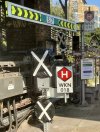
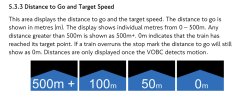
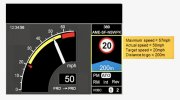
If operating in Protected Manual, the in-cab display will show how many meters counting down until the stopping position. Driver should aim to stop at “0” meters. Outside stations there are no lineside markers. At stations there are also markers for more accurate stop:
 

Attachments

  • IMG_7006.jpeg
    IMG_7006.jpeg
    642.4 KB · Views: 150
  • IMG_7008.jpeg
    IMG_7008.jpeg
    281 KB · Views: 152
  • IMG_7009.jpeg
    IMG_7009.jpeg
    206.9 KB · Views: 152
Last edited:

Chrius56000

Member
Joined
18 Aug 2010
Messages
262
Location
Walsall
. . .Member Dstock7080, thank you for your answer and pictures!

. . .I am curious to know, however, having looked at the D.T.G. display, why consideration was not given to have a "four aspect" type display:–

"500 m+" with a blue background as shown ;
"500m" with a green background ;
"200m and 100m" with a yellow background ;
"0m" with a red background!

. . .The programming for this would purely be in the display drivers rather than the vital safety components of the signalling!

Any ideas?
 

eastrail

Member
Joined
25 Mar 2025
Messages
20
Location
London
Hopping onto this thread, does anyone know that the signal aspects mean in the DTG-R system for the Victoria line?

In this video, it seems like there are red, green and blue aspects. I believe most CBTC/DTG systems only have both blue and green aspect signals if there needs to be an overlay or underlay for non-equipped trains. Yet I am pretty sure the Victoria line doesn’t need to provide an underlay, or at least not since the 1967 stock were withdrawn.
 

bramling

Veteran Member
Joined
5 Mar 2012
Messages
20,306
Location
Hertfordshire / Teesdale
. . .Member Dstock7080, thank you for your answer and pictures!

. . .I am curious to know, however, having looked at the D.T.G. display, why consideration was not given to have a "four aspect" type display:–

"500 m+" with a blue background as shown ;
"500m" with a green background ;
"200m and 100m" with a yellow background ;
"0m" with a red background!

. . .The programming for this would purely be in the display drivers rather than the vital safety components of the signalling!

Any ideas?

Drivers don’t really use the metre countdown except for final stopping positions. They generally just follow the speed, match the braking curve as the hand drops, and with some experience will know where the common stopping locations are. I’m not sure what purpose having it on the display actually serves apart from for final stopping.
 

Chrius56000

Member
Joined
18 Aug 2010
Messages
262
Location
Walsall
. . .Having just watched the linked Victoria Line Cab Ride video, any particular reason why King's Cross St. Pancras station two (I presume they're "co–acting!") signals were provided at the platform–end rather than one?

. . .There is also the usual sequence of numbered marker boards and a platform–end signal going southbound from the terminus at Brixton – is this a "safety overrun" or does the line continue to a depot?

. . .Any particular reason why the final signal before Brixton Station (s/b) or Walthamstow Central (n/b) doesn't show a yellow cautionary aspect for "clear" as has always been L.U. and B.R. practice for terminal platforms since the 1975 Moorgate accident?
 
Last edited:

bramling

Veteran Member
Joined
5 Mar 2012
Messages
20,306
Location
Hertfordshire / Teesdale
Hopping onto this thread, does anyone know that the signal aspects mean in the DTG-R system for the Victoria line?

In this video, it seems like there are red, green and blue aspects. I believe most CBTC/DTG systems only have both blue and green aspect signals if there needs to be an overlay or underlay for non-equipped trains. Yet I am pretty sure the Victoria line doesn’t need to provide an underlay, or at least not since the 1967 stock were withdrawn.

The Victoria Line system follows the Central Line convention.

On the Central Line, green means the line is clear to the next *signal* (wherever that may be). Whereas lunar white means clear to at least the next block marker board but not as far as the next signal. By the time the Victoria Line was resignalled lunar white was no longer allowed, so blue was used instead.

In practice drivers essentially treat both the same in normal working.

== Doublepost prevention - post automatically merged: ==

. . .Having just watched the linked Victoria Line Cab Ride video, any particular reason why King's Cross St. Pancras station two (I presume they're "co–acting!) signals at the platform–end rather than one?

. . .There is also the usual sequence of numbered marker boards and a platform–end signal going southbound from the terminus at Brixton – is this a "safety overrun" or does the line continue to a depot?

. . .Any particular reason why the final signal before Brixton Station (s/b) or Walthamstow Central (n/b) doesn't show a yellow cautionary aspect for "clear" as has always been L.U. and B.R. practice for terminal platforms since the 1975 Moorgate accident?

LU doesn’t have the last signal displaying yellow, except in multi-aspect areas (I believe the only terminus this applies to is Chesham, though Ongar had a fixed yellow which was somewhat non-standard).

Terminal stations have other protection, normally the last signal would have some form of speed control on it instead, but would be allowed to clear to green, with further protection by train stops. As ever, there was an exception - Shoreditch’s home signal was not speed controlled.

ATC lines don’t require any form of approach or speed control, as the ATC enforces speed.
 

Dstock7080

Established Member
Joined
17 Feb 2010
Messages
3,510
Location
West London
. . .Having just watched the linked Victoria Line Cab Ride video, any particular reason why King's Cross St. Pancras station two (I presume they're "co–acting!") signals were provided at the platform–end rather than one?

. . .There is also the usual sequence of numbered marker boards and a platform–end signal going southbound from the terminus at Brixton – is this a "safety overrun" or does the line continue to a depot?
King’s Cross SB is indeed provided with a co-acting signal, the main aspect is on the right.

Brixton has a stabling siding beyond each platform.
 

Harsig

Member
Joined
2 Oct 2013
Messages
26
. . .Any particular reason why the final signal before Brixton Station (s/b) or Walthamstow Central (n/b) doesn't show a yellow cautionary aspect for "clear" as has always been L.U. and B.R. practice for terminal platforms since the 1975 Moorgate accident?
My understanding is that the policy adopted after the Moorgate accident was not the blanket adoption of a single yellow aspect on the last stop signal before a terminal platform. Rather it was that the last stop signal before the terminal platform should display the most restrictive proceed aspect available for the type of signalling employed in the area concerned. For three or four aspect signalling the most restrictive proceed aspect is indeed a single yellow, as is now widely seen on the national rail network. For two aspect signals the most restrictive proceed aspect available on a stop signal is green, hence this remains the standard arrangement on the London Underground, albeit, as noted above usually with some form of speed control applied.
 

Pegpilot

Member
Joined
26 Mar 2020
Messages
114
Location
Northants
Pretty sure you're right, Harsig. Back in the early 80s I was part of the drawing office design team that implemented the TETS programme after Moorgate (Trains Entering Terminal Stations). A train entering the terminus would meet a series of 2 aspect approach controlled signals, each designed to clear to green as long as the approaching train was proved to be no faster than 15 mph, then 10, then 5, and finally a fixed trainstop beyond the normal terminus stopping position. (It was all a bit Heath-Robinson as we only had 13 second and 4.5 second timing electro-mechanical relays to do the timing work, so getting the timing section lengths right was a bit of an iterative process).
 
Status
Not open for further replies.

Top