• Our new ticketing site is now live! Using either this or the original site (both powered by TrainSplit) helps support the running of the forum with every ticket purchase! Find out more and ask any questions/give us feedback in this thread!

Lorry backs over LC and breaks barrier

Status
Not open for further replies.

zwk500

Veteran Member
Joined
20 Jan 2020
Messages
18,524
Location
Northampton
Why didn’t the lorry stop when the barriers were being lowered? He would have seen that in his mirrors.
I can entirely understand that the lorry driver would not necessarily know or remember that the crossing is interlocked, and therefore felt that ripping off the barrier was better than potentially causing a crash.
 
Sponsor Post - registered members do not see these adverts; click here to register, or click here to log in
R

RailUK Forums

Taunton

Veteran Member
Joined
1 Aug 2013
Messages
12,277
Its there to check the crossing is clear before clearing the signals.
That is a rather railway-centric approach.

I think if the old signalman at the gate box crossing that used to be over the main line a mile west of Taunton station had just wound the gates across when getting Train Entering Section, without looking first if there were any vehicles obstructing, and said "I only look once the gates are across", they would have been off the job ... pretty soon.
 

GB

Established Member
Joined
16 Nov 2008
Messages
6,558
Location
Somewhere
I can entirely understand that the lorry driver would not necessarily know or remember that the crossing is interlocked, and therefore felt that ripping off the barrier was better than potentially causing a crash.
Fair point.

That is a rather railway-centric approach.

I think if the old signalman at the gate box crossing that used to be over the main line a mile west of Taunton station had just wound the gates across when getting Train Entering Section, without looking first if there were any vehicles obstructing, and said "I only look once the gates are across", they would have been off the job ... pretty soon.
Completely irrelevant.
 

Watershed

Veteran Member
Associate Staff
Senior Fares Advisor
Joined
26 Sep 2020
Messages
16,669
Location
UK
Because it is expected that A, traffic would obey the road signals
In this case, it looks as though the driver obeyed the signals/lights. Just that they may not have complied with signage requiring slow moving vehicles to contact the signaller (if indeed this was present and clearly visible).

B, traffic would be going in the right direction
It's unclear whether the lorry could have squeezed through half of the road, if they'd been going on the correct side of the road.

C, if a car or lorry would happen to get caught they would stop and not rip the barrier off be continuing on
Most drivers would, quite reasonably, consider they're better off breaking barriers than getting stuck on a crossing. In any case the barrier only started moving just before the cab passed the barrier, so with reaction time it's unlikely the driver could have stopped in time to stop it colliding with the cab.

Its there to check the crossing is clear before clearing the signals.
Indeed. Which means that NR's claim that the lorry driver was "endangering passengers and trains" is utter nonsense. Unless they're suggesting there's a risk if the signaller doesn't do their job properly?

As I said, it's no good considering level crossings from the idealistic perspective of "people will stop when the lights are illuminated and comply with all instructions, no matter how complex". That's asking for trouble.

You have to have a holistic view, in the same way as multi-SPAD signals are sometimes fitted with countdown and warning boards. And how TPWS is fitted despite it being unnecessary in an ideal world.

 

WestRiding

Member
Joined
21 Mar 2012
Messages
1,014
I think if this came to a court case rather than an excited moment for the Network Rail PR department, having CCTV displayed to a remote operator who had full control over stopping the barrier process, but where the procedure was not necessarily to look at it while the barriers lowered themselves, would have the truckers' lawyers having a field day.

It really does make you wonder what's the point of providing the CCTV in the first place. What if pedestrians were crossing at that speed?
The point of the CCTV is to check the crossing IS clear. The point of the Light Sequence, timings and Claxton is to stop road vehicles and pedestrians. The railway cannot account for lorrys reversing and/or disobeying the Flashing Lights, that no road vehicle has the right to disobey, even emergency services. Because of all that, the Signaller is required to check the crossing is clear of obstruction before clearing the signal. I suggest none signallers stop telling signallers what should and shouldn't be done.

== Doublepost prevention - post automatically merged: ==

In this case, it looks as though the driver obeyed the signals/lights. Just that they may not have complied with signage requiring slow moving vehicles to contact the signaller (if indeed this was present and clearly visible).


It's unclear whether the lorry could have squeezed through half of the road, if they'd been going on the correct side of the road.


Most drivers would, quite reasonably, consider they're better off breaking barriers than getting stuck on a crossing. In any case the barrier only started moving just before the cab passed the barrier, so with reaction time it's unlikely the driver could have stopped in time to stop it colliding with the cab.


Indeed. Which means that NR's claim that the lorry driver was "endangering passengers and trains" is utter nonsense. Unless they're suggesting there's a risk if the signaller doesn't do their job properly?

As I said, it's no good considering level crossings from the idealistic perspective of "people will stop when the lights are illuminated and comply with all instructions, no matter how complex". That's asking for trouble.

You have to have a holistic view, in the same way as multi-SPAD signals are sometimes fitted with countdown and warning boards. And how TPWS is fitted despite it being unnecessary in an ideal world.
I doubt trains and passengers were directly put at risk. But the method of working after a barrier is snapped, introduces passing signals at danger, and cautioned, providing the road lights are working. Then there is potential for trains to conflict with road vehicles because of the lack of barrier. You cannot trust the public to obey a red light, especially when the barrier is missing.
 
Last edited:

Tomnick

Established Member
Joined
10 Jun 2005
Messages
5,933
That is a rather railway-centric approach.

I think if the old signalman at the gate box crossing that used to be over the main line a mile west of Taunton station had just wound the gates across when getting Train Entering Section, without looking first if there were any vehicles obstructing, and said "I only look once the gates are across", they would have been off the job ... pretty soon.
There's a pretty obvious compromise here, between having an old signalman at lots of gate box crossings, and having a railway that's actually vaguely affordable - hence the proliferation of AHB crossings where they're suitable, and full barrier crossings supervised by CCTV* otherwise.

* - or, more recently, by obstacle detection - which doesn't check for obstructions before lowering the leading barriers.

It's still far far preferable to the approach to level crossing safety in many other countries.
 

Llanigraham

On Moderation
Joined
23 Mar 2013
Messages
6,488
Location
Powys
Most drivers would, quite reasonably, consider they're better off breaking barriers than getting stuck on a crossing. In any case the barrier only started moving just before the cab passed the barrier, so with reaction time it's unlikely the driver could have stopped in time to stop it colliding with the cab.

As I said earlier, that seems to confirm that the driver started his maneuveur whislt the yellow light was flashing. So he is at fault.
 

WestRiding

Member
Joined
21 Mar 2012
Messages
1,014
Network Rail seem to think this is fine for AHB crossings and AOCLs.
There is an escape route though, not fully barrier blocked.

With a CCTV, the train would have to pass signal at danger, be cautioned and stop to check clear before proceeding.

That's the difference.
 

Llanigraham

On Moderation
Joined
23 Mar 2013
Messages
6,488
Location
Powys
There's a pretty obvious compromise here, between having an old signalman at lots of gate box crossings, and having a railway that's actually vaguely affordable - hence the proliferation of AHB crossings where they're suitable, and full barrier crossings supervised by CCTV* otherwise.

* - or, more recently, by obstacle detection - which doesn't check for obstructions before lowering the leading barriers.

It's still far far preferable to the approach to level crossing safety in many other countries.

And again, as I said earlier, even having the crossing directly overlooked by the Box, and BTP present and one of thir camera vans, it doesn't stop people behaving exactly as this driver did. I had to provide statements and be prepared to go to Court because of things like this that happened in my Box, nearly always on racedays at Ludlow Racecourse.
I really cannot understand why there are some here who cannot accept that this is one area that signallers do know more about, because they have experienced it.
 

Deafdoggie

Established Member
Joined
29 Sep 2016
Messages
3,414
Running on over the rail crossing and the canal bridge shows much better provision over the other side, with a big turning area and a height limiting beam acros the road.
There is no turning area between the level crossing and the bridge, hence the reverse manouver. The car park is disused and blocked off to all access.
 

BrianW

Established Member
Joined
22 Mar 2017
Messages
2,132
There is no turning area between the level crossing and the bridge, hence the reverse manouver. The car park is disused and blocked off to all access.
Indeed. There should be a turning area, and it shouldn't depend on private provision- it's a public road- or is it Wedgwood Estate?

Will there be an investigation, and report, and follow-up? Does it qualify for a RAIB attention- was it a rail accident?

The approach from the west is a lot clearer;

I also question whether the vehicle would be classified (going forward!) as 'slow moving'.

Far too much scope for confusion and consequently predictable incident. Not 'fail safe'.

Gonziou (#30) rightly referred back to Hixon:

Looking from above: https://www.google.com/maps/place/W...e7f3c5ff8978a62!8m2!3d52.9516577!4d-2.1709899

makes me wonder whether the closure of the car park and the provision of the turning loop to the east were post-Hixon 'improvements'?
 

Deafdoggie

Established Member
Joined
29 Sep 2016
Messages
3,414
Indeed. There should be a turning area, and it shouldn't depend on private provision- it's a public road- or is it Wedgwood Estate?

Far too much scope for confusion and consequently predictable incident. Not 'fail safe'.

Gonziou (#30) rightly referred back to Hixon:

Looking from above: https://www.google.com/maps/place/W...e7f3c5ff8978a62!8m2!3d52.9516577!4d-2.1709899

makes me wonder whether the closure of the car park and the provision of the turning loop to the east were post-Hixon 'improvements'?
It is a private road and part of Wedgwood Estate. How that affects signage I don't know.

The car park closed when the station did (well, when the trains stopped calling at the station) to prevent travellers with caravans using it as a base.

The turning area has always been there, as it's the bus route terminus and the bus needs to turn. There aren't many large vehicles that use the road, my guess is the building of the new housing estate is producing some extra ones.

The issues really are that the signage isn't as clear as it could be & NR don't monitor the barriers whilst lowering. If there is an investigation it is up to that to decide if that should change. Whilst it would have helped in this case, it is a bit unique.
 

zwk500

Veteran Member
Joined
20 Jan 2020
Messages
18,524
Location
Northampton
Indeed. There should be a turning area, and it shouldn't depend on private provision- it's a public road- or is it Wedgwood Estate?

Will there be an investigation, and report, and follow-up? Does it qualify for a RAIB attention- was it a rail accident?
Unlikely that there'll be a full investigation from the RAIB. Fundamentally, all the railway-controlled parts worked as intended.
The approach from the west is a lot clearer;
Although even there it could really be better, and if there's a few more cars parked in the turning circle and lorry would be rather stumped!
I also question whether the vehicle would be classified (going forward!) as 'slow moving'.
But it is quite a large vehicle, although reversing over a crossing is probably a rare enough move that the railway wouldn't think to instruct on it and the driver does it everywhere else so wouldn't think he needed to ring the signaller before attempting it.
Far too much scope for confusion and consequently predictable incident. Not 'fail safe'.
On the contrary - everything that failed did so in a manner that put nobody at risk.

The ultimate resolution here, especially in light of the housing development, would be to build new bridges over both canal and railway that can take a lorry. You'd have to take a fair amount of land out of Wedgewood's entrance to do it though, so I suspect it won't happen anytime soon.
 

Deafdoggie

Established Member
Joined
29 Sep 2016
Messages
3,414
The ultimate resolution here, especially in light of the housing development, would be to build new bridges over both canal and railway that can take a lorry. You'd have to take a fair amount of land out of Wedgewood's entrance to do it though, so I suspect it won't happen anytime soon.
It would be easier to close the crossing and bridge. The crossing used to close at night and weekends before barriers were installed.
 

zwk500

Veteran Member
Joined
20 Jan 2020
Messages
18,524
Location
Northampton
It would be easier to close the crossing and bridge. The crossing used to close at night and weekends before barriers were installed.
Is it workable to send all traffic round the local villages, rather than having the quick exit to Barlaston old road for the dual carriageway Stone Road?
 

Deafdoggie

Established Member
Joined
29 Sep 2016
Messages
3,414
It's not too much of a detour. And it used to happen anyway at nights and weekends. There aren't really any villages to pass through going the other way, and all HGVs have to go that way anyway.
 

Taunton

Veteran Member
Joined
1 Aug 2013
Messages
12,277
I suggest none signallers stop telling signallers what should and shouldn't be done.
That's actually the basic issue, that the railway only looks at things from their own perspective. Unfortunately, after 200 years of railways, RAIB still needs to issue fresh Learning Points ...

I do believe that when first introduced CCTV was portrayed as something that would ensure the full crossing sequence was overseen - and it was just one or two installations in a box. Slowly over time this view has been twisted such that it's only a final check, and it was made almost a peripheral task to other signal functions. It would be good to see the Risk Assessment of that change. The don't disobey the flashing lights even if an emergency vehicle comes initially from AHB rules, and fair enough. Somehow this got extrapolated to crossings which need full CCTV control and both-sides barriers, as here.

However, the only signage here is "Stop when lights show" (the rear of the lorry seems to have passed the stop line before they did) and notices about overhead line clearance. There is no "Large/slow vehicles phone signalbox" that you get at an AHB. In fact there's no phone. And yet somehow one is expected to know this one is automatic lowering without checking first as well. So just what is a slow vehicle meant to do?
 

2HAP

Member
Joined
12 Apr 2016
Messages
473
Location
Hadlow
The lorry didn't seem to be going that slowly, even in reverse. "Slow" is defined as 5mph or less. Seems that the lorry was doing much more than that.
 

pelli

Member
Joined
15 Sep 2016
Messages
356
Why didn’t the lorry stop when the barriers were being lowered? He would have seen that in his mirrors.
I can entirely understand that the lorry driver would not necessarily know or remember that the crossing is interlocked, and therefore felt that ripping off the barrier was better than potentially causing a crash.

If a vehicle ends up trapped on a level crossing (whether between full barriers or between half barriers and standstill traffic), the only failsafe way to avoid a potential collision with the approaching train is to drive forward/reverse off the tracks, breaking any barrier in the way. I'm surprised the UK Highway Code does not contain any guidance of what to do if trapped by barriers (whether it's to ram the barriers, or hope that the signalling system will stop the train). Although there is Rule 299 "Incidents and breakdowns. [...] If the alarm sounds, or the amber light comes on, leave the vehicle and get clear of the crossing immediately.", so at the very least if you've decided you don't want to ram the barriers then you should abandon your vehicle.

Is it the case in the UK that at every barriered level crossing, if everything works as intended, a vehicle trapped on the crossing would cause the train to be stopped by signals? That's the only way it would make sense to tell motorists to not ram the barriers (which would cause a longer delay) and instead leave the car on the tracks (abandoned, just in case systems fail to stop the train) and wait for obstacle detection / CCTV / signaller eyeball to kick in and reraise the barriers (presumably resulting in just a few minutes' delay).

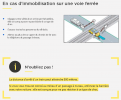
In France, for example, the official guidance (see attachment) has a section on what to do if stuck on a level crossing, which starts with the instruction to ram the barrier, and this message is reinforced with an image as well as a reminder box.
 

Attachments

  • passageaniveau.png
    passageaniveau.png
    163.7 KB · Views: 67

Bonafide

Member
Joined
6 Dec 2019
Messages
7
Location
Woking
The lorry appears to reverse across the level crossing much faster than normal walking pace, perhaps 8mph, so a pedestrian who starts to walk across the crossing just after the barrier closing sequence is initiated risks being hit on the head as the barrier on the far side of the crossing comes down.

The pedestrian could be lying on the ground injured, yet is deemed to be safe because the damaged barrier will prevent the signalling from clearing to permit a train over the crossing. According to the protocol suggested in this thread, the pedestrian would be held responsible because the railway had acted correctly.

Something about this incident and how the barriers at this level crossing are intended to be operated simply does not seem to make sense.
 

LowLevel

Established Member
Joined
26 Oct 2013
Messages
8,912
The lorry appears to reverse across the level crossing much faster than normal walking pace, perhaps 8mph, so a pedestrian who starts to walk across the crossing just after the barrier closing sequence is initiated risks being hit on the head as the barrier on the far side of the crossing comes down.

The pedestrian could be lying on the ground injured, yet is deemed to be safe because the damaged barrier will prevent the signalling from clearing to permit a train over the crossing. According to the protocol suggested in this thread, the pedestrian would be held responsible because the railway had acted correctly.

Something about this incident and how the barriers at this level crossing are intended to be operated simply does not seem to make sense.
There are timers so that the barriers fall in pairs rather than all 4 together. The answer to your question is not to walk beneath a falling barrier expecting it to stop for you. A quick Google will reveal very many videos from car parks of people choosing to walk under barriers being clonked on the head. **** happens.
 

GB

Established Member
Joined
16 Nov 2008
Messages
6,558
Location
Somewhere
so a pedestrian who starts to walk across the crossing just after the barrier closing sequence is initiated risks being hit on the head as the barrier on the far side of the crossing comes down.
...and how's that any different to a pedestrian using and Automatic Half Barrier crossing?
 

WestRiding

Member
Joined
21 Mar 2012
Messages
1,014
The lorry appears to reverse across the level crossing much faster than normal walking pace, perhaps 8mph, so a pedestrian who starts to walk across the crossing just after the barrier closing sequence is initiated risks being hit on the head as the barrier on the far side of the crossing comes down.

The pedestrian could be lying on the ground injured, yet is deemed to be safe because the damaged barrier will prevent the signalling from clearing to permit a train over the crossing. According to the protocol suggested in this thread, the pedestrian would be held responsible because the railway had acted correctly.

Something about this incident and how the barriers at this level crossing are intended to be operated simply does not seem to make sense.
The pedestrian would stop, if they have anything about them, rather than be hit on the head. Initially be trapped, and upon the signaller checking the crossing is clear, which it wouldn't be, would raise the barriers to free the person. All completely safe. Not the railways fault if somebody needlessly gets hit on the head. A case like this happened at Denaby around 2007, the court threw it out.

If the same happens at a AHB, there is an escape route, step to the left and walk around. No need to be hit on the head.

== Doublepost prevention - post automatically merged: ==

so a pedestrian who starts to walk across the crossing just after the barrier closing sequence is initiated risks being hit on the head as the barrier on the far side of the crossing comes down.
Well in that case, the pedestrian breaks the law.
 
Last edited:

BrianW

Established Member
Joined
22 Mar 2017
Messages
2,132
Is it workable to send all traffic round the local villages, rather than having the quick exit to Barlaston old road for the dual carriageway Stone Road?
It's not too much of a detour. And it used to happen anyway at nights and weekends. There aren't really any villages to pass through going the other way, and all HGVs have to go that way anyway.
Would the local authority have been able to require some improvement to these roads in relation to the extensive developments and more traffic- there are a lot of parking spaces at the 'works' too- Section 106/ Community Infrastructure Levy? Or does Sir/ Lord Wedgwood rule the roost? How about reopening the station- a 'green transport plan' for Wedgwoodworld? And the former siding now car parking??
 

zwk500

Veteran Member
Joined
20 Jan 2020
Messages
18,524
Location
Northampton
Would the local authority have been able to require some improvement to these roads in relation to the extensive developments and more traffic- there are a lot of parking spaces at the 'works' too- Section 106/ Community Infrastructure Levy? Or does Sir/ Lord Wedgwood rule the roost? How about reopening the station- a 'green transport plan' for Wedgwoodworld? And the former siding now car parking??
Some improvement yes, but the S.106 payments wouldn't have come close to providing a bridge over the railway, Local aristocrat or not. Reopening the station is being looked at, I believe, but it's very close to Barlaston and on the busy Stone-Stoke section where adding in stops in short succession could cause issues for the intercity traffic.
 

Deafdoggie

Established Member
Joined
29 Sep 2016
Messages
3,414
Would the local authority have been able to require some improvement to these roads in relation to the extensive developments and more traffic- there are a lot of parking spaces at the 'works' too- Section 106/ Community Infrastructure Levy? Or does Sir/ Lord Wedgwood rule the roost? How about reopening the station- a 'green transport plan' for Wedgwoodworld? And the former siding now car parking??
The land for the new houses was sold to the developers by Wedgwood. In that respect therefore Wedgwood isn't responsible for the development nor any improvements.
Although no official announcement, it's widely expected Barlaston station may reopen and Wedgwood will officially close. However, no-one is in a hurry to do either.
 

Llanigraham

On Moderation
Joined
23 Mar 2013
Messages
6,488
Location
Powys
That's actually the basic issue, that the railway only looks at things from their own perspective. Unfortunately, after 200 years of railways, RAIB still needs to issue fresh Learning Points ...

I do believe that when first introduced CCTV was portrayed as something that would ensure the full crossing sequence was overseen - and it was just one or two installations in a box. Slowly over time this view has been twisted such that it's only a final check, and it was made almost a peripheral task to other signal functions. It would be good to see the Risk Assessment of that change. The don't disobey the flashing lights even if an emergency vehicle comes initially from AHB rules, and fair enough. Somehow this got extrapolated to crossings which need full CCTV control and both-sides barriers, as here.

However, the only signage here is "Stop when lights show" (the rear of the lorry seems to have passed the stop line before they did) and notices about overhead line clearance. There is no "Large/slow vehicles phone signalbox" that you get at an AHB. In fact there's no phone. And yet somehow one is expected to know this one is automatic lowering without checking first as well. So just what is a slow vehicle meant to do?

Couple of points here that need correcting:
Even in a manual Box directly overlooking a crossing it isn't always possible to watch the whole proceedure. I can think of three crossing near my old Box when that is not possible.
The Rules about the flashing lights is NOT linked to AHB's. It is in place in numerous other places as well, from outside Fire Stations to moveable bridges.
 

Llanigraham

On Moderation
Joined
23 Mar 2013
Messages
6,488
Location
Powys
The lorry appears to reverse across the level crossing much faster than normal walking pace, perhaps 8mph, so a pedestrian who starts to walk across the crossing just after the barrier closing sequence is initiated risks being hit on the head as the barrier on the far side of the crossing comes down.

The pedestrian could be lying on the ground injured, yet is deemed to be safe because the damaged barrier will prevent the signalling from clearing to permit a train over the crossing. According to the protocol suggested in this thread, the pedestrian would be held responsible because the railway had acted correctly.

Something about this incident and how the barriers at this level crossing are intended to be operated simply does not seem to make sense.

In that "case" the pedestrian would have ignored the flashing lights, just as this driver apparently did.

And if we follow your argument to it's logical conclusion ALL crossings would have to be manned. Can youreally see that happening?
As is proven millions of times every day level crossings are NOT a problem when everyone obeys the Rules.
 

Baxenden Bank

Established Member
Joined
23 Oct 2013
Messages
4,746
Some improvement yes, but the S.106 payments wouldn't have come close to providing a bridge over the railway, Local aristocrat or not. Reopening the station is being looked at, I believe, but it's very close to Barlaston and on the busy Stone-Stoke section where adding in stops in short succession could cause issues for the intercity traffic.
Would the local authority have been able to require some improvement to these roads in relation to the extensive developments and more traffic- there are a lot of parking spaces at the 'works' too- Section 106/ Community Infrastructure Levy? Or does Sir/ Lord Wedgwood rule the roost? How about reopening the station- a 'green transport plan' for Wedgwoodworld? And the former siding now car parking??

Point of Order Chair.

Both Barlaston and Wedgwood stations are open. It's just that they haven't had a passenger train call at them since the WCML upgrade in 2004 (I think it was).

Wedgwood (the pottery producer) is owned by whatever Waterford Wedgwood Royal Doulton (WWRD) became after in 'went bust'. If I recall, the Irish owners bought the elements they wanted from the administrator / receiver, leaving the pension liabilites etc to fall upon the historic pottery collections held by the museum / trustees. Forcing the sale of rare items to fill the pension black hole.

The land for the new super-executive housing estate was bought by Barratts back in 2014 for £12m. The houses on the estate sold so far have brought in a total of £77.8m (182 sales out of approx 216 to be built, as per the most recent Land Registry data publicly available).

The council was more interested / excited at the prospect of new properties in Council Tax Band G and H than they were about residential development in the Green Belt or Section 106 receipts of any significance. Also the justification for the housing development was that the capital receipt (from sale of the land) was essential to allow investment in the remaining part of the factory and the jobs that would be saved as a result. I'm sure the applicants highway consultants will have produced figures showing how all the traffic would turn left out of the estate, and in any event it would be less traffic than if the factory were to return to full operation.
 
Status
Not open for further replies.

Top