alxndr
Established Member
- Joined
- 3 Apr 2015
- Messages
- 1,672
I’ve left REB/relay room doors open to try and achieve some cooling, but never a loc.
I’ve also wondered the sense of tending to put point and signal modules next to each other as they tend to generate a bit of heat themselves, and don’t seem too fond of overheating. It would seem prudent to me to intersperse them with other equipment so that they stand something of a chance of being able to dissipate the heat.
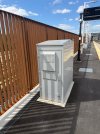
Locs are generally water tight, I can’t think of any which have actually let water in providing the doors have been shut. I have come across a wet dis box that we went back to the next sunny day and left it propped open and then sent the night shift back to secure it.Perhaps they were trying to dry the boxes out following the heavy storms that affected parts of London overnight?
The additional top has been discontinued as it’s now thought that the angle of the sun is too low at this latitude to be effective. We snapped up the last two in the country when looking for solutions to location cases which were severely rusting due to their position under bridges that allow the salt water from gritting to drip onto them in the winter. (If any S&T bods have any going spare we’ll take them!)We also see locs made out of a shiny unpainted material, stainless steel I assume, with louvred doors as mentioned above. Some also have a second top above the main one, presumably so that can take the heat from the sun without conducting it through to the inside of the cabinet.
Most tend to have them now in my experience. It makes a huge difference if they’re working, but unfortunately they’re not always. Maintenance of them needs to be more proactive rather than reactive IMO, as you only notice it’s gone wrong when either the temperature alarms (if monitoring is fitted), or if something within starts failing in the heat.I've seen relay rooms with air conditioner units on the side.
We had only one of the galvanised doors left before resignalling. Twelve or so years later I can still recall exactly where and which of the bank it was on because it wouldn’t half catch you out if you were expecting one of the lighter ones!The original doors (which lift off) also used galvanised sheet steel, but were very heavy, so a lighter metal was used instead (I don't know what).
I recall that a lot of the evaluators rapidly had their doors taken away too.And yes, electronic signalling equipment does fail if the air temperature in them gets too high. There have been failures of axle counter evaluator racks as a result... Network Rail learned the hard way that they needed to install an extra air conditioning unit in them...
I’ve also wondered the sense of tending to put point and signal modules next to each other as they tend to generate a bit of heat themselves, and don’t seem too fond of overheating. It would seem prudent to me to intersperse them with other equipment so that they stand something of a chance of being able to dissipate the heat.