• Our new ticketing site is now live! Using either this or the original site (both powered by TrainSplit) helps support the running of the forum with every ticket purchase! Find out more and ask any questions/give us feedback in this thread!

LNER A4s in service.

Status
Not open for further replies.

Magdalia

Established Member
Joined
1 Jan 2022
Messages
7,372
Location
The Fens
Top Shed had some steam passenger diagrams until it’s closure on Sunday 16th June 1963, so 34A allocated A4s would be seen daily between Kings Cross and Peterborough until then.
David Percival's "Kings Cross Lineside 1958-84" is the best source for this sort of thing. He writes:

As the last day drew near, the gallery on platform 10 every evening admired steam departures at 6.12, 6.17 and 6.26.

These were to Leeds, Peterborough and Doncaster. The last day refers to closure of "Top Shed".

Earlier in the evening were 4.21 to Peterborough and 5.5 to Grantham (with a portion for Cambridge) which I think were also steam hauled until Top Shed closed.

Only steam loco there. Must have been about 5pm. Name long forgotten, except it wasn't one of the celebrities.

Any ideas which train?
If your time is right probably the 5.5 to Grantham.

The Baby Deltic is a clue to the year; - 1962. All ten were stored out of use by May/June 1963, prior to being sent to Doncaster for refurbishment.
David Percival is also the best source on Baby Deltics, especially his article in Railway World May 1971. 7 of them were already out of traffic by autumn 1962, but D5905 hung on well into 1963 and was actually dragged away the same weekend that Top Shed closed.

The Baby Deltics were modified at Vulcan Foundry not Doncaster.
 
Sponsor Post - registered members do not see these adverts; click here to register, or click here to log in
R

RailUK Forums

Route115?

Member
Joined
26 Jun 2021
Messages
372
Location
Ruislip
"Mileage turns" still existed long after steam had finished. Drivers I knew at Cambridge in the 1970s told me that the threshold was 200 miles so a "double London" qualified but Cambridge-Kings Lynn-Liverpool Street-Cambridge did not.
Mileage payments were indeed unfair but tahts what comes out of pay negotiations. As an aside when were mileage allowances finally abolished? I assume that it was after privatisation with driver pay restructuring where ASLEF wanted "clean" salaries.
 

Gloster

Veteran Member
Joined
4 Sep 2020
Messages
12,970
Location
Up the creek
It looks as though D5900/1/5 were still operating into 1963, with D5905 being the last to go when it failed in June.

Source: Part 5, Third Edition, of The Allocation History of BR Diesels & Electrics, Roger Harris, (Author, 2005).
 

E27007

Member
Joined
25 May 2018
Messages
1,039
The spare boiler he purchased in 1966, came from withdrawn A3 60041. This boiler was stored at Carnforth for some years in the 1970s, and I can remember photographing it there, but the slides are long lost. When was it stored at Doncaster?
For several years , stored at Doncaster during the mid to late 1960s, the carrier was a a Lowmac type of wagon, something of a fixture, it never moved for years, then we noticed it had gone

== Doublepost prevention - post automatically merged: ==

The roller bearing A1 were noted for their extended mileages between main Works shopping for overhaul. "the most cost-effective express passenger locomotive to operate in Great Britain." If Peppercorn had specified A4 style streamlining on the A1, would the A1 have usurped the A4 as king of the ECML?
 
Last edited:

Elecman

Established Member
Joined
31 Dec 2013
Messages
3,571
Location
Lancashire
For several years , stored at Doncaster during the mid to late 1960s, the carrier was a a Lowmac type of wagon, something of a fixture, it never moved for years, then we noticed it had gone
Certainly was at Carr Loco as I saw it there in the early 70s
 

E27007

Member
Joined
25 May 2018
Messages
1,039
Mention of the Scotch Goods reminds of when Bill Hoole was in charge of it. He was running behind the down Talisman and such was the vigour of his driving, he caught up with the express he was following. IIRC some wagons had to be removed from the train with smoking axle bearings. I don’t thing management was best please.
I think the Bill Hoole anecdote was written up by Gerard Fiennes in his memoir, " I tried to run a railway"
 

70014IronDuke

Established Member
Joined
13 Jun 2015
Messages
4,068
Steam was almost completely eliminated from East Anglia in September 1962, and that's when the last J15s and J17s (and J20s) were withdrawn. Cambridge shed had closed a bit earlier, in June 1962.

March retained a steam allocation until November 1963, but only B1s, O1s and Britannias, mainly used on trains going north and west from March, and steam between March and Cambridge was rare after September 1962. But, according to Shedbash, J17s 65541/82 and J20s 64691/99 were still at March in July 1963, and I've not been able to trace when they departed or where they went.

Steam continued to reach Cambridge from the Bletchley direction until the turntable was removed in July 1964, so steam at Sandy, and J17s or J20s going for scrap on a steam hauled freight, in spring 1964 is plausible. But the train loco would be based at Bletchley, probably a Black 5 or a Standard 5.
I have just found my Winter 62-3 Combined volume and indeed, I have all four GE 0-6-0s you note here underlined.
That doesn't mean that I saw them on that day 60001 came flying through Sandy - I might have seen them at March in 61 or 62 (or, just possibly, Cambridge), but I definitely suspect that indeed at least some of them were in that scrap train. (I didn't think there were four locos in that train though, max 3 is in my memory.) That would put the date of 60001's venture south as late ast July 63 at the earliest.
 

Harvester

Established Member
Joined
9 Nov 2020
Messages
1,756
Location
Notts
I have just found my Winter 62-3 Combined volume and indeed, I have all four GE 0-6-0s you note here underlined.
That doesn't mean that I saw them on that day 60001 came flying through Sandy - I might have seen them at March in 61 or 62 (or, just possibly, Cambridge), but I definitely suspect that indeed at least some of them were in that scrap train. (I didn't think there were four locos in that train though, max 3 is in my memory.) That would put the date of 60001's venture south as late ast July 63 at the earliest.
According to ”What happened to steam” - Peter Hands: J17 65541 remained at March as a stationary boiler until Jan 1964, then went to Doncaster for scrap.

J20s 64691 and 64699 went into Doncaster Works for scrapping on 14 August 1963, and J17 65582 was cut up at Doncaster in September 1963, but no arrival date is given for the latter. Hence 65582, 64691 and 64699 could well have made up the scrap train, which must have run between 17 July (all still present at 31B) and 14 August 1963.
 

70014IronDuke

Established Member
Joined
13 Jun 2015
Messages
4,068
According to ”What happened to steam” - Peter Hands: J17 65541 remained at March as a stationary boiler until Jan 1964, then went to Doncaster for scrap.

J20s 64691 and 64699 went into Doncaster Works for scrapping on 14 August 1963, and J17 65582 was cut up at Doncaster in September 1963, but no arrival date is given for the latter. Hence 65582, 64691 and 64699 could well have made up the scrap train, which must have run between 17 July (all still present at 31B) and 14 August 1963.
Ah! Well, if they were cut at Doncaster, they wouldn't have been hauled via Cambridge and Sandy on the Bedford branch - they'd have presumably gone straight up to Spalding and the joint line. Sp that rules them out.
 

Gloster

Veteran Member
Joined
4 Sep 2020
Messages
12,970
Location
Up the creek
According to ”What happened to steam” - Peter Hands: J17 65541 remained at March as a stationary boiler until Jan 1964, then went to Doncaster for scrap.

J20s 64691 and 64699 went into Doncaster Works for scrapping on 14 August 1963, and J17 65582 was cut up at Doncaster in September 1963, but no arrival date is given for the latter. Hence 65582, 64691 and 64699 could well have made up the scrap train, which must have run between 17 July (all still present at 31B) and 14 August 1963.

As the What Really Happened to Steam site says, there were a lot of errors in Hands’ books, which have been perpetuated elsewhere, as he was fed a lot of false information by a fantasist. LMS and LNER locos seem to be particularly badly affected.
 

Harvester

Established Member
Joined
9 Nov 2020
Messages
1,756
Location
Notts
As the What Really Happened to Steam site says, there were a lot of errors in Hands’ books, which have been perpetuated elsewhere, as he was fed a lot of false information by a fantasist. LMS and LNER locos seem to be particularly badly affected.
That puts some more doubt on whether the two J20s, and J17 65582 went to Doncaster. One primary source (Railway Observer, April 1964) does however report 65541 being in Doncaster works for scrap. It was recorded during a RCTS visit on 9/2/64.
 

DHB1950

Member
Joined
22 Sep 2020
Messages
16
Location
Bedford
Top Shed had some steam passenger diagrams until it’s closure on Sunday 16th June 1963, so 34A allocated A4s would be seen daily between Kings Cross and Peterborough until then. From the start of the summer timetable (17 June 63) a steam ban came into force on the ECML south of Peterborough so scheduled steam workings ceased, but steam substitutes were fairly common.

The last report I can find of 60001 working up to London is in the Railway Observer. It worked a Newcastle to Kings Cross relief on Maundy Thursday 11 April 1963.

It is possible that I caught it's return the next week, I suppose. (I wasn't there over the Easter holiday, I'm fairly sure.) I have a feeling it was later, however, more like May or June.

Well, this has certainly sent me down a rabbit hole, but I found several ex-GER J15s listed on BRDatabase as cut at Cashmore’s West Bromwich, the last two in May 1963, 65564/69 iirc - I’ve closed that tab ;)

Unfortunately they are the only ex-GER 0-6–0s which have a cutting site given on BRDatabase, but the May 63 date fits well with 60001’s last recorded excursion to London. One of the two J15s was withdrawn from Stratford in September 63 (which still had several J15s then per BRDatabase - the other one is listed as withdrawn from March, also September 63).

A move from Stratford to West Bromwich via Cambridge and Bletchley for the WCML (or even via Oxford for the ex-GWR route) makes sense and so do the dates, and weather in late April or May can be pretty pleasant. 60001 doesn’t seem to have been in great shape (at least a year later anyway) and could easily have languished at the Cross with minor faults (still then open to steam with its own allocation of A4s, which presumably didn’t get much work by that time) before they shoved it back north on the working Iron Duke saw. Probably its last ever appearance at Sandy ;)

By April or May 1963 the loco hauling the 0-6-0s would almost certainly have been from Bletchley.
 

D6968

Member
Joined
30 Sep 2021
Messages
433
Well, this has certainly sent me down a rabbit hole, but I found several ex-GER J15s listed on BRDatabase as cut at Cashmore’s West Bromwich, the last two in May 1963, 65564/69 iirc - I’ve closed that tab ;)

Unfortunately they are the only ex-GER 0-6–0s which have a cutting site given on BRDatabase, but the May 63 date fits well with 60001’s last recorded excursion to London. One of the two J15s was withdrawn from Stratford in September 63 (which still had several J15s then per BRDatabase - the other one is listed as withdrawn from March, also September 63).

A move from Stratford to West Bromwich via Cambridge and Bletchley for the WCML (or even via Oxford for the ex-GWR route) makes sense and so do the dates, and weather in late April or May can be pretty pleasant. 60001 doesn’t seem to have been in great shape (at least a year later anyway) and could easily have languished at the Cross with minor faults (still then open to steam with its own allocation of A4s, which presumably didn’t get much work by that time) before they shoved it back north on the working Iron Duke saw. Probably its last ever appearance at Sandy ;)

By April or May 1963 the loco hauling the 0-6-0s would almost certainly have been from Bletchley.
Point of order, Cashmores yard was at Great Bridge, not West Bromwich (a bit pedantic maybe, but I’m a Black Country lad, trust me theres a difference) :D
 

70014IronDuke

Established Member
Joined
13 Jun 2015
Messages
4,068
Well, this has certainly sent me down a rabbit hole, but I found several ex-GER J15s listed on BRDatabase as cut at Cashmore’s West Bromwich, the last two in May 1963, 65564/69 iirc - I’ve closed that tab ;)

Unfortunately they are the only ex-GER 0-6–0s which have a cutting site given on BRDatabase, but the May 63 date fits well with 60001’s last recorded excursion to London. One of the two J15s was withdrawn from Stratford in September 63 (which still had several J15s then per BRDatabase - the other one is listed as withdrawn from March, also September 63).

A move from Stratford to West Bromwich via Cambridge and Bletchley for the WCML (or even via Oxford for the ex-GWR route) makes sense and so do the dates, and weather in late April or May can be pretty pleasant. 60001 doesn’t seem to have been in great shape (at least a year later anyway) and could easily have languished at the Cross with minor faults (still then open to steam with its own allocation of A4s, which presumably didn’t get much work by that time) before they shoved it back north on the working Iron Duke saw. Probably its last ever appearance at Sandy ;)

By April or May 1963 the loco hauling the 0-6-0s would almost certainly have been from Bletchley.
This all sounds plausible in theory - to a point. The point being that 65564/9 are not only not underlined in my 1961-2 winter combined volume, they are not even listed as in service!

This is not necessarily to say they were not the locos I saw in the scrap train - but I kind of think it unlikely if we are talking about engines passing by Sandy something like 2.5 years after withdrawal. Are you sure these are the numbers that are recorded as cut up at West Bromwich on the dates you say?

But yes, I would strongly believe that the sighting of 60001 at Sandy was the last time it passed through - it was a rare sight indeed to see any pacific at the time I saw it on a Class 1 express - that I am sure of. It was what made the entire 30 - 60 seconds of action stick in the memory!
 

Wilts Wanderer

Established Member
Joined
21 Nov 2016
Messages
3,199
What a fascinating discussion. One of my earliest memories was seeing Mallard at York in the late 80s on a northbound charter, must have been 1988-89 as I can’t have been more than 3 years old.

The earlier point made about Leeds-KX expresses not changing locos at Grantham is backed up by the book British Railway Centres No1: Leeds Central (Express Publishing) which stated that, once the viaduct at Wakefield had been strengthened to accept Pacifics in 1937, West Riding expresses (which confusingly included portions to Leeds, Harrogate, Bradford/Halifax, Hull and even York) were diagrammed as through engine workings to replace the prior arrangement of loco change at Doncaster. Copley Hill received an allocation of A3s, and later A1s, which worked through to Kings Cross, and of course Top Shed locos worked the other way. In a perhaps unsurprising bit of classic railway fragmentalisation, the historic separation of carriage and loco workings between London-West Riding (i.e. GNR) and London-NE England / Anglo-Scot (GNR-NER-NBR Joint) services continued right up until the end of top link steam haulage.

In 1957 one of the most arduous steam crew workings possible was diagrammed to Link 1 at Copley Hill - 1045 Leeds Central-Kings Cross (arr 1437), returning with 1540 Kings Cross-Leeds Central (arr 1919) - the White Rose no less. This was considered to be the hardest turn in the U.K. at the time. All other Leeds expresses worked through involved a lodging turn at either end for the crew.
 

D6130

Established Member
Joined
12 Jan 2021
Messages
9,028
Location
West Yorkshire/Tuscany
As an aside when were mileage allowances finally abolished? I assume that it was after privatisation with driver pay restructuring where ASLEF wanted "clean" salaries.
Correct. Mileage turns persisted even after the 'flexible rostering' disputes in 1982....and applied equally to guards. When I moved to Skipton in 1991, we still had two mileage turns in the top link - each one Skipton-Carlisle-Leeds-Skipton (226 miles). As you correctly say, they were abolished with train crew pay restructuring on privatisation in the late 1990s.
 

MarkyT

Established Member
Joined
20 May 2012
Messages
7,565
Location
Torbay
The A4s as built already had a good front end with streamlined steam passages. The four with double Kylchap front ends improved on that and in the mid/late 50s all the remaining A4s were similarly modified. All the indicator diagrams I've seen in books show that output was never equal across all three cylinders of the Pacifics be they Gresely, Thompson or Peppercorn. The trial that saw a few A4s with their middle cylinders sleeved up to reduce power output of that cylinder was discontinues and AFAIK all returned to normal and the next overhaul. One improvement was an early post nationalisation redesign of the big end which was successful and reduced dramatically the number of middle big end failures. The A4s were really on top of their form once these modifications were made but you must not forget the wonderful performances they put in during their pre war LNER days when coal was better and a dedicated maintenance regime was available. 2509's press run in September 1935 stands head and shoulders above most runs by steam in this country.
Gresley knew the Kylchap exhaust was the real game-changer for performance after the rest of the steam circuit had been streamlined, but the company couldn't afford the huge licensing fees for wider fitment prewar, which for each installation amounted to something like 10% of the cost of an entire new loco. Once the patent expired during WW2, Thompson, Peppercorn and BR(E) were free to use it more widely, and Doncaster got the engineering costs down to circa £200 per loco in the 1950s by simplification of the assembly in the smokebox (slightly more for an A4 than an A3 with the complex front end shape). After the formation of the NCB in 1947 the railway was still unable to get the special high-grade coal ordered previously for top link work before the war. After some years and some high-level government intervention, that situation improved again and by the mid-50s when my father was at Top Shed it was no longer a problem. In addition to the middle big-end issues, there was a problem with a weird conical wear pattern on the axle bearings of the centre axle onto which all cylinders drive in the standard Gresley 3-cylinder V-form design. Dad mitigated both these problems by arranging to have centre axle and middle big-end bearings renewed routinely at 36,000 miles. No in-service failures of either were experianced after that. Dad certainly never believed the conjugated valve gear had much to do with the problem and it may have been simply the huge forces involved on that axle on an A4 when at full power and speed. He never had any problems with 2 to 1 on any locos and it significantly reduced risk of missing oiling points in preparation as there was simply very little needing attention between the frames. One theory was that, with the middle connecting rod flying around, there was no room to put in any additional cross-bracing or other strengthening between the frames and there was often some visible distortion of the frames in that area around the centre driving axle box horns. I remember seeing this on Sir Nigel Gresley when it was first disassembled for its recent overhaul at York and I visited with Dad. There had been new frame pieces welded in around the horn area, possibly from its initial overhaul in preservation at Crewe in the 1960s. I have my own wild speculative theory that on the A4s, a gyroscopic force was in play and became significant because the crank axle was so heavy, well-balanced and so quickly rotated on the fastest express duties. Thompson actually got it right in splitting the drive arrangement I think, connecting the middle cylinder to the leading driving axle instead and Peppercorn refined that concept in the A1s and A2s, realising the connecting rods didn't all have to be exactly the same length. There was an LNER divided-drive design prewar in the shape of the B17, which incorporated Gresley's 2 to 1 gear in a different position between the outside and inside middle cylinder which was projected forward in a similar arrangement to the later Peppercorns. Importantly, it didn't need the middle cylinder inclined steeply to clear the leading driving axle so they could all be in line and could have valve events set to exactly 120 degrees apart, hence didn't need the fiddle factor incorporated as in the classic Gresley arrangement.
 

Magdalia

Established Member
Joined
1 Jan 2022
Messages
7,372
Location
The Fens
Thanks to @Cowley for reopening this.

One of the few I remember - mainly because it was surely the last A4 I saw at the London end in normal service, and the last I copped - was 60001.

I think this must have been a pleasant day in 1964, probably April or May. I was at Sandy, on the road bridge to the north of the station. It was around 17.00 and about to leave, when (I forget the order) the up main was pulled off, the down main was pulled off, and the Bedford branch too was pulled off (quite an unusual occurrence). Well, I couldn't leave then, of course. First past was the Bedford branch train - which comprised a train loco - I forget what it was, possibly a B1 or K3, and two GER 0-6-0s (J17s or J15s) going west, presumably all for scrap, though I've no idea where to.

This cavalcade had barely gone by when an A4 appeared on the down main - a mighty rare occurence by this time - and it was 60001 hurrying north - presumably deputising for a failed Deltic on the 16.00 ex KX Talisman (although I didn't realise this at the time). And as this train was still passing under the bridge, the up express hurtled past too. I missed that, of course, as I was still looking to the south. I think it was a Class 40, BICBW.
This story has fascinated me since I first read it, and I have been trying to work out when it happened.
The last report I can find of 60001 working up to London is in the Railway Observer. It worked a Newcastle to Kings Cross relief on Maundy Thursday 11 April 1963.
My research has this too, with 60001 going back north on a Kings Cross-Edinburgh overnight relief.

But 60001's penultimate visit to Kings Cross was on 14 March 1963 when it worked out on 1N22 4.5 pm Kings Cross-Leeds. Timewise this fits with the original story. Weatherwise it fits at a stretch too: in March 1963 anything above freezing would have felt pleasant after what had gone before in January and February.
I have just found my Winter 62-3 Combined volume and indeed, I have all four GE 0-6-0s you note here underlined.
That doesn't mean that I saw them on that day 60001 came flying through Sandy - I might have seen them at March in 61 or 62 (or, just possibly, Cambridge), but I definitely suspect that indeed at least some of them were in that scrap train. (I didn't think there were four locos in that train though, max 3 is in my memory.) That would put the date of 60001's venture south as late ast July 63 at the earliest.
But March (date) 1963 rules out the locos that were stored at March (place) as they did not move until July 1963 at the earliest.
Well, this has certainly sent me down a rabbit hole, but I found several ex-GER J15s listed on BRDatabase as cut at Cashmore’s West Bromwich, the last two in May 1963, 65564/69 iirc - I’ve closed that tab ;)

Unfortunately they are the only ex-GER 0-6–0s which have a cutting site given on BRDatabase, but the May 63 date fits well with 60001’s last recorded excursion to London. One of the two J15s was withdrawn from Stratford in September 63 (which still had several J15s then per BRDatabase - the other one is listed as withdrawn from March, also September 63).

A move from Stratford to West Bromwich via Cambridge and Bletchley for the WCML (or even via Oxford for the ex-GWR route) makes sense and so do the dates, and weather in late April or May can be pretty pleasant. 60001 doesn’t seem to have been in great shape (at least a year later anyway) and could easily have languished at the Cross with minor faults (still then open to steam with its own allocation of A4s, which presumably didn’t get much work by that time) before they shoved it back north on the working Iron Duke saw. Probably its last ever appearance at Sandy ;)

By April or May 1963 the loco hauling the 0-6-0s would almost certainly have been from Bletchley.

This all sounds plausible in theory - to a point. The point being that 65564/9 are not only not underlined in my 1961-2 winter combined volume, they are not even listed as in service!

This is not necessarily to say they were not the locos I saw in the scrap train - but I kind of think it unlikely if we are talking about engines passing by Sandy something like 2.5 years after withdrawal. Are you sure these are the numbers that are recorded as cut up at West Bromwich on the dates you say?

But yes, I would strongly believe that the sighting of 60001 at Sandy was the last time it passed through - it was a rare sight indeed to see any pacific at the time I saw it on a Class 1 express - that I am sure of. It was what made the entire 30 - 60 seconds of action stick in the memory!

So I looked instead at the last GER 0-6-0s withdrawn and/or stored at Stratford. There are 10 J15s withdrawn in August or September 1962 known to have been stored at Stratford in October 1962.

4 of them are known to have moved on 12/11/62 to Cashmores for cutting up: 65420/453/460/476.
2 of them are known to have lingered at Stratford: 65462 was preserved and 65445 was photographed in a scrapyard in nearby Poplar in 1964.

We can eliminate these from our enquiries!

But the other 4 are possible suspects, and they break into 2 pairs: 65361 with 65465 and 65464 with 65469.

BR Database has 65464/469 scrapped at Cashmores in May 1963, but I have contradictory reports that they were still at Stratford until at least September 1963.

BR Database has 65465 scrapped at Cashmores in January 1963, but no details for 65361. WHTS has both of these still at Stratford on 10/03/63 and 31/03/63, but there are no known sightings after that.

This all sounds plausible in theory - to a point. The point being that 65564/9 are not only not underlined in my 1961-2 winter combined volume, they are not even listed as in service!

Before trying to come to a conclusion, I need to know whether any of 65361, 65464, 65465 and 65469 are underlined in the trusty 1961-62 winter combined volume!
 
Last edited:

70014IronDuke

Established Member
Joined
13 Jun 2015
Messages
4,068
Thanks to @Cowley for reopening this.


This story has fascinated me since I first read it, and I have been trying to work out when it happened.

My research has this too, with 60001 going back north on a Kings Cross-Edinburgh overnight relief.

But 60001's penultimate visit to Kings Cross was on 14 March 1963 when it worked out on 1N22 4.5 pm Kings Cross-Leeds. Timewise this fits with the original story. Weatherwise it fits at a stretch too: in March 1963 anything above freezing would have felt pleasant after what had gone before in January and February.
It certainly matches the passing time (more or less) at Sandy.
But 14 March, 1963, at approx 17.00, I suspect would still be 'orribly cold. And with sunset at around 18.00, I think it would, in all probability (knowing English weather), cloudy and very gloomy. And very much 'let's get home sooner rather than later' time.

This is not my memory at all. I would bet a decent pint that my experience was most definitely later (and warmer) that 14 March, 1963, which means that that day was not the penultimate working of 60001 out of Kings Cross.

But March (date) 1963 rules out the locos that were stored at March (place) as they did not move until July 1963 at the earliest.

So I looked instead at the last GER 0-6-0s withdrawn and/or stored at Stratford. There are 10 J15s withdrawn in August or September 1962 known to have been stored at Stratford in October 1962.

4 of them are known to have moved on 12/11/62 to Cashmores for cutting up: 65420/453/460/476.
2 of them are known to have lingered at Stratford: 65462 was preserved and 65445 was photographed in a scrapyard in nearby Poplar in 1964.

We can eliminate these from our enquiries!

But the other 4 are possible suspects, and they break into 2 pairs: 65361 with 65465 and 65464 with 65469.

BR Database has 65464/469 scrapped at Cashmores in May 1963, but I have contradictory reports that they were still at Stratford until at least September 1963.

BR Database has 65465 scrapped at Cashmores in January 1963, but no details for 65361. WHTS has both of these still at Stratford on 10/03/63 and 31/03/63, but there are no known sightings after that.

Before trying to come to a conclusion, I need to know whether any of 65361, 65464, 65465 and 65469 are underlined in the trusty 1961-62 winter combined volume!
I have indeed found the trusty 1961-2 combined volume. And looked up said numbered locos, all of which are listed as in traffic when the book was published. And, having examined said combined volume, I can hereby declare, with hand on heart ... none of these four locomotives is underlined. (sob - I wish one or two were. 65462 is underlined, and I even cabbed it - I have absolutely no idea where or when! But none of the four you mention. Very sorry.)

So, I think we can rule out that any of these four locos were in the train heading west for scrap when I saw them back in ... well, when?

There are really three (at least) mysteries here, all a result of my memory of this observation:

1) A4 60001 was heading north through Sandy at approx 17.00 with a down express one day when steam, any steam, on Class 1 trains on the ECML was either not common, or - and this is my memory of the event - actually very rare indeed. This is why I placed it as more likely Spring 1964 orginally. It might have been late Spring or Summer 63, but March '63 ... I don't think so.

Gosh, at that time, the Beatles had just had their first number 1 hit with "Please, Please Me" ... doesn't that take you back?

2) What were the ex-GER 0-6-0s being towed west towards Bedford/Bletchley at the same time? And where did they originate from?

3) Why were these locos being towed on this route and where were these ex-GER 0-6-0s heading? This, for me, is possibly the most 'mysterious' question, even if it appears far less exotic than Qn1 and its association with the celebrated A4s. (And as much as I would like to know the answer to this today!)

A year or two later, it was a reasonably common occurence to have ex-SR locos (Ns, Us, Qs?, Q1s and S15s) towed EASTWARDS on the Oxford - Cambridge line for scrapping at King's yard in Norwich, but I never knew of, or saw, any other ER locomotives being towed westwards on the route for scrapping. It is a real mystery not only what they were, but where they ended up!

 

Magdalia

Established Member
Joined
1 Jan 2022
Messages
7,372
Location
The Fens
I have indeed found the trusty 1961-2 combined volume. And looked up said numbered locos, all of which are listed as in traffic when the book was published. And, having examined said combined volume, I can hereby declare, with hand on heart ... none of these four locomotives is underlined. (sob - I wish one or two were. 65462 is underlined, and I even cabbed it - I have absolutely no idea where or when! But none of the four you mention. Very sorry.)
Thanks for looking. I'm a bit disappointed too, but all is not lost!

I would bet a decent pint that my experience was most definitely later (and warmer) that 14 March, 1963, which means that that day was not the penultimate working of 60001 out of Kings Cross.
1) A4 60001 was heading north through Sandy at approx 17.00 with a down express one day when steam, any steam, on Class 1 trains on the ECML was either not common, or - and this is my memory of the event - actually very rare indeed. This is why I placed it as more likely Spring 1964 orginally. It might have been late Spring or Summer 63, but March '63 ... I don't think so.

Gosh, at that time, the Beatles had just had their first number 1 hit with "Please, Please Me" ... doesn't that take you back?
It does appear that the 4.5 pm Kings Cross-Leeds was still regularly steam hauled in spring 1963. I have found the following in Railway Observer June 1963. I'm quoting it at length because I'm not sure how to interpret it, and would like to know what those who remember "Please Please Me" make of it!

From 1st April class 7 freight workings were extended to the Southern section of the GN and Brush type 4s have replaced steam engines on a number of coal trains. Many class 4 freights were also handed over. The Kings Cross B1 working to Hull has disappeared. The up train is now worked from Peterborough by a Finsbury Park Brush diesel. Kings Cross have lost their working on the 4-5 (SX) Leeds passenger; this train has been worked by NE Pacifics including A3s 60040/42/53/77 and various A1s.

I think that this makes it at least possible that 60001 made another unrecorded appearance on the 4.5 pm Kings Cross-Leeds right up to the June timetable change. Would others agree?
2) What were the ex-GER 0-6-0s being towed west towards Bedford/Bletchley at the same time? And where did they originate from?

3) Why were these locos being towed on this route and where were these ex-GER 0-6-0s heading? This, for me, is possibly the most 'mysterious' question, even if it appears far less exotic than Qn1 and its association with the celebrated A4s. (And as much as I would like to know the answer to this today!)
This is the bit that most interests me too!

but I never knew of, or saw, any other ER locomotives being towed westwards on the route for scrapping. It is a real mystery not only what they were, but where they ended up!
That's because I do know of ER locomotives being towed westwards by this route, but they are B1s and K3s, not 0-6-0s. The dates are in June 1963, with the last on 2 July 1963. These are immediately after the Peterborough Black Bridge fire, which was 60 years ago today, blocking the usual route west from March towards the LMR.

The B1s and K3s had been stored at March, and were hauled away via Cambridge and Bletchley, some to Cashmores but mainly to Central Wagon Co at Ince. I don't have a full list of moves and I'm looking for at least two more for K3s, which could also have been in the last week of May 1963. The hauling locos were a mix of O1s, WDs, B1s and Brush Type 2s.

So a date in late May or early June 1963 is plausible, but only if there is an unrecorded appearance by 60001 on the 4.5 pm Kings Cross-Leeds coincident with a scrap move of B1s or K3s (not 0-6-0s) to Cashmores or Central Wagon Co.
 

Bevan Price

Established Member
Joined
22 Apr 2010
Messages
8,327
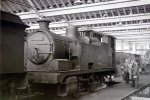
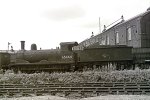
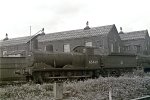
These photos were taken at Stratford MPD on 11 August 1963:

Departmental 33, 65464 and 65469.
 

Attachments

  • xbw630707n_StratfordMPD_110863.jpg
    xbw630707n_StratfordMPD_110863.jpg
    1.6 MB · Views: 19
  • xbw630708n_StratfordMPD_110763.jpg
    xbw630708n_StratfordMPD_110763.jpg
    2.7 MB · Views: 19
  • xbw630709n_StratfordMPD_110863.jpg
    xbw630709n_StratfordMPD_110863.jpg
    2.7 MB · Views: 19
Last edited:

70014IronDuke

Established Member
Joined
13 Jun 2015
Messages
4,068
It does appear that the 4.5 pm Kings Cross-Leeds was still regularly steam hauled in spring 1963. I have found the following in Railway Observer June 1963. I'm quoting it at length because I'm not sure how to interpret it, and would like to know what those who remember "Please Please Me" make of it!

I think that this makes it at least possible that 60001 made another unrecorded appearance on the 4.5 pm Kings Cross-Leeds right up to the June timetable change. Would others agree?
Yup.
That's because I do know of ER locomotives being towed westwards by this route, but they are B1s and K3s, not 0-6-0s. The dates are in June 1963, with the last on 2 July 1963. These are immediately after the Peterborough Black Bridge fire, which was 60 years ago today, blocking the usual route west from March towards the LMR.

The B1s and K3s had been stored at March, and were hauled away via Cambridge and Bletchley, some to Cashmores but mainly to Central Wagon Co at Ince. I don't have a full list of moves and I'm looking for at least two more for K3s, which could also have been in the last week of May 1963. The hauling locos were a mix of O1s, WDs, B1s and Brush Type 2s.
Ince in Lancashire? Why didn't they take them via March, Spalding and the joint?

So a date in late May or early June 1963 is plausible, but only if there is an unrecorded appearance by 60001 on the 4.5 pm Kings Cross-Leeds coincident with a scrap move of B1s or K3s (not 0-6-0s) to Cashmores or Central Wagon Co.
No. I didn't see any B1s AFAIR and I don't think there was a K3 (might have been). The main locos in the consist was ex-GER 0-6-0s.
And the interesting personal aspect was I think I 'copped' them all. Now I had been to both Cambridge and March in 1961-2, so I'd seen a good many of the locos allocated to those shed. This indicates the locos on that day did not originate from either of those two depots.

Eee by gum, if only I'd still got those logbooks!
 

Harvester

Established Member
Joined
9 Nov 2020
Messages
1,756
Location
Notts
It does appear that the 4.5 pm Kings Cross-Leeds was still regularly steam hauled in spring 1963. I have found the following in Railway Observer June 1963. I'm quoting it at length because I'm not sure how to interpret it, and would like to know what those who remember "Please Please Me" make of it!

I think that this makes it at least possible that 60001 made another unrecorded appearance on the 4.5 pm Kings Cross-Leeds right up to the June timetable change. Would others agree?
From the June timetable change (17/6/63) the 4.05 pm departure to Leeds was moved back to a 4.20 pm departure, and so would reach Sandy pretty close to 5 o’clock. In the months prior to this date steam was still fairly common on ECML passenger workings south of Peterborough, on rostered diagrams, substitutes for failed diesels and the Kings Cross-Peterborough locals. @IronDuke seems positive steam had become rare by the time he spotted 60001 which seems to suggest the date was after 17/6/63.

Steam substitutes still continued south of Peterborough during the summer months that year, despite their ban south of Hitchin. Indeed the Railway Observer reports that in July 1963 Gateshead A4s were in charge of the up Northumbrian on four occasions, although 60001 was not one of them. The last 52A A4 recorded at Kings Cross was 60023 in November 1963.
 
Last edited:

L+Y

Member
Joined
4 Jul 2011
Messages
502
Aside from the last few years in Scotland, did A4s stray off ECML workings at all under LNER/BR, or were they as fixed to the main line as their Deltic successors?
 

Gloster

Veteran Member
Joined
4 Sep 2020
Messages
12,970
Location
Up the creek
Aside from the last few years in Scotland, did A4s stray off ECML workings at all under LNER/BR, or were they as fixed to the main line as their Deltic successors?

They apparently made a few trips over the Settle & Carlisle. It seems that most, if not all, the appearances were due to late substitutions.
 

Harvester

Established Member
Joined
9 Nov 2020
Messages
1,756
Location
Notts
Aside from the last few years in Scotland, did A4s stray off ECML workings at all under LNER/BR, or were they as fixed to the main line as their Deltic successors?
They were fairly common over the Waverley route (Edinburgh-Carlisle), between Leeds-Newcastle (via Harrogate-Northallerton) and on the Durham Coast line. I grew up close to the latter, and between 1961-1963 saw all of Gateshead‘s A4s, all of Top Shed’s except 60007 and 60022, and also Haymarket’s 60009. The latter was ex works on a Leeds-Newcastle semi-fast in August 1961. They also worked Sunday diversions in the NER via Bishop Aukland, and over the Leamside route.
 

Wilts Wanderer

Established Member
Joined
21 Nov 2016
Messages
3,199
They were fairly common over the Waverley route (Edinburgh-Carlisle), between Leeds-Newcastle (via Harrogate-Northallerton) and on the Durham Coast line. I grew up close to the latter, and between 1961-1963 saw all of Gateshead‘s A4s, all of Top Shed’s except 60007 and 60022, and also Haymarket’s 60009. The latter was ex works on a Leeds-Newcastle semi-fast in August 1961. They also worked Sunday diversions in the NER via Bishop Aukland, and over the Leamside route.

There was one long-standing booked working over the Waverley Route; a southbound early morning parcels train and returning on one of the hourly fitted freights.
 

Harvester

Established Member
Joined
9 Nov 2020
Messages
1,756
Location
Notts
There was one long-standing booked working over the Waverley Route; a southbound early morning parcels train and returning on one of the hourly fitted freights.
There is a mention in the Railway Observer (April 1961 issue) that ex-works A4 60004 made it’s first appearance for over a year on a passenger train at Newcastle on 22/2/61. The report also adds that this (elusive) A4 had been relegated to freight work throughout 1960 and restricted to the Waverley route.
 
Status
Not open for further replies.

Top