• Our new ticketing site is now live! Using either this or the original site (both powered by TrainSplit) helps support the running of the forum with every ticket purchase! Find out more and ask any questions/give us feedback in this thread!

Light Rail v Heavy Rail

Pick what you would prefer on your local line.


  • Total voters
    86
Status
Not open for further replies.

cle

Established Member
Joined
17 Nov 2010
Messages
5,634
A tram-train with its insane acceleration will probably do quite well compared to the current journey times out to Warrington Central, even running all stops.
That is my thinking. 25 mins all-stops to Alty flies by. Not to mention average wait and one-seat ride to more parts of Manchester. Cornbrook connectivity also for MediaCity and the South Manchester lines.

No to mention, quieter and greener. It wouldn't justify heavy rail wires at the current frequency - which also only gets to Oxford Road and ideally we need that bay demo-ed - but at 5tph and with all the suppressed demand - definitely.
 
Sponsor Post - registered members do not see these adverts; click here to register, or click here to log in
R

RailUK Forums

Purple Orange

On Moderation
Joined
26 Dec 2019
Messages
3,459
Location
The North
That is my thinking. 25 mins all-stops to Alty flies by. Not to mention average wait and one-seat ride to more parts of Manchester. Cornbrook connectivity also for MediaCity and the South Manchester lines.

No to mention, quieter and greener. It wouldn't justify heavy rail wires at the current frequency - which also only gets to Oxford Road and ideally we need that bay demo-ed - but at 5tph and with all the suppressed demand - definitely.
This all day long. The notion of not converting lines across the various city regions (especially if political boundaries are given as a reason for saying no) purely holds back the economic development of a given city.
 

LOL The Irony

Established Member
Joined
29 Jul 2017
Messages
5,335
Location
Chinatown, New York
I picked those options specifically because that tends to be the options at hand. It is never a 5 tph heavy rail service converted to a 5 tph light rail service. Lines are converted to light rail as part of a discreet network because as a heavy rail line there isnt the capacity to operate atvthe frequencies needed. Hence why asking the question of 2 tph heavy rail v 5 tph light rail.
I see, fair enough.

Unfortunately, the Metrolink everything including your kitchen sink brigade have come across this thread.
Almost nobody is going to pick an ancient Sprinter over an M5000.
How about a T-68 vs a 350?
 

daodao

Established Member
Joined
6 Feb 2016
Messages
3,601
Location
Dunham/Bowdon
25 mins all-stops to Alty flies by.
That is true from Deansgate to Altrincham, although the tram journey from Piccadilly to Deansgate is a crawl taking about 10 minutes.

This all day long. The notion of not converting lines across the various city regions (especially if political boundaries are given as a reason for saying no) purely holds back the economic development of a given city.
Unfortunately, there aren't a large number of existing heavy rail lines that can be converted, as they are often also used by fast or freight trains. Many of the potential lines not only serve urban areas, but extend into surrounding countryside serving smaller villages where 1-2 tph may suffice. Examples include all the ex-LNW lines south from Piccadilly.
 

Purple Orange

On Moderation
Joined
26 Dec 2019
Messages
3,459
Location
The North
That is true from Deansgate to Altrincham, although the tram journey from Piccadilly to Deansgate is a crawl taking about 10 minutes.


Unfortunately, there aren't a large number of existing heavy rail lines that can be converted, as they are often also used by fast or freight trains. Many of the potential lines not only serve urban areas, but extend into surrounding countryside serving smaller villages where 1-2 tph may suffice. Examples include all the ex-LNW lines south from Piccadilly.
WCML is obviously out of the question. Glossop, Hadfield, Rose Hill, Atherton are all fair game for conversion to metrolink. After that there isnt much else to go at, apart from extending existing lines.

However there is opportunity for the Styal Line and CLC to see a more uniform service pattern tending towards metro service levels. It is a long term situation for those two lines and it all depends on the delivery of NPR and HS2.
 

daodao

Established Member
Joined
6 Feb 2016
Messages
3,601
Location
Dunham/Bowdon
However there is opportunity for the Styal Line and CLC to see a more uniform service pattern tending towards metro service levels.
The Styal and CLC lines only merit higher frequencies for stopping trains within the metropolitan areas, which within Greater Manchester means as far west as Irlam on the CLC line to Liverpool and between Piccadilly and the Airport on the "Styal" line.
 

cle

Established Member
Joined
17 Nov 2010
Messages
5,634
The Styal and CLC lines only merit higher frequencies for stopping trains within the metropolitan areas, which within Greater Manchester means as far west as Irlam on the CLC line to Liverpool and between Piccadilly and the Airport on the "Styal" line.
Which is why the former belongs on Metrolink. Far greater numbers than Warrington (who are served) and the main Liverpool-Manchester route has changed, crucially - so the CLC is not what it once was.

Styal line should remain heavy rail, but definitely with some adjusted stopping patterns to provide a decent Manchester commuter service. Airport to be third stop on all services out of Piccadilly, for instance and at 9tph we can nearly get 4tph to each station.
 

miklcct

Established Member
Joined
2 May 2021
Messages
5,017
Location
Cricklewood
Travelling in London shows just how much difference frequency makes to the usefulness of public transport. In Devon, I barely use public transport, as the flexibility just isn't there. In London, I wouldn't even consider getting out the car. That's why I voted for 5tph over 2tph.

I see speed, rather than frequency, as the main measure of the usefulness of public transport. If the car takes 15 minutes to get from A to B but the frequent tram (let's say on 2-minute headway) takes 45 minutes because of circuitous routing, I will use a car if I can afford one.

However, if the train only takes 10 minutes, I will shift to it immediately, no matter it is 5 tph or 2 only. The main measure is how the journey time compared to a car, and whenever the total journey time is within 1.5x of driving I prefer public transport.
 

py_megapixel

Established Member
Joined
5 Nov 2018
Messages
7,474
Location
Northern England
How about a T-68 vs a 350?
Well then I'd probably choose the 350 if the frequency is the same. But you aren't getting anything remotely close in quality or quantity to five 350s an hour to Rose Hill on heavy rail. If they were still in service, five T68s an hour would be an entirely realistic prospect.

Heavy rail is, compared to light rail, simply less well suited to providing a frequent-departure, frequent-stop local stopping service cost-effectively. It stands to reason, therefore, that heavy rail lines which exist solely to support a frequent-stop service (i.e. there is no traffic on those lines other than the stoppers) within a metropolitan area which has light rail, should be converted to light rail where possible, to allow better service to be provided with smaller increases in cost.
 

Ianno87

Veteran Member
Joined
3 May 2015
Messages
15,214
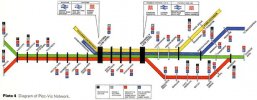
The Picc-Vic network was proposed at 2 tph on each route, so while the Radcliffe-Piccadilly section would have had 8 tph, the outer sections in south Manchester and into Cheshire would only have been 2 tph.

No it wasn't, it was 6tph on each service pattern:

Bolton-Styal-Wilmslow
Bury-Alderley Edge
(Rochdale)-Victoria-Macclesfield
(Rochdale-Oldham)-Victoria-Hazel Grove-(Buxton)
 

LOL The Irony

Established Member
Joined
29 Jul 2017
Messages
5,335
Location
Chinatown, New York
Well then I'd probably choose the 350 if the frequency is the same.
See, the entire Sprinter vs M5000 argument is just a bunch of whataboutism and you admit it yourself via this post. As I and @Bletchleyite said before, if given the choice between LRV or train for a metro service, from a passenger standpoint, any sane person is picking the train.
 

py_megapixel

Established Member
Joined
5 Nov 2018
Messages
7,474
Location
Northern England
See, the entire Sprinter vs M5000 argument is just a bunch of whataboutism and you admit it yourself via this post. As I and @Bletchleyite said before, if given the choice between LRV or train for a metro service, from a passenger standpoint, any sane person is picking the train.
You haven't paid attention to the rest of the post, have you...
 

Ianno87

Veteran Member
Joined
3 May 2015
Messages
15,214
See, the entire Sprinter vs M5000 argument is just a bunch of whataboutism and you admit it yourself via this post. As I and @Bletchleyite said before, if given the choice between LRV or train for a metro service, from a passenger standpoint, any sane person is picking the train.

Only where capacity, journey time and frequency are like-for-like

== Doublepost prevention - post automatically merged: ==

I did. In a straight up head to head of 5tph, LRV vs train, you're picking the train.

Not if its not stopping at your stop it isn't. Light Rail adds capability to serve more intermediate stops.
 

py_megapixel

Established Member
Joined
5 Nov 2018
Messages
7,474
Location
Northern England
I did. In a straight up head to head of 5tph, LRV vs train, you're picking the train.
But there will never be a choice of 5tph LRV vs train on the routes being discussed here.
Plus it depends what the LRV and train are. If the train is a Northern sprinter - which it would be; nobody's magicking up 350s - then I'd pick any light rail in service in this country over it.

I also find it ironic that you have accused me of whataboutism when it's you that's pulled the idea of a 5tph service of 350s on any of the lines currently proposed for Metrolink conversion out of thin air.
 

Peregrine 4903

Established Member
Joined
18 Aug 2019
Messages
1,518
Location
London
Which is why the former belongs on Metrolink. Far greater numbers than Warrington (who are served) and the main Liverpool-Manchester route has changed, crucially - so the CLC is not what it once was.

Styal line should remain heavy rail, but definitely with some adjusted stopping patterns to provide a decent Manchester commuter service. Airport to be third stop on all services out of Piccadilly, for instance and at 9tph we can nearly get 4tph to each station.
And so, when engineering works are on, there would be no services between Manchester and Liverpool, that's completely unacceptable in my view and is why the CLC should not be converted at all in my view, and if you are desperate to convert it, then wait until an alternative Mancherster - Liverpool route through NPR is built.
 

LOL The Irony

Established Member
Joined
29 Jul 2017
Messages
5,335
Location
Chinatown, New York
But there will never be a choice of 5tph LRV vs train on the routes being discussed here.
I am answering the original question which was;
What do you prefer?
The question and thread title don't fully line up with what's on the poll. Ideally, it should be; "Do you prefer Trains or LRVs?" and "Would you rather have 2tph or 5tph?". If it was split like that, it would be trains and 5tph. As I said in my original post, most people would go for the greater frequency, however, would also prefer a train over an LRV.

The poll title itself being "Pick what you would prefer on your local line", meaning that each point of view will most likely wind up being different.

If the train is a Northern sprinter - which it would be; nobody's magicking up 350s - then I'd pick any light rail in service in this country over it.
Well this thread never said what train or LRV would be up against each other, again showing every POV will wind up being different.
I also find it ironic that you have accused me of whataboutism when it's you that's pulled the idea of a 5tph service of 350s on any of the lines currently proposed for Metrolink conversion out of thin air.
I'm talking from a nationwide standpoint here, and it's you who keeps pulling this "every Northern service will be an awful Sprinter" nonsense out every time someone brings up alternatives to trams. My T-68 vs 350 was simply pointing out that your fallback of Sprinter vs M5000 argument can be turned around to make the tram look bad. Both have their strengths and weaknesses but remember that the other side also has gold standards, hence the 350. If we pick and choose, we can make anything look good or bad.

So anyways, no specific routes were ever mentioned in the initial question which I was responding to and continuing down this path is ignoring what I originally said to begin with, which for the record was;
I find the 2 questions slightly disingenuous. Of course most people are going to pick the greater service pattern. Now if it was a choice between equal service patterns, heavy rail would be miles in the lead.

And before it's brought up, yes I did talk about Picc-Vic and Metrolink before, but that scenario did involve time machines, so if you took it as anything but purely theoretical or alt history, then well...
Also, I never said anywhere that Metrolink would cease to exist, as Eccles, Ashton and the Airport would still exist. And as I recall, Picc-Vic was to be powered by 25kv AC trains, so y'know, no diesel sheds.

 

daodao

Established Member
Joined
6 Feb 2016
Messages
3,601
Location
Dunham/Bowdon
No it wasn't, it was 6tph on each service pattern:

Bolton-Styal-Wilmslow
Bury-Alderley Edge
(Rochdale)-Victoria-Macclesfield
(Rochdale-Oldham)-Victoria-Hazel Grove-(Buxton)
That is not wholly correct, in 2 respects:
  • There were never any proposals to extend the services to Oldham/Rochdale or to Buxton
  • The base/off-peak service frequency was to be 2 tph on each route, with more frequent services (6 tph) only at peak periods.
The concept of high all day frequencies on commuter routes was not generally accepted in the 1960s/70s. The LMR 1961 timetable available on Timetable World shows a 6 minute (10 tph) peak period frequency on the DC electrified Manchester-Altrincham and Manchester-Bury lines, with an off-peak Mon-Sat frequency of every 20 minutes (3 tph).
 
Last edited:

Ianno87

Veteran Member
Joined
3 May 2015
Messages
15,214
That is not correct, in 2 respects:
  • There were never any proposals to extend the services to Oldham/Rochdale
  • The base/off-peak service frequency was to be 2 tph on each route, with more frequent services (6 tph) only at peak periods.

Please explain this map then. And the artists impression of Royal Exchange station even shows "Second train Oldham" on the departure board.

And yes, there are 6tph on each route (you made no mention of peak periods in your first post I quoted, so there are 6tph on each route in peak periods)
 

Attachments

  • Picc_Vic_plan.jpg
    Picc_Vic_plan.jpg
    34 KB · Views: 27

py_megapixel

Established Member
Joined
5 Nov 2018
Messages
7,474
Location
Northern England
The question and thread title don't fully line up with what's on the poll. Ideally, it should be; "Do you prefer Trains or LRVs?" and "Would you rather have 2tph or 5tph?". If it was split like that, it would be trains and 5tph. As I said in my original post, most people would go for the greater frequency, however, would also prefer a train over an LRV.

I'm talking from a nationwide standpoint here, and it's you who keeps pullinra this "every Northern service will be an awful Sprinter" nonsense out every time someone brings up alternatives to trams. My T-68 vs 350 was simply pointing out that your fallback of Sprinter vs M5000 argument can be turned around to make the tram look bad. Both have their strengths and weaknesses but remember that the other side also has gold standards, hence the 350. If we pick and choose, we can make anything look good or bad.
My argument, though, is that it is inherently more expensive to provide heavy rail than light rail services, and as such it is necessary to adjust the expectations of each to allow for that if we want a realistic comparison.
Heavy rail trains are more expensive than light rail so surely heavy rail systems will surely have to stick around with old rolling stock for longer.

If the choice is "Here is the same infrastructure and the same timetable; do you want us to run it with 350s or T68s?" then of course I am choosing the 350, but that is a moot point because no choice of that nature is ever going to come up.

I think you are entirely correct about the disconnect between the thread and poll titles. There's also the fact that this thread seems to be something of a spin-off from many previous discussions of Metrolink that make my mind immediately jump to that.
 

javelin

Member
Joined
6 Sep 2021
Messages
135
Location
_
I see speed, rather than frequency, as the main measure of the usefulness of public transport. If the car takes 15 minutes to get from A to B but the frequent tram (let's say on 2-minute headway) takes 45 minutes because of circuitous routing, I will use a car if I can afford one.

However, if the train only takes 10 minutes, I will shift to it immediately, no matter it is 5 tph or 2 only. The main measure is how the journey time compared to a car, and whenever the total journey time is within 1.5x of driving I prefer public transport.
You may be the exception rather than the rule. Whenever a low frequency train has been replaced by higher frequency tram, passenger numbers have gone up, often very significantly.

For a start many people, particularly women, don't want to be hanging around stations in the middle of nowhere for significant periods of time. And people nowadays don't want to be planning journeys far in advance and worrying about connections.
 

daodao

Established Member
Joined
6 Feb 2016
Messages
3,601
Location
Dunham/Bowdon
Please explain this map then. And the artists impression of Royal Exchange station even shows "Second train Oldham" on the departure board.

And yes, there are 6tph on each route (you made no mention of peak periods in your first post I quoted, so there are 6tph on each route in peak periods)
None of the printed literature that I have ever seen before for the Picc-Vic proposals (and I have an original copy of the publicity leaflet for the proposed scheme from the early 1970s) made any mention of services to Buxton or Oldham/Rochdale.

The costs of running a high frequency heavy rail (vs light rail) service are quite high, which is why the high frequency service was only proposed for peak hours. I just referred to the standard off-peak frequency in my original post, as the peak frequency would have only applied for 1-2 hours in the Monday-Friday peak periods, whereas the much lower frequency (2 tph on each route) would have applied at other times and is more representative of what was actually proposed.
 
Last edited:

Purple Orange

On Moderation
Joined
26 Dec 2019
Messages
3,459
Location
The North
The Styal and CLC lines only merit higher frequencies for stopping trains within the metropolitan areas, which within Greater Manchester means as far west as Irlam on the CLC line to Liverpool and between Piccadilly and the Airport on the "Styal" line.
Yes, the metropolitan area. It’s also worth noting that metropolitan and urban areas can extend beyond the political boundaries, but that is (or should) be an irrelevant point.

However, by your logic you would curtail metro services on the Glossop & Hadfield line at Broadbottom just because the boundary of a Greater Manchester ends there, despite the logical place to terminate would of course be Glossop & Hadfield. On the CLC, beyond the Greater Manchester boundary there is only Birchwood, Padgate & Warrington Central, therefore like Glossop & Hadfield, you may as well run to those stations (especially Birchwood & Warrington). The political boundaries should not be a determinant.

== Doublepost prevention - post automatically merged: ==

I picked those options specifically because that tends to be the options at hand. It is never a 5 tph heavy rail service converted to a 5 tph light rail service. Lines are converted to light rail as part of a discreet network because as a heavy rail line there isnt the capacity to operate atvthe frequencies needed. Hence why asking the question of 2 tph heavy rail v 5 tph light rail.

The question and thread title don't fully line up with what's on the poll. Ideally, it should be; "Do you prefer Trains or LRVs?" and "Would you rather have 2tph or 5tph?". If it was split like that, it would be trains and 5tph. As I said in my original post, most people would go for the greater frequency, however, would also prefer a train over an LRV.

The poll title itself being "Pick what you would prefer on your local line", meaning that each point of view will most likely wind up being different.

I did address this in post 55, quoted above.
 

Grumpy

Established Member
Joined
8 Nov 2010
Messages
1,316
it is inherently more expensive to provide heavy rail than light rail services, and as such it is necessary to adjust the expectations of each to allow for that if we want a realistic comparison.
Heavy rail trains are more expensive than light rail so surely heavy rail systems will surely have to stick around with old rolling stock for longer.
All no doubt true. However I dont understand why some effort cant be made to get the heavy rail costs down towards light rail. For example on lines only carrying a local passenger service, trains stopping at every station (and thus arriving /departing at low speed), why does heavy rail in the UK we need to provide/footbridges and lifts rather than a simple barrow crossing? Light rail passengers happily cross busy roads. Similarly why do such lines need heavy signalling costs rather than line of sight driving (no doubt with beefed up brakes)?
 

daodao

Established Member
Joined
6 Feb 2016
Messages
3,601
Location
Dunham/Bowdon
Glossop & Hadfield
Glossop and Hadfield are in a peculiar situation. The remain in Derbyshire from a local government administrative perspective, but from other angles (e.g. health and transport) for logistical reasons they have been regarded as part of the Greater Manchester conurbation, e.g. from the days of SELNEC in the case of transport, and from the mid 1970s for health - the commissioning body is the NHS Tameside and Glossop CCG.
 

HSTEd

Veteran Member
Joined
14 Jul 2011
Messages
20,315
The cost of providing 5 tram-trains per hour on a converted or partially converted line will not be substantially greater than two "normal" trains per hour - and indeed may be lower.

BR demonstrated that shorter trains more often tends to generate dramatically increased patronage.

It should be five trams an hour to Warrington Central and then integrate the portion west into Merseyrail.
There is no point trying to maintain low intensity services in "rural" areas because they don't "justify it" - it just confuses the offer to the customer and makes the service less attractive.

EDIT:

Also as far as I can tell there are no freight trains on the CLC line west of Trafford. Certainly there doesn't seem to be anything through Warrington central on realtimetrains.
It seems eminently suitable for conversion - Warrington even has a second route to Manchester
 

Bletchleyite

Veteran Member
Joined
20 Oct 2014
Messages
113,311
Location
"Marston Vale mafia"
Glossop and Hadfield are in a peculiar situation. The remain in Derbyshire from a local government administrative perspective, but from other angles (e.g. health and transport) for logistical reasons they have been regarded as part of the Greater Manchester conurbation, e.g. from the days of SELNEC in the case of transport, and from the mid 1970s for health - the commissioning body is the NHS Tameside and Glossop CCG.

In practice (in a transport sense) they are no different from Town Green-Ormskirk, Hooton-Chester/Ellesmere Port or indeed wherever the Zone 6 boundary is to Watford or Chesham.
 

Purple Orange

On Moderation
Joined
26 Dec 2019
Messages
3,459
Location
The North
The cost of providing 5 tram-trains per hour on a converted or partially converted line will not be substantially greater than two "normal" trains per hour - and indeed may be lower.

BR demonstrated that shorter trains more often tends to generate dramatically increased patronage.

It should be five trams an hour to Warrington Central and then integrate the portion west into Merseyrail.
There is no point trying to maintain low intensity services in "rural" areas because they don't "justify it" - it just confuses the offer to the customer and makes the service less attractive.

Precisely. However Capenhurst is an example on Merseyrail where there are only 2 tph rather than 4 tph. If 4 tph work at stations like Bache and Hooton, it’ll work at similar stations elsewhere if the capacity is available.

== Doublepost prevention - post automatically merged: ==

In practice (in a transport sense) they are no different from Town Green-Ormskirk, Hooton-Chester/Ellesmere Port or indeed wherever the Zone 6 boundary is to Watford or Chesham.

Indeed. The notion of services sticking rigidly to the boundaries of a city region, when it works to go beyond on a practical sense and if the demand exists, is tail wagging the dog territory.
 

tbtc

Veteran Member
Joined
16 Dec 2008
Messages
18,054
Location
Reston City Centre
I find the 2 questions slightly disingenuous. Of course most people are going to pick the greater service pattern. Now if it was a choice between equal service patterns, heavy rail would be miles in the lead.

Exactly. If you had to give the people of Altrincham, Didsbury, Bury and Oldham a time machine and a choice between an expanded Picc-Vic or the current Metrolink, with nothing changing but what you travel in*, Picc-Vic would probably come out on top

*Of course things would be slightly different in Manchester city center with fewer stops

I think that the OP has chosen a reasonable comparison

Firstly, given the capacity difference between trams and trains (and the significant difference in operating costs - e.g. cheaper to build, signalling, line of sight, having a "safety" trained conductor operating the doors etc), trams tend to come with a frequency upgrade. Nobody is seriously suggesting replacing a four coach 350 with a single tram (on an equivalent frequency).

Secondly, Manchester has a number of heavy rail lines with roughly two trains per hour (Glossop, Rose Hill Marple, Atherton) whilst the base Metrolink frequency is five per hour

Thirdly, the Oldham loop is an example of two trains per hour (Manchester - Oldham) replaced with five trams per hour and two trains per hour (Manchester - Oldham - Rochdale) replaced with five trams per hour, so that seems a reasonable benchmark of what change you'd get if you converted a line - I don't know what the Wimbledon - Croydon comparisons are - Sheffield/ Nottingham/ Edinburgh trams didn't directly replace trains - the Tyne'n'Wear Metro was originally built so long ago that frequency comparisons wouldn't be much indication what would happen nowadays

Lastly, and perhaps most importantly, there's no spare space in city centre stations for the significant frequency increases needed to improve a heavy rail line to the kind of headways generally associated with light rail - so if you are on the Rose Hill Marple/ Glossop/ Atherton lines then you're not going to get "more trains" very easily (given the capacity problems at Castlefield etc) - so you'd have to decide whether you wanted to trade trains for trams if you wanted a better number of services

Otherwise, there's no argument - there's a fairly clear hierarchy of "InterCity train" > "local train" > "tram" > "double decker bus" > "single decker bus" > "minibus" - it'd be a pointless thread if it was taking people's favourites since there'd be no jeopardy - whereas including frequencies in the OP makes it a more interesting trade off - is frequency more important to you than on board ambiance... is a toilet more important to you than a service that penetrates the city centre rather than dumping you half a mile away...

The conversion of the Oldham Loop line means that there are now nine stops in between Oldham Central and Manchester Victoria - I think the trains only had four intermediate stops - is the slower journey that stops ever mile better than a faster journey that only stops every couple of miles (given that it may mean you have a local station that is more "local" to you)? The costs of building additional stations on heavy rail stations and the significantly increased requirements make it unlikely that you'd introduce all of those intermediate stations if it stayed heavy rail (e.g. tram passengers can cross the tracks without an expensive foot bridge, which means you can have a tram station in places where a train station wouldn't be feasible).

So there needs to be some differences - I sometimes shop at Lidl/Aldi because it's cheaper than Waitrose - the frantic packing at the tills and the reduced choice of each item is the trade off for the saving in my pocket - if I had to pay the same price in each supermarket then I'm going to take the "bells and whistles" of Waitrose every time - similarly I might prefer a minibus every five minutes to a double decker bus every fifteen minutes, but I'm not going to choose a minibus if the two vehicles ran at the same frequency.
 
Status
Not open for further replies.

Top