• Our new ticketing site is now live! Using either this or the original site (both powered by TrainSplit) helps support the running of the forum with every ticket purchase! Find out more and ask any questions/give us feedback in this thread!

Leyland Rail Motors 29950-29952

Status
Not open for further replies.

Andy873

Established Member
Joined
23 Mar 2017
Messages
1,421
I thought I'd have a look at the early history of 29950-52, three diesel "rail buses" that were commissioned by the LMS early in the 1930's, as I don't have any books on the subject I decided to dive into the newspapers to see what I could find...

The Derby Daily Telegraph from March 1934 has a good writeup about them, which gives us some clues. It states one of them is currently based in Leicester and the other one running between Blackpool and Lytham St. Annes (doesn't say which was which). The last of the three (29952) seems to be undergoing trials between Preston and Carlisle. The author notes interestingly, that while going over the Shap section, it was only one minute slower than the fastest steam locomotives.

I've read / been told these were single units, had four wheels and 40 seats, but what else do we know about these trains? Could they be driven from both ends for example? Top speed etc?
 
Sponsor Post - registered members do not see these adverts; click here to register, or click here to log in
R

RailUK Forums

Gloster

Veteran Member
Joined
4 Sep 2020
Messages
13,042
Location
Up the creek
21’ wheelbase, 41’ 1” long, 40 seats placed in pairs either side of a central gangway and looking towards the nearest end, central sliding entrance door on each side, 13 t 2 cwt in working order and 10 t 10 cwt empty. 95 hp (output) Leyland 6-cylinder motor, 3’ diameter wheels and maximum speed of 56 mph, possibly 63 for 29952. Small driver‘s compartment on the left-hand side at each end.

Because of the light weight and construction they could not be relied on to work track circuits and would suffer badly in a collision. As a result some special working instructions were in effect including not allowing them or following trains up to an Intermediate Block Signal, i.e. the existence of the IBS should be ignored. They were not to run over sections with automatic signalling and special arrangements had to be made when facing points were locked only by track circuits. They could only operate where authorised by the Chief Operating Manager.

They were tried out and shown off in various places on the LMS between February and June 1934, but in early July they went to Lower Darwen and seem to have remained there for the Spring Vale-Clitheroe service until it was replaced by steam in 1941; one may have spent a period at Dalry Road in 1937. Transferred to Hamilton in or shortly after 1941. By 1949 only 29952 was still in use, although it had been out of service for a long time before being repaired using parts from the other two. All three were withdrawn in week ending 28 April 1951; the first two may have been scrapped at Kilmarnock the previous year, while 29952‘s scrapping location is unknown, though possibly on site at Hamilton after a serious accident in March 1950.

Source as before with some BR-era details from The Allocation History of BR Diesel Multiple Units (Harris, self, 2017)

As this is a new thread I will make clear that the ’source as before’ was LMS Diesel Locomotives and Railcars (Richards, RCTS, 1996).
 
Last edited:

Clarence Yard

Established Member
Joined
18 Dec 2014
Messages
3,272
RCTS Locomotives of the LMS series has them detailed in their “LMS Diesel Locomotives and Railcars” book. Pages 189 to 193 cover these three railcars.
 

Sir Felix Pole

Established Member
Joined
21 Oct 2012
Messages
2,209
Location
Wilmslow
I imagine they were kept in the Lancashire area initially, close to Leyland, in case of 'teething' problems. Blackpool to Lytham was an additional steam rail-motor service starting in 1914, with new halts added, to counter tram competition. The railcar (nicknamed 'The Bug') operated these for a time, but the service was withdrawn by 1939.
 

Andy873

Established Member
Joined
23 Mar 2017
Messages
1,421
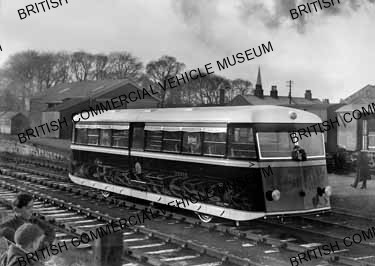
Other than what is on Wikipedia, I know no more. The article has no plicture of them, but there is what appear to be a picture of one here
That's a great photo of one, thanks.

21’ wheelbase, 41’ 1” long, 40 seats placed in pairs either side of a central gangway and looking towards the nearest end, central sliding entrance door on each side, 13 t 2 cwt in working order and 10 t 10 cwt empty. 95 hp (output) Leyland 6-cylinder motor, 3’ diameter wheels and maximum speed of 56 mph, possibly 63 for 29952. Small driver‘s compartment on the left-hand side at each end.
That certainly answer all my technical questions, a very detailed answer, thanks.

They were tried out and shown off in various places on the LMS between February and June 1934, but in early July they went to Lower Darwen and seem to have remained there for the Spring Vale-Clitheroe service until it was replaced by steam in 1941; one may have spent a period at Dalry Road in 1937. Transferred to Hamilton in or shortly after 1941. By 1949 only 29952 was still in use, although it had been out of service for a long time before being repaired using parts from the other two. All three were withdrawn in week ending 28 April 1951; the first two may have been scrapped at Kilmarnock the previous year, while 29952‘s scrapping location is unknown, though possibly on site at Hamilton after a serious accident in March 1950.
It must have been hard to justify using these units during the war with the shortage of oil, especially as most of it had to be imported. I had a quick look to see if I could find an article about that accident in 1950, but can't find anything yet. But there are several articles reporting that the LMS had ordered these three to be built by Leyland motors, May 1933.

I imagine they were kept in the Lancashire area initially, close to Leyland, in case of 'teething' problems.
Yes, that was my initial thought too, keep them close to where they were made just in case (at least at the beginning).

Because of the light weight and construction they could not be relied on to work track circuits and would suffer badly in a collision. As a result some special working instructions were in effect including not allowing them or following trains up to an Intermediate Block Signal, i.e. the existence of the IBS should be ignored. They were not to run over sections with automatic signalling and special arrangements had to be made when facing points were locked only by track circuits. They could only operate where authorised by the Chief Operating Manager.
I see now why these wouldn't appear in a WTT, but as you mentioned in a different thread, they'd be in some sort of weekly / special notice. Much safer in fact to use on a branch line late one Saturday night / very early Sunday morning after all other traffic has stopped and several hours at least before it begins again.

I presume there would have been a guard on board? who perhaps sat in the spare drivers seat at the other end during journeys?

Regarding the Spring Vale-Blackburn-Clitheroe trips, do we know if these too were late night journeys, or perhaps during a Sunday when this line would have been quieter?
 

Gloster

Veteran Member
Joined
4 Sep 2020
Messages
13,042
Location
Up the creek
It must have been hard to justify using these units during the war with the shortage of oil, especially as most of it had to be imported. I had a quick look to see if I could find an article about that accident in 1950, but can't find anything yet. But there are several articles reporting that the LMS had ordered these three to be built by Leyland motors, May 1933.

I see now why these wouldn't appear in a WTT, but as you mentioned in a different thread, they'd be in some sort of weekly / special notice. Much safer in fact to use on a branch line late one Saturday night / very early Sunday morning after all other traffic has stopped and several hours at least before it begins again.

I presume there would have been a guard on board? who perhaps sat in the spare drivers seat at the other end during journeys?

Regarding the Spring Vale-Blackburn-Clitheroe trips, do we know if these too were late night journeys, or perhaps during a Sunday when this line would have been quieter?

No, the initial runs during their first few months would have been on special notices, but after they settled down to regular work their trains between Spring Vale and Clitheroe would have been in the timetable like any other regular service, although possible marked as worked by railcars. The Spring Vale-Blackburn-Clitheroe service was a normal passenger one and seems to have been operated by them from mid-1934, fully from April 1935, to 1941; I don’t know if they worked the full service or shared it with steam workings, but they presumably had taken it over from steam (unless it was a newly introduced service).

To make clear: Spring Vale-Clitheroe was a normal passenger throughout the day, just like hundreds of others throughout the country. It just happened to be railcar worked and was their main job when at Lower Darwen.

I do not know what the arrangements for the trains to Accrington and Padiham were, but as they got as far as being mentioned in the special instructions for the railcars, I would suspect that they had at least paths in the WTT which could be activated either in advance by notice or on the day by Control instructions. A pure guess is that they would be for passengers from Manchester or Preston whose (last) train had arrived late at Blackburn and missed the connection; this would avoid holding the connection back for a small number of passengers. But I do not know without evidence.

I am pretty well certain that they had a guard on board as he is mentioned in the special instructions and single-manning was virtually unknown. There might have been a tip-up seat, but he would probably have to be prepared to stand.

Just to make a point clear: the railcars were only used on trials between delivery around February and June 1934, after which they were based at Lower Darwen for, primarily, the Spring Vale-Clitheroe service. It looks as thought to be the railcars started working this in summer 1934, but the full service started in April 1935. The Accrington and Padiham trains were also part of their normal duties, but probably only operated on an As Required basis. There was no practice of only using them at quiet times because of the operating restrictions due to their light weight and reduced crash-worthiness: they could be used at any time, just with certain adjustments.

 

6Gman

Established Member
Joined
1 May 2012
Messages
9,228
I get the impression that their riding would have been pretty poor!
 

stuving

Member
Joined
26 Jan 2017
Messages
741
The first report I found was in the Wishaw Press of 12 October 1934. It tells of an "L.M.S. Leyland rail coach which is running in Lanarkshire." After relating some of the same technical details as were given above, it goes on a bit about how simple it is to drive and how good the passengers' view out all round is.

Finally it says that "This coach travels from Holytown, via Wishaw central to Law Junction every night (except Saturday), leaving Wishaw at 7.17 and returning from Law at 7.33." Clearly that's not a serious contribution to service levels, just a demonstration (to LMS themselves and the public) of what it can do.
 

Andy873

Established Member
Joined
23 Mar 2017
Messages
1,421
No, the initial runs during their first few months would have been on special notices, but after they settled down to regular work their trains between Spring Vale and Clitheroe would have been in the timetable like any other regular service, although possible marked as worked by railcars. The Spring Vale-Blackburn-Clitheroe service was a normal passenger one and seems to have been operated by them from mid-1934, fully from April 1935, to 1941; I don’t know if they worked the full service or shared it with steam workings, but they presumably had taken it over from steam (unless it was a newly introduced service).

To make clear: Spring Vale-Clitheroe was a normal passenger throughout the day, just like hundreds of others throughout the country. It just happened to be railcar worked and was their main job when at Lower Darwen.
Very detailed reply, thank you. I've gone back to look again at the July 1939 passenger timetable, and there are indeed several weekday services from Spring Vale to Blackburn and Clitheroe, which sometimes ends at Gisburn, and vice versa. So exactly as you said, a regular service here.

As this is the public timetable, it doesn't show of course the type of train, only the service times. We would of course need a WTT to confirm this was a rail motor service. As for the Blackburn to Accrington or Padiham ones, once more as you said, if they were run as and when required then they would / should be denoted by a Q in a WTT, but sadly I can't find any such WTT available for viewing.

The first report I found was in the Wishaw Press of 12 October 1934. It tells of an "L.M.S. Leyland rail coach which is running in Lanarkshire." After relating some of the same technical details as were given above, it goes on a bit about how simple it is to drive and how good the passengers' view out all round is.
I seem to recall watching a few videos from the 1950's showing off some of the new DMU's, the favourite seat seems to be the very first one where you could look straight ahead / drivers view.

Finally it says that "This coach travels from Holytown, via Wishaw central to Law Junction every night (except Saturday), leaving Wishaw at 7.17 and returning from Law at 7.33." Clearly that's not a serious contribution to service levels, just a demonstration (to LMS themselves and the public) of what it can do.
Thanks as well for this. It looks then, the LMS were keen to get publicity regarding these trains, with one in Scotland, one (then two) in NW England and for a time one in Leicester, that's covering a large part of the LMS network.

Of course, it wasn't just the LMS experimenting, the other big four were also trying out diesels. These diesel units do make a fascinating piece of railway history!
 

Merle Haggard

Established Member
Joined
20 Oct 2019
Messages
3,991
Location
Northampton
In the late 1940s - early 1950s the "British Locomotive Society" - which seems to have evolved from "The Birmingham Railway Club" produced a magazine titled Railway Locomotives. It was very similar in style and content to The Railway Observer as far as locomotive news and reports.
The May/June 1950 edition contains the following report of a Society 'shed bash', "The battered remains of railcar 29952 were inspected at Hamilton on the same day (30/3/50). It appears that an engine having dead-centred while standing near the coaling-stage was given an encouraging push, in the absence of the crew, by another loco. standing behind. The regulator of the first engine being open, it moved away, the first object it encountered being the railcar which was promptly propelled into the shed. After a few moments a loud and expensive noise was heard at the far end, the railcar having penetrated the wall."

Hamilton later became a dmu shed, of course.
 
Status
Not open for further replies.

Top