• Our new ticketing site is now live! Using either this or the original site (both powered by TrainSplit) helps support the running of the forum with every ticket purchase! Find out more and ask any questions/give us feedback in this thread!

Leigh (Lancs) Station

Status
Not open for further replies.

George Shaw

Member
Joined
23 Jul 2016
Messages
8
Good evening.

Am looking for help to solve a query.

There are several on-line documents which allude to Leigh Station closing directly because of the findings of the Beeching Report but the branch line serving said station doesn't seem to appear in the lists published in that report.

My question is, was Leigh Station "Beechinged" and, if not, which administrative act led to its demise?

Thanks in anticipation. :)
 
Sponsor Post - registered members do not see these adverts; click here to register, or click here to log in
R

RailUK Forums

yorksrob

Veteran Member
Joined
6 Aug 2009
Messages
44,343
Location
Yorks
The main station going towards Manchester was on the Leigh loop. It didn't close until 1969 due to Pte withdrawing support, so not under the Dr.
 

George Shaw

Member
Joined
23 Jul 2016
Messages
8
The main station going towards Manchester was on the Leigh loop. It didn't close until 1969 due to Pte withdrawing support, so not under the Dr.

Thank you for the quick response.

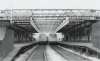
I've attached a reminder of what Leigh now lacks!
 

Attachments

  • Leigh Railway Station 0001.jpg
    Leigh Railway Station 0001.jpg
    121.2 KB · Views: 103

Springs Branch

Established Member
Joined
7 Nov 2013
Messages
1,681
Location
Where my keyboard has no £ key
The line through Leigh station was actually proposed for closure in the 1963 Beeching Report Part 1.

The service is listed in Appendix 2, page 104 as "Liverpool Lime St - Tyldesley - Patricroft - Manchester Exchange (Local)", under the Passenger Service, Line and Station Closures section.

By this time, many of the stopping trains on the ex-LNWR Liverpool/Manchester route were diverted at Kenyon Jn onto a loop through Leigh and Tyldesley, rather than travelling directly across Chat Moss. They rejoined the main line at Eccles (and never served Patricroft station - Beeching obviously got confused!), meaning during the 1960s Leigh had direct trains to both Manchester Exchange and Liverpool Lime Street.

This line actually hung on for a good few years until May 1969, unlike many of Beeching's targets, the majority of which closed in the mid-1960s (including the Manchester - Tyldesley - Wigan NW local trains).

I don't think closure of the "Leigh Loop" had anything to do with withdrawal of PTE funding. SELNEC PTE only came into existence on 1 April 1969, literally weeks before Leigh (and Tyldesley, Worsley & Monton Green) stations closed. British Railways would have had their closure plans well in hand before the PTE came along, and it took until 1972 before SELNEC PTE took over responsibility for funding local rail in the Manchester area. It was the final stage in a rolling scheme of closures in this part of South Lancashire, and BR had ripped up tracks and dismantled bridges on the Leigh line by October 1969, so there was no chance of any reprieve!

One explanation I have seen for BR wanting to be rid of the line was extensive mining subsidence throughout the area, requiring frequent and ongoing repairs at a cost totally out of proportion to the traffic on offer.

The two books "A Lancashire Triangle" (Parts 1 & 2) by Dennis Sweeney give a lot of interesting history and some excellent pictures of former railways in the Leigh area, if you can access them at a library or direct from Triangle Publishing (I don't think they're available from Amazon and the like).

 

yorksrob

Veteran Member
Joined
6 Aug 2009
Messages
44,343
Location
Yorks
The Vantage guided busway is a reasonable substitute to be fair. I'd recommend it to those travelling between Manchester and Leigh.

I'm usually travelling from further East than Manchester, so train to Atherton is still my preferred option in the absence of Leigh proper.
--- old post above --- --- new post below ---
The line through Leigh station was actually proposed for closure in the 1963 Beeching Report Part 1.

The service is listed in Appendix 2, page 104 as "Liverpool Lime St - Tyldesley - Patricroft - Manchester Exchange (Local)", under the Passenger Service, Line and Station Closures section.

By this time, many of the stopping trains on the ex-LNWR Liverpool/Manchester route were diverted at Kenyon Jn onto a loop through Leigh and Tyldesley, rather than travelling directly across Chat Moss. They rejoined the main line at Eccles (and never served Patricroft station - Beeching obviously got confused!), meaning during the 1960s Leigh had direct trains to both Manchester Exchange and Liverpool Lime Street.

This line actually hung on for a good few years until May 1969, unlike many of Beeching's targets, the majority of which closed in the mid-1960s (including the Manchester - Tyldesley - Wigan NW local trains).

I don't think closure of the "Leigh Loop" had anything to do with withdrawal of PTE funding. SELNEC PTE only came into existence on 1 April 1969, literally weeks before Leigh (and Tyldesley, Worsley & Monton Green) stations closed. British Railways would have had their closure plans well in hand before the PTE came along, and it took until 1972 before SELNEC PTE took over responsibility for funding local rail in the Manchester area. It was the final stage in a rolling scheme of closures in this part of South Lancashire, and BR had ripped up tracks and dismantled bridges on the Leigh line by October 1969, so there was no chance of any reprieve!

One explanation I have seen for BR wanting to be rid of the line was extensive mining subsidence throughout the area, requiring frequent and ongoing repairs at a cost totally out of proportion to the traffic on offer.

The two books "A Lancashire Triangle" (Parts 1 & 2) by Dennis Sweeney give a lot of interesting history and some excellent pictures of former railways in the Leigh area, if you can access them at a library or direct from Triangle Publishing (I don't think they're available from Amazon and the like).

Thanks for the more detailed explanation. In that case I will apportion blame to Dr Beeching for this one as well.

I do wonder whether the out of proportion maintenance costs were somewhat overstated in the manner of the costs for repairing Ribblehead viaduct fifteen years later.

In terms of passenger transport opportunities, running all stoppers via the loop would have made absolute sense, given the lack of population on the mainline between Eccles and Kenyon Junction. The Minister should have refused closure outright.
 
Last edited:

George Shaw

Member
Joined
23 Jul 2016
Messages
8
Thank you Springs Branch for your detailed and informative contribution. So, it seems that Beeching was the cause but that effect was delayed.
 

randyrippley

Established Member
Joined
21 Feb 2016
Messages
5,382
Looking at that photo it appears to me the station would have to close on safety grounds......those timber platform supports look decidedly badly constructed, neither platform has an even surface, while the right hand platform has a significant slope on it. Whole lot needed bulldozing and starting again. I'm not surprised it closed
 

Bevan Price

Established Member
Joined
22 Apr 2010
Messages
8,329
The Vantage guided busway is a reasonable substitute to be fair. I'd recommend it to those travelling between Manchester and Leigh.

Having used the busway several times, it is a bit of an improvement over other bus services, but it is very inferior to the railway. The main problem is that the busway is at the "quiet" end of the route. The "Manchester" end of the route used ordinary roads, and suffers from road congestion, and too many poorly phased traffic lights. Even at off-peak hours, the final 2-3 miles from Pendleton to Manchester city centre can take 25 - 30 minutes.

In its final days as a railway, the line suffered badly from mining subsidence between Ellenbrook, Tyldesley & Leigh. The mines have long gone, and faster running would have been possivble if the line still existed.

Best times between Manchester & Leigh (about 13 miles) in the early 1900s were about 25 minutes - admittedly only 2 or 3 times per day; bus times of 50+ minures compare badly with that (And some peak hour bus journeys are allowed over 60 minutes)
 

billh

Member
Joined
7 Jan 2015
Messages
320
The line through Leigh station was actually proposed for closure in the 1963 Beeching Report Part 1.


One explanation I have seen for BR wanting to be rid of the line was extensive mining subsidence throughout the area, requiring frequent and ongoing repairs at a cost totally out of proportion to the traffic on offer.

The two books "A Lancashire Triangle" (Parts 1 & 2) by Dennis Sweeney give a lot of interesting history and some excellent pictures of former railways in the Leigh area, if you can access them at a library or direct from Triangle Publishing (I don't think they're available from Amazon and the like).

I always understood that damage due to mining subsidence was repaired at the expense of the National Coal Board and was added to the cost of winning the coal in the first place. In fact the cost of these reparations was so high that certain Manchester area collieries were deemed uneconomic and closed. Although BR would have undertaken any repair work, there would have been no cost to the railways, a similar arrangement applied to canals- the Bridgewater canal needed constant attention between Leigh and Monton while collieries were worked in that area. I suppose, as BR and NCB were both nationalised,then the tax payer was footing the bill anyway!
Bill
 

yorksrob

Veteran Member
Joined
6 Aug 2009
Messages
44,343
Location
Yorks
I always understood that damage due to mining subsidence was repaired at the expense of the National Coal Board and was added to the cost of winning the coal in the first place. In fact the cost of these reparations was so high that certain Manchester area collieries were deemed uneconomic and closed. Although BR would have undertaken any repair work, there would have been no cost to the railways, a similar arrangement applied to canals- the Bridgewater canal needed constant attention between Leigh and Monton while collieries were worked in that area. I suppose, as BR and NCB were both nationalised,then the tax payer was footing the bill anyway!
Bill

Could still have been used as a convenient excuse to close a line though.
 

Springs Branch

Established Member
Joined
7 Nov 2013
Messages
1,681
Location
Where my keyboard has no £ key
If I had to bet, I'd say mining subsidence was a BR excuse for closure in the style of Ribblehead Viaduct and the Hayfield tunnel*. (Roger the Dodger, the Beano character with his collection of "dodge books" comes to mind)

Given that the Leigh - Tyldesley - Worsley - Manchester passenger service dodged the bullet of Beeching closure for quite a while, it's a pity the line did not survive a few more years until the mid-1970s when the PTE (Greater Manchester rather than SELNEC) became more supportive of traditional local rail services, once the Picc-Vic tunnel scheme had evaporated.

Several other railways and stations in the Manchester area were proposed for closure by BR, but survived with PTE support - Oldham/Rochdale and Stockport/Stalybridge being examples.

Unfortunately another nearby line with the same fate as Leigh was the Bolton - Bury - Rochdale, which was actually listed for "retain and develop" by Beeching, but the service seems to have been run down by BR to become barely usable, then when SELNEC came along (mainly a club of ex-municipal busmen in its early days) they replaced the train with their spiffy new Trans Lancs Express buses in 1970.


* In the same period we're discussing for Leigh, BR proposed (and succeeded in) closing the short branch line from New Mills Central to Hayfield. A main justification was the 197-yard Hayfield tunnel at the start of the branch near New Mills Central station - according to BR the tunnel needed expensive repairs and had become dangerous.
Closure to Hayfield went ahead in January 1970, but regular local trains from Manchester Piccadilly remained, now terminating at New Mills Central. The DMU turned around by shunting into a siding, which happened to be formed by the truncated branch line inside the "dangerous" tunnel! (I notice that siding is not on the latest track maps - maybe the tunnel did collapse)
 

fergusjbend

Member
Joined
11 Sep 2011
Messages
141
As a boy I used to spend time train-spotting at Worsley Station, which in the late 1960's was quiet and rural in character. Apart from the DMUs to and from Manchester, there were coal trains from Ellenbrook and a NCB mineral line from Walkden Yard that joined the mainline nearby. A friendly station master named Roger even provided free cups of tea!
 

Taunton

Veteran Member
Joined
1 Aug 2013
Messages
12,277
The line through Leigh station was actually proposed for closure in the 1963 Beeching Report Part 1.

The service is listed in Appendix 2, page 104 as "Liverpool Lime St - Tyldesley - Patricroft - Manchester Exchange (Local)", under the Passenger Service, Line and Station Closures section.

By this time, many of the stopping trains on the ex-LNWR Liverpool/Manchester route were diverted at Kenyon Jn onto a loop through Leigh and Tyldesley, rather than travelling directly across Chat Moss. They rejoined the main line at Eccles (and never served Patricroft station - Beeching obviously got confused!), meaning during the 1960s Leigh had direct trains to both Manchester Exchange and Liverpool Lime Street.
Leigh had a poor and irregular service until about 1960, when diesels were introduced on the stopping service from Liverpool to Manchester, which was routed off the main line through Leigh, then joining the old LNWR Manchester to Wigan line through Tyldesley. An hourly service was provided which bettered what went before. Separately, there were a handful of stopping trains which continued on the main line, and served Patricroft.

The real issue though was the trains ran once an hour, whereas the Lancashire United buses at the time had multiple routes which covered the area every 5-10 minutes in all directions and didn't really need a timetable. These took the bulk of the traffic. I can remember taking the Leigh route once in the mid-1960s, having gone to "bunk" Patricroft steam shed. I think we were the only ones to use Monton Green station for that train, and the 2-car unit was near-empty. Patricroft station itself had no service for much of the day at the time; ironically, it is the only one of this group of stations left open, with a much better service though it doesn't seem used much.
 

Francis

Member
Joined
22 Dec 2011
Messages
184
Location
Chorley, Lancs
I travelled every schoolday from Leigh to Eccles from Sept 1965 through to closure in May 1969.
The diesel service was hourly through most of the day, with extras in the rush hour. I still remember the Leigh departure times for Manchester: 07.46, 08.00, 08.20 (late for school!) On icy winter mornings we sometimes got a Patricroft 8F hauling three coaches. With sanding gear they could get up the bank into Tyldesley, which the dmus couldn't.
It was usually 32 mins to Manchester Exchange. In the opposite direction it was about 45 mins to Liverpool Lime St via Kenyon Jc.

It may have been the summer 67 or winter 67 timetable changes or even summer 68 when they started to run the service down. Instead of being hourly, it became irregular, with 80-100 min intervals between trains - hard to remember. If there were rolling stock shortages, it seemed to be the Leigh line which suffered first with trains being cancelled.

A friend who worked at Hunts Bank (Victoria) for BR told me that closure was definitely on the cards. The tell-tale signs were there - they were repainting the bridges in order to inflate the running costs and make the line seem uneconomic.

I learnt later that a prime motive for the line's closure was the construction of the M602 between Monton Green and Eccles. Had the railway remained open, it would have required an extra £500,000 for a bridge to be constructed over it. Once the Leigh loop line was closed, they could build it more or less on the level - you can see how it swallowed the slow lines from Patricroft to Eccles and onwards.

So Leigh and Tyldesley with a joint population of about 65,000 were stripped of their rail service. The No 26 bus to Manchester took 55 mins or more in the rush hour. The 39 to Liverpool - if anybody ever travelled through on it, I think took over 2 hours (for about 25 miles!)

The £15 million spent on the new guided busway has delivered bus schedules of Leigh/Atherton to Manchester Albert Square:

40 minutes early mornings and evenings
45 minutes off-peak daytime
55 minutes peak
according to TfGM.
This is much worse than the 32 mins of 1968, though Albert Square is far more central than Exchange was.

In my opinion, money might have been better spent building a mile of new track from Tyldesley/Ellenbrook to join the Walkden line near Little Hulton, and re-instating rail track between Leigh and Tyldesley, operating Leigh as a branch off the Victoria-Atherton-Wigan Wallgate route.
More realistic and cheaper might be a Leigh and Culcheth Parkway on the site of the old Glazebury station on the Chat Moss line - this would be within 15 mins of Manchester central stations, and could relieve a lot of traffic on the A580/A572.

Anyway, Wigan Metropolitan Borough Council and Cheshire County Council (Glazebury now falls within Cheshire, just) seem to have little interest in Leigh's transport problems, and are quite content to leave it as one of the largest towns in the country unconnected to the rail network. The biggest after Gosport, I think.
 
Last edited:

Edgeley

Member
Joined
27 Jul 2017
Messages
109
Location
North West
I With sanding gear they could get up the bank into Tyldesley, which the dmus couldn't.

That's an interesting point, Francis. There's quite a steep incline on the guided busway to the east of the Cooling Lane stop going up towards Tyldesley. Last winter (the first winter of busway operations) was generally mild so the buses weren't tested on this section in very icy conditions.

I agree with you that a rail link to the Walkden line would have been a preferable option [I think the cost of the guided bus track was nearer to £70m]. A parkway station on the Chat Moss line would also be useful but, as you indicate, any progress on that proposal is complicated by that area of line falling in the Warrington (Cheshire) administrative area.
 

yorksrob

Veteran Member
Joined
6 Aug 2009
Messages
44,343
Location
Yorks
I learnt later that a prime motive for the line's closure was the construction of the M602 between Monton Green and Eccles. Had the railway remained open, it would have required an extra £500,000 for a bridge to be constructed over it. Once the Leigh loop line was closed, they could build it more or less on the level - you can see how it swallowed the slow lines from Patricroft to Eccles and onwards.

So Leigh and Tyldesley with a joint population of about 65,000 were stripped of their rail service. The No 26 bus to Manchester took 55 mins or more in the rush hour. The 39 to Liverpool - if anybody ever travelled through on it, I think took over 2 hours (for about 25 miles!)

Ah, one of those breathtaking examples of institutional stupidity which seems to characterise the late 1960's/early 70's.
 

Bevan Price

Established Member
Joined
22 Apr 2010
Messages
8,329
In retrospect, I think that Leigh suffered due to rail history and its geography. Prior to the introduction of regular interval dmu stopping services, the passenger services can only be described as awful. Leigh was treated as a backwater, with the Chat Moss route and Wigan Borth Western - Tyldesley - Eccles / Manchester Exchange treated as the "main" lines.

The new dmu services started to attract more passengers, but it can take years to recover from poor services to well-used services, and the "accountant types" in Whitehall would not wait. The frequency reductions were implemented in a supplement to the 1967/1968 timetable. Leigh appeared in the May 1969 timetable, but closed on the day the new timetable was due to start. See also note below ($$).

---------------------------------------------------------------
Leigh rail services, 1959 timetable.

Eastbound (to Manchester Exchange) 07:07, 07:37, 08:44, 10:15, 13:58(SO),
(to Tyldesley) 07:50 (SX), 16:05, 17:54, 19:17(SX).

Westbound arrivals (from Manchester Exchange):08:34, 09:42(SO**), 12:42(SO), 18:25(SX),
(from Tyldesley): 07:12, 13:27(SO), 15:56, 16:36(SX), 18:52(SX).
Last possible departures from Manchester to Leigh were 12:35 (SO), or 18:06(SX)

Some, but not all of these continued west of Leigh to reach Kenyon Junction (very few went further on to Earlestown or Warrington), but you could not reach Liverpool before 09:29, and could return (SX) no later than 18:10

The train marked ** was a summer saturday service from Cross Lane to Barrow via Leigh & Wigan but there was no corresponding reverse service via Leigh.

($$) - Other stations also suffered from the post 1967 frequency reductions; for example by 1971, Rainhill had some 3 hour gaps between trains, with many trains terminating at Newton Le Willows; Patricroft had an almost 7 hour gap between westbound trains. But for PTE support, these stations might also have gone into terminal decline.
 

Shaw S Hunter

Established Member
Joined
21 Apr 2016
Messages
3,495
Location
Over The Hill
Other stations also suffered from the post 1967 frequency reductions; for example by 1971, Rainhill had some 3 hour gaps between trains, with many trains terminating at Newton Le Willows; Patricroft had an almost 7 hour gap between westbound trains. But for PTE support, these stations might also have gone into terminal decline.

Hindsight is such a wonderful thing! Given how busy Rainhill is these days, with commuting in both directions, the gaps seem really surprising viewed from 46 years in the future. If Leigh had retained its rail connections would it now have booming passenger numbers? No guarantee of course but it does seem likely!
 

yorksrob

Veteran Member
Joined
6 Aug 2009
Messages
44,343
Location
Yorks
Hindsight is such a wonderful thing! Given how busy Rainhill is these days, with commuting in both directions, the gaps seem really surprising viewed from 46 years in the future. If Leigh had retained its rail connections would it now have booming passenger numbers? No guarantee of course but it does seem likely!

Perhaps if the authorities had taken a strategic look at what was needed for the area and mis-calculated, I might have some sympathy. Instead it boils down to the local authority wanting to build a motorway on the cheap and the rail authorities being obsessed with closing as much route mileage as possible.
 

Bevan Price

Established Member
Joined
22 Apr 2010
Messages
8,329
Hindsight is such a wonderful thing! Given how busy Rainhill is these days, with commuting in both directions, the gaps seem really surprising viewed from 46 years in the future. If Leigh had retained its rail connections would it now have booming passenger numbers? No guarantee of course but it does seem likely!

That we will never know - but in all probability it would have attracted lots more passengers - and would probably have been included in the Liverpool / Manchester electrification.

As a further afterthought, Leigh also had another station, WestLeigh, on the line from Kenyon Jn to Bolton Great Moor Street; that station was about 1/2 mile from the town centre, and the train service was not not very frequent, and was withdrawn in 1955 - probably it could not compete with high frequency bus servives serving Leigh town centre. (The Atherton station at Bag Lane was also badly sited relative to Atherton town centre.)

Looking at bus loadings, Bolton seems to be the preferred location for "out of town" shopping trips from the Leigh & Atherton areas - alas not by rail.
 

Shaw S Hunter

Established Member
Joined
21 Apr 2016
Messages
3,495
Location
Over The Hill
Perhaps if the authorities had taken a strategic look at what was needed for the area and mis-calculated, I might have some sympathy. Instead it boils down to the local authority wanting to build a motorway on the cheap and the rail authorities being obsessed with closing as much route mileage as possible.

As we have discussed previously Marples was the chief culprit. Local authority involvement in rail affairs was minimal unlike today.

That we will never know - but in all probability it would have attracted lots more passengers - and would probably have been included in the Liverpool / Manchester electrification.

As a further afterthought, Leigh also had another station, WestLeigh, on the line from Kenyon Jn to Bolton Great Moor Street; that station was about 1/2 mile from the town centre, and the train service was not not very frequent, and was withdrawn in 1955 - probably it could not compete with high frequency bus servives serving Leigh town centre. (The Atherton station at Bag Lane was also badly sited relative to Atherton town centre.)

Looking at bus loadings, Bolton seems to be the preferred location for "out of town" shopping trips from the Leigh & Atherton areas - alas not by rail.

Not to mention various direct routes to Wigan. People from Leigh also go to the Trafford Centre but the buses had to be timetabled around school services restricting the time there so the car is king on that flow.
 
Last edited:

Francis

Member
Joined
22 Dec 2011
Messages
184
Location
Chorley, Lancs
That we will never know - but in all probability it would have attracted lots more passengers - and would probably have been included in the Liverpool / Manchester electrification.

As a further afterthought, Leigh also had another station, WestLeigh, on the line from Kenyon Jn to Bolton Great Moor Street; that station was about 1/2 mile from the town centre, and the train service was not not very frequent, and was withdrawn in 1955 - probably it could not compete with high frequency bus servives serving Leigh town centre. (The Atherton station at Bag Lane was also badly sited relative to Atherton town centre.)

Looking at bus loadings, Bolton seems to be the preferred location for "out of town" shopping trips from the Leigh & Atherton areas - alas not by rail.

It was still trolleybuses from Leigh to Bolton in the late 1950's, and they seemed to take an eternity, at least to a five-year old!
Like many medium sized towns surrounded by larger ones, I think shopping patterns varied widely - maybe depending on public transport and which bus route was nearest your home, - or just on family habit or preference. We always went shopping to Manchester, perhaps because my mother had worked there before 1939, and my grandparents had had accounts with a couple of the clothing warehouses, having been in the trade. I'm sure others went to Bolton or Wigan though obviously they had nothing like the choices Manchester offered.
 

yorksrob

Veteran Member
Joined
6 Aug 2009
Messages
44,343
Location
Yorks
As we have discussed previously Marples was the chief culprit. Local authority involvement in rail affairs was minimal unlike today.

Similar machinations were involved in the closure of Uckfield - Lewes. The local authority was very keen to build a local by-pass on the cheap.
 
Status
Not open for further replies.

Top