
-
Our new ticketing site is now live! Using either this or the original site (both powered by TrainSplit) helps support the running of the forum with every ticket purchase! Find out more and ask any questions/give us feedback in this thread!
You are using an out of date browser. It may not display this or other websites correctly.
You should upgrade or use an alternative browser.
You should upgrade or use an alternative browser.
Last mixed use train?
- Thread starter Jan Mayen
- Start date
- Status
- Not open for further replies.
Sponsor Post - registered members do not see these adverts; click here to register, or click here to log in
R
RailUK Forums

Pedantically here there’s a bit of a difference between items carried in NPCCS (non passenger-carrying coaching stock) and “true” freight. Newspapers fall into the former category. Thanks to a brief trial iin the Far North line, I think that the date for the genuinely “mixed train” may ironically be later than for the newspaper trains with the odd passenger coach.I understand there were trains which used to convey passengers and freight (such as newspapers) until around forty years ago. Anyone know when the last one was, please?
Gloster
Veteran Member
A Mixed Train had both passenger carriages carrying passengers and goods wagons. I think the very last of these was the fuel for the boats at Mallaig that was carried in tanks on the rear of Fort William-Mallaig passenger trains (and v.v.) until the early 1990s (somebody will probably have the date). There were also a few workings using some modified container flats on the Far North line, but I think these had ended earlier.
The basic point about a Mixed Train is that it is carrying both passenger and goods traffic. Parcels, mail and newspapers are not considered to be goods traffic, but in a category that is carried either on passenger trains or dedicated ones. The dedicated parcels and mail trains were treated as their own class; the most important news trains were Class 1 like express passenger trains. Other parcels trains were in their own category, normally Class 3 or 4, but they were not Mixed Trains.
You may have seen odd pictures of passenger trains with one or more goods vans tacked on the back back in steam or early diesel days: these are mostly not Mixed Trains, but passenger trains with the vans being used for parcels.
The basic point about a Mixed Train is that it is carrying both passenger and goods traffic. Parcels, mail and newspapers are not considered to be goods traffic, but in a category that is carried either on passenger trains or dedicated ones. The dedicated parcels and mail trains were treated as their own class; the most important news trains were Class 1 like express passenger trains. Other parcels trains were in their own category, normally Class 3 or 4, but they were not Mixed Trains.
You may have seen odd pictures of passenger trains with one or more goods vans tacked on the back back in steam or early diesel days: these are mostly not Mixed Trains, but passenger trains with the vans being used for parcels.

Big Jumby 74
Established Member
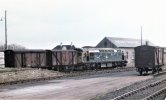
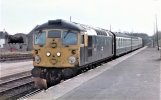
My ride at Thurso one day in 1981. Outbound from Inverness formed loco/2 x TSO (or SK?)/BG/2 x 12T vans, one plywood and one planked as seen being deposited in the yard.You may have seen odd pictures of passenger trains with one or more goods vans tacked on the back back in steam or early diesel days: these are mostly not Mixed Trains, but passenger trains with the vans being used for parcels.
Attachments

sprinterguy
Veteran Member
That was certainly the first working that came to my mind when I saw this thread: The fuel oil traffic itself continued until 1992 or possibly 1993, but to the best of my knowledge was, of necessity, a separate working once 156s took over passenger workings on the route in late January 1989. Certainly I've never personally encountered a photo of a mixed working when summer dated loco-hauled workings were reintroduced to a limited extent in 1992.I think the very last of these was the fuel for the boats at Mallaig that was carried in tanks on the rear of Fort William-Mallaig passenger trains (and v.v.) until the early 1990s (somebody will probably have the date).
Last edited:
ChiefPlanner
Established Member
We ran a test train on the Andover - Ludgershall line one day in 1986 which had an ex GWR Hall class 4-6-0 and a passenger coach under the control on the then Area Manager in advance of steam operation , the next day being a Saturday. Eastleigh Yard ran a special of 2 loaded PFB war wells which had missed the normal branch working , so to save time , we included them in the test train and delivered them to the MOD who were delighted at the novelty down the branch. Being a GWR loco and with a seasoned Salisbury crew this was easily done and good fun. Nobody alas , had a camera.
DMU(T) i.e. tail traffic on BR DMUs was quite common, usually parcels vans I believe. Were they ever used to haul freight, e.g. milk tanks, or would their brake power have been inadequate?That was certainly the first working that came to my mind when I saw this thread: The fuel oil traffic itself continued until 1992 or possibly 1993, but to the best of my knowledge was, of necessity, a separate working once 156s took over passenger workings on the route in late January 1989. Certainly I've never personally encountered a photo of a mixed working when summer dated loco-hauled workings were reintroduced to a limited extent in 1992.
sprinterguy
Veteran Member
Yeah parcels vans of varying vintages, and bogie or four wheel, weren't uncommon as tail loads for first gen DMUs, and there's a photo from March 1969 about half way down the following linked page that shows a class 118 unit with milk tanks on a specific local flow to Plymouth - apparently they were restricted to two tanks when filled: https://www.railcar.co.uk/images/feature/tail-loadsDMU(T) i.e. tail traffic on BR DMUs was quite common, usually parcels vans I believe. Were they ever used to haul freight, e.g. milk tanks, or would their brake power have been inadequate?
Last edited:
Sir Felix Pole
Established Member
Milk tanks were tripped to Plymouth by the local DMU service from Saltash. There was a siding at the west end on the up side.
The beginning of the end for distribution of newspapers by rail was the Times moving their printing to Wapping in 1986.I understand there were trains which used to convey passengers and freight (such as newspapers) until around forty years ago. Anyone know when the last one was, please?
It folded very quickly afterwards.
that's a good one for the modellers then... How to make a DMU train interesting!Milk tanks were tripped to Plymouth by the local DMU service from Saltash. There was a siding at the west end on the up side.
Going back a bit, there were some independent lines on which all (or almost all) trains were mixed. The Bishops Castle for instance. Does anyone know which was the last one of these to close? A constituent of Col Stephens' empire perhaps?
godfreycomplex
Established Member
- Joined
- 23 Jun 2016
- Messages
- 1,751
If you really want to stand on the point fish was carried in cool boxes in the guards' van on the Caledonian Sleeper from Inverness until the Mk 2s were replaced in around 2017 I believe, although this may be outside the scope of the OP's question
Gloster
Veteran Member
If you really want to stand on the point fish was carried in cool boxes in the guards' van on the Caledonian Sleeper from Inverness until the Mk 2s were replaced in around 2017 I believe, although this may be outside the scope of the OP's question
Traffic carried in guards compartments would be classified as parcels and sundries, amongst other things, and not regarded as goods. Even when fish was carried in its own vans it was regarded as a higher class of traffic than goods. A fish van on the back of a passenger train (I travelled on an Inverness-Aberdeen DMU with a fish van hooked on behind in 1977) would not alter the fact that the train was still a passenger train, not a goods or mixed one.
It mainly relates to whether the contents of the wagon are categorised as goods or otherwise. Newspapers, parcels, mail, etc are not; fish and other perishables are often categorised similarly, but sometimes, usually when in bulk, can be goods.
The Germans (of course) had 2 separate train categories - goods train with provision for conveyance of passengers (Gmp) and vice versa (Pmg). The latter was preferable from the passengers’ pov and survived on the former DR network into the 1990s.A fish van on the back of a passenger train (I travelled on an Inverness-Aberdeen DMU with a fish van hooked on behind in 1977) would not alter the fact that the train was still a passenger train, not a goods or mixed one.
Gloster
Veteran Member
A lot of the reason for treating all such trains as passenger trains is that there are some variations between the signalling rules applicable to passenger trains and those to non-passenger ones, particularly the rule requiring all facing points used by passenger trains to have a facing point lock (FPL). By classifying a Mixed Train as a passenger train (Class 1 or 2, previously A or B) the signalman knows that all rules applying to passenger trains must be applied, not the variations that can apply to non-passenger ones: no running through goods loop without FPLs, no permissive block working where only allowed for goods, etc. If it could be carrying passengers, it must be treated as a passenger train.
Big Jumby 74
Established Member
4930 Hagley Hall. Took a few pics on the main public day, as no doubt many others did, and there were a couple of loaded (with armoured vehicles) war wells at Andover.We ran a test train on the Andover - Ludgershall line one day in 1986 which had an ex GWR Hall class 4-6-0 and a passenger coach under the control on the then Area Manager in advance of steam operation , the next day being a Saturday. Eastleigh Yard ran a special of 2 loaded PFB war wells
ChiefPlanner
Established Member
4930 Hagley Hall. Took a few pics on the main public day, as no doubt many others did, and there were a couple of loaded (with armoured vehicles) war wells at Andover.
It was a very busy day for revenue connection on the public days ! ,all checking done.
I did rather enjoy the changing of the headlamps on the Hall to give the appropriate lights , in order to give the correct code for a mixed working. (and of course ensuring the vac brake was at correct setting , not forgetting the correct one for when the 33 took the stock off to Eastleigh at days end !)
Deepgreen
Established Member
Cheshire Scot
Established Member
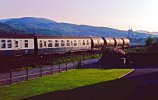
The tanks typically ran a couple of times each week, varying between two and six on a train.The Mallaig line had the occasional mixed train well into the 1980s, with a passenger train also conveying fuel tankers for the Mallaig trawlers. This was a Fort William train arriving at Corpach in 1983 weith four empty tanks.

Adrian Barr
Member
I think the very last of these was the fuel for the boats at Mallaig that was carried in tanks on the rear of Fort William-Mallaig passenger trains (and v.v.) until the early 1990s (somebody will probably have the date).
As per post #5, apparently DMUs took over the loco-hauled workings to Mallaig on 23/01/89, and the mixed trains appear to have continued to the end (or very close). The most recent photo I can find online of a mixed working on the Mallaig line is from September 1988.
Some photos illustrating these workings:
June 1986 - At least 3 TTA tanks on the rear of the afternoon train from Fort William behind 37406 at Loch Dubh:
https://www.flickr.com/photos/144388905@N03/32498689565/ (Photo: David Price)
May 1987 - 2Y58 18:50 Mallaig - Fort William seen before departure with nose-first 20205, 3 Mk1s and a tank wagon.
https://www.flickr.com/photos/85954524@N02/48010108407/ (Photo: RobT653)
The "Frigo" vans on the right in that picture are rather interesting... for fish I assume, but I never knew wagonload fish traffic was still around in 1987!
September 1988 - 16:05 Fort William - Mallaig "mixed" service at Banavie with 37422, 5 coaches, 3 tanks
https://www.flickr.com/photos/brian_dentons_linesidephotos-europe/54733040074/ (Photo: Brian Denton)
January 1989 - Not a mixed train, but the last week of loco haulage before DMUs took over on 23/01/89 (info from caption).
https://www.flickr.com/photos/36034969@N08/8189604206/ (Photo: Adrian Nicholls)
April 1989 - Tanks now running as a separate freight train (a single TTA seen behind 37401 at Loch Eilt):
https://www.flickr.com/photos/152950454@N08/32839447048/ (Photo: Alan Mitchell)
May 1990 - 37409 with 3 TTAs in the platform at Mallaig.
https://www.flickr.com/photos/monkeysnapper/53607242787/ (Photo: Bill Watson)
I understand there were trains which used to convey passengers and freight (such as newspapers) until around forty years ago.
There were some interesting late night workings which ran primarily for newspapers and mail, but were also advertised as conveying passenger accommodation, in some cases a single coach (or half a coach if it was a BSK). Even if they weren't technically "mixed" trains, a mail train conveying a small amount of passenger accommodation (rather than the other way around) is an interesting sort of category by itself.
I associate these with the southern region - the caption to the first photo gives an interesting flavour of what they were like.
73002 with 03:30 Victoria - Dover Western Docks in October 1986:
https://www.flickr.com/photos/199083012@N02/53237375040/ (Photo: R Baldwin)
33005 at Waterloo in 1983 with the 01:40 to Yeovil Junction:
https://www.flickr.com/photos/skiddaw_d3/12212599215/ (Photo: Steve Robinson)
47440 with 1K89 20:45 Holyhead - Crewe "primarily carrying mails from Ireland" being unloaded at Crewe:
https://www.flickr.com/photos/robmcrorie/5359961644/ (Photo: robmcrorie)
More information in this thread:
https://www.railforums.co.uk/thread...-on-mail-parcels-trains-recollections.191815/
I'm not sure when those kind of workings ended?
Gloster
Veteran Member
Just to make clear a couple of definitions:
Passenger trains are any train that is supposed to convey passenger. They may also convey parcels, mail, newspapers, fish, live chicks and so on in the van, but they are still a passenger train. They may have various vans in the formation or on the back: if these are what were latterly called NPCCS (Non-Passenger Carrying Coaching Stock) they are built to standards that allow them to run in passenger trains and their inclusion does not in any way alter the situation if the train is intended to carry passengers. If the wagons on the back are goods wagons not built to these standards and not classified as NPCCS then the train becomes a Mixed Train, but it is still regarded as a passenger train and must obey the Rules & Regulations applicable to passenger trains.
Parcels, mail, newspapers hot off the press, luggage in advance and a lot else are not regarded as goods, but come under a category that in my time was Parcels & Sundries and can be carried by passenger train. Even items in certain types of vehicle, such as Fish Vans, Milk Tanks, Prize Cattle Vans, Horse Boxes, can be included in a passenger train if the vehicle is to NPCCS standards and that will be seen as a passenger train not a mixed.
Basically, a Mixed Train is a train that includes both passenger carriages available to passengers AND goods wagons, i.e. ones that are not NPCCS. If all the non-passenger load is in the guard’s van or in NPCCS-rated vans, then it remains just a passenger train.
The various newspaper trains were either Passenger Trains if they included seating available to the public (sometimes not advertised) or Newspaper Trains if they weren’t available to the public. In both cases they were treated as a Class 1. A train just carrying mails would not be a Passenger Train if it didn’t have accommodation for the public. Some mail trains, including the Postals with sorting carriages, would also be a Class 1, others might be a Class 3.
My 1972 Signalman’s Regulations give a Class 1 as: Express passenger train, postal train, newspaper train… Class 2 was Ordinary passenger train, mixed train… Class 3 was an Express parcels train composed of vehicles permitted to run at 90 m.p.h. or over. These were still valid into the 1980s.
Passenger trains are any train that is supposed to convey passenger. They may also convey parcels, mail, newspapers, fish, live chicks and so on in the van, but they are still a passenger train. They may have various vans in the formation or on the back: if these are what were latterly called NPCCS (Non-Passenger Carrying Coaching Stock) they are built to standards that allow them to run in passenger trains and their inclusion does not in any way alter the situation if the train is intended to carry passengers. If the wagons on the back are goods wagons not built to these standards and not classified as NPCCS then the train becomes a Mixed Train, but it is still regarded as a passenger train and must obey the Rules & Regulations applicable to passenger trains.
Parcels, mail, newspapers hot off the press, luggage in advance and a lot else are not regarded as goods, but come under a category that in my time was Parcels & Sundries and can be carried by passenger train. Even items in certain types of vehicle, such as Fish Vans, Milk Tanks, Prize Cattle Vans, Horse Boxes, can be included in a passenger train if the vehicle is to NPCCS standards and that will be seen as a passenger train not a mixed.
Basically, a Mixed Train is a train that includes both passenger carriages available to passengers AND goods wagons, i.e. ones that are not NPCCS. If all the non-passenger load is in the guard’s van or in NPCCS-rated vans, then it remains just a passenger train.
The various newspaper trains were either Passenger Trains if they included seating available to the public (sometimes not advertised) or Newspaper Trains if they weren’t available to the public. In both cases they were treated as a Class 1. A train just carrying mails would not be a Passenger Train if it didn’t have accommodation for the public. Some mail trains, including the Postals with sorting carriages, would also be a Class 1, others might be a Class 3.
My 1972 Signalman’s Regulations give a Class 1 as: Express passenger train, postal train, newspaper train… Class 2 was Ordinary passenger train, mixed train… Class 3 was an Express parcels train composed of vehicles permitted to run at 90 m.p.h. or over. These were still valid into the 1980s.
The various photos of mixed trains upthread show goods vehicles coupled to the rear of passenger trains. Presumably these vehicles had to be fully fitted with continuous brakes. Was it a requirement that such goods vehicles had to be coupled behind the coaching stock, or were they ever permitted to be marshalled next to loco?
in that case they would have to be piped through for steam heat. Horse boxes might have been heated anyway (for the grooms) but I doubt any freight vehicles would have been. (Banana vans excepted, which I think were heated anyway.)The various photos of mixed trains upthread show goods vehicles coupled to the rear of passenger trains. Presumably these vehicles had to be fully fitted with continuous brakes. Was it a requirement that such goods vehicles had to be coupled behind the coaching stock, or were they ever permitted to be marshalled next to loco?
Gloster
Veteran Member
The various photos of mixed trains upthread show goods vehicles coupled to the rear of passenger trains. Presumably these vehicles had to be fully fitted with continuous brakes. Was it a requirement that such goods vehicles had to be coupled behind the coaching stock, or were they ever permitted to be marshalled next to loco?
I think that at a very early date the Railway Inspectors recommended that wagons should be behind the coaches. I think that it was the Regulation of Railways Act 1889 (it might have been earlier, or that have just been ‘urging‘) that finally mandated that the automatic brake was to be in force on all the passenger section. As almost all goods wagons right up until we’ll after World War II had hand-brakes only, they had to be behind the coaches and in turn required a brake van at the rear.
If there were unbraked goods wagons (as the majority were before nationalisation) then a brake van on the back was required. If there happened to be no freight load on a day this could cause there to be just a brake van behind the coaches, and because the majority of brake vans were also not vacuum fitted either (little point if the intervening wagons were not) the guard still had to ride there.
The Saltash milk tanks to Plymouth arose because of the very limited space at Saltash and the dislocation to the main line of getting a loco out to haul them. Because of this traffic the frequent 2-car Plymouth to Saltash shuttles, from before the road bridge was built, was long formed of two 'bubble car' power cars, to give sufficient power. Being vacuum braked there was no need for a brake van. The loaded milk tanks were notably heavy; they were 6-wheeled because of being well over the weight limit for 4-wheeled ones. Pictures taken from down by the river of the formation crossing the Albert Bridge turned up in multiple rail magazines of the era.
I did understand the return Mallaig oil tanks to Grangemouth were not always empty, as one was commonly left there for trawler maintenance to pump out fuel tank sludge, or any fuel contaminated by seawater, which when full was periodically sent back to the refinery for reprocessing.
The Saltash milk tanks to Plymouth arose because of the very limited space at Saltash and the dislocation to the main line of getting a loco out to haul them. Because of this traffic the frequent 2-car Plymouth to Saltash shuttles, from before the road bridge was built, was long formed of two 'bubble car' power cars, to give sufficient power. Being vacuum braked there was no need for a brake van. The loaded milk tanks were notably heavy; they were 6-wheeled because of being well over the weight limit for 4-wheeled ones. Pictures taken from down by the river of the formation crossing the Albert Bridge turned up in multiple rail magazines of the era.
I did understand the return Mallaig oil tanks to Grangemouth were not always empty, as one was commonly left there for trawler maintenance to pump out fuel tank sludge, or any fuel contaminated by seawater, which when full was periodically sent back to the refinery for reprocessing.
norbitonflyer
Established Member
The conveyance of passengers on trains primarily run for mail or newspapers more or less ended with sectorisation, because the relevant passenger sector was deemed "prime user" of any service carrying passengers, and bore all the costs of running the service except the marginal cost of the extra vehicles to carry the mail/newspapers/parcels
There certainly were a decade or so ago: I was most impressed to see a 3-car EMU come down off the Bernina with a few bogie wagons of big logs on the back!If GB not specified, 'proper' mixed trains still operate on the Rhaetian Railway in Switzerland.
We also saw a mixed train hauled by a crocodile (people still in the coaches) propelling cattle wagons into the bay/cattle dock (at Davos I think,) after which the animals were unloaded and driven up through the town to the high pastures.
Last edited:

43096
On Moderation
- Joined
- 23 Nov 2015
- Messages
- 18,745
I think I may have posted this photo of such a working at Bernina Lagalb before. Taken back in 2018.There certainly were a decade or so ago: I was most impressed to see a 3-car EMU come down off the Bernina with a few bogie wagons of big logs on the back!

- Status
- Not open for further replies.