• Our new ticketing site is now live! Using either this or the original site (both powered by TrainSplit) helps support the running of the forum with every ticket purchase! Find out more and ask any questions/give us feedback in this thread!

Ladybank Junction

Status
Not open for further replies.

jadmor

Member
Joined
26 Nov 2013
Messages
154
I was looking at some photographs of the 2014 resignaling at Ladybank (by Bill Robertson, on Flickr) and noticed his comment that the junction was now set for the main route being to Hilton Junction and Perth, and the branch line to Dundee.

What was the reason for doing that, given that the Dundee route is the busier one?

I can see that raising the speed limit towards Hilton Junction would have been of benefit to direct Inverness services, but of course these have now been discontinued.

On the other hand, we now have what must be the best ever service on the Perth service, in terms of frequency, if not in running time.
 
Last edited by a moderator:
Sponsor Post - registered members do not see these adverts; click here to register, or click here to log in
R

RailUK Forums

Sunset route

Established Member
Joined
27 Oct 2015
Messages
1,223
Without knowing too much about the location, I would say it’s flank protection, where the normal position of the points is set towards the non conflicting route regardless what is the main or branch route.
 

Railsigns

Established Member
Joined
15 Feb 2010
Messages
2,754
Look at the geometry. The route towards Perth is straighter and therefore faster than the route to Dundee.
 

jadmor

Member
Joined
26 Nov 2013
Messages
154
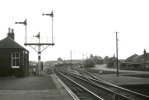
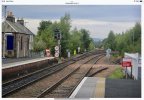
Yes, that is the change that I was referring to. I have attached these photos (not mine ) to illustrate.
 

Attachments

  • IMG_1835.jpeg
    IMG_1835.jpeg
    482 KB · Views: 156
  • IMG_1816.jpeg
    IMG_1816.jpeg
    47.8 KB · Views: 151
  • IMG_1836.jpeg
    IMG_1836.jpeg
    1,018.2 KB · Views: 155

Adrian Barr

Member
Joined
2 Jul 2020
Messages
743
Location
Doncaster
I was looking at some photographs of the 2014 resignaling at Ladybank (by Bill Robertson, on Flickr) and noticed his comment that the junction was now set for the main route being to Hilton Junction and Perth, and the branch line to Dundee.

This assumes that the lower speed route is always defined as the branch, which I don't think is necessarily the case. If you head towards Dundee at the junction you are continuing on the Down Fife, and the presentation of the track layout in the sectional appendix gives the Dundee route the appearance of being the main line. Trackmaps shows the lines towards Perth as Up/Dn branch or Up/Dn branch loop (continuing as the Ladybank single).

This got me wondering about the way that such junctions are signalled in cases where the branch line is directly ahead and the main line veers off to the left or right (I can't think of specific examples offhand, but there must be plenty of cases where the original route that went straight ahead is now a branch line, and a former subsidiary route or a line built at a later date is now the main line). Looking in a 2001 edition of the Modern Signalling Handbook, this paragraph on junction indicators makes no mention of branches and main lines, but only to the highest speed route:

A junction indicator, normally located above the junction signal, which indicates the route by displaying a row of white lights, either to the right or left. No route indication is given for the highest speed route, except that where there is no obvious main route a junction indicator will be provided for all routes. Where there are routes of equal speed a junction indicator may be provided for each route. Where the track layout through the switches and crossings straight ahead appears to the driver to be a legitimate route, but which actually leads to an unsignalled route (e.g. a route used only by trains running in the opposite direction), a junction indicator will be provided for all signalled routes.
[from the Modern Signalling Handbook, quoted text is from the 3rd edition]

There may have been some changes to signalling practices since that was written, but the junction at Ladybank follows that approach. One thing I'm not clear on is whether the position 1 route indicator seen here - https://www.flickr.com/photos/cuparexpat/50661222053/ - means the route is set into the loop, or onto the Up/Dn branch. Is entry into the loop on the Perth line controlled by subsidiary signals at either end? Can passenger trains use the loop if that's the case?

The signalling is shown nicely in this cab ride video (no sound) - it should start playing at 2:29:40, approaching Ladybank heading towards Dundee:

2:29:40 Speed Restriction sign (75 / HST 85)
2:31:05 Flashing yellow signal
2:31:45 50 mph advanced speed restriction warning sign for Dundee-bound trains
2:32:30 Ladybank station approaches
2:32:50 75 mph speed restriction sign
2:33:05 50 mph speed restriction sign for curve towards Dundee

Driver's Eye View - Sidings No4 Glasgow to Dundee - 2023 | Mick Lewis

In the other direction, the approach to Ladybank coming from Perth is seen here:

Driver's Eye View - Lady Bank Single (EB 672) to Lady Bank Station - 2021 | Mick Lewis

 

jadmor

Member
Joined
26 Nov 2013
Messages
154
I was also thinking about how to read this signal, and my best guess is that the left feather is for the branch loop, green only for the branch, and right feather for the Dundee line.

I have certainly been on trains that use the (new since 2014) down branch loop.

Slightly off topic, the up line out of Perth towards Hilton Junction uses a type of colour light splitting distant on the approach to the Hilton Junction semaphore home signals.

It is possible to see these in Moncrieff tunnel from Down trains, displaying(for example) yellow beside yellow, or yellow beside green. There is a plan of their sequencing in a Network Rail guide.

== Doublepost prevention - post automatically merged: ==

This assumes that the lower speed route is always defined as the branch, which I don't think is necessarily the case. If you head towards Dundee at the junction you are continuing on the Down Fife, and the presentation of the track layout in the sectional appendix gives the Dundee route the appearance of being the main line. Trackmaps shows the lines towards Perth as Up/Dn branch or Up/Dn branch loop (continuing as the Ladybank single).

This got me wondering about the way that such junctions are signalled in cases where the branch line is directly ahead and the main line veers off to the left or right (I can't think of specific examples offhand, but there must be plenty of cases where the original route that went straight ahead is now a branch line, and a former subsidiary route or a line built at a later date is now the main line). Looking in a 2001 edition of the Modern Signalling Handbook, this paragraph on junction indicators makes no mention of branches and main lines, but only to the highest speed route:


There may have been some changes to signalling practices since that was written, but the junction at Ladybank follows that approach. One thing I'm not clear on is whether the position 1 route indicator seen here - https://www.flickr.com/photos/cuparexpat/50661222053/ - means the route is set into the loop, or onto the Up/Dn branch. Is entry into the loop on the Perth line controlled by subsidiary signals at either end? Can passenger trains use the loop if that's the case?

The signalling is shown nicely in this cab ride video (no sound) - it should start playing at 2:29:40, approaching Ladybank heading towards Dundee:

2:29:40 Speed Restriction sign (75 / HST 85)
2:31:05 Flashing yellow signal
2:31:45 50 mph advanced speed restriction warning sign for Dundee-bound trains
2:32:30 Ladybank station approaches
2:32:50 75 mph speed restriction sign
2:33:05 50 mph speed restriction sign for curve towards Dundee

Driver's Eye View - Sidings No4 Glasgow to Dundee - 2023 | Mick Lewis

In the other direction, the approach to Ladybank coming from Perth is seen here:

Driver's Eye View - Lady Bank Single (EB 672) to Lady Bank Station - 2021 | Mick Lewis
Thanks for posting these. It is interesting to see that the down line to branch has a 75mph limit, that would have been very useful when the Inverness service was still running this way.
 
Last edited:

Railsigns

Established Member
Joined
15 Feb 2010
Messages
2,754
I was also thinking about how to read this signal, and my best guess is that the left feather is for the branch loop, green only for the branch, and right feather for the Dundee line.
That's right.
 
Status
Not open for further replies.

Top