
A while ago, I was watching Don Coffey’s videos with a cab ride in a TPE service from Manchester to Scotland. Part of it shows the 4-track approach to Preston from Buckshaw Parkway, taking the 3rd line from the right. There are some junction indicators showing the various pathing possibilities that I really can’t get my head around. I’ve checked on railsigns and tried to work through that, but no dice. Anyone got any simple ways for me to get my head around it?

-
Our new ticketing site is now live! Using either this or the original site (both powered by TrainSplit) helps support the running of the forum with every ticket purchase! Find out more and ask any questions/give us feedback in this thread!
You are using an out of date browser. It may not display this or other websites correctly.
You should upgrade or use an alternative browser.
You should upgrade or use an alternative browser.
Junction route indicators
- Thread starter Bayum
- Start date
- Status
- Not open for further replies.
Sponsor Post - registered members do not see these adverts; click here to register, or click here to log in
R
RailUK Forums
Hi Bayum, what would be a great help for us to answer your query would be for you to post a link of the video under question and tell us at what point in the video in terms of minutes and seconds the junction indicators appear.
Lampshade
Established Member

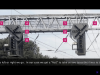
You can have up to 3 on each side of the signal. The ones on the left side are 1,2 and 3 from top to bottom, the ones on the right are 4, 5 and 6 from top to bottom.
So if you take each indicator in turn...
1 4
2 5
3 6
No indicator - main route, no divergence.
3 2 1 4 5 6
Are the lines you would end up on.
There is a bit more to it than that but that is it in simplified terms.
Bear in mind it is routes available and not necessarily tracks. If you are crossing a line you can't use (for example for it is worked in the other direction only) or even several lines but still only moving one 'route' to the left you would get only a position 1 route indicator.
So if you take each indicator in turn...
1 4
2 5
3 6
No indicator - main route, no divergence.
3 2 1 4 5 6
Are the lines you would end up on.
There is a bit more to it than that but that is it in simplified terms.
Bear in mind it is routes available and not necessarily tracks. If you are crossing a line you can't use (for example for it is worked in the other direction only) or even several lines but still only moving one 'route' to the left you would get only a position 1 route indicator.
zwk500
Veteran Member
Also to bear in mind signals only read to the next available Main Aspect signal. In a complex area like Preston, the signals are close together to allow the driver to read a series of 'feathers' so the signal you've highlighted doesn't actually give authority all the way through the station - there's another set of signals protecting the platforms, each with their own Indicators.
this link may give you a better idea of the signalling layout at Preston
 www.opentraintimes.com
Specifically at this signal, some lines are signalled bi-directionally, but not all. Immediately south of Preston you have 2 goods lines, 2 slow lines and 2 fast lines. the Fast and Slows are bi-di between Ribble Jn and preston but the Goods are not
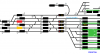
At the signal in the screenshot (PN76), the train is on the Down Fast. Main aspect only for Platforms 3/4/5, No. 1 JI reads to the Up Slow (platform 2), No. 2 to the Down Slow (Platform 1), and No 3. to the Down Goods. In between the Down Slow and Down Goods is the Up Goods, which is not signalled for northbound moves, hence there is no JI reading to that line. No 4 Jn indicator reads to the Up Fast, where a further signal will indicate which platform (4/5/6/old 7 now UG Loop) the train is routed to. This is why there's only one JI on the right had side - it only shows the route to the next signal.
For reference the adjacent signal in the photo PN75 reads MA: Dn Slow, No 1 JI: Dn Gds, No 4: Up Slow, No 5. Dn Fast, No. 6 Up Fast.
this link may give you a better idea of the signalling layout at Preston
Live map of Leyland to Lancaster
See trains move in real-time on our live map of Leyland to Lancaster
www.opentraintimes.com
Specifically at this signal, some lines are signalled bi-directionally, but not all. Immediately south of Preston you have 2 goods lines, 2 slow lines and 2 fast lines. the Fast and Slows are bi-di between Ribble Jn and preston but the Goods are not
At the signal in the screenshot (PN76), the train is on the Down Fast. Main aspect only for Platforms 3/4/5, No. 1 JI reads to the Up Slow (platform 2), No. 2 to the Down Slow (Platform 1), and No 3. to the Down Goods. In between the Down Slow and Down Goods is the Up Goods, which is not signalled for northbound moves, hence there is no JI reading to that line. No 4 Jn indicator reads to the Up Fast, where a further signal will indicate which platform (4/5/6/old 7 now UG Loop) the train is routed to. This is why there's only one JI on the right had side - it only shows the route to the next signal.
For reference the adjacent signal in the photo PN75 reads MA: Dn Slow, No 1 JI: Dn Gds, No 4: Up Slow, No 5. Dn Fast, No. 6 Up Fast.

High Dyke
Established Member
Dave_Cardboard
Member
- Joined
- 18 Oct 2017
- Messages
- 215
Maybe it's worth mentioning that trains drivers have to "learn" all the routes they operate over, including learning what all the various junction indicators mean. This differs from those of us that drive motor cars where we expect to be able to go anywhere without prior knowledge and "figure out" how each junction works from the signage when we get there for the first time.
And I respect that. Doesn’t stop me wanting to know how the junction indicators work, however.Maybe it's worth mentioning that trains drivers have to "learn" all the routes they operate over, including learning what all the various junction indicators mean. This differs from those of us that drive motor cars where we expect to be able to go anywhere without prior knowledge and "figure out" how each junction works from the signage when we get there for the first time.
Do you understand now?And I respect that. Doesn’t stop me wanting to know how the junction indicators work, however.
DeparturesBeck
Member
- Joined
- 17 Aug 2013
- Messages
- 152
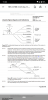
Take a look at section 2.3 of RS521 located here.
As mentioned in a previous post only valid routes are counted in the 1-2-3 4-5-6 system therefore route one is not necessarily the adjacent line on the left, but it would normally be the first valid route on the left.
As mentioned in a previous post only valid routes are counted in the 1-2-3 4-5-6 system therefore route one is not necessarily the adjacent line on the left, but it would normally be the first valid route on the left.

alxndr
Established Member
- Joined
- 3 Apr 2015
- Messages
- 1,687
Seeing it shown graphically might help. The numbers relate to where each junction indicator routes a train to, red numbers for PN75 and yellow numbers for PN76.
As you can see between the junction indicators and the main aspect (no junction indicators lit) all possible signalled moves are accounted for.
As you can see between the junction indicators and the main aspect (no junction indicators lit) all possible signalled moves are accounted for.
Attachments
- Status
- Not open for further replies.