Our new ticketing site is now live! Using either this or the original site (both powered by TrainSplit) helps support the running of the forum with every ticket purchase! Find out more and ask any questions/give us feedback in this thread!
Hi all. New member here. Both my granddads arrived in London in 1951 from Italy to work for British Rail. I've been doing some research online as I've found very little about how they arrived here beyond what my family told me but recently I found some evidence at The National Archives; documents relating to a little-known post-war scheme to recruit Italian workers for Britain's railways which I believe is the scheme they arrived on. I was wondering if anyone here knows about the scheme or about Italians working on British Rail in the 1950s. My granddads worked as railway track maintenance workers (platelayers) and slept on train carriages in their first year but I don't know where that was. Any information or tips where to look would be greatly appreciated. Thank you!
There is a fair amount of coverage of this in the newspapers in the British Newspaper Archive, as well as Italian workers in other industries (the best known being brick-making). A lot of the news is about the impact on labour relations and the attitude of the unions. I can see mention of track workers in 1951 in Doncaster, and further proposals in 1955.
Some Italian POWs were at a military camp just outside Taunton, and one was assigned to the short-staffed engine shed as a labourer to shovel ash, etc. Quite soon became accepted, and I believe later on even made the daily trip to/fro unaccompanied. After 1943 he stayed on, was taken on the books by the railway, progressed through the firing links, and by 1960 was a main line driver. Married a local girl, you can imagine the rest.
When I was a booking clerk at Guildford in the mid-1970s, there was an Italian Railman named Baldasarre working at the station. His English language was not great, but he was a pleasant, cheerful soul and always willing to help out. His main job was driving the battery-powered tractor that was used for pulling BRUTES (British Rail Universal Trolley Equipment) loaded with parcels around the station.On occasions of severe staff shortage he would be put to work on the ticket barrier. His excess ticket book was a nightmare to reconcile and the stations written thereon were virtually indecipherable....but he was as honest as the day was long. I don't know how long he had been working on the railway, but he could have joined in the 1950s.
Little did I know at that time that my parents would move to Italy five or six years later....and that that would be the beginning of a life-long love affair with that country!
Slightly off topic, but when I started on the railway in 1964 in the north west, several of the relaying gangs were heavily manned with eastern europeans, Ukraine and Poland being well represented.
I think quite a few PoWs stayed on after WW2 ended, there were/still is quite large Italian communities in Bedford and Peterborough predominantly from the brickwork.
There used to be two italian guys who ran a barbers in the town where I grew up (Huntingdon) who had been captured by the Eighth Army in the Western Desert and never went home.
Slightly off topic, but when I started on the railway in 1964 in the north west, several of the relaying gangs were heavily manned with eastern europeans, Ukraine and Poland being well represented.
I'm sure there was a government scheme related to this dating to the period soon after the end of world war 2 - potentially not without controversy given the creation of the Iron Curtain.
Just had a brief internet search and Wikipedia mentions 'European Voluntary Workers' - mostly talks about eastern Europeans but occurs to me if similar or related schemes existed in relation to Italy
Link here - not posting all the text but copied the intro
European Voluntary Workers (EVW) was the collective name given to continental Europeans invited by the British government to work in the UK in the immediate Post-World War II period from 1946 to 1951,[1] to help people who have become homeless during the war and to support labor shortages in industry. Programmes inviting staff include Balt Cygnet, which recruited Baltic women for nursing, housework and textile work. In spite of its name, Balt Cygnet also accepted applicants from Ukraine, Poland and countries in the Balkans, among others. Later Westward Ho! which recruited men for unskilled jobs in industry.[2]
I think quite a few PoWs stayed on after WW2 ended, there were/still is quite large Italian communities in Bedford and Peterborough predominantly from the brickwork.
There used to be two italian guys who ran a barbers in the town where I grew up (Huntingdon) who had been captured by the Eighth Army in the Western Desert and never went home.
Yes, Italian community in Bedford ref brickworks industry came to my mind too - I suspect @Mauro has already searched for links and found stuff on that - but I seem to recall in the past when reading stuff on the brickworks near the Midland Main Line finding interesting stuff on local history and archives sites for Bedfordshire about Italian migration including IIRC some oral history recordings or transcripts (probably in Bedfordshire museums or local archives)
Made me wonder if recruitment to the brickmaking industry might have been part of some similar scheme to recruit to railway at around the same time / or as part of some variation on the scheme linked above in my post.
== Doublepost prevention - post automatically merged: ==
Hi all. New member here. Both my granddads arrived in London in 1951 from Italy to work for British Rail. I've been doing some research online as I've found very little about how they arrived here beyond what my family told me but recently I found some evidence at The National Archives; documents relating to a little-known post-war scheme to recruit Italian workers for Britain's railways which I believe is the scheme they arrived on. I was wondering if anyone here knows about the scheme or about Italians working on British Rail in the 1950s. My granddads worked as railway track maintenance workers (platelayers) and slept on train carriages in their first year but I don't know where that was. Any information or tips where to look would be greatly appreciated. Thank you!
couple of thoughts on other places that may be worth asking this same question are places i have seen people ask via letters / e-mails for this sort of thing in publications:
Railnews (former BR staff newspaper which I think still exists)
Penfriend - magazine that gets sent to railway pension scheme members and has articles / letters about other things of interest
Check out Penfriend online today - your newsletter if you've already started taking your pension from the Scheme.
www.railwayspensions.co.uk
It may be that they would reach former staff who may have service recollections of people doing those jobs originally from Italy (or given the timescale 'worked with people who worked with people who originally....')
My granddads worked as railway track maintenance workers (platelayers) and slept on train carriages in their first year but I don't know where that was. Any information or tips where to look would be greatly appreciated. Thank you!
Presumably the railways had vehicles that track gangs could sleep in if sent to work on jobs further away from home when required? - which could have been used for staff like this who arrived in UK to do this sort of job and had no home at all - until they found lodgings / housing - or of course the two things could get conflated as stories get passed from one generation to the next.
I'm sure there was a government scheme related to this dating to the period soon after the end of world war 2 - potentially not without controversy given the creation of the Iron Curtain.
Just had a brief internet search and Wikipedia mentions 'European Voluntary Workers' - mostly talks about eastern Europeans but occurs to me if similar or related schemes existed in relation to Italy
Link here - not posting all the text but copied the intro
Although I was quite young at the time I remember the arrival of Polish immigrants in 1956 which seemed to be connected to the state crushing resistance. I remember the radio news reporting on the situation in Warsaw but Wikipedia suggests actually Poznan. In my town there were young-ish Polish conductors on the Corporation buses.
Although I was quite young at the time I remember the arrival of Polish immigrants in 1956 which seemed to be connected to the state crushing resistance. I remember the radio news reporting on the situation in Warsaw but Wikipedia suggests actually Poznan. In my town there were young-ish Polish conductors on the Corporation buses.
That's interesting. 1956 also is the date of Hungarian uprising which I seem to recall also resulted in refugees / people escaping to the west. Hadn't previously heard of the polish incidents you mention so interesting to learn that. Suspect they get overshadowed by the Hungarian uprising in the popular consciousness.
Back when I lived in Bristol the local Greengrocer was Italian Heritage
He told me........
Basically UK Government agents were recruiting workers from Italy after WW2 they came over and were provided with accommodation and jobs, women in the NHS men in the coal mines
A lot of the Italian POWs didn't go home and were well regarded locally, my granny told me long ago. They would enthusiastically light smoke beacons on Tyneside to thwart the Luftwaffe and many seemed glad to be away from the front line. Northampton has many Italians who came after the war to work in the shoe and leather industry.
The very small Italian community in Taunton (see my note above) all kept up with one another, and were a distinct sub-group at the catholic church, which had traditionally been dominated by the Irish, including our family doctor whose degree was from Trinity Dublin. The Irish expatriates didn't work on the railway per-way, but did form a group with the town council highways. Apart from the PoW-cum-WR driver there was our near-neighbour, who from being in the army in Italy in 1945 had met and married an Italian lady, and both returned to Taunton, and also stereotypically the ice cream man, who had an (unprecedented) ice cream cafe in the town centre, and also a couple of ice cream vans run by his late-teenage sons in the summer.
In 1956 arrived apparently a Hungarian exile baker, who brought to his shop middle-European cream cakes (think Vienna), the best in the town.
The very small Italian community in Taunton (see my note above) all kept up with one another, and were a distinct sub-group at the catholic church, which had traditionally been dominated by the Irish, including our family doctor whose degree was from Trinity Dublin. The Irish expatriates didn't work on the railway per-way, but did form a group with the town council highways. Apart from the PoW-cum-WR driver there was our near-neighbour, who from being in the army in Italy in 1945 had met and married an Italian lady, and both returned to Taunton, and also stereotypically the ice cream man, who had an (unprecedented) ice cream cafe in the town centre, and also a couple of ice cream vans run by his late-teenage sons in the summer.
In 1956 arrived apparently a Hungarian exile baker, who brought to his shop middle-European cream cakes (think Vienna), the best in the town.
Although I was quite young at the time I remember the arrival of Polish immigrants in 1956 which seemed to be connected to the state crushing resistance. I remember the radio news reporting on the situation in Warsaw but Wikipedia suggests actually Poznan. In my town there were young-ish Polish conductors on the Corporation buses.
There were a lot of refugee camps in former Army / RAF bases right across the country for Polish soldiers and their families who fought for the Allies and who couldn't return home after the Communist takeover in 1948. They gradually closed as the refugees integrated into society, but one still remains at Stover near Newton Abbot in Devon. Ncknamed 'Little Poland' it is scheduled for closure in 2028 as there are very few veterans left now.
There were a lot of refugee camps in former Army / RAF bases right across the country for Polish soldiers and their families who fought for the Allies and who couldn't return home after the Communist takeover in 1948. They gradually closed as the refugees integrated into society, but one still remains at Stover near Newton Abbot in Devon. Ncknamed 'Little Poland' it is scheduled for closure in 2028 as there are very few veterans left now.
Thanks everyone for your replies! The government European Voluntary Workers (EVW) scheme ended in 1951. My family arrived at the end of 1951 on an unofficial scheme funded by the Railway Executive. I've been doing some more research this week and I've found some info on the train carriages.
Old Oak Common (Acton/Willesden area) This massive Great Western Railway (and later British Railways) hub featured extensive carriage sidings. To combat severe housing and labor shortages following World War II and into the early 1950s, British Railways utilized converted passenger coaches parked on dedicated sidings to serve as makeshift residential blocks.
Other London Sidings Similar configurations of residential hostel carriages were deployed by the London Midland Region and Southern Region at key entry points and junctions around the capital (such as Southall and Cricklewood) to house single men drafted in for heavy track maintenance and engineering.
I've been unable to find out any more detail or any connection to my grandparents though. Does anyone know anything about them?
== Doublepost prevention - post automatically merged: ==
I'm sure there was a government scheme related to this dating to the period soon after the end of world war 2 - potentially not without controversy given the creation of the Iron Curtain.
Just had a brief internet search and Wikipedia mentions 'European Voluntary Workers' - mostly talks about eastern Europeans but occurs to me if similar or related schemes existed in relation to Italy
Link here - not posting all the text but copied the intro
== Doublepost prevention - post automatically merged: ==
Yes, Italian community in Bedford ref brickworks industry came to my mind too - I suspect @Mauro has already searched for links and found stuff on that - but I seem to recall in the past when reading stuff on the brickworks near the Midland Main Line finding interesting stuff on local history and archives sites for Bedfordshire about Italian migration including IIRC some oral history recordings or transcripts (probably in Bedfordshire museums or local archives)
Made me wonder if recruitment to the brickmaking industry might have been part of some similar scheme to recruit to railway at around the same time / or as part of some variation on the scheme linked above in my post.
== Doublepost prevention - post automatically merged: ==
couple of thoughts on other places that may be worth asking this same question are places i have seen people ask via letters / e-mails for this sort of thing in publications:
Railnews (former BR staff newspaper which I think still exists)
Penfriend - magazine that gets sent to railway pension scheme members and has articles / letters about other things of interest
Check out Penfriend online today - your newsletter if you've already started taking your pension from the Scheme.
www.railwayspensions.co.uk
It may be that they would reach former staff who may have service recollections of people doing those jobs originally from Italy (or given the timescale 'worked with people who worked with people who originally....')
Presumably the railways had vehicles that track gangs could sleep in if sent to work on jobs further away from home when required? - which could have been used for staff like this who arrived in UK to do this sort of job and had no home at all - until they found lodgings / housing - or of course the two things could get conflated as stories get passed from one generation to the next.
When my grandmother, a crossing keeper on the Leighton Buzzard to Dunstable line got fed up with me, she would send me off for the day tramping down the line with a gang of Polish platelayers. I seem to recall that they were very kind to me, but had very little English.
I have no idea how they came to be there but I believe there was a POW camp in the area so they may have settled around there.
I tended to get sent back to my grandmother's box in a brake van although on one memorable occasion it was on a footplate.
This would have been about 1962 I guess.
Thanks everyone for your replies! The government European Voluntary Workers (EVW) scheme ended in 1951. My family arrived at the end of 1951 on an unofficial scheme funded by the Railway Executive. I've been doing some more research this week and I've found some info on the train carriages.
Old Oak Common (Acton/Willesden area) This massive Great Western Railway (and later British Railways) hub featured extensive carriage sidings. To combat severe housing and labor shortages following World War II and into the early 1950s, British Railways utilized converted passenger coaches parked on dedicated sidings to serve as makeshift residential blocks.
Other London Sidings Similar configurations of residential hostel carriages were deployed by the London Midland Region and Southern Region at key entry points and junctions around the capital (such as Southall and Cricklewood) to house single men drafted in for heavy track maintenance and engineering.
I've been unable to find out any more detail or any connection to my grandparents though. Does anyone know anything about them?
== Doublepost prevention - post automatically merged: ==
Thanks! I hadn't clocked Railnews or Penfriend. I'll give them a go! And yes, I agree they might have slept in vehicles that track gangs used to use!
Thanks for update.
V interesting about the use of the carriages in such a fashion. I’d not read of that before. What was the source of your info there? Is it easy to access. Eg read on line.
Yes I used to browse my late father in laws copies of Penfriend when visiting him and it would have letters / emailed letters in it asking questions like your original post here. That was 3 or 4 years ago.
Possibly a good way to reach older generation railway people as by definition it goes to railway pensioners.
a gang of Polish platelayers. I seem to recall that they were very kind to me, but had very little English.
I have no idea how they came to be there but I believe there was a POW camp in the area so they may have settled around there.
Although Poles would (with perhaps some exceptions who found themselves conscripted into the German army for one reason or another) have been allies rather than prisoners.
When my grandmother, a crossing keeper on the Leighton Buzzard to Dunstable line got fed up with me, she would send me off for the day tramping down the line with a gang of Polish platelayers. I seem to recall that they were very kind to me, but had very little English.
I have no idea how they came to be there but I believe there was a POW camp in the area so they may have settled around there.
Not many Poles were POWs, we were on the same side! But large numbers did spend the war years involved with the Army and especially the Air Force, and some did stay on after the war. In many cases they didn’t have homes to go back to. This led to Polish communities all over the UK, but most notably in and around Ealing where a lot of the airmen settled.
Surprised nobody's mentioned Carnforth shed. Not really helpful for @Mauro directly (but there might be personal connections), AIUI - unless it's one of those urban myths - Carnforth (near Lancaster) loco shed was rebuilt by Italian PoWs during WW2.
Not many Poles were POWs, we were on the same side! But large numbers did spend the war years involved with the Army and especially the Air Force, and some did stay on after the war. In many cases they didn’t have homes to go back to. This led to Polish communities all over the UK, but most notably in and around Ealing where a lot of the airmen settled.
Can't speak for Ealing, but there were a great many people from Poland in Derby post WW2 and 1956. There was a White Eagle Club on Charnwood Street (good for Sunday evening discos, as I remember). I suspect it was similar in places like Stoke, the Erewash coal fields and Sheffield.
Derby certainly attracted a great variety of E Europeans. Always keen to hear and identify foreign tongues, on a bus one day in 75 or 76, I heard two fairly elderly men speaking what I took to be a European language, but I couldn't identify it. It obviously wasn't Germanic, nor Slavic. So I thunked around. I'd got a Time Life Book on Eastern Europe at the time and learned that there existed the Baltic states, which in those days, incorporated* into the Soviet Union, almost nobody among the general GB public knew about.
Knowing the Baltic languages were from other linguistic families, I said: Excuse me, are you speaking one of the Baltic languages? (or something like that).**
They almost fell off their seats in surprise at the question from a youthful Brit. They were - though I can't remember which one.
I've since made good friends with a British-Latvian couple, one originally from Leamington Spa, the other from Nottingham.
* I know the Baltic states were never officially recognised as part of the USSR by the UN. I'm talking about the de facto situation post-WW2.
** Equally, they could have been speaking Hungarian, but that possibility never crossed my mind at the time.
Thanks for update.
V interesting about the use of the carriages in such a fashion. I’d not read of that before. What was the source of your info there? Is it easy to access. Eg read on line.
Yes I used to browse my late father in laws copies of Penfriend when visiting him and it would have letters / emailed letters in it asking questions like your original post here. That was 3 or 4 years ago.
Possibly a good way to reach older generation railway people as by definition it goes to railway pensioners.
Hi. I found a mention of carriage sidings being used as accommodation after WWII here - http://www.glias.org.uk/journals/16-e.pdf. I've dropped the Great Western Society and Greater London Industrial Archaeology Society a message to see if they know any more. I'll try Penfriend today. Thank you!
Hi. I found a mention of carriage sidings being used as accommodation after WWII here - http://www.glias.org.uk/journals/16-e.pdf. I've dropped the Great Western Society and Greater London Industrial Archaeology Society a message to see if they know any more. I'll try Penfriend today. Thank you!
Thanks for that link - interesting stuff and will be good to have a full read. An initial look clearly mentions carriages as accommodation which seems to me to certainly verify that your grandfathers might / would have been offered something like this in that period.
Hopefully you have luck in getting more information.
The sort of track world they would have been doing would have been tough, potentially risky / dangerous and unglamorous. Probably never got the sort of recognition in railway histories and articles then more high profile work carried out by others (driving being the obvious example of that).
All part of the important story that helps make up the population of the modern UK in my view.
== Doublepost prevention - post automatically merged: ==
Although Poles would (with perhaps some exceptions who found themselves conscripted into the German army for one reason or another) have been allies rather than prisoners.
certainly a point well made but occurs to me that former PoW camps that had been vacated by prisoners might have been re-used as available for others coming into the country under scheme like EVW scheme?
As would probably have been former military camps - which might have had better facilities come to think of it - I have read about a camp at Tonfanu that was used in the early 1970s for Asian refugees from Uganda in the early 1970s which was an ex military camp.
Reading Signal Works used to have its own 0-4-0 Drewry (?) shunter, number 20. It's regular crew were a couple of Italians. They had come to the UK post war, looking for work. Sadly their English language skills weren't good enough to let them loose on the main line, so they were confined to shunting the occasional wagon around, Monday to Friday, permanent day shift. Even sending Shunter 20 across to Reading depot for fuel required the service of a main line pilot driver.
The NUR had negotiated restrictions on these Italian workers, as described in the Yorkshire Post and Leeds Intelligencer Published Monday, 14 January 1952:
Before last night's meeting. Councillor O. H. Jackson, secretary the No. 2 branch, told The Yorkshire Post: "Our men have heard this with mixed feelings. If the railways start using the Italians the disadvantage British labour there will trouble. So long as the Italians do a Job of work and not retard the promotion our men I think they will be accepted." This attitude is different from that the miners who have barred Italian labour from all but one the 12 Doncaster pits.
Councillor Jackson spoke of previous experience of Italian railway workers during the war and immediately afterwards. Numbers had been employed at Retford as well Doncaster. and the procedure then was to have them working together In mobile groups.
"The Executive of the National Union (unlike the National Union of. Mineworkers) have discussed the allocation of Italians in detail with the Railway Executive ". "The Union's Executive have gone very carefully Into it, and guarantees have been asked for and given. The Union will continue to watch the position carefully," said Councillor Jackson.
One the guarantees that the Italians should be the first to go in the event of redundancy. Others are concerned with safeguards against their use dilutee labour In higher grades of employment.
The latter safeguards are regarded most Important by railwaymen who are determined to maintain the traditional progress through the various grades of skill...
Jackson then turned up to welcome these 98 Italians on arrival in the name of the union. They were, at least initially, living in the Sandringham Road Miners' Hostel, where (since none of them could speak any English) a translator was provided to help with meal service etc. They were to work as permanent way workers, wagon examiners and greasers - "jobs for which there is insufficient British labour". Initially they had a one year contract, but most stayed longer.
== Doublepost prevention - post automatically merged: ==
I'm not sure exactly how many came into BR, I can only find "more than 700" for that number. They were (officially) restricted to working in the job for which they were recruited for four years, and by 1955 about 400 remained. A plan that year for a further 2,000 for permanent way work did not, I think, happen. For one thing the NUR was in dispute then about contractors brought in to do that work at much higher rates than railwaymen; obviously they thought their rates should go up. I'm sure the NUR knew quite well that only a limited adjustment of differentials was possible before pay across BR would need to go up as well - after all, they would be demanding it! But there were shortages then of all kinds of railway workers, at least in areas where there were other employers in light industry offering similar pay with better hours and conditions of work and overtime rates.
Although Poles would (with perhaps some exceptions who found themselves conscripted into the German army for one reason or another) have been allies rather than prisoners.
You can learn some remarkable facts in these forums, amazing that this is still running after almost 80 years. Here’s a link to an MOD summary about “Ilford Park Polish Home”:
Today Ilford Park is now the last remaining home run by the Ministry of Defence (MOD), who took on this responsibility from the Assistance Board, under the 1947 act. The home first opened in 1948 at Stover Camp, the site of a hospital built for expected D-Day casualties amongst American troops. Its original purpose was to resettle members of the Polish forces into a new life in the UK but over the years it evolved into a residential care and nursing home for elderly Polish veterans.
Thanks for that link - interesting stuff and will be good to have a full read. An initial look clearly mentions carriages as accommodation which seems to me to certainly verify that your grandfathers might / would have been offered something like this in that period.
Hopefully you have luck in getting more information.
The sort of track world they would have been doing would have been tough, potentially risky / dangerous and unglamorous. Probably never got the sort of recognition in railway histories and articles then more high profile work carried out by others (driving being the obvious example of that).
All part of the important story that helps make up the population of the modern UK in my view.
== Doublepost prevention - post automatically merged: ==
certainly a point well made but occurs to me that former PoW camps that had been vacated by prisoners might have been re-used as available for others coming into the country under scheme like EVW scheme?
As would probably have been former military camps - which might have had better facilities come to think of it - I have read about a camp at Tonfanu that was used in the early 1970s for Asian refugees from Uganda in the early 1970s which was an ex military camp.
Thanks for this! I agree they would have worked really hard on the tracks. We actually had another relative who died working on the tracks during this time. I've lost touch with that side of the family now but I remember hearing the story growing up. And thank you about what you said recognising their contributions to the British railways. I think that's why I've been keen to do the research. I'll keep you all posted if I find anything else.
== Doublepost prevention - post automatically merged: ==
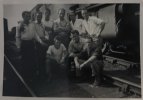
Thanks for all your contributions and suggestions. If it helps I'm posting a picture here of my grandad with some fellow Italian workers. It would have been taken circa 1951/52. Does anyone recognise the train they are standing in front of? Or where it may have been taken? It's a long shot I know! Thank you.
If it helps I'm posting a picture here of my grandad with some fellow Italian workers. It would have been taken circa 1951/52. Does anyone recognise the train they are standing in front of? Or where it may have been taken? It's a long shot I know! Thank you.
Do you have any idea where the photo may have been taken? From what can be seen of the loco it would appear to be a tank engine. The combination of the inclined cylinders and the cutaway into the tank above the framing just ahead of the change in the framing line suggest it is an LNER L-1 class 2-6-4T introduced in 1945. IIRC there were a hundred or so of these built for London suburban services. Others will know where else they may have got to by 1951.
We are aware of an issue with emails from the Forum to Microsoft-based email accounts (hotmail/outlook/live.com email addresses). This is being looked into currently, thanks for your patience meanwhile.