Our new ticketing site is now live! Using either this or the original site (both powered by TrainSplit) helps support the running of the forum with every ticket purchase! Find out more and ask any questions/give us feedback in this thread!
If you did this, you'd be marked as an overstayer later on, which could affect future trips.
It would also bring up some difficult conversations in the future at border control.
Effectively if you traveled to St Pancras to enrol in the system then went straight home or elsewhere within London or wider UK, the EU/schengen area would not know that and would think you've actually travelled.
There would be no record of you having left, because you never travelled to begin with, leading to you being marked on a database somewhere as an overstayer.
If you are keen to enrol early, just to get it done, this can be done.
Basically do a day trip to anywhere. Early morning flight out afternoon or evening flight back. Low fares airlines would be of great help. This way even if you never go further than the airport, at least you wont be markex as an overstayer in the next 6 months (possibly without even knowing).
If you did this, you'd be marked as an overstayer later on, which could affect future trips.
It would also bring up some difficult conversations in the future at border control.
Effectively if you traveled to St Pancras to enrol in the system then went straight home or elsewhere within London or wider UK, the EU/schengen area would not know that and would think you've actually travelled.
I agree with this that I don't think you would be marked as having entered the EU.
Doing this would save you seconds at best. Irrespective of what has been claimed on this thread, you have to use the kiosks every time you enter and exit the EU under current plans for St Pancras (You will have to undergo the process in some way everywhere, it just might be at the passport desk at airports). The only difference when going through after the first time will be that only one biometric identifier needs to be taken, likely a facial scan the majority of times. Unless there does start to be separation in the queues between people who have registered before and haven't there will be no meaningful time saving in having completed the checks, only in a greater proportion of people having completed it, and being familiar with the process will the queues shorten.
Regardless, St Pancras isn't currently doing the process anyways, the kiosks aren't open as far as I know.
Irrespective of what has been claimed on this thread, you have to use the kiosks every time you enter and exit the EU under current plans for St Pancras (You will have to undergo the process in some way everywhere, it just might be at the passport desk at airports).
I thought that the kiosks were only for registering i.e. you only need to use one once at the point when you encounter the new system for the first time?
It looks like there is no coordinated approach with EES, just as well it is being slowly phased in! One example the EU as a bloc can't function well where some member states are completely different to others personality wise, e.g. fastidious Northern vs unhurried Southern etc.
I wouldn't be surprised if there are different makes of kiosks, running the same software, across the bloc thus many taken out of use when broken, that just one manufacturer should be possibly used for consistency.
I agree with this that I don't think you would be marked as having entered the EU.
Doing this would save you seconds at best. Irrespective of what has been claimed on this thread, you have to use the kiosks every time you enter and exit the EU under current plans for St Pancras (You will have to undergo the process in some way everywhere, it just might be at the passport desk at airports). The only difference when going through after the first time will be that only one biometric identifier needs to be taken, likely a facial scan the majority of times. Unless there does start to be separation in the queues between people who have registered before and haven't there will be no meaningful time saving in having completed the checks, only in a greater proportion of people having completed it, and being familiar with the process will the queues shorten.
Regardless, St Pancras isn't currently doing the process anyways, the kiosks aren't open as far as I know.
I think we need to get this right, as @Mag_seven states above, the kiosks only for registering; a bit like buying a passport once every ten years, except you register once every three.
Once registered, you can then proceed (or not, as the case may be r/e St Pancras - unless they are after you have swiped your ticket??) to the actual scanners which allow you access to Schengen.
First time; Arrive at foreign airport/St Pancras; Register your details; then proceed to the scanner for entry.
Second and future times for the next 3 years*; arrive then immediately proceed to scanners (ignoring the kiosks) which will identify you and proceed. *of course the ETIAS is coming which will add further administration, but that will be done at home and will automatically be linked to your passport and biometrics.
I thought that the kiosks were only for registering i.e. you only need to use one once at the point when you encounter the new system for the first time?
That was my understanding initially, but a circular Eurostar sent to travel agents earlier this month stated passengers in scope of EES at St Pancras and Gare du Nord would need to go and use the kiosks every time they travel and before going through security and passport control. I don't know if that's happening on the ground, it's all clear as mud. I have an Irish passport so am not spending a great deal of time or energy on it.
That was my understanding initially, but a circular Eurostar sent to travel agents earlier this month stated passengers in scope of EES at St Pancras and Gare du Nord would need to go and use the kiosks every time they travel and before going through security and passport control. I don't know if that's happening on the ground, it's all clear as mud. I have an Irish passport so am not spending a great deal of time or energy on it.
The official EES guidance is also very confusing - it states:
If you have crossed the borders of the European countries using the EES more than once since the EES started
The photo of your face and/or your fingerprints will already be recorded in the EES. The passport control officers will only verify your fingerprints and photo, which will take less time. In rare cases, it may be necessary to collect and record your data again.
If you hold a biometric passport, you will be able to enter more quickly using the self-service system (if available at that border crossing point).
The bit in bold is mine - for "self service system" read kiosk, therefore it implies you should use it again. But how can that let you "enter more quickly" when you will be in the exact same queue of people using the kiosk to register for the first time?
I think we need to get this right, as @Mag_seven states above, the kiosks only for registering; a bit like buying a passport once every ten years, except you register once every three.
Once registered, you can then proceed (or not, as the case may be r/e St Pancras - unless they are after you have swiped your ticket??) to the actual scanners which allow you access to Schengen.
First time; Arrive at foreign airport/St Pancras; Register your details; then proceed to the scanner for entry.
Second and future times for the next 3 years*; arrive then immediately proceed to scanners (ignoring the kiosks) which will identify you and proceed. *of course the ETIAS is coming which will add further administration, but that will be done at home and will automatically be linked to your passport and biometrics.
The understanding which was done for work on the facilities for the scanner was the plan is you use them every time. It is in theory possible that they could do it how you state, but this isn't the plan that has been worked to, nor is it the plan which Eurostar has communicated to agents or the government.
There has been talk of putting separate queues in for people who have registered before depending on how much quicker it ended up being.
The issue really here is the process is partially up to the country, and some have been a bit secretive about what the process will be, hence for example the 4 questions being removed for the trial period now.
== Doublepost prevention - post automatically merged: ==
To add to this, a direct quote from Eurostar's help article on the topic (My bold):
In time, all non-EU nationals required to register for EES (including British nationals) will need to do so every time they enter or leave the EU - so, every time they travel to or from London with Eurostar. We’ll provide a further update well in advance and contact impacted travellers to let them know what to expect and help them prepare for their journey.
In time, all non-EU nationals required to register for EES (including British nationals) will need to do so every time they enter or leave the EU - so, every time they travel to or from London with Eurostar. We’ll provide a further update well in advance and contact impacted travellers to let them know what to expect and help them prepare for their journey.
I think what they mean is you will have to be scanned for your biometrics every time you enter/leave Schengen - not that you will have to go to a kiosk to have them registered on the system every time. At least I hope so and it's just poorly worded otherwise the queues in summer especially will be horrendous - and totally unmanageable by airports and airlines.
I think what they mean is you will have to be scanned for your biometrics every time you enter/leave Schengen - not that you will have to go to a kiosk to have them registered on the system every time. At least I hope so and it's just poorly worded otherwise the queues in summer especially will be horrendous - and totally unmanageable by airports and airlines.
Yes I think that those who are drawing up these so called "help articles" seem to be missing something somewhere. Why should I also have to "register" again on leaving?
I think what they mean is you will have to be scanned for your biometrics every time you enter/leave Schengen - not that you will have to go to a kiosk to have them registered on the system every time. At least I hope so and it's just poorly worded otherwise the queues in summer especially will be horrendous - and totally unmanageable by airports and airlines.
The idea you have to use the kiosk every time is certainly what we were working to when designing for one of the EES points within the UK at work. The idea behind it is that while you can take the biometrics at a border point it is done at a kiosk to make it quicker. When using the kiosk on subsequent times you will be taken through a condensed flow and only required to provide one biometric.
Registering is probably a mistranslation, but is referring to giving a biometric details, whether first time or subsequent times. if you didn't have to Eurostar wouldn't have installed the suite of the machines at Paris Gare du Nord.
The idea you have to use the kiosk every time is certainly what we were working to when designing for one of the EES points within the UK at work. The idea behind it is that while you can take the biometrics at a border point it is done at a kiosk to make it quicker. When using the kiosk on subsequent times you will be taken through a condensed flow and only required to provide one biometric.
From 12 October 2025, the EU will introduce new border checks known as the Entry/Exit system (EES). This will change requirements for British and other non-EU citizens travelling to Europe. When introduced, you may need to submit your fingerprints, have your photo taken and your passport scanned at dedicated booths.
There's nothing mentioned/shown about having to keep registering - as in having to submit all your details again and again - at a registration booth every time you enter Schengen, just do it once, and then for the next three years all you have to do is provide one biometric at the border (say a fingerprint) which will be a version of the e-gate and you're through no matter how many times you travel there (subject to the 90/180 limit).
I noticed at Ibiza the outbound departure gates (eg 14 - 16) have those new biometric gate scanners, although unused this time, I could see where you put your passport and fingers and there was a camera too.
There's nothing mentioned/shown about having to keep registering - as in having to submit all your details again and again - at a registration booth every time you enter Schengen, just do it once, and then for the next three years all you have to do is provide one biometric at the border (say a fingerprint) which will be a version of the e-gate and you're through no matter how many times you travel there (subject to the 90/180 limit).
I noticed at Ibiza the outbound departure gates (eg 14 - 16) have those new biometric gate scanners, although unused this time, I could see where you put your passport and fingers and there was a camera too.
Whether it is undertaken at the gate or at a kiosk is entirely up to the airport/country. That it will be done at a kiosk under the current plan is Eurostar's plan, because of the existing issues of passport control throughput. At some airports the initial registration will be done at the control booth as well, it is up to them. There is no overall information on what you will use when because it is entirely dependant on the port.
Whether it is undertaken at the gate or at a kiosk is entirely up to the airport/country. That it will be done at a kiosk under the current plan is Eurostar's plan, because of the existing issues of passport control throughput. At some airports the initial registration will be done at the control booth as well, it is up to them. There is no overall information on what you will use when because it is entirely dependant on the port.
Whether it is undertaken at the gate or at a kiosk is entirely up to the airport/country. That it will be done at a kiosk under the current plan is Eurostar's plan, because of the existing issues of passport control throughput.
That is also how Prague seem to be implementing it for arrivals. Everyone arriving who is not going into the EU queue is required to use one of the kiosks first, before joining the queue for the immigration booths. I didn't spot either fingerprint or facial recognition devices at the arrivals booths themselves.
For departures, each of the manned booths has been provided with a fingerprint scanner and facial recognition device. Everyone was being instructed to use both. This was certainly slowing the rate at which departing passengers were being processed.
That is also how Prague seem to be implementing it for arrivals. Everyone arriving who is not going into the EU queue is required to use one of the kiosks first, before joining the queue for the immigration booths. I didn't spot either fingerprint or facial recognition devices at the arrivals booths themselves.
For departures, each of the manned booths has been provided with a fingerprint scanner and facial recognition device. Everyone was being instructed to use both. This was certainly slowing the rate at which departing passengers were being processed.
What I found to be odd about Prague Airport was that the macbines were switched on and some people were using them on September 17th.
It did not look like there was any kind of enforcement, meaning someone who didn't use it would be asked to go back and use it, so it seemed somewhat voluntary.
But they were definately on. I even walked up to one and the screen worked and everything.
I found it to be interesting as it was before the official start date.
Other people who have been through Prague Airport around September time are saying similar things on a travel group I'm part of on Facebook.
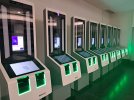
Directional signage has been installed at St Pancras to registration points A, B and C. I can't remember which one is which but one of the signs directs to the upper floor, one to the existing Eurostar check-in area, the other to an area opposite the GTR ticket hall.
It's not exactly clear whether thsi is where kiosks will be, and if there'll be additional ways through security and passport control, or whether these will be separate areas where there are kiosks to register before you then go through check-in and security in it's existing location.
Directional signage has been installed at St Pancras to registration points A, B and C. I can't remember which one is which but one of the signs directs to the upper floor, one to the existing Eurostar check-in area, the other to an area opposite the GTR ticket hall.
It's not exactly clear whether thsi is where kiosks will be, and if there'll be additional ways through security and passport control, or whether these will be separate areas where there are kiosks to register before you then go through check-in and security in it's existing location.
These are the locations for the kiosks yes. The one upstairs and the one opposite the GTR ticket office is for Standard passengers, and the one pointing into the check in area is likely towards the business one.
As I understand it the plan is for these to be areas you go before check in and security.
Directional signage has been installed at St Pancras to registration points A, B and C. I can't remember which one is which but one of the signs directs to the upper floor, one to the existing Eurostar check-in area, the other to an area opposite the GTR ticket hall.
It's not exactly clear whether thsi is where kiosks will be, and if there'll be additional ways through security and passport control, or whether these will be separate areas where there are kiosks to register before you then go through check-in and security in it's existing location.
They were up and running long before September. I flew from Prague in May, and some of the terminals were up and running back then. With time to kill before my departure, I registered my fingerprints and photo. However, I suspect that they may have got switched off again, as on a subsequent visit in early September, they all appeared to be switched off, and the rows of kiosks before the immigration desks were roped off, and we just went straight to the queue for the desks.
Finally, on my last visit in late September (for the 150 year tram parade), everyone arriving was being directed to use the kiosks before joining the queue for the desks (unless using the EU lane). And they had also implemented the fingerprinting and facial scanning of everyone departing too.
From what I understand, there's been quite a mess in terms of communication with EES, but this is how it should work:
- Registration at a kiosk (if they exist, otherwise at a desk) once every three years: this is only carried out once, either on entry or on exit from Schengen depending on your situation. Some people will have to use the kiosks on exit for various reasons, such as previously being resident with a residence permit and now no longer having one, so they're subject to the EES. Some countries are simply doing it all at the desks/booths, others are using kiosks.
- Once registered, you proceed straight to passport control. If you're previously registered, you don't need to mess about with the machines, you just do the EES checks (fingerprints / biometrics) at the desk or the e-gates.
- Eurostar *may* be implementing their own version by moving some of the desk checks to the machines, hence they have to be used before travel. I'm not certain about this, but it seems that it might be the case. This would allow them to streamline the actual check at the desks and eliminate the need to take pictures/fingerprints at the desk.
At Dover and Folkestone, there's a two stage check: first the collection of biometrics before passport control, then at the border control, the passengers have already been checked, so it will speed up the actual physical check. Passengers will already have got out of their cars and submitted their biometrics/scanned their passports, so at passport control, the PAF will only need to confirm that the passports belong to the passengers in the car. For coach passengers at Dover, they will undergo a 'remote' passport control, so they will proceed straight to the ferry lanes without having to go through a second passport check.
I could be wrong, but it appears that the checks on UK territory are being designed as a two step process, but this is not the norm elsewhere.
== Doublepost prevention - post automatically merged: ==
This explains it all perfectly. It seems that the kiosks in St Pancras are essentially the same thing that will be installed at Dover: a kind of pre-border check where travel information will be obtained and biometric information will be captured. This allows them to avoid doing this at the desks, so it should significantly speed up throughput.
This explains the confusion: this isn't the standard system elsewhere, where they're simply using kiosks for EES registration only (so once every three years). This seems to be one of the reasons why the French weren't ready: they wanted to have this system in place in the UK.
At Dover, they will process coach passengers at the Western Docks by having both pre-registration and border control in the same building, so the coaches will 'skip' passport control at the Eastern Docks. Car passengers will do the pre-border control at the Western Docks before driving to the Eastern Docks for passport control, again cutting down on queues of cars in front of the Eastern Docks.
== Doublepost prevention - post automatically merged: ==
No. This is because these kiosks are carrying out an element of pre-border control, specifically that while the first visit to them will 'register' you in the EES, the use of the kiosk on the day is an integrated part of the border control process. But this seems to be specific to UK-based controls, whereas other places won't require you to use the kiosks if the EES infrastructure (biometrics) are available at the desks or e-gates.
== Doublepost prevention - post automatically merged: ==
That is also how Prague seem to be implementing it for arrivals. Everyone arriving who is not going into the EU queue is required to use one of the kiosks first, before joining the queue for the immigration booths. I didn't spot either fingerprint or facial recognition devices at the arrivals booths themselves.
Yup, it seems that the implementation depends on the specifics of a border post. Some places are doing them at all booths, others have EES-specific lanes, others are doing the routine of kiosk check followed by a EES verification check.
Interestingly, Spain has declared that they won't implement the EES at the Gibraltar border as of now. The official information is that they are using their discretion during the implementation period not to introduce the checks, which means that they may be hoping that a deal can be done with Gibraltar before the end of April. Spain has also chosen not to implement it at other land border crossings.
I have a question - I often travel on both Eurostar and the DFDS ferry from Newcastle to Amsterdam with a wheelchair user in the party?. What is the set up for such a person because all the images and information I can find are for those able to stand up which my friend can not
I have a question - I often travel on both Eurostar and the DFDS ferry from Newcastle to Amsterdam with a wheelchair user in the party?. What is the set up for such a person because all the images and information I can find are for those able to stand up which my friend can not
Each border crossing will have arrangements for those in wheelchairs. Usually it's via mobile terminals, but there's also the option of simply not collecting the biometric data and recording the reason as to why. One other possibility that normally exists is for the control to be carried out at the place of the 'second line control', which is also equipped with biometric readers and other equipment.
There's a requirement for a certain amount of kiosks/booths to be wheelchair friendly, so it will very much depend on the individual border crossing as to how it's done. But in general, don't worry, they will be ready for such passengers
As far as I know the plan is you need to use the kiosk every time - not just first time registration. It may be quicker once you are registered, but the idea is you answer questions on each trip (do you have funds, return ticket, etc. The questions are not harmonized across the Schengen area, so may vary between member states, I can't see how they could handle this with just one registration).
However the kiosks themselves are really meant as a fallback as the idea is you will do it all on an app and go straight to the egates. Sweden apparently has the app running. But noone else yet as the app has been horrendously delayed.
Quite why they have insisted on this is beyond me. The questions are extremely basic, and they don't check the answers. They should have just done a one off registration then the rest on egates.
It's going to be a total car crash for the summer peak if they don't delay it again. A lot of EU airports cannot handle the non Schengen load anyway (between Brits post Brexit and a huge increase in US etc tourists).
I also read that there is an option for border crossings even past the full go live to skip EES in high queue scenarios, which is going to cause so many data problems.
As far as I know the plan is you need to use the kiosk every time - not just first time registration. It may be quicker once you are registered, but the idea is you answer questions on each trip (do you have funds, return ticket, etc. The questions are not harmonized across the Schengen area, so may vary between member states, I can't see how they could handle this with just one registration).
Worth noting the questions have been dropped for now, I believe the French are hoping they can get away without them permanently, but the won't appear when the Eurostar checks are fully rolled out next year, at least until the end of the implementation period.
I also read that there is an option for border crossings even past the full go live to skip EES in high queue scenarios, which is going to cause so many data problems.
I'm not sure it will, when they do this they will still record your passport and therefore have a record of entry and exits, they just won't take biometrics and ask the questions.