• Our new ticketing site is now live! Using either this or the original site (both powered by TrainSplit) helps support the running of the forum with every ticket purchase! Find out more and ask any questions/give us feedback in this thread!

Hydrogen-Powered High Speed Train

Status
Not open for further replies.

Doomotron

Established Member
Joined
25 Jun 2018
Messages
1,423
Location
Kent
A while back, EastWestRail's electrification was cancelled to save money (and was negatively received). At the same time, new DMUs were being built, using fossil fuels that the government want to remove by 2040. With electrification being too costly, hydrogen may be the best way to go as it is clean and renewable (sort of).

Inspired by this model for Transport Fever, I decided to think of my own hydrogen-powered train for use on long-distance services, compared to the train this is based on, which actually is a commuter train that can go high speeds. It's a Javelin!

First of all, the design of the train is very close to the original for Transport Fever. However, on the exterior, there are several changes:
  • The front of the train will be slightly wider, as I think the thin tapered ends look like that snake meme.
  • On one side of each coach is a door that is completely glass. This looks cool, but disability regulations will prevent this from happening in the real world, so they'd look like the normal doors.
  • Opposite the glass doors is the staircase. I'd try moving this somewhere else or at least have it switch sides depending on the coach it's on (in coach 1, it would be on the left, and in 2 it would be on the right) so as not to affect dwell times too much.
  • The train in the game is driverless and passengers on the top floor can see out of the front. Crash regulations are a pain sometimes, so I'd have to add a driver, but maybe to keep things interesting they'd be on the top floor...
Anyway, now I've covered those, I can talk about my own ideas for the train that are brand new.

The commuter 2+2 seating would be scrapped. The seats would be replaced with something comfortable, like Grammar IC3000s. However, even though I'm ditching the commuter layout, the 3 doors on each side would stay as double-decker trains have very bad dwell times. The buffet car and staircases would also be 'open air', where the top floor is a balcony looking down onto the floor below. The train would retain its walk-through design on both floors.

The model for Transport Fever is a bi-mode (although due to limitations in the game can't work on electric mode) and is capable of 186mph. Considering the train is unlocked in 2042 in the game, I'm not sure if we can get to 186 on hydrogen at all, but it's worth a shot.

Although not included by default, first class could be included and would be located at the ends of the train. By default the PIS system would be a dot matrix display (screens aren't that good with light and many screen-based systems are... bad).

This is now just me being an enthusiast but on electric mode the train would (well, should :D) sound like a Class 373 mixed with a 374 or ICE 3. The train could theoretically be used on future high speed lines as an alternative to electrification (or any line for that matter if they were upgraded to fit double-decker trains). Therefore high-speed rail could be more attractive with a cheaper price, not needing to electrify.

Feel free to tell me what you think of Alex's original design (the person who made the model) and any changes/improvements to make to my own version.
 
Sponsor Post - registered members do not see these adverts; click here to register, or click here to log in
R

RailUK Forums

LOL The Irony

Established Member
Joined
29 Jul 2017
Messages
5,335
Location
Chinatown, New York
A while back, EastWestRail's electrification was cancelled to save money (and was negatively received). At the same time, new DMUs were being built, using fossil fuels that the government want to remove by 2040. With electrification being too costly, hydrogen may be the best way to go as it is clean and renewable (sort of).

Inspired by this model for Transport Fever, I decided to think of my own hydrogen-powered train for use on long-distance services, compared to the train this is based on, which actually is a commuter train that can go high speeds. It's a Javelin!

First of all, the design of the train is very close to the original for Transport Fever. However, on the exterior, there are several changes:
  • The front of the train will be slightly wider, as I think the thin tapered ends look like that snake meme.
  • On one side of each coach is a door that is completely glass. This looks cool, but disability regulations will prevent this from happening in the real world, so they'd look like the normal doors.
  • Opposite the glass doors is the staircase. I'd try moving this somewhere else or at least have it switch sides depending on the coach it's on (in coach 1, it would be on the left, and in 2 it would be on the right) so as not to affect dwell times too much.
  • The train in the game is driverless and passengers on the top floor can see out of the front. Crash regulations are a pain sometimes, so I'd have to add a driver, but maybe to keep things interesting they'd be on the top floor...
Anyway, now I've covered those, I can talk about my own ideas for the train that are brand new.

The commuter 2+2 seating would be scrapped. The seats would be replaced with something comfortable, like Grammar IC3000s. However, even though I'm ditching the commuter layout, the 3 doors on each side would stay as double-decker trains have very bad dwell times. The buffet car and staircases would also be 'open air', where the top floor is a balcony looking down onto the floor below. The train would retain its walk-through design on both floors.

The model for Transport Fever is a bi-mode (although due to limitations in the game can't work on electric mode) and is capable of 186mph. Considering the train is unlocked in 2042 in the game, I'm not sure if we can get to 186 on hydrogen at all, but it's worth a shot.

Although not included by default, first class could be included and would be located at the ends of the train. By default the PIS system would be a dot matrix display (screens aren't that good with light and many screen-based systems are... bad).

This is now just me being an enthusiast but on electric mode the train would (well, should :D) sound like a Class 373 mixed with a 374 or ICE 3. The train could theoretically be used on future high speed lines as an alternative to electrification (or any line for that matter if they were upgraded to fit double-decker trains). Therefore high-speed rail could be more attractive with a cheaper price, not needing to electrify.

Feel free to tell me what you think of Alex's original design (the person who made the model) and any changes/improvements to make to my own version.
A hybrid h2-electric train, nice.
 

Doomotron

Established Member
Joined
25 Jun 2018
Messages
1,423
Location
Kent
Where do you store the gas?
I don't know, you'll have to ask the person who made the original design. My best guess though is that on the bottom floor at each end of the train is where it's kept as there are no windows there.
 

randyrippley

Established Member
Joined
21 Feb 2016
Messages
5,382
I don't know, you'll have to ask the person who made the original design. My best guess though is that on the bottom floor at each end of the train is where it's kept as there are no windows there.

That wouldn't be safe. You need to store it above roof level so that in the event of a leak it vents to air. Otherwise it will get trapped in the vehicle creating an explosive mix.

Makes your idea unworkable
 

DerekC

Established Member
Joined
26 Oct 2015
Messages
2,435
Location
Hampshire (nearly a Hog)
What's the off-wire range and at what speed? How much hydrogen have you got store? What's your storage mode (compressed gas, liquid, hydride)? How much will the stored hydrogen in its containers weigh and what space will it take up? Where will you put it? Will you be using fuel cells? Will you need storage batteries as well for energy recovery? How much will all those weigh and where will you put them? All those questions have to be answered to start with before you have a viable train concept. Not pouring cold water - I think this is probably the way to go - it's just that deciding details like nose shape and seating configuration is a bit premature!
 

Doomotron

Established Member
Joined
25 Jun 2018
Messages
1,423
Location
Kent
That wouldn't be safe. You need to store it above roof level so that in the event of a leak it vents to air. Otherwise it will get trapped in the vehicle creating an explosive mix.
As I said earlier, the train is not originally my design. You'll have to ask the creator, but as the train was designed as part of a contest for futuristic vehicles, he might have not bothered as it might be stored in a way that we don't know yet.

What's the off-wire range and at what speed? How much hydrogen have you got store? What's your storage mode (compressed gas, liquid, hydride)? How much will the stored hydrogen in its containers weigh and what space will it take up? Will you be using fuel cells? Will you need storage batteries as well for energy recovery? How much will all those weigh and where will you put them.
Since hydrogen trains aren't that popular yet, I don't have much to compare range or speed to. The original version runs at 186mph on hydrogen that's probably not possible right now. As for the other questions I have no idea, nor do I really care. I'm interested in design, not function.
 

DerekC

Established Member
Joined
26 Oct 2015
Messages
2,435
Location
Hampshire (nearly a Hog)
Since hydrogen trains aren't that popular yet, I don't have much to compare range or speed to. The original version runs at 186mph on hydrogen that's probably not possible right now. As for the other questions I have no idea, nor do I really care. I'm interested in design, not function.

Design isn't just about what things look like.

To design something you have to start with what you are planning to achieve (i.e. how long a train; how many passengers; over what sort of length of route; with how many stops; to achieve what journey time in what level of comfort).

Then you have to decide how the train is to be powered, depending on how much of your route is to be electrified - and answer all the nasty difficult questions about hydrogen - and how much space your equipment is going to take up.

Assuming the concept works (i.e. that you can fit the passengers and the power kit into the length of train you want) you can then start worrying about what it looks like. But remember that the train will have to comply with crashworthiness standards and that that sexy pointed noses take up valuable train length and are only worth it from an aerodynamic point of view if you are going very fast.

It's all very messy and full of compromises! If you don't want to think about these things you aren't going to make much of a designer.
 

Struner

Member
Joined
13 Dec 2018
Messages
926
Location
Ommelanden, EU
That wouldn't be safe. You need to store it above roof level so that in the event of a leak it vents to air. Otherwise it will get trapped in the vehicle creating an explosive mix.

Makes your idea unworkable
& that’s indeed the way it’s stored on ;) the iLint.
 

greatvoyager

Established Member
Joined
15 Aug 2019
Messages
2,426
Location
Exeter
Interesting idea, depends on the range and how fast the hydrogen power can allow trains to go.
 

randyrippley

Established Member
Joined
21 Feb 2016
Messages
5,382
........ I'm interested in design, not function.

Then you'll never be a designer who produces things that work.
When designing something theres a basic tenet: form follows function. Not the other way round.
In this case the hydrogen storage will probably take up to 30% of the available volume within the train. Until you know how you're going to achieve that, everything else is pointless
 

big all

On Moderation
Joined
23 Sep 2018
Messages
876
Location
redhill
140 mph will need perhaps 3x or 4x the gas capacity over say 90mph as the drag doubles or squares with greater speed and as said you need batteries for energy recovery when braking so optimum efficiency will be in the perhaps 60 to 90mph bracket ??
 
Last edited by a moderator:

Struner

Member
Joined
13 Dec 2018
Messages
926
Location
Ommelanden, EU
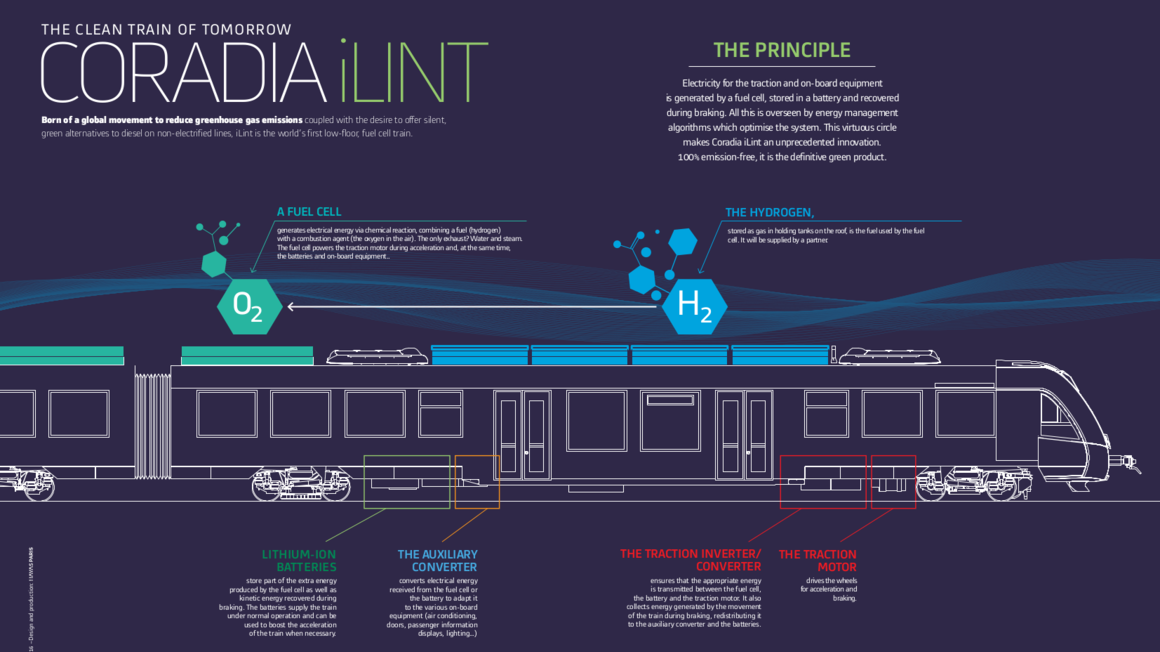
This is alstom’s picture of the iLint:
Alstom_Coradia-iLint_Decryption_EN_OK.png
 

Doomotron

Established Member
Joined
25 Jun 2018
Messages
1,423
Location
Kent
Then you'll never be a designer who produces things that work.
When designing something theres a basic tenet: form follows function. Not the other way round.
In this case the hydrogen storage will probably take up to 30% of the available volume within the train. Until you know how you're going to achieve that, everything else is pointless
I repeat, I did not create the original design.
 

DerekC

Established Member
Joined
26 Oct 2015
Messages
2,435
Location
Hampshire (nearly a Hog)
I repeat, I did not create the original design.

Understood - and maybe you have got some over-reaction to your statement - but you did say in your OP that you wanted a high speed train for long distance and that's a very different animal to the iLint and would need a complete top-down redesign. The point that @randyrippley and I have been trying to get over is that design isn't just about what things look like (form) - you have to start with what you want something to do (function) and get the basic concept right before you can start tweaking things like doors and what sort of seats to have.

End of lecture.
 

gingertom

Established Member
Joined
19 Jun 2017
Messages
1,335
Location
Kilsyth
back of fag packet calculations:
The iLint will have around 1200BHP and has hydrogen fuel cells and storage batteries to deliver this. Top speed 80-90mph.
HST 4500BHP diesel engines top speed 125mph.
Class 91 6300BHP electric top speed 140mph.
Eurostar cl 373 12000bhp+ electric top speed 186mph.
Your fuel cells and storage have to increase by an order of magnitude, but doesn't take into account the range of the train- as you are going at least 2x the speed you will be expecting to cover far more distance, so the storage requirements increase in proportion. All this adds weight and takes away from the payload carrying capacity. The recommendation from the industry for high speed travel is OLE and let the electricity supplier decide about how best they are going to generate that power needed.
 

option

Member
Joined
1 Aug 2017
Messages
639
That wouldn't be safe. You need to store it above roof level so that in the event of a leak it vents to air. Otherwise it will get trapped in the vehicle creating an explosive mix.

Makes your idea unworkable

Is there even space above the existing roofline on a UK train, or would the internal roof/headheight need lowering?
 

randyrippley

Established Member
Joined
21 Feb 2016
Messages
5,382
Is there even space above the existing roofline on a UK train, or would the internal roof/headheight need lowering?
I dunno, but I suspect not. Weight distribution / balance might be an issue as well as those pressure tanks are going to need some heavy duty metal structures. Forget trying to hold the gas as metal hydrides - no-one has ever made that work commercially. Big pressure tanks on the roof will potentially make the vehicles unstable on bends unless you increase the track cant
 

43096

On Moderation
Joined
23 Nov 2015
Messages
18,784
You are confusing 'design' with 'styling'.

Terry Miller 'designed' the HST, Kenneth Grange 'styled' it.
Although some of what Grange did on the HST was more than styling - the wind tunnel modelling was very much about design as aerodynamic performance become more critical the further above 100mph you go. It should also be said he doesn't believe in form over function and very much wants the user to enjoy using the product.
 
Status
Not open for further replies.

Top