Hi, does anyone know and could tell me how to measure curve radius? I would like to compare the sharpness of curves (Rutherglen, Earlestown, Shipley, St Pancras LL) for example to see which one is the sharpest. Thank you!

-
Our new ticketing site is now live! Using either this or the original site (both powered by TrainSplit) helps support the running of the forum with every ticket purchase! Find out more and ask any questions/give us feedback in this thread!
You are using an out of date browser. It may not display this or other websites correctly.
You should upgrade or use an alternative browser.
You should upgrade or use an alternative browser.
How to measure Curve radius?
- Thread starter Peter0124
- Start date
- Status
- Not open for further replies.
Sponsor Post - registered members do not see these adverts; click here to register, or click here to log in
R
RailUK Forums
davidknibb
Member
- Joined
- 30 Oct 2012
- Messages
- 96
Are you assuming that the curves are of a constant radius - which is unlikely but probably a necessary assumption. That is a curve made from Hornby 00 track will be of a constant radius -but not probable in real life.
Then you have to identify where the curve starts and ends.
Then within the bit of interest draw 2 tangents - and then where each tangent 'grazes' the curve draw the perpendicular (that is a line at right angles).
Where the 2 intersect is the focus of the curve - and the distance from the focus back to the curve is then the radius you are looking for.
But since you cannot go to the railway and start making measurements - it'll have to be done from a large scale map - Open Street Map will be better than Ordnance Survey because it is a vector map (OS is a raster map) and so can be zoomed on line to fill your computer screen .
Then you have to identify where the curve starts and ends.
Then within the bit of interest draw 2 tangents - and then where each tangent 'grazes' the curve draw the perpendicular (that is a line at right angles).
Where the 2 intersect is the focus of the curve - and the distance from the focus back to the curve is then the radius you are looking for.
But since you cannot go to the railway and start making measurements - it'll have to be done from a large scale map - Open Street Map will be better than Ordnance Survey because it is a vector map (OS is a raster map) and so can be zoomed on line to fill your computer screen .
Weymouth Quay I believe used to had the sharpest. In GWR days the boat trains had to stop, have their corridor connections pulled back, and screw couplings slackened off. Only short wheelbase small locos were used. Quite a lot of longer wheelbase freight stock was branded WXQ, not to work on Weymouth Quay.

DelW
Established Member
- Joined
- 15 Jan 2015
- Messages
- 5,963
That does need quite a large map (or screen) though.Are you assuming that the curves are of a constant radius - which is unlikely but probably a necessary assumption. That is a curve made from Hornby 00 track will be of a constant radius -but not probable in real life.
Then you have to identify where the curve starts and ends.
Then within the bit of interest draw 2 tangents - and then where each tangent 'grazes' the curve draw the perpendicular (that is a line at right angles).
Where the 2 intersect is the focus of the curve - and the distance from the focus back to the curve is then the radius you are looking for.
But since you cannot go to the railway and start making measurements - it'll have to be done from a large scale map - Open Street Map will be better than Ordnance Survey because it is a vector map (OS is a raster map) and so can be zoomed on line to fill your computer screen .
The radius can be calculated by drawing a chord between two points on the curve, and measuring (a) its length and (b) the maximum offset to the curve, at midpoint of the chord. I can remember working out the trigonometry for that many years ago, but unfortunately I doubt if I've still got the calculations. It may well be somewhere out there on t'internet though. If I have a spare hour or two I might even try working it out again.
davidknibb
Member
- Joined
- 30 Oct 2012
- Messages
- 96
for your method - if r is the radius, l is the length of the chord and a is the offset - then good old Pythagoras tells us that after simplification that
r=a/2+l*l/(8a)
just check my workings though - done quickly on 'the back of a fag packet'
== Doublepost prevention - post automatically merged: ==
It would have made a good GCE O level question - esp if it asked for 2 ways of solving the problem - your way and my way
r=a/2+l*l/(8a)
just check my workings though - done quickly on 'the back of a fag packet'
== Doublepost prevention - post automatically merged: ==
It would have made a good GCE O level question - esp if it asked for 2 ways of solving the problem - your way and my way
DelW
Established Member
- Joined
- 15 Jan 2015
- Messages
- 5,963
Yes, looks right to me, and rather simpler than the calculations I remembered, which got into heavyweight trigonometry. Maybe I was calculating something else then!for your method - if r is the radius, l is the length of the chord and a is the offset - then good old Pythagoras tells us that after simplification that
r=a/2+l*l/(8a)
just check my workings though - done quickly on 'the back of a fag packet'
== Doublepost prevention - post automatically merged: ==
It would have made a good GCE O level question - esp if it asked for 2 ways of solving the problem - your way and my way
davidknibb
Member
- Joined
- 30 Oct 2012
- Messages
- 96
Trigonometry isn't really involved - just basic geometry
I place cylindrical objects on my laptop screen and compare the curves, making sure I have the same scale on both maps.Hi, does anyone know and could tell me how to measure curve radius? I would like to compare the sharpness of curves (Rutherglen, Earlestown, Shipley, St Pancras LL) for example to see which one is the sharpest. Thank you!
I used to get a variety of coins, washers, jar lids &c. and see which was the best fit with the curve on a street map, measure the diameter of the coin (or whatever), and see what the map scale was; and a simple calculation gave the average curve radius. The last time I did it was for the new bit of the East London line that joined it to the former Broad Street line, which I think came to about 10 chains. This assumes the cartographers of the London A to Z had bothered to draw the curve accurately, which was a bit rash of me.

rower40
Member
- Joined
- 1 Jan 2008
- Messages
- 579
This is why railways measure things in chains. You attach one end of the chain to the outer rail of the curve. You attach the other end of the chain to the outer rail. You then measure the sideways distance from the rail to the midpoint of the chain. One of they clever formulae (or a table) above gives the radius of curvature, from the sideways distance.

Dr Hoo
Established Member
Particularly as you can do it just on a section in the 'middle', where the curve is probably at its sharpest.This is why railways measure things in chains. You attach one end of the chain to the outer rail of the curve. You attach the other end of the chain to the outer rail. You then measure the sideways distance from the rail to the midpoint of the chain. One of they clever formulae (or a table) above gives the radius of curvature, from the sideways distance.
Most curves used at any speed will have 'transitions', where the radius comes down from infinity (straight) and the cant increases from zero to maximum with the aim of minimising wear and flange contact, and maximising comfort.
Some tramways and underground lines have been built with 'circular' curves (i.e. like Hornby track) because of space constraints and the snatches on entering or leaving the curve are very noticeable.
Better still, draw 3 tangents, roughly equally spaced. If the 3 perpendiculars intersect at a point, great. If they make a small triangle, eyeball the centre of that. If they make a large triangle, you need to try harder (or the constant radius assumption is too far from reality).Are you assuming that the curves are of a constant radius - which is unlikely but probably a necessary assumption. That is a curve made from Hornby 00 track will be of a constant radius -but not probable in real life.
Then you have to identify where the curve starts and ends.
Then within the bit of interest draw 2 tangents - and then where each tangent 'grazes' the curve draw the perpendicular (that is a line at right angles).
Where the 2 intersect is the focus of the curve - and the distance from the focus back to the curve is then the radius you are looking for.
To improve on eyballing the tangents, you could use a pair of compasses and construct the perpendicular bisectors of chords.
Yes, I did do traditional 'technical drawing' at school.
Snow1964
Established Member
I place cylindrical objects on my laptop screen and compare the curves, making sure I have the same scale on both maps.
The bigger the screen the better, but can use same on aerial photos (eg google) which has a scale in the corner.
Measure the sharpest continuous curve, not the transitions to straighter track (where the radius eases out).
philthetube
Established Member
- Joined
- 5 Jan 2016
- Messages
- 4,181
Thanks for the information, I knew curves were measured in chains but had no idea howThis is why railways measure things in chains. You attach one end of the chain to the outer rail of the curve. You attach the other end of the chain to the outer rail. You then measure the sideways distance from the rail to the midpoint of the chain. One of they clever formulae (or a table) above gives the radius of curvature, from the sideways distance.
Is the radius measured to the inner or outer rail, or a line midway between the rails?
Is this data not in the sectional indices? Or some other publication.
And is the Redditch line at Barnt Green up there with the others mentioned above.
Is this data not in the sectional indices? Or some other publication.
And is the Redditch line at Barnt Green up there with the others mentioned above.

Trog
Established Member
This is why railways measure things in chains. You attach one end of the chain to the outer rail of the curve. You attach the other end of the chain to the outer rail. You then measure the sideways distance from the rail to the midpoint of the chain. One of they clever formulae (or a table) above gives the radius of curvature, from the sideways distance.
Using strong fishing line or piano wire is more accurate, mark up a series of points evenly spaced around the curve, and run the wire between two of the points that are one apart. The wire between the points forms a chord the points are usually referred to as half chord points, measure at 90' from the rail at the middle half chord point to the wire, this is the versine. The curve radius for that point can then be calculated from the values of the chord length and versine value. There is a system called Hallade that allows you to design/adjust curves by manipulating the set of versine values obtained by measuring overlapping chords round a curve. This has been done in metric for decades.
Ploughman
Established Member
Google Hallade Survey.
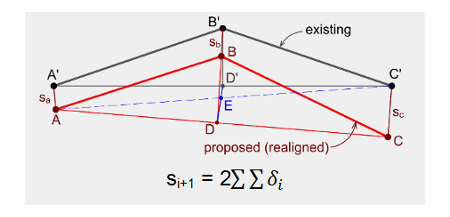
 pwayblog.com
A (Hallade) moment to remember
For the track realignment methods (Hallade or similar) the existing alignment is surveyed by measuring the outer rail offsets (versines) to overlapping chords. One such setup is drawn below: A̵…
pwayblog.com
- Status
- Not open for further replies.