Our new ticketing site is now live! Using either this or the original site (both powered by TrainSplit) helps support the running of the forum with every ticket purchase! Find out more and ask any questions/give us feedback in this thread!
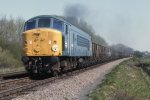
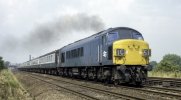
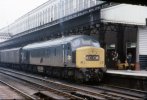
I realise there were differences in the prime mover and power output between the three classes, but can anyone give me some tips on how to distinguish them visually? (Without looking at the number!)
Maybe I just haven’t seen enough of them to gain familiarity, but to me they seem hard to distinguish.
I realise there were differences in the prime mover and power output between the three classes, but can anyone give me some tips on how to distinguish them visually? (Without looking at the number!)
Maybe I just haven’t seen enough of them to gain familiarity, but to me they seem hard to distinguish.
I also found them hard to distinguish, but some partial clues are:
Class 44 were built without headcode boxes. They had 4 metal discs on the front to indicate the "class" of the train they were working (express, local, freight, etc.)
Anything with "split" headcode boxes (2 characters on each side of the front of a loco) was definitely a Class 45.
But some Class 45 and all Class 46 were built with central headcode boxes.
Also - some locos got modifications after mishaps, so at least one Class 44 got a central headcode box. In later years, headcode boxes were removed, either completely, or covered by panels.
Any loco fitted for electric train heating (jumper cables on each front end) was a Class 45/1.
46s don't have crosses on battery box doors and, if have headcodes, were one piece rather than two piece of the 45s. 44s have longer side grills than the 45/46.
46s don't have crosses on battery box doors and, if have headcodes, were one piece rather than two piece of the 45s. 44s have longer side grills than the 45/46.
There were various headcode types and modifications though, and in their later years both the 45s and 46s had them plated over and marker lights fitted.
If it has split headcode boxes (i.e. one either side of the nose) then it's a 45 (only they had them, but not all of them did and they were removed in later years!). Disc headcodes means it's a 44.
So far as I know the battery box without crosses is reliable and means it's a 46, and if it has ETS connections then it's a 45/1.
46s don't have crosses on battery box doors and, if have headcodes, were one piece rather than two piece of the 45s. 44s have longer side grills than the 45/46.
There's also the small hinged hatch on one side of 45s below the large grille and the the roof access hatch between radiator fan and engine access hatch on 46s
Am I right in thinking that even though some of the 45s had split headcodes they never received nose end doors?
Re sealed beam headlights - Yes only 45/1s I believe.
There's also the small hinged hatch on one side of 45s below the large grille and the the roof access hatch between radiator fan and engine access hatch on 46s
That's the battery charge sockets and light switch behind that, do 46s not have that? Know they're 110V so don't need two separate charging sockets like 45s.
I don't know how to identify, but a batch of the Class 46, those allocated to Laira, were equipped with GWR-pattern AWS/ATC when moved there. This was in the early 1970s, before the WR routes were converted to BR-pattern AWS for the arrival of HST.
It had always been the practice, back to steam days, that locos without the GW-style equipment were not used on lines so equipped. This got a bit sloppy, and there was a serious collision at Bridgwater in 1974 with a signal overrun and a Class 45 fitted with BR equipment, but the line still had GWR style. Things were much tightened after that. Typically you had to look beneath the bufferbeam to see the GWR equipment.
Mechanically 44s have non intercooled engines so rated at 2300hp, 45s are intercooled and so 2500hp also uprated traction motors and generators, I believe, and 46s were equipped with Brush electrical equipment and 110V auxiliary equipment and hydrostatic fans whereas 44/45 were 220V auxiliary machines and electric cooling fans. So in reality quite a few differences compared to subclasses of 47s which are mechanically and electrically similar (first 20 had a few differences and early build were series-parallel and later build all parallel).
Mechanically 44s have non intercooled engines so rated at 2300hp, 45s are intercooled and so 2500hp also uprated traction motors and generators, I believe, and 46s were equipped with Brush electrical equipment and 110V auxiliary equipment and hydrostatic fans whereas 44/45 were 220V auxiliary machines and electric cooling fans. So in reality quite a few differences compared to subclasses of 47s which are mechanically and electrically similar (first 20 had a few differences and early build were series-parallel and later build all parallel).
The first 20 47s have a number of differences - main ones are that the ETS is from a generator (later ones with ETS had alternators - two fitted from new, the others retro-fitted), and I believe the main fan is electric on them whereas it isn't on all the others.
Later ones are more similar to each other as you say, with the series-parallel and all parallel being the main difference, plus whether or not they were fitted with ETS alternators and/or steam generators.
That's the battery charge sockets and light switch behind that, do 46s not have that? Know they're 110V so don't need two separate charging sockets like 45s.
Mechanically 44s have non intercooled engines so rated at 2300hp, 45s are intercooled and so 2500hp also uprated traction motors and generators, I believe, and 46s were equipped with Brush electrical equipment and 110V auxiliary equipment and hydrostatic fans whereas 44/45 were 220V auxiliary machines and electric cooling fans. So in reality quite a few differences compared to subclasses of 47s which are mechanically and electrically similar (first 20 had a few differences and early build were series-parallel and later build all parallel).
The differing electrical systems give the 46s a slightly lower continous power-at-rail rating, but I read somewhere they 46s are lower geared? Something like 45s have 100mph gearing but 46s 90mph or something?
Must try Google see if I can find a source, I read so much over the years from so many sources I'm damned if I can ever remember where half of it was originally written!
I believe they don't, I think I read that on Derby Sulzers or something similar some time ago. There was another thing but it's gone from my mind.
The differing electrical systems give the 46s a slightly lower continous power-at-rail rating, but I read somewhere they 46s are lower geared? Something like 45s have 100mph gearing but 46s 90mph or something?
Must try Google see if I can find a source, I read so much over the years from so many sources I'm damned if I can ever remember where half of it was originally written!
I believe they don't, I think I read that on Derby Sulzers or something similar some time ago. There was another thing but it's gone from my mind.
The differing electrical systems give the 46s a slightly lower continous power-at-rail rating, but I read somewhere they 46s are lower geared? Something like 45s have 100mph gearing but 46s 90mph or something?
Must try Google see if I can find a source, I read so much over the years from so many sources I'm damned if I can ever remember where half of it was originally written!
45s were definitely superior performers due to 5 stages of field weakening and more robust electrics. 46s produced marginally less power at rail, think gearing is the same for both classes.
45s were definitely superior performers due to 5 stages of field weakening and more robust electrics. 46s produced marginally less power at rail, think gearing is the same for both classes.
And yet someone showed a document on here a while ago that 46s were allowed a greater load over the Devon banks than the 45s. I wonder why that would be?
And yet someone showed a document on here a while ago that 46s were allowed a greater load over the Devon banks than the 45s. I wonder why that would be?
Interesting, maybe it's because they produce a greater continuous tractive effort at a lower speed so probably better for slogging up a hill but overall the 45 has the edge.
45s were definitely superior performers due to 5 stages of field weakening and more robust electrics. 46s produced marginally less power at rail, think gearing is the same for both classes.
And yet someone showed a document on here a while ago that 46s were allowed a greater load over the Devon banks than the 45s. I wonder why that would be?
Interesting, maybe it's because they produce a greater continuous tractive effort at a lower speed so probably better for slogging up a hill but overall the 45 has the edge.
When new some at least of the 44s had slatted louvres over the bodyside vents rather than the grilles of the later models.
I get the impression these were later retrofitted with grilles
The cab interiors are subtly different on all three classes. If you were in a Peak cab, you could tell whether it was a 44, 45 or 46 straight away. The Class 44s were all vacuum-only until withdrawal, so retain the chunky Davies and Metcalfe vacuum brake valve also used on Class 26s. Given the Crompton-Parkinson electrical equipment, the power controller and master switch are also the same as those on Class 26s. The big chunky power handle doesn’t look very user-friendly, but it’s perhaps easier to move than it looks.
All the extant Class 45s are dual braked (in fact I think almost the whole class had received dual brakes by the mid-70s) so they use the standard Davies and Metcalfe FV4 train brake valve as you’d see on a dual-braked 47. The electrical equipment is still Crompton-Parkinson, but the power controller and master switch are a more modern design (which looks much kinder to the driver’s hand), the same as those used on the Class 33.
A Class 46 would have the same Davies and Metcalfe brake controllers as a 45 or 47 (again, I think these were all dual braked in the late 60s/early 70s) but the master controller is again different- because Brush electrical equipment is used, the power controller and master switch are the same design as those used on a 31 or 47 and sit on the same pedestal as on those classes. Presumably the driving technique for a 46 is quite similar to that for a 47?
I‘m sure there are other subtle differences in the cabs too, but those are the ones I can think of. Obviously the secondman’s side of a 44 will be different as there’s no train heating equipment at all, and again on a 45/1 with controls for ETS instead of steam heating. 45/0s and 46s of course had controls for steam heating- presumably they all had Stone-Vapor boilers, or were some other kinds of boiler used in the 46s?
== Doublepost prevention - post automatically merged: ==
When new some at least of the 44s had slatted louvres over the bodyside vents rather than the grilles of the later models.
I get the impression these were later retrofitted with grilles
These were 44009 and 44010 (or D9 and D10 as built), and I think it was an experimental modification which never took off. As far as I can see from photos, they retained them until withdrawal in the late 70s.
I‘m sure there are other subtle differences in the cabs too, but those are the ones I can think of. Obviously the secondman’s side of a 44 will be different as there’s no train heating equipment at all
There was initially of course. An early account in Trains Illustrated of D2 on WCML expresses (just this one seemed to be well used there) described how the boiler would stick on full output and it would blow off steam continually, as much as a steam loco might, until the water was exhausted, when heating would shut down.
There was initially of course. An early account in Trains Illustrated of D2 on WCML expresses (just this one seemed to be well used there) described how the boiler would stick on full output and it would blow off steam continually, as much as a steam loco might, until the water was exhausted, when heating would shut down.
That’s right- yes, the 44s did have boilers until the early 1960s, when they were transferred to Toton to see out the rest of their lives on freight. I seem to think they were removed rather than just isolated (with even the underslung tanks removed), and the pressure gauge and alarm light on the secondman’s side of the cabs plated over (that’s how it is on 44008 anyway).
I‘m sure there are other subtle differences in the cabs too, but those are the ones I can think of. Obviously the secondman’s side of a 44 will be different as there’s no train heating equipment at all, and again on a 45/1 with controls for ETS instead of steam heating. 45/0s and 46s of course had controls for steam heating- presumably they all had Stone-Vapor boilers, or were some other kinds of boiler used in the 46s?
My 1962 Ian Allan book has Peaks numbered up to D193, then another forthcoming batch of 20 numbered D194-199 and then D1500-1513. Presumably these were cancelled or rearranged and became the first 20 Generator Brush Type 4, D1500-1519.
My 1962 Ian Allan book has Peaks numbered up to D193, then another forthcoming batch of 20 numbered D194-199 and then D1500-1513. Presumably these were cancelled or rearranged and became the first 20 Generator Brush Type 4, D1500-1519.
The engines intended for the 20 which never happened were used in the prototype batch of 47s. They had to extend the generator frame to accommodate the ETS generator, which of course no 46s ever had.
My 1962 Ian Allan book has Peaks numbered up to D193, then another forthcoming batch of 20 numbered D194-199 and then D1500-1513. Presumably these were cancelled or rearranged and became the first 20 Generator Brush Type 4, D1500-1519.
They did. Their electrical equipment was used by Brush to build D1500-D1519, which is why this batch were different to the rest. The ETH was tapped from the generator rather than an alternator, and the braking system was also different.