• Our new ticketing site is now live! Using either this or the original site (both powered by TrainSplit) helps support the running of the forum with every ticket purchase! Find out more and ask any questions/give us feedback in this thread!

Historic track layout at Embsay Junction, Skipton

Status
Not open for further replies.

Rob F

Member
Joined
17 Dec 2015
Messages
453
Location
Notts
Embsay Junction is where the Grassington branch left the Skipton to Ilkley line.

On the NLS Maps site (https://maps.nls.uk/geo/explore/#zoom=18.5&lat=53.97197&lon=-2.00005&layers=173&b=MapTilerSat&o=100) we see this:

Embsay.PNG
The single track branch divides into 2 and forms a double junction with the double-track mainline. This is all logical so far. However, what was the purpose of the trailing crossover immediately to the south? It seems that the points at 1&2 and the diamond crossing at 3 could all be eliminated and not change the function of the junction at all. I must be missing something obvious as it seems this layout was quite common( e.g Penwithers Jct where the Falmouth branch diverges from the Cornish main line) yet it seems overly complicated.
 

Attachments

  • Embsay.PNG
    Embsay.PNG
    1.1 MB · Views: 18
Sponsor Post - registered members do not see these adverts; click here to register, or click here to log in
R

RailUK Forums

Gloster

Veteran Member
Joined
4 Sep 2020
Messages
13,001
Location
Up the creek
I have presumed that the reason for the junction was that there was a preference, possibly from as high up as the Railway Inspectorate, to avoid having trains facing each other on the same line, as would happen (and happens now) with single lead junctions. The crossover would allow locos from Ilkley to Grassington or v.v. to reverse without any wrong road running. (Or it might just be MR standard practice.)

Penwithers wascomplicated by having the Newnham branch feed in to the Falmouth line in a trailing direction. Cooke’s diagram for 1915 only shows the crossover very lightly, so it may be doubtful or related to the doubling westwards.
 
Last edited:

Rob F

Member
Joined
17 Dec 2015
Messages
453
Location
Notts
I understand your point but the length of 'wrong line running' is tiny I cannot imagine the collision risk is greater than crossing the line at the diamond. I thought the issue with single-lead junctions was where they replace a double junction between two double track lines, which is not what we have here.
 

Gloster

Veteran Member
Joined
4 Sep 2020
Messages
13,001
Location
Up the creek
I thought it might be related to the way that detection was more rudimentary early on and there was a chance of points not being set right. Similarly, the earlier and simpler interlocking could cause the same problem. Once both were reliable the preference, possibly just someone’s obsession or the result of a particular accident, faded…but things can take a long while to change on the railway.
 

Rescars

Established Member
Joined
25 May 2021
Messages
2,553
Location
Surrey
Could it be that the purpose of this crossover was to permit wrong line working on the main line in case of emergencies, engineering etc? Perhaps the fact that there was a branch line junction also was merely coincidental?
 

Rob F

Member
Joined
17 Dec 2015
Messages
453
Location
Notts
I see your point, but once you have the crossover you don't really need the double junction.
 

Railsigns

Established Member
Joined
15 Feb 2010
Messages
2,754
From 1867, the Board of Trade's Requirements for new railways stated: "When two single lines meet, the junction should in ordinary cases be formed as a double line junction". This requirement remained until 1925.
 

30907

Veteran Member
Joined
30 Sep 2012
Messages
21,959
Location
Airedale
It was commonplace to provide a trailing crossover at signalboxes generally, though not invariably at junctions. However, the MR were extremely averse to facing crossovers on main lines (and generous with trailing ones!).

Once the rules were relaxed, some companies/regions took the opportunity to eliminate the fixed diamond. On BR(S) this happened at Winchester Jn and Worgret Jn (but not, AFAIK, at Lymington Jn) - requiring the addition of a crossover (facing at Winchester Jn) as the previous layout had none. Meldon Jn further West was similarly altered (as was Hardham Jn near Pulborough, but that may have been after the Midhurst passenger service was withdrawn).

BTW Penwithers Jn had a section of double track onto the branch, partly because of the Newham branch which trailed in here.
 

John Webb

Established Member
Joined
5 Jun 2010
Messages
3,774
Location
St Albans
The crossover was there to allow trains off the branch, and therefore heading towards Skipton, to be reversed onto the Ilkley-bound line soon after clearing the branch. The Yorkshire Dales Railway who built the line had agreed that the Midland Railway would operate it. It is unlikely that either would have been allowed to signal moves directly off the branch onto the Ilkley-bound line as the line drops quite steeply down to Skipton - hence if a train ran away coming off the branch it would at least be running away 'right line'.
Apparently the trailing crossover was fitted with a facing point-lock in 1910 so that passenger trains could use it in the facing direction. From Martin Bairstow's "Railways through Airedale and Wharfdale" (2004) the 7.45am train from Grassington had two portions, one for Skipton, one for Bradford. Stopping south of the junction, a loco running right line from Embsay joined the end of the train and then took the Bradford portion over the crossover and off to Ilkley and beyond. Bairstow says there was not a corresponding train the other way. Regular passenger services ran until 1930, when this service disappeared with the rest.
 

xotGD

Established Member
Joined
4 Feb 2017
Messages
7,873
The crossover was there to allow trains off the branch, and therefore heading towards Skipton, to be reversed onto the Ilkley-bound line soon after clearing the branch. The Yorkshire Dales Railway who built the line had agreed that the Midland Railway would operate it. It is unlikely that either would have been allowed to signal moves directly off the branch onto the Ilkley-bound line as the line drops quite steeply down to Skipton - hence if a train ran away coming off the branch it would at least be running away 'right line'.
Apparently the trailing crossover was fitted with a facing point-lock in 1910 so that passenger trains could use it in the facing direction. From Martin Bairstow's "Railways through Airedale and Wharfdale" (2004) the 7.45am train from Grassington had two portions, one for Skipton, one for Bradford. Stopping south of the junction, a loco running right line from Embsay joined the end of the train and then took the Bradford portion over the crossover and off to Ilkley and beyond. Bairstow says there was not a corresponding train the other way. Regular passenger services ran until 1930, when this service disappeared with the rest.
I have visions of 1910-era track bashers doing an overnight in Grassington in order to catch the 07:45 and yellow-pen* the crossover.

*Acknowledging that yellow highlighter pens may not have been available at the time.
 

Gloster

Veteran Member
Joined
4 Sep 2020
Messages
13,001
Location
Up the creek
I have visions of 1910-era track bashers doing an overnight in Grassington in order to catch the 07:45 and yellow-pen* the crossover.

*Acknowledging that yellow highlighter pens may not have been available at the time.

Those gentlemen used a special paint supplied by Messrs Winsor & Newton called Railwayist’s Travelling Tint.
 

308165

Member
Joined
11 Feb 2017
Messages
103
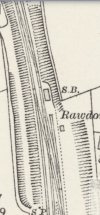
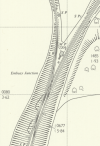
I've just looked at Rawdon Junction, another double track mainline and single track branch, and also a Midland Line. The screenshot below show the 1922 and 1936 25inch map on NLS.

The 1922 layout is very similar to Embsay Junction, including the seperate trailing crossover. The only difference is the addition of a headshunt.

By 1936 the layout has been simplified with the diamond removed and the trailing crossover used to cross from the branch to the down line - so a change has taken place fairly early in the LMS period.
 

Attachments

  • Screenshot_20241127_215453_Chrome.jpg
    Screenshot_20241127_215453_Chrome.jpg
    193.8 KB · Views: 37
  • Screenshot_20241127_215541_Chrome.jpg
    Screenshot_20241127_215541_Chrome.jpg
    192.7 KB · Views: 37

John Webb

Established Member
Joined
5 Jun 2010
Messages
3,774
Location
St Albans
I've just looked at Rawdon Junction, another double track mainline and single track branch, and also a Midland Line. The screenshot below show the 1922 and 1936 25inch map on NLS.

The 1922 layout is very similar to Embsay Junction, including the seperate trailing crossover. The only difference is the addition of a headshunt.

By 1936 the layout has been simplified with the diamond removed and the trailing crossover used to cross from the branch to the down line - so a change has taken place fairly early in the LMS period.
The Embsay junction is on an embankment, and I assume they did not include the trap point arrangement (your 'headshunt') due to a lack of room.
 

Rescars

Established Member
Joined
25 May 2021
Messages
2,553
Location
Surrey
I know nothing of the gradients at Rawdon, but if that headshunt is intended as a trap point or catch point, the bobby does appear to be located in the crosshairs!
 

30907

Veteran Member
Joined
30 Sep 2012
Messages
21,959
Location
Airedale
I know nothing of the gradients at Rawdon, but if that headshunt is intended as a trap point or catch point, the bobby does appear to be located in the crosshairs!
I suspect the Yeadon branch gradient was a good reason for insisting on it :)
 

Bradford PA

Member
Joined
3 Jun 2024
Messages
87
Location
Luton
The layout at Embsay Junction was also simplified in later years (there is a signaling diagram of this reduced form in the Bairstow book quoted above). The main line was singled during the First World War and the second line was not reinstated until 1921/22 so wrong line working would have been in place at one time. I am not sure where the single line extended to westwards from its source at Ilkley but Embsay junction would seem to be a logical end to this, given the branch activity.
 

John Webb

Established Member
Joined
5 Jun 2010
Messages
3,774
Location
St Albans
The layout at Embsay Junction was also simplified in later years (there is a signaling diagram of this reduced form in the Bairstow book quoted above). The main line was singled during the First World War and the second line was not reinstated until 1921/22 so wrong line working would have been in place at one time. I am not sure where the single line extended to westwards from its source at Ilkley but Embsay junction would seem to be a logical end to this, given the branch activity.
Another book I have on the Skipton-Ilkley line (F W Smith and Donald Binns, 1986) says that the line was singled between Embsay Station and Addingham, with a passing loop left at Bolton Abbey station in January 1917. The track was reinstated in March 1921. So it would seem the junction remained unaltered at that time. The diagram in both this book and also in the Bairstow book - in the latter credited to Richard Pulleyn (of the Signalling Record Society) - seems to agree with the OP's map extract, so I'm not clear in what way it was 'simplified'.
The diagram also shows the branch did have a catch-point in the 'Down' leg of the branch from the junction, although this could be closed by a lever in the box.
This book also has a gradient diagram, showing that Embsay Junction was on a 1:125 gradient that steepened to 1:90 and then 1:85 through Skipton Station! (This was over a distance of two miles.)
 
Status
Not open for further replies.

Top