• Our new ticketing site is now live! Using either this or the original site (both powered by TrainSplit) helps support the running of the forum with every ticket purchase! Find out more and ask any questions/give us feedback in this thread!

High Speed Two (HS2) discussion

Status
Not open for further replies.

jopsuk

Veteran Member
Joined
13 May 2008
Messages
12,774
Section 4, Franchising
Why was the Norwich-Liverpool route not transferred to XC with most of the other Central Citylink routes? It would have made sense, since it is clearly an inter-regional express route, but for reasons which I have never understood, EMT got it. It's about time that was put right.

Because it doesn't pass through Birmingham. It was decided that XC should be a Birmingham-centric franchise.
 
Sponsor Post - registered members do not see these adverts; click here to register, or click here to log in
R

RailUK Forums

HSTEd

Veteran Member
Joined
14 Jul 2011
Messages
20,281
Could all the vestigal intercity trains fit into three 200m platforms? (That would be what.... six trains per hour max?)

If so then the Cambridge cruiser coudl be converted to a High Speed service and use the main trainshed at King's Cross, with the station platforms extended by skylighting the tunnels north of the station and putting the Canal on a bridge over the station approach.

All the suburban trains would be taken up by Thameslink or Moorgate.
 

Kettledrum

Member
Joined
13 Nov 2010
Messages
804
Practically, I don't know what difference it would make under XC (same stock, just a different colour scheme). As for it being an "inter-regional express route", EMT do run "Intercity" services to London, so it's not like leaving the route with a wholly-local TOC.

Really, it's an odd-ball route. Whoever you give Liverpool - Norwich to, it'll sit badly with them.

Do EMT run Liverpool to Norwich like an inter-regional express route?
 

LE Greys

Established Member
Joined
6 Mar 2010
Messages
5,389
Location
Hitchin
Could all the vestigal intercity trains fit into three 200m platforms? (That would be what.... six trains per hour max?)

If so then the Cambridge cruiser coudl be converted to a High Speed service and use the main trainshed at King's Cross, with the station platforms extended by skylighting the tunnels north of the station and putting the Canal on a bridge over the station approach.

All the suburban trains would be taken up by Thameslink or Moorgate.

Sounds expensive. It's more likely that the Beer Train would be lumped in with all the other rump ECML services, as you say, and just operate out of the main line platforms, with the suburban ones being converted into a car park.
--- old post above --- --- new post below ---
Do EMT run Liverpool to Norwich like an inter-regional express route?

It depends on how you define it, but they use pairs of 158s (or even single ones). It's one of those bits-n-pieces routes that links together a string of big places and some rather smaller ones. They could, but they don't really.
 

LE Greys

Established Member
Joined
6 Mar 2010
Messages
5,389
Location
Hitchin
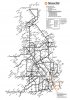
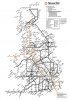
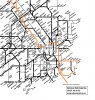
Incidentally, I've modified a map to show current HSR services in orange and the way I think it'll look in 2028, with 2033 on its way. One picture speaks a thousand words. Please forgive any problems around Birmingham and London, there was not much space to work with.

<EDIT> Just had to add a second version, the originals weren't very clear.

<EDIT-2> I've now incorporated the Javelin service, as suggested by si404. The reason I have slimmed down the Trent Valley is that I work under the assumption that two railways in a privatised industry operate by competitive exclusion, so complete competitors cannot coexist. 2033 is still on the way.
 

Attachments

  • National Rail 2013.jpg
    National Rail 2013.jpg
    149.7 KB · Views: 32
  • National Rail 2028.jpg
    National Rail 2028.jpg
    151.2 KB · Views: 30
  • National Rail 2013a.jpg
    National Rail 2013a.jpg
    144.8 KB · Views: 28
  • National Rail 2028a.jpg
    National Rail 2028a.jpg
    147.2 KB · Views: 36
Last edited:

tbtc

Veteran Member
Joined
16 Dec 2008
Messages
18,051
Location
Reston City Centre
Do EMT run Liverpool to Norwich like an inter-regional express route?

Without trying to sound facetious, I'm not sure what one of those is (in terms of definition).

The service pattern/ frequency haven't changed since Central Trains days - the seats in refurbished 158s are fairly suited to long distance travel - very comfortable - there's a trolley for part of the journey too.

However the nature of the route changes at various stages - in terms of demand and speed - a "one size fits all" approach wouldn't work.

(sorry, going way off topic)
 

LE Greys

Established Member
Joined
6 Mar 2010
Messages
5,389
Location
Hitchin
Without trying to sound facetious, I'm not sure what one of those is (in terms of definition).

The service pattern/ frequency haven't changed since Central Trains days - the seats in refurbished 158s are fairly suited to long distance travel - very comfortable - there's a trolley for part of the journey too.

However the nature of the route changes at various stages - in terms of demand and speed - a "one size fits all" approach wouldn't work.

(sorry, going way off topic)

'Inter-regional', train that travels through more than one of the traditional BR regions (the 'inter-regional' part of BR Intercity became VXC). For that, you can read 'franchise areas', the crucial part being that it does not serve London. 'Express', Class 1 passenger train. So a Class 1 passenger train that travels through more than one region/franchise area and does not serve London.
 

si404

Established Member
Joined
28 Dec 2012
Messages
1,267
Incidentally, I've modified a map to show current HSR services in orange and the way I think it'll look in 2028, with 2033 on its way. One picture speaks a thousand words. Please forgive any problems around Birmingham and London, there was not much space to work with.

<EDIT> Just had to add a second version, the originals weren't very clear.
No to Blackpool, and Holyhead is even less likely (it's not yet even hourly - even if electrified, I doubt it will be classic-compatible). As such, while it looks very elegant to have a thin line there, the Trent Valley will remain thicker.

There will be via-Crewe Manchester classic-compatible services under phase 1, IIRC.

Not sure you got Old Oak right, either.

And where's the Kent services? If you have classic compatibles, you need the Javelins as equivalent.

However, the cartography (yes, I know that the base map is NR's) is top notch.
 

HSTEd

Veteran Member
Joined
14 Jul 2011
Messages
20,281
Sounds expensive. It's more likely that the Beer Train would be lumped in with all the other rump ECML services, as you say, and just operate out of the main line platforms, with the suburban ones being converted into a car park.

I was proposing to shunt the rump ECML services into the suburban platforms to free the main trainshed for conversion into a high speed rail terminus.

The Cambridge cruiser would likely be a captive or classic compatible service anyway, so there would be no problem in it using the main trainshed (atleast in Option 'E', in Option 'M' a bay of the main trainshed would have to be retained (8tph into 3 platforms sounds iffy) which is annoying because that would leave only six platforms for the high speed terminus, when eight would be required for capacity reasons to handle 14+tph).
 
Last edited:

LE Greys

Established Member
Joined
6 Mar 2010
Messages
5,389
Location
Hitchin
No to Blackpool, and Holyhead is even less likely (it's not yet even hourly - even if electrified, I doubt it will be classic-compatible). As such, while it looks very elegant to have a thin line there, the Trent Valley will remain thicker.

There will be via-Crewe Manchester classic-compatible services under phase 1, IIRC.

Not sure you got Old Oak right, either.

And where's the Kent services? If you have classic compatibles, you need the Javelins as equivalent.

However, the cartography (yes, I know that the base map is NR's) is top notch.

Old Oak was a bit of a nightmare, I had to compromise by running HS2 south of Marylebone, because the only alternative was to put a kink in the GWML. You're right about the Javelins, sorry. :oops:

I'm currently working under the assumption that most Trent Valley expresses will run directly onto HS2, leaving the current LM semi-fasts, suitably reinforced, to take over the route. I considered shrinking the WCML south of Birmingham as well, but ruled that out on the grounds that it will still handle an inter-urban service covering Milton Keynes and Northampton. I'm not sure how the franchises will work out, but its possible we'll have 'HS2+WC' and 'WC+LM'. Covering Holyhead and Blackpool was another compromise, since the only other way to serve them would be to cut both trains back to Birmingham (I'm assuming that whoever gets ICWC restores the Birmingham-London service). I'm further assuming that both lines are electrified before 2028 (which may or may not happen). I'm sure it's possible to extend one train from Curzon Street to cover both, alternating between the two.

Anyway, back to the drawing board (or rather MS Paint).
 

deltic

Established Member
Joined
8 Feb 2010
Messages
3,713
If I have understood the data correctly - (and not sure if I have!) then HS2 will lead to a 80% fall in traffic on WCML franchise and 60% reductions on both MML & ECML - compared with the without HS2 situtation in 2026. That doesnt mean traffic will be down by that amount from today because traffic is expected to grow between 2013 and then by possibly 50%. Which in reality means that with HS2 in 2026 MML and ECML will have only less 10% traffic then than they do now. - see http://www.hs2.org.uk/news-resources/publications/economic-documents - Phase 2 (Leeds, Manchester and Heathrow) Demand Sheets – towards the bottom of the page
 

The Ham

Veteran Member
Joined
6 Jul 2012
Messages
12,035
If I have understood the data correctly - (and not sure if I have!) then HS2 will lead to a 80% fall in traffic on WCML franchise and 60% reductions on both MML & ECML - compared with the without HS2 situtation in 2026. That doesnt mean traffic will be down by that amount from today because traffic is expected to grow between 2013 and then by possibly 50%. Which in reality means that with HS2 in 2026 MML and ECML will have only less 10% traffic then than they do now. - see http://www.hs2.org.uk/news-resources/publications/economic-documents - Phase 2 (Leeds, Manchester and Heathrow) Demand Sheets – towards the bottom of the page

The 50% growth in passenger numbers between now and HS2 sounds about right. Although that is based on growth of about 2.5% year on year between now and then, anything more than that, even for the first few years, and passenger numbers could be a lot higher than expected.

However you future passenger numbers are a little off. To make the maths a little easier to understand we'll compare it to 100 passengers today:

WCML 100 today, 150 pre HS2 opening, then a 80% fall in passenger numbers is 30 passengers (so a 70% drop on today's flows).

ECML/MML 100 today, 150 pre HS2 opening, then a 70% fall in passenger numbers is 45 passengers (so a 55% drop on today's flows).

It is likely to mean that for every three ICWC trains which runs today, post HS2 there will still be demand for one. However, in reality it is more likely mean a similar frequency of trains just in shorter formations and/or calling at more locations and/or splitting partway to run to multiple locations.

Likewise it would mean that the ECML and MML could see a reduction in the capacity of trains by about half.

 

LE Greys

Established Member
Joined
6 Mar 2010
Messages
5,389
Location
Hitchin
The 50% growth in passenger numbers between now and HS2 sounds about right. Although that is based on growth of about 2.5% year on year between now and then, anything more than that, even for the first few years, and passenger numbers could be a lot higher than expected.

However you future passenger numbers are a little off. To make the maths a little easier to understand we'll compare it to 100 passengers today:

WCML 100 today, 150 pre HS2 opening, then a 80% fall in passenger numbers is 30 passengers (so a 70% drop on today's flows).

ECML/MML 100 today, 150 pre HS2 opening, then a 70% fall in passenger numbers is 45 passengers (so a 55% drop on today's flows).

It is likely to mean that for every three ICWC trains which runs today, post HS2 there will still be demand for one. However, in reality it is more likely mean a similar frequency of trains just in shorter formations and/or calling at more locations and/or splitting partway to run to multiple locations.

Likewise it would mean that the ECML and MML could see a reduction in the capacity of trains by about half.

This sounds like a decidedly bleak future for all these remaining lines. And that depends on the 2.5% growth being sustainable over the intervening period, but that's a-whole-nother issue.
 

JohnB57

Member
Joined
26 Jun 2008
Messages
721
Location
Holmfirth, West Yorkshire
The 50% growth in passenger numbers between now and HS2 sounds about right. Although that is based on growth of about 2.5% year on year between now and then, anything more than that, even for the first few years, and passenger numbers could be a lot higher than expected
Being nit-picky, 2.5% year on year gives approximately 38% growth by 2026 and 64% by 2033 versus today. Useful figures - if you believe they'll happen - for the justification of HS2 as structured but also useful to those who believe it's the wrong thing over too long a timescale.

However, if the figures are as accurate as projections for, say, HS1 and the 4G auction, it's a different picture altogether.
 

tbtc

Veteran Member
Joined
16 Dec 2008
Messages
18,051
Location
Reston City Centre
WCML 100 today, 150 pre HS2 opening, then a 80% fall in passenger numbers is 30 passengers (so a 70% drop on today's flows).

ECML/MML 100 today, 150 pre HS2 opening, then a 70% fall in passenger numbers is 45 passengers (so a 55% drop on today's flows)

This sounds like a decidedly bleak future for all these remaining lines. And that depends on the 2.5% growth being sustainable over the intervening period, but that's a-whole-nother issue.

Take all of the longer distance passengers out of the equation on "middle distance" journeys and that's a lot of spare seats. That also frees up a lot of space for "different" services on the existing lines (which don't all focus on London).
 

jon0844

Veteran Member
Joined
1 Feb 2009
Messages
30,864
Location
UK
If there are less services on the WCML and ECML, I doubt the paths will be wasted - it will allow for an increase in freight movements.

For long distance lorries, I am not sure how long it will be until we can have alternative fuels to deliver the range needed - so when diesel is likely to be astronomically high, going by rail with lorries at each end will seem very sensible - if not essential.
 

LE Greys

Established Member
Joined
6 Mar 2010
Messages
5,389
Location
Hitchin
Take all of the longer distance passengers out of the equation on "middle distance" journeys and that's a lot of spare seats. That also frees up a lot of space for "different" services on the existing lines (which don't all focus on London).

I'll do a bit of number-crunching to see if I can built up a picture of the railways in the 2030s. It's highly speculative, and I'll try to avoid drawing conclusions, but the question to answer is "Where does the DfT prioritise its spending once HS2 is fully open?".
 

HSTEd

Veteran Member
Joined
14 Jul 2011
Messages
20,281
If there are less services on the WCML and ECML, I doubt the paths will be wasted - it will allow for an increase in freight movements.

For long distance lorries, I am not sure how long it will be until we can have alternative fuels to deliver the range needed - so when diesel is likely to be astronomically high, going by rail with lorries at each end will seem very sensible - if not essential.

The huge inherent subsidies in the road freight system are likely to make significant increase in the number of freight movements impractical.
However the existing movements will likely see steadily increasing trainweights between now and 2033.

It is likely that the freights will be run with less stringent timetabling and lower power:weight ratios as not so many paths will be required.
 

The Ham

Veteran Member
Joined
6 Jul 2012
Messages
12,035
Being nit-picky, 2.5% year on year gives approximately 38% growth by 2026 and 64% by 2033 versus today. Useful figures - if you believe they'll happen - for the justification of HS2 as structured but also useful to those who believe it's the wrong thing over too long a timescale.

However, if the figures are as accurate as projections for, say, HS1 and the 4G auction, it's a different picture altogether.

I did say about and were using the figures from the original poster and from HS2 Ltd, however from 2010 (the date of the report and only 2 years before the current full years worth of data that is available) it does work out at about 50% by 2026.

You are right, I don't think that the growth rate of 2.5% is going to be accurate, but that is because the growth rate from September 2010 to August 2011 was over 8.59% meaning that from that year alone the growth in passenger numbers is more than 3 years at 2.5%. Which means that we are going to have to see some quite significant falls in the number of new passengers over the next decade (possibly even falling to 0) to end up being on "target".

Even taking the last 5 years of passenger growth (2006-2011 - 20.7% growth or 3.8% year on year growth) it is still significantly higher than the 2.5% growth year on year (or 13.1% over 5 years) which is being used to determine passenger numbers and we need to remember that during the later half of that time the UK has been in and out of recession a few times.

It should also be noted that roads had the same amount of road traffic (vehicle kilometres) on them in 2011 as they did in 2003 (as this figure has been falling year on year since 2007) such is the fall in the usage of the private car.

It is true that HS1 and 4G numbers were off from what the government were anticipating, but then so where 3G and almost every other rail passenger number for the last 10 years and they were a lot higher.
 

tbtc

Veteran Member
Joined
16 Dec 2008
Messages
18,051
Location
Reston City Centre
Even if we are quibbling over the 2.5% annual growth rates, the result of twenty years of such increases really does make me think that there's no real alternative to HS2 - we can't simply "make do and mend" when confronted with that kind of pressure on existing networks.
 
Joined
9 Feb 2009
Messages
807
Even if we are quibbling over the 2.5% annual growth rates, the result of twenty years of such increases really does make me think that there's no real alternative to HS2 - we can't simply "make do and mend" when confronted with that kind of pressure on existing networks.

The fatal flaw with that argument is..."what about all the other lines?" HS2 is diverting attention from the rest of the network. The CP5 plans are a damp squib by comparisons - electrification per se does not increase capacity
 

D365

Veteran Member
Joined
29 Jun 2012
Messages
13,161
...The CP5 plans are a damp squib by comparisons - electrification per se does not increase capacity

Actually, it does. Electric trains are more reliable, meaning they are more useful and extra service can be provided. Acceleration is greater, reducing journey time and opening up more paths. Carriage interiors are improved. Furthermore, running costs are cheaper overall and track wear is reduced. Electrification is an improvement in its own right. It is already being implemented alongside a nationwide upgrade.
 
Last edited:

tbtc

Veteran Member
Joined
16 Dec 2008
Messages
18,051
Location
Reston City Centre
The fatal flaw with that argument is..."what about all the other lines?" HS2 is diverting attention from the rest of the network. The CP5 plans are a damp squib by comparisons - electrification per se does not increase capacity

900 miles of electrification is a "damp squib"?

You've not spotted the remodelling of various bottlenecks, the reopening of lines like Oxford - Bedford, the Ordsall Chord and new platforms at Manchester Piccadilly, the fact that EMUs will generally mean longer trains than the DMUs that they replace, planned frequency increases (like the Manchester - Huddersfield - Leeds services going up from four an hour to six an hour), the fact that displaced DMUs are going to provide enhancements on unelectrified lines etc?
 
Joined
9 Feb 2009
Messages
807
Actually, it does. Electric trains are more reliable, meaning they are more useful and extra service can be provided. Acceleration is greater, reducing journey time and opening up more paths. Carriage interiors are improved. Furthermore, running costs are cheaper overall and track wear is reduced. Electrification is an improvement in its own right. It is already being implemented alongside a nationwide upgrade.

Please try to red what I said - I said "per se". Electric trains on average do have better acceleration but not always - Voyagers will out accelerate quite a few electric trains. Equally, electric trains are usually more reliable but not always - the SWT 158s and XC Voyagers outshine several EMU classes.

How exactly are carriage interiors improved by simply being electric?: A VT Mk.3 hauled by an 87 is better than a Mk.3 in a HST set?:lol:

You've not spotted the remodelling of various bottlenecks, the reopening of lines like Oxford - Bedford, the Ordsall Chord and new platforms at Manchester Piccadilly, the fact that EMUs will generally mean longer trains than the DMUs that they replace, planned frequency increases (like the Manchester - Huddersfield - Leeds services going up from four an hour to six an hour), the fact that displaced DMUs are going to provide enhancements on unelectrified lines etc?

I'm more than aware of those schemes. Much of that was already announced prior to the CP5 HLOS - very little new was added.
 

Haydn1971

Established Member
Joined
11 Dec 2012
Messages
2,101
Location
Sheffield
I'm reading the "interiors improved" as having less noise - a DEMU or DMU is noisier than a EMU, but I doubt I could tell the difference between a electric or diesel loco from inside the carriages being pulled.
 

tbtc

Veteran Member
Joined
16 Dec 2008
Messages
18,051
Location
Reston City Centre
I'm more than aware of those schemes. Much of that was already announced prior to the CP5 HLOS - very little new was added.

Plenty is being done, and in several areas. The idea that HS2 is somehow "diverting attention from the rest of the network" doesn't stack up, I'm afraid.

Despite the planning for HS2. we are seeing more investment/ upgrades on "classic" lines than at any time since privatisation.
 

The Ham

Veteran Member
Joined
6 Jul 2012
Messages
12,035
The fatal flaw with that argument is..."what about all the other lines?" HS2 is diverting attention from the rest of the network. The CP5 plans are a damp squib by comparisons - electrification per se does not increase capacity

Just the electrification of the XC line between Manchester and the South Coast means that instead of 4 or 5 coach trains running the service there will be new EMU's which will be much longer AND a load of DMU's which will be able to be use to strengthen the other XC services.

Multiply that out over the whole network and there is likely to be a lot more capacity on the network than at present, without having to build new DMU's which potentially wouldn't be used for their full life span.

Yes there may come a point where the lines which will benefit the most from HS2 will stop needing funding to increase capacity, but there are still a lot more locations where HS2 will make no difference to the number of people travelling there.

Once HS2 opens all the trains anywhere south of Birmingham (other than a few inter city trains between Birmingham and London) will still be just as busy as before and any service which isn't an intercity train north of there will be just as busy as before. There's an argument that with HS2 all the feeder services will be even busier and that by building HS2 we'll have to spend more on improving capacity (i.e. Crossrail 2) than at present.
--- old post above --- --- new post below ---
CP4 - £14bn
CP5 - £9bn (only £4bn of new projects)

The figures don't stack up...

Can you provide sources for those figures as according the House of Commons transport select committee (July 2012).

Over the CP4 period, Network Rail’s capital expenditure will total £8 billion (in 201011 prices), equating to an average yearly spend of £1.6 billion.

http://www.publications.parliament.uk/pa/cm201213/cmselect/cmtran/329/329we06.htm
 

Chris125

Established Member
Joined
12 Nov 2009
Messages
3,267
Location
Isle of Wight
Much of that was already announced prior to the CP5 HLOS - very little new was added.

What difference does that make? They are still being delivered in CP5.

There is neither evidence nor logic to the idea that HS2 is somehow 'distracting' from the existing network, if anything it should prove a lot less distracting than trying to accommodate the predicted growth without it. Remember the WCRM, and how that one project dominated the agenda of both Railtrack and Network Rail for over a decade?

As Crossrail has shown, even during the worst recession in living memory said multi-billion pound project did not 'distract' from the need to invest in both Thameslink and the Tube Upgrade and i see no reason to think HS2 will be any different - indeed the arms length nature of it's delivery compared to conventional upgrades is arguably a bonus.

Chris
 
Last edited:

swt_passenger

Veteran Member
Joined
7 Apr 2010
Messages
34,248
Projects don't just neatly start and stop in synch with Control Periods, as you imply above - a typical major project, including all the GRIP stages, could easily appear in three CPs from first expenditure on design to final tying up as built information and drawings.

Massive projects such as Reading Station Area Rebuild are clearly going to cross the April 2014 period, so the split of expenditure on Reading in CP4 and CP5 is not any sort of trick, it's just normal accounting.

The figure above of £14bn is inclusive of maintenance expenditure, I believe. CP4 enhancements budget is and always was £8bn, as already mentioned.

CP5 will still include three or four years work on Thameslink - so as expected, three or four years worth of Thameslink's overall budget is part of that chunk of expenditure that isn't actually new work - but that is entirely predictable and as expected...
 
Status
Not open for further replies.

Top