There are other alternatives, like electrification or just having a unit stabled every so often to recharge which are better than changing a battery pack, which is very involved and not easy to change, see how Bombardier install it on the Talent 3, it may only be 2 people but they have to crane it in.Surely a few extra staff and a bit of cash spent on land and equipment is worth it if it means work is being done to safe our environment.

-
Our new ticketing site is now live! Using either this or the original site (both powered by TrainSplit) helps support the running of the forum with every ticket purchase! Find out more and ask any questions/give us feedback in this thread!
You are using an out of date browser. It may not display this or other websites correctly.
You should upgrade or use an alternative browser.
You should upgrade or use an alternative browser.
Has electrification had its day?
- Thread starter jayah
- Start date
- Status
- Not open for further replies.
Sponsor Post - registered members do not see these adverts; click here to register, or click here to log in
R
RailUK Forums
The charging issue is most specific to IPEMUs which don't have much/any time charging on 25kV during other parts of their journey. If they can do battery charging whilst running under the wires, use that stored energy to cover the section of track which isn't electrified, and get back to the OLE either elsewhere on the journey or on the return working, charging is much less of an issue, or ceases to be an issue at all. It's those out and back workings where there's only a short distance under OLE that's the real problem.
Exactly. Taking the Uckfield line as an oft quoted (D.C.) example, a BEMU on a typical cycle would have 1h20 or so on the juice (of which 21 mins is stationary) and 1h35 off the juice (of which, by coincidence, 21 mins is stationary). I forget how much ‘net’ juice the modelling said it would need to get a 4 car to Uckfield and back, including auxiliaries, but from memory it was in the 500kWh ‘ball park’ - all the stops helped with the recharging through regen. The question then is could the unit get c500kWh back from the third rail Hurst Green - London Bridge - Hurst Green. Two ways of looking at it:
a) c375kW power draw (500Amps), on average over the 1h20 ‘on juice’ time, over and above what is needed for traction and auxiliaries
b) c400kWh drawn at 1.2MW for the 21 minutes spent stationary on the juice, with the remaining c100kWh captured through regenerating for the station stops / junctions on the juice and/or by drawing a higher than normal level of power when coasting or at less than full power (which is most of the time). A 4 car Class 377 regenerates something like 15kWh when braking from 70mph to a stop.
So, the pure energy in / out ‘account’ works in this example, and a 1MWh battery is more than enough. The two issues are, firstly, the capability of the power supply on the existing electrified network to cope with the additional power draw (which, in any event, would have to be sorted if pure electrics were running), and secondly, the capability of the train / battery system to be able to manage all these new flows of high power within it.
In summary, Battery hybrid EMUs will work best on routes where they branch off, or extend from, an already electrified line, and spend (roughly) as much time on the juice as off it. There are various trade offs in terms of speed, stopping patterns and distance. Where the off juice section is low speed and frequent stopping, this works best.
Last edited:

Philip Phlopp
Established Member
- Joined
- 31 May 2015
- Messages
- 3,003
So could you have 2 batteries in circulation, with one being charged while the other is in operation? Take the Marks Tey to Sudbury branch: One battery could do the shuttle for 45 minutes (MKT-MKT) then a quick changeover (15 mins allowed with less time at Sudbury) and the other battery, which has just been charged, replaces the used one (which is then charged) and the cycle repeats.
Physically changing the battery raft on a train ?
The battery pack on the Class 379 was 6 tonnes. It has to be charged in-situ (bolted underneath the unit). There would be a lot of wiring and plumbing potentially included in the pack too - there's thermal management of the battery which can include oil/water cooling, radiators/heaters etc, and you really don't want to be plugging and unplugging the battery from the main power bus on the unit, which will have safety implications.
Physically changing the battery raft on a train ?
The battery pack on the Class 379 was 6 tonnes. It has to be charged in-situ (bolted underneath the unit). There would be a lot of wiring and plumbing potentially included in the pack too - there's thermal management of the battery which can include oil/water cooling, radiators/heaters etc, and you really don't want to be plugging and unplugging the battery from the main power bus on the unit, which will have safety implications.
What with the labour costs & all the maintenance of switching gear & quick-change connectors on the train ( presuming you designed it to be regularily removed ) I think you might be better off swapping in another already-charged train.
I've seen some of the battery swap proposals for race cars, and even they are fairly industrial when we're talking about a few hundred kg. The alternative is of course H2, but the safety case for refilling a train at a terminus must be quite interesting
 so you end up carrying loads of the stuff. Still needs a battery too.
Bletchleyite
Veteran Member
Physically changing the battery raft on a train ?
The battery pack on the Class 379 was 6 tonnes. It has to be charged in-situ (bolted underneath the unit). There would be a lot of wiring and plumbing potentially included in the pack too - there's thermal management of the battery which can include oil/water cooling, radiators/heaters etc, and you really don't want to be plugging and unplugging the battery from the main power bus on the unit, which will have safety implications.
I'm not genuinely suggesting this, but it would be easier to change a locomotive with batteries in than do that.
I think Tesla got about as far as anyone with their fully automated battery swap system, which took about 2-3 minutes:
(Not a good quality video, but it shows the process the best)
They even got as far as build a public trial battery swap station for end users and even got some end users into it.
It was reported as taking 7 minutes with some human work involved.
But later seem to have shutdown the program:
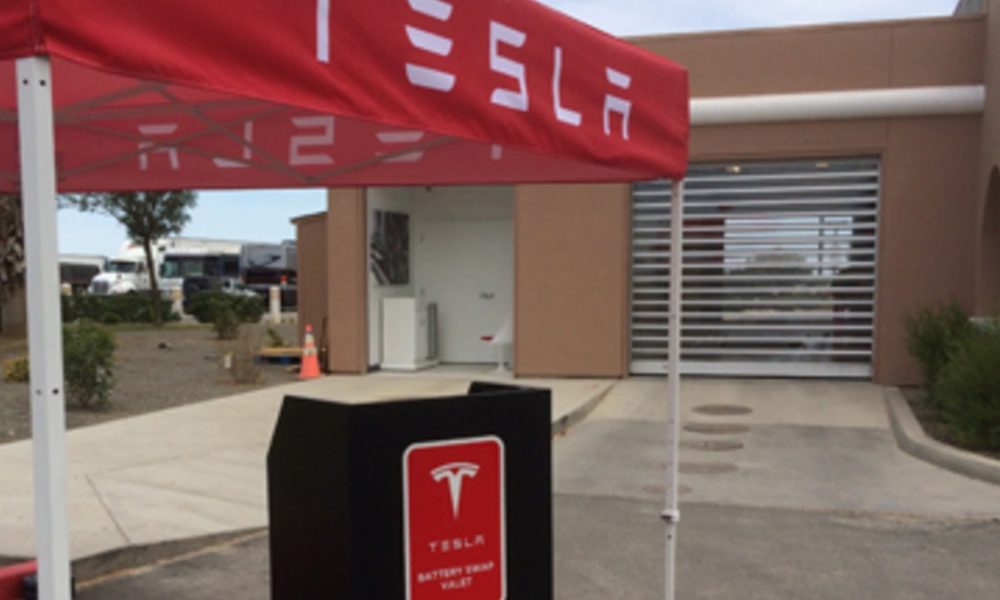
 www.teslarati.com
Primarily due to lack of demand:
 insideevs.com
(customers didn't actually use it much)
insideevs.com
(customers didn't actually use it much)
I can't see obvious reasons why a similar system couldn't be built for rail.
It would have to be designed and built specifically to support this though, there's almost no possibility
of retrofitting it to existing designs.
They even got as far as build a public trial battery swap station for end users and even got some end users into it.
It was reported as taking 7 minutes with some human work involved.
But later seem to have shutdown the program:
Tesla shuts down battery swap program in favor of Superchargers, for now
Tesla’s battery swap station near the Harris Ranch Supercharger station in Coalinga, CA seems to have been shut down, at least for now. What started out as a company vision to recharge Tesla vehicles in the same amount of time, if not quicker, as refueling a gas vehicle, turned into a pilot...
www.teslarati.com
Primarily due to lack of demand:
Elon Musk Comments On Failed Tesla Battery Swap
Quoting Elon Musk, "Why would you do the pack swap? It doesn't make much sense."
insideevs.com
I can't see obvious reasons why a similar system couldn't be built for rail.
It would have to be designed and built specifically to support this though, there's almost no possibility
of retrofitting it to existing designs.

Jozhua
Established Member
- Joined
- 6 Jan 2019
- Messages
- 1,891
It doesn't bear thinking about! It seems like a practical solution, until you get round to implementing it. Sure, it's technically feasible, but operationally impractical.Changing over the entire battery pack would be require a lot of effort and extra staff and equipment.
I don't see how changing a several tonne battery multiple times a day will contribute to a safe working environment.Surely a few extra staff and a bit of cash spent on land and equipment is worth it if it means work is being done to safe our environment.
Six tonnes sounds about right, then remember you might need to do it for multiple carriages on an MU!Physically changing the battery raft on a train ?
The battery pack on the Class 379 was 6 tonnes. It has to be charged in-situ (bolted underneath the unit). There would be a lot of wiring and plumbing potentially included in the pack too - there's thermal management of the battery which can include oil/water cooling, radiators/heaters etc, and you really don't want to be plugging and unplugging the battery from the main power bus on the unit, which will have safety implications.
It doesn't bear thinking about! This is just not a practical solution at all.What with the labour costs & all the maintenance of switching gear & quick-change connectors on the train ( presuming you designed it to be regularily removed ) I think you might be better off swapping in another already-charged train.
I've seen some of the battery swap proposals for race cars, and even they are fairly industrial when we're talking about a few hundred kg. The alternative is of course H2, but the safety case for refilling a train at a terminus must be quite interesting
The most practical solution remains to electrify mainlines, so battery trains dipping onto the branches can get some juice from there. Possibly have a charging cable too if it spends 10-15 minutes at the terminus station, although this could decrease service resiliency if the charge is low.
Discontinuous electrification is not practical either, due to the need to lower/raise the pantograph, something which can be fairly involved. The idea the driver is just going to be raising and lowering the pantograph between each bridge and tunnel is silly. Again, technically feasible, operationally impractical. Termination of electrical connections can be costly, then there's the cost of all the broken pantographs! Discontinuous electrification makes even less sense where it becomes more financially appealing (a.k.a in places with frequent bridges & tunnels)
Philip Phlopp
Established Member
- Joined
- 31 May 2015
- Messages
- 3,003
It doesn't bear thinking about! It seems like a practical solution, until you get round to implementing it. Sure, it's technically feasible, but operationally impractical.
I don't see how changing a several tonne battery multiple times a day will contribute to a safe working environment.
Six tonnes sounds about right, then remember you might need to do it for multiple carriages on an MU!
It doesn't bear thinking about! This is just not a practical solution at all.
The most practical solution remains to electrify mainlines, so battery trains dipping onto the branches can get some juice from there. Possibly have a charging cable too if it spends 10-15 minutes at the terminus station, although this could decrease service resiliency if the charge is low.
Discontinuous electrification is not practical either, due to the need to lower/raise the pantograph, something which can be fairly involved. The idea the driver is just going to be raising and lowering the pantograph between each bridge and tunnel is silly. Again, technically feasible, operationally impractical. Termination of electrical connections can be costly, then there's the cost of all the broken pantographs! Discontinuous electrification makes even less sense where it becomes more financially appealing (a.k.a in places with frequent bridges & tunnels)
Six tonnes was the total weight of the battery pack included on the Class 379 - so roughly six tonnes per 4 car, 100mph EMU. It's unlikely but not impossible you would need to do it for several units coupled together in the consist, but that then means the electrical draw on the system, whether existing rail electrification or some form of grid connection including that with a battery storage, moves from potentially 5MW to 10MW or 15MW over that circa 5 minute charging period, admittedly through 2 or 3 pantographs, but a huge additional complication. It's still a complication swapping out battery packs, if they're to be charged up at this remote location.
Raising and lowering the pantograph isn't an issue, and we can include APCO (automatic power change over) balises to allow the unit to do it all for the driver, but this would be something done when there would be a significant gap (miles, rather than metres) between each energised section of OLE. You also need to be reasonably careful with the OLE, to minimise dewirement risk - plain OLE, level track, perhaps with higher tensioning depending on speeds and energies involved (remember pantographs are aerodynamically designed to stick to the contact wire like glue at line speeds, so forces imparted can be quite significant). Carbon wear is also an issue to take into account.
Discontinuous electrification doesn't mean pantograph lowering and raising is needed in any case, the limiting factor in most situations is electricial clearance, not mechanical clearance, so some of the work in the sphere of discontinuous electrification involves the use of a 'jumbo neutral section' whereby at the end of the energised section, the usual insulated neutral section components are installed, but instead of the OLE stopping, it continues but is earthed (typically through the use of cantilever arms minus their insulators) until the next section of energised catenary, where again there's a typical neutral section. This means the pantograph remains raised through the non energised section, avoiding the need for repeated raising and lowering in quick succession.
Discontinuous electrification doesn't mean pantograph lowering and raising is needed in any case, the limiting factor in most situations is electricial clearance, not mechanical clearance, so some of the work in the sphere of discontinuous electrification involves the use of a 'jumbo neutral section' whereby at the end of the energised section, the usual insulated neutral section components are installed, but instead of the OLE stopping, it continues but is earthed (typically through the use of cantilever arms minus their insulators) until the next section of energised catenary, where again there's a typical neutral section. This means the pantograph remains raised through the non energised section, avoiding the need for repeated raising and lowering in quick succession.
See Paisley Canal.

Aictos
Established Member
- Joined
- 28 Apr 2009
- Messages
- 10,403
Since when have all the Thames Valley branches been electrified? Can you clarify with a independent source of this?A tram-train vehicle basically is that, I suppose.
It certainly worked fine for buses on the route 7 trial in MK. Not sure how much point there is for rail - a pantograph and short length of OHLE (even if low voltage OHLE rather than 25kV, though given that branch line origin stations will increasingly have 25kV OHLE anyway, e.g. all the Thames Valley branches do, that's probably easier) would do the job fine and doesn't present the same issues as that does on roads. Or even third rail where that is present on the mainline (e.g. for Uckfield, Burscough Bridge or Kirkby-Skem/Wigan).
I don't see the Marlow line being done anytime soon to name just one.
Philip Phlopp
Established Member
- Joined
- 31 May 2015
- Messages
- 3,003
See Paisley Canal.
Indeed, it may be that some electrification projects proceed with the route fully cleared for EMU stock, with a continuous 25kV AC OLE electrification, but that remote lockout options are used to enable freight, RHTT or other rolling stock which can't meet the reduced electrical clearance loading gauge combination.
I do hear that Paisley Canal is likely to be revisited and properly gauge cleared sooner rather than later though.
Indeed, it may be that some electrification projects proceed with the route fully cleared for EMU stock, with a continuous 25kV AC OLE electrification, but that remote lockout options are used to enable freight, RHTT or other rolling stock which can't meet the reduced electrical clearance loading gauge combination.
I do hear that Paisley Canal is likely to be revisited and properly gauge cleared sooner rather than later though.
Will be interesting to see the costs of that. If it didn’t have wires already, it would be perfect for batteries. Low speed, frequent stops, handful of units, 27 mins on the wire, 29 off it.

squizzler
Established Member
This thread seem to invoke 1960s thinking where gas turbine power was seen as the future. Prototype TGV and Advanced Passenger Train adopted this power source before the implication of high oil prices knocked it on the head. This of course was in an age where the carbon emissions were not a cause for concern.
IMO, gas turbines are the only power sources capable of electric performance if you are going to rule out wires. If you want to go at 200mph or haul several thousand tonnes at decent speed without wires, this jet age technology is still without equal. Bi-mode and battery EMU are all relatively heavy even in comparison with straight diesel hydraulic. Only gas turbines deliver similar power densities to electric traction. Unfortunately, there were considerable downsides with fuel consumption and other antisocial results of running a jet turbine at ground level which could never be overcome. Electric traction turned out the only practical way of producing lightweight and reliable trains with the high performance railways needed for their intercity operations.
Fuel cells and batteries are a cool way of giving EMUs the ability to break into the DMU enclaves. They extend the reach of electrification, not replace it.
IMO, gas turbines are the only power sources capable of electric performance if you are going to rule out wires. If you want to go at 200mph or haul several thousand tonnes at decent speed without wires, this jet age technology is still without equal. Bi-mode and battery EMU are all relatively heavy even in comparison with straight diesel hydraulic. Only gas turbines deliver similar power densities to electric traction. Unfortunately, there were considerable downsides with fuel consumption and other antisocial results of running a jet turbine at ground level which could never be overcome. Electric traction turned out the only practical way of producing lightweight and reliable trains with the high performance railways needed for their intercity operations.
Fuel cells and batteries are a cool way of giving EMUs the ability to break into the DMU enclaves. They extend the reach of electrification, not replace it.
Philip Phlopp
Established Member
- Joined
- 31 May 2015
- Messages
- 3,003
Will be interesting to see the costs of that. If it didn’t have wires already, it would be perfect for batteries. Low speed, frequent stops, handful of units, 27 mins on the wire, 29 off it.
Again, indeed. I don't fully see the need, given the oil terminal Hawkshead won't be re-opening, though I guess with Scotland wanting to eliminate diesel traction, things like RHTT could well be electrically hauled in future so eliminating short routes with unusual OLE restrictions is probably not a bad thing.
The electrification of the route has certainly proven its value in looking at how to electrify in a very cost effective manner - the flip side of the ECML scheme, in many ways, with a proper mechnically independent registration system with correct mast spacing and wire runs but with limits on what rolling stock can use the route, in comparison to a system capable of being used by all AC 25kV rolling stock but with significant limitations on registration and corners cut on mast spacing.

Western Sunset
Established Member
I wonder if a more elegant method of connecting train to electricity supply will ever be devised?
At the moment we have a metal contraption on the roof physically connecting/sliding along wires strung up expensively/obtrusively overhead (ac) or metal shoes rubbing along on a ground-level rail (dc).
At the moment we have a metal contraption on the roof physically connecting/sliding along wires strung up expensively/obtrusively overhead (ac) or metal shoes rubbing along on a ground-level rail (dc).
This thread seem to invoke 1960s thinking where gas turbine power was seen as the future. Prototype TGV and Advanced Passenger Train adopted this power source before the implication of high oil prices knocked it on the head. This of course was in an age where the carbon emissions were not a cause for concern.
IMO, gas turbines are the only power sources capable of electric performance if you are going to rule out wires. If you want to go at 200mph or haul several thousand tonnes at decent speed without wires, this jet age technology is still without equal. Bi-mode and battery EMU are all relatively heavy even in comparison with straight diesel hydraulic. Only gas turbines deliver similar power densities to electric traction. Unfortunately, there were considerable downsides with fuel consumption and other antisocial results of running a jet turbine at ground level which could never be overcome. Electric traction turned out the only practical way of producing lightweight and reliable trains with the high performance railways needed for their intercity operations.
Fuel cells and batteries are a cool way of giving EMUs the ability to break into the DMU enclaves. They extend the reach of electrification, not replace it.
The most efficient place for a gas turbine is in a power station where it can run at it's ideal load the entire time. Running a turbo-generator on a battery-electric unit would allow the turbine to run at it's most efficient while it's actually running ( micro-turbine generators are occasionally tried in cars ), but what with the heat & all the other issues I would imagine you're better off using a fuel cell. A gas turbine can at least use anything you can atomize & burn, but then again you can put practically anything in a diesel engine too.
I wonder if a more elegant method of connecting train to electricity supply will ever be devised?
At the moment we have a metal contraption on the roof physically connecting/sliding along wires strung up expensively/obtrusively overhead (ac) or metal shoes rubbing along on a ground-level rail (dc).
Which is why I asked about induction loops, before I stopped & thought a bit more & realised road vehicles only use induction loops because they travel two dimensionally. If you know where your vehicle is going, directly connecting it to the power is cheaper & more efficient - we use plugs in the house instead of wirelessly charging everything for the same reason. Induction loops made to charge vehicles in motion still need wires under the whole -or at least part of the - route ( I would expect that eventually major roads will get them as sections are redone, but that's in the future ).
I wonder if a more elegant method of connecting train to electricity supply will ever be devised?
At the moment we have a metal contraption on the roof physically connecting/sliding along wires strung up expensively/obtrusively overhead (ac) or metal shoes rubbing along on a ground-level rail (dc).
Well, both those contact systems have been in use for nearly 140 years; I think if something better was available we’d have found it now. Although this does provide ‘another chance to see’ one of the more advanced contact systems in use on a railway...
Bletchleyite
Veteran Member
With regard to OHLE being ugly, it doesn't have to be, it's just that attractively shaped masts are more expensive. A number of the tramways use more attractive looking masts, and there are some on the mainline in France too.
Well, both those contact systems have been in use for nearly 140 years; I think if something better was available we’d have found it now. Although this does provide ‘another chance to see’ one of the more advanced contact systems in use on a railway...
Well, there's linear induction motors for when everything is converted to hovering monorails too! although that's less power provision & more shooting the train at it's destination...
Western Sunset
Established Member
Thank goodness Norman Wisdom wasn't the driver...Well, both those contact systems have been in use for nearly 140 years; I think if something better was available we’d have found it now. Although this does provide ‘another chance to see’ one of the more advanced contact systems in use on a railway...
I particularly liked the speed control system!Well, both those contact systems have been in use for nearly 140 years; I think if something better was available we’d have found it now. Although this does provide ‘another chance to see’ one of the more advanced contact systems in use on a railway...

ABB125
Established Member
I want one for Christmas!Well, both those contact systems have been in use for nearly 140 years; I think if something better was available we’d have found it now. Although this does provide ‘another chance to see’ one of the more advanced contact systems in use on a railway...
Jozhua
Established Member
- Joined
- 6 Jan 2019
- Messages
- 1,891
I mean, apart from arguably safety (although that is becoming increasingly better managed with OLE systems), it works pretty well. Unless you changed the method of propulsion to say maglev.I wonder if a more elegant method of connecting train to electricity supply will ever be devised?
At the moment we have a metal contraption on the roof physically connecting/sliding along wires strung up expensively/obtrusively overhead (ac) or metal shoes rubbing along on a ground-level rail (dc).
Ultimately it's a cable connection to the grid, in a way that doesn't involve plugging it in to a 50km long extension lead...

Maglev isn't a method of propulsion. It's really just the contactless guideway suspension technology. A floating Maglev car could plausibly be propelled by the wind using a sail, or an aero engine of some sort, but far more likely by a linear induction motor, a separate but related technology that can also be used to propel a conventional rail-bound train, as on parts of Canada's Vancouver Skytrain system. Maglevs and LIMs can have active powered components built into the vehicles or the guideway. In the former case a method to supply power to the vehicle is still needed, just like a conventional train, using a set of collection wipers running along a number of continuous conductors. The more expensive solution incorporates all the controlled suspension and propulsion coils in the guideway structure.I mean, apart from arguably safety (although that is becoming increasingly better managed with OLE systems), it works pretty well. Unless you changed the method of propulsion to say maglev.
- Joined
- 13 Dec 2018
- Messages
- 4,576
This actually seems a more sensible suggestion. Attach a battery locomotive at end of electric section to run over non-electrified section and then can be removed upon return to the electrified section. Unit then not carrying tons of batteries around when on juice. Obviously locomotives would have reasonable down time whilst they charge so may be more expensive initially due to investment in said locomotives.I'm not genuinely suggesting this, but it would be easier to change a locomotive with batteries in than do that.
By my calculation the non carbon electricity in the UK grid mix has now been allocated at least 200% of its actual capacity. You therefore have to calculate that any increased electricity consumption by the rail industry (new electrification) is generated by closed circuit gas turbine power stations. Once the transmission losses etc are taken in to account I doubt there is much reduction in CO2 by new electrification. Alternatively you could factor the cost of new nuclear power stations to power rail in to the business case.That all depends on how much value you assign to 1kg of CO2e emissions in the business case
Philip Phlopp
Established Member
- Joined
- 31 May 2015
- Messages
- 3,003
By my calculation the non carbon electricity in the UK grid mix has now been allocated at least 200% of its actual capacity. You therefore have to calculate that any increased electricity consumption by the rail industry (new electrification) is generated by closed circuit gas turbine power stations. Once the transmission losses etc are taken in to account I doubt there is much reduction in CO2 by new electrification. Alternatively you could factor the cost of new nuclear power stations to power rail in to the business case.
Nonsense. Total and utter nonsense.

You therefore have to calculate that any increased electricity consumption by the rail industry (new electrification) is generated by closed circuit gas turbine power stations. Once the transmission losses etc are taken in to account I doubt there is much reduction in CO2 by new electrification.
I don't see why it has to be assumed to be CCGT - after all there's plenty of renewables coming online and they continue to provide more and more of the grid output
As a little exercise, I've used the BEIS conversion factors to determine some values for kg CO2e/kWh, including T&D/Well-to-tank factors
Pure mineral diesel (which I think is what the railway uses): 0.33155kg/kWh
Biodiesel: 0.31695 kg/kWh
UK grid average: 0.25319 kg/kWh
CCGT: 0.36924 kg/kWh
Given that electric trains are generally far lighter, efficient, and importantly are able to regenerate electricity under braking, I don't think a more than 20% reduction in kWh/km is implausible (if anything, this is a massive underestimate), leading to CO2 reductions, even with the bizarre assumption about railway traction electricity being solely generated by CCGT. If you (more sensibly) take the grid average, you're saving straight off the bat even before considering the reduction in kWh/km.
UK grid average: 0.25319 kg/kWh
U.K. Grid average is much lower than that. This year it has been 167g/kWh. Last year it was 188g/kWh. Right now it’s 91g.
As I posted elsewhere (possibly upthread), you can argue three different scenarios for U.K. rail electricity carbon consumption:
1) zero (or nearly so) as Network Rail contracts with EDF for Nuclear baseload on a ‘zero’ carbon tariff
2) Grid average (167g/kWh), as electrons are agnostic
3) the carbon rate of the marginal generation necessary to power U.K. rail - ie if rail wasn’t drawing power, which power generators would be switched out, and their carbon emissions avoided. Often this is CCGT, but not always. On windy nights, or sunny breezy days, after CCGT has been reduced to a minimum, biomass is turned down, as are the imports from Europe, and often wind farms are switched out. We were in that position 4 hours ago - electricity prices were negative. In these situations, the marginal power for U.K. rail is also zero carbon. That is likely to happen more frequently as more wind comes on stream - approx 2GW a year for the next 6 years.
- Joined
- 13 Dec 2018
- Messages
- 4,576
Think this is an important point, electric trains are lighter and hence will require less energy in the first place and, as mentioned, there is the possibility of regeneration. Don't forget still seems to be an issue with shutting engines down in stations so wasted energy there and trains do coast for long distances where diesels would also be idling. Then there's the emissions just getting the fuel to the train in the first place, admittedly there with some electricity generation but would imagine this is lower.Given that electric trains are generally far lighter, efficient, and importantly are able to regenerate electricity under braking, I don't think a more than 20% reduction in kWh/km is implausible (if anything, this is a massive underestimate), leading to CO2 reductions, even with the bizarre assumption about railway traction electricity being solely generated by CCGT. If you (more sensibly) take the grid average, you're saving straight off the bat even before considering the reduction in kWh/km.
- Status
- Not open for further replies.