Great picture, thank you.
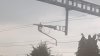
I think this has been explained before (I've done a search, couldn't find why) but those masts looks to be a mess of different sizes and heights. Why?
You're welcome.
To add to what others have posted - most of the masts along the line appear to be overheight in order to provide brackets for supporting the -25kV ATF wire. In the picture the short mast nearest the camera will carry an anchor boom which is used for terminating a set of wire lengths. There's another one the other side of the ATF station which has a bracket to support the boom already fitted. The other shorter masts will support the catenary and contact wires.
The set of overheight masts adjacent to the ATF station (I think there will be four on each side eventually) will support wires which run from the busbars on the ATF station transversely across the tracks (I think these are called 'drapes') and wires from these will feed vertically down to the catenary wires. This is how power is fed from the feeder and ATF stations into the OLE.
Prior to the new footbridge there are two overheight masts which are slightly set back from the track. Looking at other locations, I think these will terminate the ATF wire which is then fed down the mast in a thick insulated cable to ground level and then through trunking under the bridge. On the other side two similar masts will be installed for the reverse configuration.
It all looks rather confusing in the photo but if you travel between Didcot and Reading and look at the completed ATF stations at Cholsey and Pangbourne, the configuration becomes more clear - as does the arrangement for getting the ATF wire under bridges.