Kite159
Veteran Member
I'm surprised that Dalmuir hasn't been dropped as a call seeing as a 6 coach set is local door only and can cause large dwells.


Agreed!I'm surprised that Dalmuir hasn't been dropped as a call seeing as a 6 coach set is local door only and can cause large dwells.

NTMU Kyle!
The issue with the MkV formations would be the choice of motive power, there isn't anything with a suitable RA apart from the 37s although they would make very, very nice WHL sets.
Like James James post above I suggested a split HST system with stripped down ex156 units in the middle nose to nose. This would still enable the split at Crianlarich and feature plenty of cycle/baggage space/buffet in the ex156 driving coach. As usual this was subjected to bouts of laughter from the 'cant do' brigade when all your talking about is stipping down a 156 and converting it to HST phase supply and control desk. Expensive? Maybe but cheaper than custom built units surely by a long shot, it would at least give you decent train to be used for another 10-15 years. The issue with this is the woefully low tractive effort of the Class 43.
Another option which springs to mind is a push/pull emu system utilising the soon to be introduced 385s and heavily modified Class 73's. This gives the ability to use the units anywhere on the network and run them as emus south of Craigendoran. I would think the interior's would have to be customised though as the 385s are very spartan IMO, micro buffet/shop inplace of trolley, more luggage space. As for expense surely it could be part of the current 385 order and I can see Hitachi offering a few for free or heavily discounted prices due the the recent fiasco.
All of these suggestions are technically possible, anything that costs more than £100 seems to be regarded by some members as hideously expensive and therefore doomed to fail.
If you build them people will come otherwise no one is going to use a clapped out basic service that hasn't changed *cough* downgraded since 1989 especially now the dreaded BUS excels in terms comfort and timings!
The rail service in these areas should be used as a tool for improving the community, expanding tourism and other social benefits, not profit!
Maybe things will change in the future when my former employer Caledonian MacBrayne get the franchise

I think the answer is just get the Swiss in!
Oh and I see we share a former employer - maybe Calmac could take over the West Highland lines as a start - they are after all fairly self contained and there is a lot of ferry connection traffic despite the best efforts of the operators to make that as difficult as possible!
Mind you Calmac are going to have their hands full soon when the Glen Sannox/802 fiasco finally breaks! To be fair it's not really their fault.
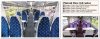
Here is one of the refurbished 156s although none of the WHL ones are done yet. Unfortunately ironing boards seats although personally I don't mind them.
Here is one of the refurbished 156s although none of the WHL ones are done yet. Unfortunately ironing boards seats although personally I don't mind them.
Platform : Current : FutureAt present Platforms 2,3,5,6 & 7 should be able to handle 7 car formations if memory serves.

This thread brings back waves of nostalgia! My father loved railways but my mother didn't. In 1958 he took me on a Scottish rail tour which included Mallaig-Glasgow and we took lunch in the dining car as we crossed Rannoch Moor. Main course was sole, and as we were the only diners we got excellent service. Father was quite excited because we were in an ex-LNER 3 carriage articulated set which seemed excessive even then. I suspect restaurant car service was withdrawn very soon after this. Maybe that was why we went. I don't recall many other passengers on that train, or from Inverness to Kyle of Lochalsh.
In those days a lot of empty coaches were being dragged around every day. No wonder Beeching had so much to say about uneconomic railways.
All the Highland lines are challenging to manage. If run non-stop from end to end they probably couldn't compete with road for speed. Tourism is very up and down, and weather doesn't help, however the Jacobite seems to load well.
This thread brings back waves of nostalgia! My father loved railways but my mother didn't. In 1958 he took me on a Scottish rail tour which included Mallaig-Glasgow and we took lunch in the dining car as we crossed Rannoch Moor. Main course was sole, and as we were the only diners we got excellent service. Father was quite excited because we were in an ex-LNER 3 carriage articulated set which seemed excessive even then. I suspect restaurant car service was withdrawn very soon after this. Maybe that was why we went. I don't recall many other passengers on that train, or from Inverness to Kyle of Lochalsh.
In those days a lot of empty coaches were being dragged around every day. No wonder Beeching had so much to say about uneconomic railways.
All the Highland lines are challenging to manage. If run non-stop from end to end they probably couldn't compete with road for speed. Tourism is very up and down, and weather doesn't help, however the Jacobite seems to load well.

Britain’s first rail carriages reserved for bikes and outdoor equipment are to run on one of Scotland’s busiest tourist lines from next summer, The Scotsman has learned.
An extra coach is expected to be coupled to ScotRail trains to ease overcrowding on the West Highland Line between Glasgow, Oban, Fort William and Mallaig.
A similar experiment may be tried on lines between Inverness and Kyle of Lochalsh and Wick.
Transport minister Humza Yousaf said the Scottish Government’s Transport Scotland agency was finalising work with ScotRail to secure five single-carriage class 153 trains.
These will be reconfigured to accommodate cyclists and their bikes, and other outdoor sports fans and equipment.

Though I qualify for a free coach trip, I wouldn’t go to Fort William by coach even if someone paid me for doing it.And it's much slower and less frequent than the coach, which is free to holders of Scottish bus passes.
 )
)A route planner from here (on the North Clyde Line) will almost always give Dalmuir as the place to change onto WHL: for the 1016 from Dalmuir, there's a Rutherglen to Balloch train that arrives at 1009; logically it'd make more sense to change at Dumbarton Central (because it's a same-platform interchange), but with the extra stops on the North Clyde train to there, it arrives only four minutes before the WHL train, under the five minute minimum connection time.I'm surprised that Dalmuir hasn't been dropped as a call seeing as a 6 coach set is local door only and can cause large dwells.
There's really not much point. 6 car trains on the North Clyde are more than sufficient, and given the tiny numbers that board WHL services at Dalmuir it would probably be better just not to call there. It's odd that the sleeper calls there too, virtually no one gets on or off that either.

I checked this one with my dad, who was all over the highlands in the period, and he reckons that the mk1 kitchen/restaurants may have lasted on the WHL until the end of the Class 27s on the route in late 1980/early 1981. So conceivably even until the mk1 sleepers went, which must have been about the same time as Class 37s took over.West Highland restaurant car service was longer lived. I seem to recall it survived into the early to mid-1970s - perhaps someone can confirm this. Worked up from Glasgow on the sleeper service, then did a round trip Fort William to Mallaig in the middle of the day, then back to Glasgow with the late afternoon service that included the southbound sleepers.
Pictures from 1968 of a Mk1 RB in trains on the West Highland Line here http://www.eastbank.org.uk/diamond.htm
Just returning to Fort William-Mallaig local trains, he says that at the time they were generally made up of, as well as a 27, a mk1 open second and an early mk2 corridor brake first. Even in high summer they weren't at all busy he says, what an appealing thought!
.
Thanks for that. I never realised. Personally, and this is way off topic, I think they should start a program of lengthening the N Clyde platforms - the station boxes at QS and Charing Cross are quite a bit longer so that the steam engines were outside.
A route planner from here (on the North Clyde Line) will almost always give Dalmuir as the place to change onto WHL