
• Our new ticketing site is now live! Using either this or the original site (both powered by TrainSplit) helps support the running of the forum with every ticket purchase! Find out more and ask any questions/give us feedback in this thread!

G'day from Sydney, Australia

Status
Not open for further replies.
Joined
31 Mar 2013
Messages
10
Location
NSW, Australia
G'day all!

I've lurked here for a while, so I thought it might be time to contribute to this board.

I'm a rail enthusiast based in Sydney, Australia, and take an interest in modern day workings around Sydney, as well as greater NSW. I have included some photos of some workings around NSW, giving a small insight into the operations of an Australian railway.

Provided here is but the smallest glimpse into the vast array of rail workings in NSW, which include 1500m superfreighters, tourist specials, regional passenger trains, local shunts, bulk wheat trains, containerised cotton, copper, and regional freight, as well as much more, far too many to list here. Below are a few hand picked examples of unique Australian workings.

Alco World series locomotives 4520 approaches Sheepwash Road, Calwalla
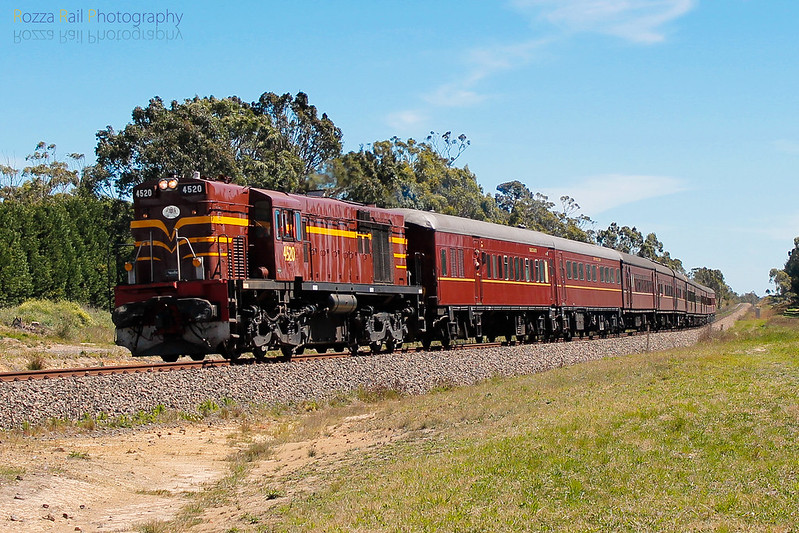
Southern Highlander @ Calwalla by Rozza Rail Photography, on Flickr

In this view, a 1963 Alco locomotive 4520 hauls an enthusiast's special, consisting of a motley assortment of preserved New South Wales Government Railways (NSWGR) rollingstock towards the town of Robertson, approximately 200km from Sydney by rail.
The train was supposed to have been hauled by a 36 class steam locomotive, however, in true Aussie style, 4520 was substituted at the last minute due to high winds and dry conditions increasing the bushfire risk, causing a total fire ban.

EL63, FreightLiner GL112, and 48s35 lead 1881 Auscott Cotton in Far West NSW
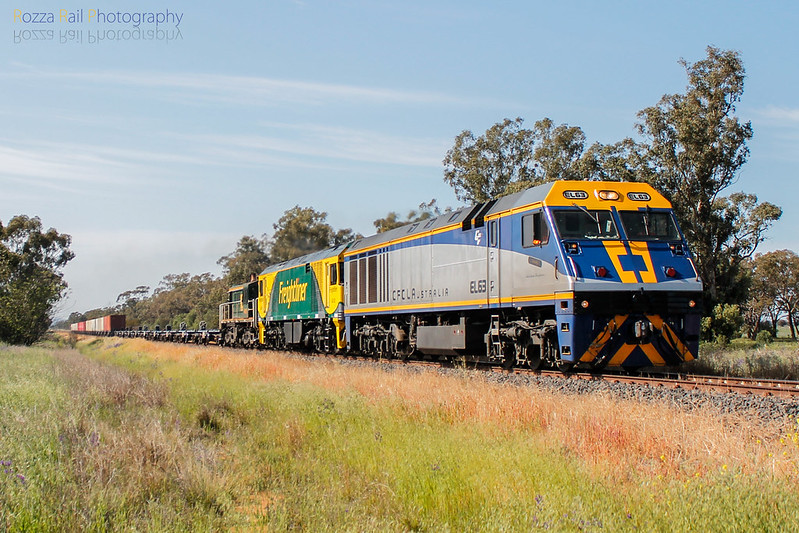
1881 Auscott's @ Ceres by Rozza Rail Photography, on Flickr

In this spring-time view, EL63, FreightLiner GL112, and vintage 1959-era Alco 48s35 are seen here in far western NSW with 1881 empty cotton train, destined for Auscott's cotton loader at Nevertire, NSW. The train is half loaded with empty containers, as the front half of the train was unloaded at Trangie, some 60km down the track.
The track here is dead straight for approximately 260 km's, with two bends. Far west NSW is noted for its flat terrain and ungodly hot summers, with temperature reaching over 40 degrees on a regular basis.

Outback Refuelling

EL63, GL112, 48s35 @ Nevertire Yard by Rozza Rail Photography, on Flickr
In Nevertire, NSW, 560km's west of Sydney by rail, EL63, GL112, and 48s35 have left their train on the mainline, and are idling in a dead end siding, whilst being refuelled. Due to the vast distances covered in Australia, makeshift solutions often come about to solve operational issues, such as the refuelling of EL63 from a mobile fuel service.

8934 Arcadia Copper Ore at Newbridge, NSW
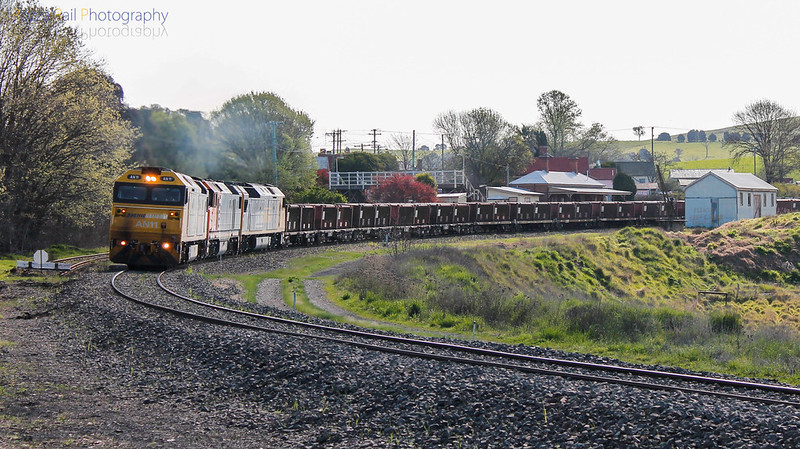
8934 @ Newbridge by Rozza Rail Photography, on Flickr

On the Main Western Railway, three Pacific National locomotives, AN11, DL49, and AN7 combine to haul 8934 Copper Ore from the Arcadia mine at Blayney, 250km's west of Sydney to the export unloader at Port Kembla, 150km's south of Sydney. Here, the train passes around a sweeping curve, on a 1 in 40 Sydney-bound descent, known as "Tumulla Bank".
The well-maintained Newbridge station sits disused in the background, a relic of days gone by. At the far left is a dead-end siding, which used to be part of the one-time double-track mainline, which was truncated into various passing loops following extensive budget cuts.

1815 Container service heads south through Tahmoor
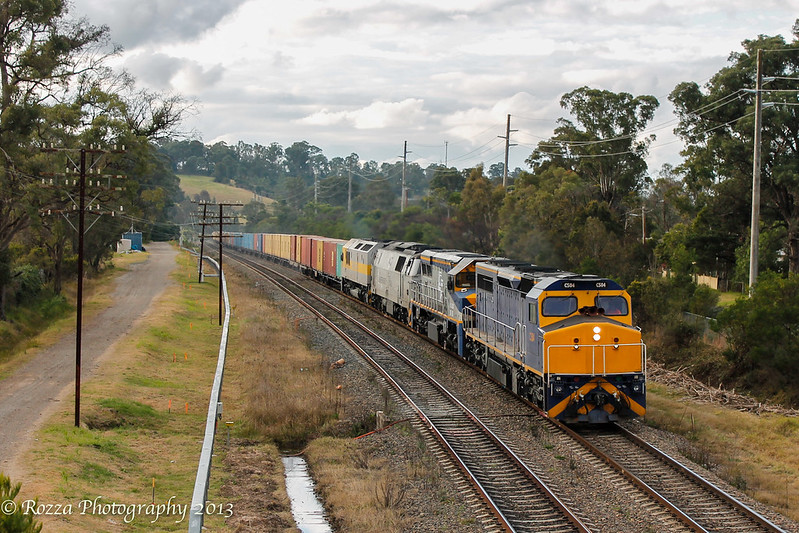
1815 roars south, led by C504, VL351, 1432, RL309 by Rozza Rail Photography, on Flickr

With four locomotives at the helm, each originating from a different state, 1815 container service heads south on the Main South Line through Tahmoor.
1815 is an especially notable service, as it travels from Port Botany, in Sydney, NSW, to Forbes, in far western NSW, via the Main South Line. Instead of taking the most direct route, via the Main Western Line, 1815 instead travels via the Main South Line to Cootamundra, before traversing the cross-country line north-west to Forbes.1815 traverses this route in order to avoid the famous 1 in 33 continuous compensated climb of the Blue Mountains, west of Sydney, as well as the 1 in 40 Tumulla Bank listed above.

[Heritage and overseas power combine at Port Botany[/b]

47's remembered by Rozza Rail Photography, on Flickr

4717, a 1970-era vintage locomotive, trundles slowly with an imported Dutch "MZ" class, 1432, toward Port Botany, Sydney's main export port, with Sydney International Airport in the background. This section of railway is exclusively used by freight services travelling to and from Port Botany, a mere mile down the track from here.

Feel free to comment and ask questions, I am more than happy to offer explanations and answers into the vast world of Australian railways :)
 
Sponsor Post - registered members do not see these adverts; click here to register, or click here to log in
R

RailUK Forums

steevp

Member
Joined
25 Jul 2012
Messages
247
Thanks RozzaDownunder - an interesting insight into "how the other half lives"
 

Matt Taylor

Established Member
Joined
31 Aug 2008
Messages
2,362
Location
Portsmouth
I was in NSW a few months back and took a trip up to Blackheath on the Blue Mountains line to visit my family, I managed a few shots of the Inter-City V sets but didn't get any time for more general rail photography which was pretty disappointing as it seemed to be a fairly busy line for freight. Hopefully next visit I'll get the chance, in the meantime here's a few from the journey up to Blackheath-a journey of around 70 miles which takes a bout 2 hours.

http://www.flickr.com/photos/40172673@N03/sets/72157633364274365/
 

jopsuk

Veteran Member
Joined
13 May 2008
Messages
12,774
The Freightliner livery is somewhat incongruous! Didn't realise they had an Aussie operation
 

Clip

Established Member
Joined
28 Jun 2010
Messages
10,821
Nice pictures there Rozza, will check your flickr too for more.

Enjoyed my time in Oz and travelling in NSW on the trains - the trip from Melbourne to Sydney was something else overnight too!

I will be back at some point
 
Joined
31 Mar 2013
Messages
10
Location
NSW, Australia
steevp said:
Thanks RozzaDownunder - an interesting insight into "how the other half lives"

No worries steevp, always nice to share an insight into the mind boggling world that is Australian railway.

Matt Taylor said:
I was in NSW a few months back and took a trip up to Blackheath on the Blue Mountains line to visit my family, I managed a few shots of the Inter-City V sets but didn't get any time for more general rail photography which was pretty disappointing as it seemed to be a fairly busy line for freight. Hopefully next visit I'll get the chance, in the meantime here's a few from the journey up to Blackheath-a journey of around 70 miles which takes a bout 2 hours.

http://www.flickr.com/photos/4017267...7633364274365/

Matt, the line to Blackheath is very scenic in places, however, if you really want a breathtaking ride, you've *got* to do Sydney-Newcastle on a V-set. For about 15kms, the line runs right on the very edge of Mullet Creek, and has a fantastic view across the river. The line then crosses the Hawkesbury River, and will leave you stunned.

As for freight on the Blue Mountains, it is no longer the preferred main line. The only freight that uses the Blue Mountains section of the Main West (through Blackheath), are coal trains, the copper ore train (the photo I posted from Newbridge), and the Dubbo freight. Everything else heading towards Perth or Adelaide will generally go via the Main South, and use a cross-country link to reach the Main West, to avoid the 1 in 33 grade.


Clip said:
Nice pictures there Rozza, will check your flickr too for more.

Enjoyed my time in Oz and travelling in NSW on the trains - the trip from Melbourne to Sydney was something else overnight too!

I will be back at some point

Thanks for that Clip, always trying to improve my photography.

Glad to hear you enjoyed your trip on the Melbourne-Sydney XPT, you're one of the few who does! The Melbourne XPT is famous for being cancelled at the slightest excuse due to trackwork issues all over the place, meaning you get shoved onto a bus at the most ridiculous hour, but enough about that :)

If anyone has any questions, feel free to ask :)
 

DownSouth

Established Member
Joined
10 Dec 2011
Messages
1,545
The Freightliner livery is somewhat incongruous! Didn't realise they had an Aussie operation
Freightliner Australia has two operations at this point: containerised cotton from northern NSW to Sydney, and the sub-contracted operation of Xstrata Rail's trains for the miner Xstrata.

All the locomotives and wagons used on the coal trains are new build stock owned by Xstrata Rail (a common tactic now to avoid rail operators holding the miners hostage during contract negotiations) while the gear used for the cotton is all leased with only two locomotives painted into FLA livery for publicity purposes.
New liveries are no longer a novelty in Australia, with privatisation, new operators popping up and dropping off is the norm nowadays.
And it's never been a better time for freight on rail in my opinion!

Numerous lines are getting upgrades to lengthen passing loops and increase signalling capacity, and operators are buying new 3300kW locomotives as fast as the manufacturers can pump them out. The need to maximise capacity is leading to some interesting technology getting deployed including electronically-operated brakes on freight wagons, the routine use of tanker wagons for refuelling locomotives on the go, and radio-controlled distributed traction on the standard gauge mainline for the first time.

The only thing to complain about is the dominance of mostly two main types of loco among most of the new orders, but there's still plenty of variety with locos up to nearly sixty years old still in daily operation as operators sweat their assets while waiting for new orders to come.


I live in Adelaide where we currently have a massive rebuild project going on to convert the first of our four diesel-only passenger lines into the most modern line in the nation with 25kV electrification, full ERTMS Level 1, a spectacular 1.2km (0.75mi) bridge over the whole width of a river estuary and the first fourth-generation EMUs in Australia. I'll try and get some pictures of the ongoing works soon, and maybe some freight snapshots as well - I'm a keen cyclist so chasing a freight train to get multiple photos on the Adelaide Hills section of the Adelaide-Melbourne interstate route is always a good challenge!
 

Clip

Established Member
Joined
28 Jun 2010
Messages
10,821
Matt, the line to Blackheath is very scenic in places, however, if you really want a breathtaking ride, you've *got* to do Sydney-Newcastle on a V-set. For about 15kms, the line runs right on the very edge of Mullet Creek, and has a fantastic view across the river. The line then crosses the Hawkesbury River, and will leave you stunned.


Thanks for that Clip, always trying to improve my photography.

Glad to hear you enjoyed your trip on the Melbourne-Sydney XPT, you're one of the few who does! The Melbourne XPT is famous for being cancelled at the slightest excuse due to trackwork issues all over the place, meaning you get shoved onto a bus at the most ridiculous hour, but enough about that :)

If anyone has any questions, feel free to ask :)

Ha ha yeah I did hear about the issues they sometimes have..

Done that trip highlighted and we were walking along somewhere and heard a steam train but couldnt get to a good view so all I saw was smoke. But a beautiful scenic trip to do
 
Joined
31 Mar 2013
Messages
10
Location
NSW, Australia
What would normally be the heaviest freight service in normal patterns and what locomotives are scheduled to haul this train.
Heaviest freight service in normal patterns would be Hunter Valley Coal trains (trains running from the coalfields of the Hunter Valley to Newcastle [Pt Waratah]), weigh in the vicinity of ~9,000 tonnes, and are nowadays mostly hauled by brand-new C44ACi locomotives, which pump out about 4,500HP and are often used in pairs or threes.

More info about them can be found here ->http://en.wikipedia.org/wiki/UGL_Rail_C44aci

I don't go photographing in the Hunter very much, as coal trains seem one and the same to me as most coal (and intermodal for that matter) are built to very similar carbody designs, no matter who they're being built for.
 

Gordon

Member
Joined
11 Feb 2011
Messages
1,128
Location
Surrey
It is a while since I followed this subject, but as far as I know the heaviest regular trains in the world are still those on the Pilbara mineral railways in Western Australia. They are regularly around 40,000 tonnes.

BHP once ran a train which grossed 99,000 tonnes


.
 

DownSouth

Established Member
Joined
10 Dec 2011
Messages
1,545
Heaviest freight service in normal patterns would be Hunter Valley Coal trains (trains running from the coalfields of the Hunter Valley to Newcastle [Pt Waratah]), weigh in the vicinity of ~9,000 tonnes, and are nowadays mostly hauled by brand-new C44ACi locomotives, which pump out about 4,500HP and are often used in pairs or threes.

More info about them can be found here ->http://en.wikipedia.org/wiki/UGL_Rail_C44aci

I don't go photographing in the Hunter very much, as coal trains seem one and the same to me as most coal (and intermodal for that matter) are built to very similar carbody designs, no matter who they're being built for.
You might be surprised to learn that you're wrong - since January this year the heaviest trains outside the Pilbara lines are actually in South Australia, on the same mixed traffic lines also used by the passenger trains of The Ghan and the Indian-Pacific.

These trains up to 15,400 tonnes gross (up to 11,360 tonnes net) and 1,750 metres long are operated by Genesee & Wyoming Australia for the miner Arrium. These trains carry haematite (a particularly high-grade iron ore) originally from the Peculiar Knob mine that is loaded at the Wirrida balloon loop (inside the Woomera Prohibited Area) to Arrium's unique dual-gauge unloading loop (serving the standard gauge mainline and the 1067mm 'local' routes) at the port of Whyalla.

The Peculiar Knob trains currently have two consists on overlapping schedules, each made up of:

2x GWU Class or GWA Class locomotives - the GWU is a GE-powered UGL Rail C44ACi variant while the GWA is an EMD-powered Downer EDI Rail GT46C ACe variant, both have inline refuelling and electro-pneumatic braking capabilities.
1x container flat with diesel tanks to supply the front locomotives.
1x crew rest van, converted from an old South Australian "Bluebird" DMU originally built in the mid-late 1950s.
80x 2-pack ore hoppers equipped with electro-pneumatic brakes - the tare weight alone of this rake is 3,216 tonnes!
2x GWU Class or GWA Class locomotives.

... which in practice looks like a big orange snake! See here - http://www.youtube.com/watch?v=120NIz3Fvg0

The two pairs of locomotives are necessary to provide enough power for the train, and they are spread out for both better train handling and making the reversal move convenient. The 'rear' pair lead from Whyalla to the reversal at the end of the Whyalla Branch (Spencer Junction yard, just outside Port Augusta) and then get shut down for most of the empty run to be reactivated only when the train is loaded. The front pair lead all the way to Wirrida, around the loop and back to Spencer Junction, which is why they get inline refuelling tanks and the rear pair don't.

The crew van is necessary to carry sleeping facilties for a second crew because it takes 33 hours (about six hours in passing loops on the low-priority empty run) for the train to head north from Spencer Junction to Wirrida, spend eight hours loading in the loop at Wirrida and then return south. Yes, that is both crews doing two shifts!
 

LesS

Member
Joined
24 Apr 2012
Messages
203
Location
Sydney
Clip
The Coutrylink trains were never fitted out for overnight travel, except in sleeping compartments. The overnight situp is really for backpackers travelling on the cheap.

The two most scenic lines out from Sydney are north to Gosford/Newcastle as noted, but also the South Coast line to Wollongong and Kiama. The variety on this line is astounding including clifftop by the ocean as well as National Park and beachside. Kiama is probably the best destination for a dayout from Sydney.

The Hunter Valley coal trains are easy to see being a 2-3 hour train ride from Sydney. They run with the frequency of trams.
 

DownSouth

Established Member
Joined
10 Dec 2011
Messages
1,545
Something that could be a little interesting for anybody with a bit of time to spare - a cab ride video from the inner suburbs of Adelaide filmed in January this year. The trip is aboard PL1, a dilapidated old AlCo switcher which spends its days pottering around the Adelaide Parklands Terminal which is the home of our two transcontinental trains - The Ghan and the Indian-Pacific.

The journey is a light engine move from the APT yard to the 'motive power centre' depot at Dry Creek.

The first section features the demolition phase of a complete track rebuild to the right of screen (which now has new track with some DMUs running again and electrification/signalling works taking place) on the broad gauge suburban network.

At a number of spots mostly near the start and end you'll get a particularly good view of a distinctive feature of Australian railways in the major cities - dual gauge points where the standard gauge interstate network and Cape (1067mm) or Victorian (1600mm) gauge local networks meet*. At the National Rail Museum in Port Adelaide you can even see some triple-gauge track and junctions, as had to exist at a number of South Australian junction stations in the past.

[youtube]HoMZl5RBIOE[/youtube]


* The gauge chaos all started in 1851 when the colonies all agreed that all railways would be 1600mm at the convincing of an Irish engineer working in Sydney, and so the three short tramways built with 1435mm tracks up to that point were converted. When said engineer ran out of job satisfaction and went home in 1854, the New South Wales people were persuaded by an English engineer to switch over to standard gauge but not before the colonies of South Australia and Victoria had already started building lots of lines to 1600mm. The world's longest passenger platform at Albury (NSW) was a result of this when the two states were linked.

Things then got even sillier later in the 19th century when new lines started being built on the cheap using 1067mm Cape Gauge, which led to there being a couple of triple-gauge stations in South Australia.

These days the major cities are all linked by standard gauge, but that hasn't solved everything.
 

Lukeo2311

Member
Joined
10 Nov 2011
Messages
72
Location
Canberra ACT Australia
G'day from Canberra :), nice to see an Aussie on here (I'm british but I have dual citizenship! Here in Canberra we have 3 trains a day! to Sydney and 3 back from Sydney
 
Joined
31 Mar 2013
Messages
10
Location
NSW, Australia
Something that could be a little interesting for anybody with a bit of time to spare - a cab ride video from the inner suburbs of Adelaide filmed in January this year. The trip is aboard PL1, a dilapidated old AlCo switcher which spends its days pottering around the Adelaide Parklands Terminal which is the home of our two transcontinental trains - The Ghan and the Indian-Pacific.

Nice vid there, never been to SA. :)
On a sad note, the PLs are slowly disappearing (if not already), all the Pelton coal units (Pelton being in the aforementioned Hunter Valley Coalfields for those overseas) have been withdrawn, and I'm unsure as to whether scrapping has begun.

These days the major cities are all linked by standard gauge, but that hasn't solved everything.
Not even close to solving everything. Yes, we have standard gauge to all mainland capital cities, however, the quality of those links in places leaves a lot to be desired. Sydney to Melbourne runs on very winding 19th and 20th century alignments and grade-easing deviations, and is consequently something like 150km than the road equivalent, the Hume Highway, which is a dual carriage way freeway all the way to Melbourne. Same with the North Coast, runs on very indirect, winding, steeply graded routes.

Both routes, as the Melbourne-Brisbane corridor, are lacking alot when it comes to a useful transport corridor: it's not direct, it's standard is lacking in places (especially on the Main South), and it's competing against a mode of transport which has far superior alignments, far fewer legislative barriers, and far more public support. But I digress. :)
 

DownSouth

Established Member
Joined
10 Dec 2011
Messages
1,545
PL1 certainly does a good enough job as the APT shunter, for a loco rated at a piddly 780 kW (we have DMU power cars in Adelaide with more than that each!) and probably putting out much less than that in reality it's a perfect last pre-retirement posting now that the mainline railway has moved on to big 3000+ kW locos.

You'd have to say that after a career of 54 years as first the NSWGR 48 Class and then as the rebuilt PL versions that they've had a good run to last that long while other classes have come and gone in that time. The same applies to the near-identical SAR 830 Class (the staff exchanger was on the opposite side) of the same age which are still to be found in daily use across four states and on all three gauges. Some even still have the old Australian National livery with GWA having done nothing more than paste scruffy decals on top...

20081003-843-841-831-dry-crk-sa-jh.jpg


When PL1 is getting serviced at Dry Creek (which is fairly often now) the loco that Pacific National bring in to shunt at APT is usually 8122 from the Leigh Creek coal train pool, which just looks stupid! Being a full-width carbody design makes it obscenely unsuitable for use as a depot/terminal shunter, but these days PN can't afford to free up a 3000+ kW loco like a NR Class for that job like National Rail used to in the 90's.

Yes, we have standard gauge to all mainland capital cities, however, the quality of those links in places leaves a lot to be desired. Sydney to Melbourne runs on very winding 19th and 20th century alignments and grade-easing deviations, and is consequently something like 150km than the road equivalent, the Hume Highway, which is a dual carriage way freeway all the way to Melbourne. Same with the North Coast, runs on very indirect, winding, steeply graded routes.
That reminds me, do you know if ARTC are still having massive problems with mudholes on the Seymour to Albury section of the North-East Line?

ARTC were using a new ballast cleaner in the Adelaide Hills earlier this year but it was rumoured that was only to give the machine a shakedown trial before it got sent to Victoria to fix their issues there.
 
Joined
31 Mar 2013
Messages
10
Location
NSW, Australia
PL1 certainly does a good enough job as the APT shunter, for a loco rated at a piddly 780 kW (we have DMU power cars in Adelaide with more than that each!) and probably putting out much less than that in reality it's a perfect last pre-retirement posting now that the mainline railway has moved on to big 3000+ kW locos.

Very true. However, I am somewhat surprised the Pelton PL's were scrapped, as they would have been ideal replacement units for the 48's currently in service on Western NSW grain work, PLs having of course been refurbished circa-1997 with much better forward vision.


When PL1 is getting serviced at Dry Creek (which is fairly often now) the loco that Pacific National bring in to shunt at APT is usually 8122 from the Leigh Creek coal train pool, which just looks stupid! Being a full-width carbody design makes it obscenely unsuitable for use as a depot/terminal shunter, but these days PN can't afford to free up a 3000+ kW loco like a NR Class for that job like National Rail used to in the 90's.

I'd be inclined to disagree about the 81's as shunting units, as they are regularly used (and apparently favoured) in Port Kembla as shunters for SteeLink services, apparently due to their full-width cabs offering a better view than say, the previous D class shunters. 8102 and one other are captive in Port Kembla specifically for that purpose. I do realise it isn't the same as Passenger Terminal shunting, however, there are 81's about that are used exclusively for shunting


That reminds me, do you know if ARTC are still having massive problems with mudholes on the Seymour to Albury section of the North-East Line?

Can't really say, as I haven't been down that way since the problems first appeared.
 
Last edited:

LesS

Member
Joined
24 Apr 2012
Messages
203
Location
Sydney
I had lunch today with a group of old railfan friends, some of them still working with various operaters. The Main South line came up for discussion.

About 9 months ago when I did a return to Melbourne it was in good condition with some very fast running. I am told today that mudholes have begun to reappear. They are reported to be in some strange places in NSW. The reports are that the situation is worse in Victoria. The whole issue is puzzleing as the weather has been mostly dry and very little by way of heavy rai.

The feeling at lunch was one of despair that the engineers have been unable to get these problems fixed and kept fixed.

A new timetable will commence on sunday for the passenger service. It continues to show 11 hours for southbound and 11.5 hours northbound. No doubt there is a considerable time built in to allow for delays due to such defects as mudholes.
 

Addington

Member
Joined
4 Sep 2009
Messages
52
Location
Sydney, Australia
Privatising the freight operations in most of Australia has turned freight movements into something far more interesting, with engines from most states travelling all over the country.

Originally I was into stills and video, but in the last five or so years have moved over to audio. After spending a week on the Central Western lines in NSW in September, I managed to record ANs and DLs from South Australia on the Cadia Ore train, WA L classes on Manildra Wheats, with Victorian G and X classes floating around. With the right conditions, you can hear these trains working for 40 or more minutes.

Whilst the alignments in NSW are dreadful by a modern day standard, for the rail enthusiast at least they and audibly and visually great!
 

Matt Taylor

Established Member
Joined
31 Aug 2008
Messages
2,362
Location
Portsmouth
Are there any realistic plans for high speed rail in Australia, it seems to me that the country is well suited to it given some of the vast distances involved? Flying from Melbourne to Sydney seems like a no brainer when it takes just an hour and has a very frequent service provided by both Virgin and Qantas meanwhile the one train a day takes 11 hours and is effectively the same distance as London to Edinburgh which takes half the time and has an hourly service generally. Likewise coastal services north to Brisbane and Cairns could easily be far more appealing if high speed rail was adopted.
 

Addington

Member
Joined
4 Sep 2009
Messages
52
Location
Sydney, Australia
Are there any realistic plans for high speed rail in Australia, it seems to me that the country is well suited to it given some of the vast distances involved? Flying from Melbourne to Sydney seems like a no brainer when it takes just an hour and has a very frequent service provided by both Virgin and Qantas meanwhile the one train a day takes 11 hours and is effectively the same distance as London to Edinburgh which takes half the time and has an hourly service generally. Likewise coastal services north to Brisbane and Cairns could easily be far more appealing if high speed rail was adopted.

There is talk of it....yet again. The NSW Premier would like Sydney's second airport to be in Canberra, with High Speed Rail linking the two cities. The grand plan is to link Sydney and Melbourne, then Sydney with Brisbane. I would cost billions and take decades.

Given previous studies and proposals have come to nothing, I dont think the duopoly of Qantas and Virgin have anything to worry about for the foreseeable future!
 

DownSouth

Established Member
Joined
10 Dec 2011
Messages
1,545
Are there any realistic plans for high speed rail in Australia, it seems to me that the country is well suited to it given some of the vast distances involved? Flying from Melbourne to Sydney seems like a no brainer when it takes just an hour and has a very frequent service provided by both Virgin and Qantas meanwhile the one train a day takes 11 hours and is effectively the same distance as London to Edinburgh which takes half the time and has an hourly service generally.
There are lobby groups which support the development of a proper high speed corridor from Sydney to Brisbane (straight line distance of 730km) and Sydney-Melbourne (770km).

A detailed feasibility study was released earlier this year into building a 1750km Brisbane-Sydney-Canberra-Melbourne route which would also serve 11 major regional centres along the way. It basically found that it would be one of the world's biggest megaprojects ever, extremely expensive, to compete with air would require building to higher-than-LGV standards for 380-400km/h cruising speeds, and it would take up to five decades to build in five stages. Before you laugh at the construction timeframe, that's equivalent to building (from scratch and including all associated facilities, no half-baked upgrades to existing lines) half a London-Glasgow route every ten years and maintaining a construction rate well over double that of Britain's HS1, all through terrain going up to 500m higher than the tallest peak in the whole of the UK.

There is also a major political issue as well, if it was fully funded by the Commonwealth parliament every person in the country would be hit with a $5300 bill regardless of whether they'll ever get to enjoy even a single benefit from the project. The timeframe from first shovel to revenue service will simply be way too long for private investors to get involved, not when the whole thing could be cancelled due to political winds changing or changes in economic circumstances.
Likewise coastal services north to Brisbane and Cairns could easily be far more appealing if high speed rail was adopted.
Brisbane-Cairns already has the QR Tilt Train running on the North Coast line (an upgraded classic line, not a true high speed line) at 160km/h already. The electric version runs only as far as Rockhampton (638km, about the same length as the ECML to Edinburgh and WCML to Glasgow) while the diesel version runs to Cairns (1680 km).

The benefit from these services is actually more to the regional centres served along the way rather than end-to-end trips. Brisbane-Cairns would not be competitive even if they had a fairly direct route capable of the same average speed as the fastest non-stop Eurostar service, it would still be over nine hours long compared to under three from city centre to city centre by air.
 
Joined
31 Mar 2013
Messages
10
Location
NSW, Australia
Are there any realistic plans for high speed rail in Australia, it seems to me that the country is well suited to it given some of the vast distances involved? Flying from Melbourne to Sydney seems like a no brainer when it takes just an hour and has a very frequent service provided by both Virgin and Qantas meanwhile the one train a day takes 11 hours and is effectively the same distance as London to Edinburgh which takes half the time and has an hourly service generally. Likewise coastal services north to Brisbane and Cairns could easily be far more appealing if high speed rail was adopted.

As it currently stands, the occasional talk that does crop up about high-speed rail is usually a pie-in-the-sky pork barrelling election promise.

The current focus with the infrastructure that exists is geared toward improving freight transit times and reliability: resleepering, ballast cleaning, signalling upgrades.

This ha been demonstrated by the Southern Sydney Freight Link, and the Northern Sydney Freight Corridor, designed to provide a separate track for freight to avoid the majority of high-frequency commuter services, and give a dedicated right of way. Previously, Melbourne Brisbane superfreighters and commuter trains shared the same tracks in the Sydney suburban area (except for a short freight-only section built in the 1920's), meaning that freight had to wait until after the peak periods had finished before entering the suburban network. Now, with the construction of the dedicated freight links through the Sydney region, freight now passes more freely through the suburban area.

Currently there is little regard for improvement to passenger transit times, all works are geared towards improving freight transit times.
 
Status
Not open for further replies.

Top