DelW
Established Member
- Joined
- 15 Jan 2015
- Messages
- 5,994
No problem, I've done the same myself in the pastOh god, of course, got myself very muddled there, sorry!
 .
.
No problem, I've done the same myself in the pastOh god, of course, got myself very muddled there, sorry!
.A 500hp loss not biggest problem especially as an AC drive will make that even less of an issue. Outright power only needed if the trailing load needs to go fast so expect 2750hp with an AC drive will maintain 75mph with little difficulty. As more of the system becomes electrified it becomes even less significant.What is the fuel tank capacity on the 99s as I imagine that will be a considerable factor on where these end up on diesel mode. Also the loss off 550hp is no small thing....whether the modern internals of the 99s offset that we will have to see.
Not so sure it is an issue. Don't some operators already fuel at selected locations ? Just need to arrange a bunded fuel tank on the site for topping up. How long do diesels currently stand around waiting for the trains to be tipped or stripped and reloaded ?What is the fuel tank capacity on the 99s as I imagine that will be a considerable factor on where these end up on diesel mode. Also the loss off 550hp is no small thing....whether the modern internals of the 99s offset that we will have to see.
Thanks for that Del. I am guessing the EMD design has changed the basics from the video of the GE ES44C4 posted upthread where the air cylinders lifted the centre bogie wheelset on the AC44.Just a minor point, the EMD 4-motor design (SD70ACE-P4) has the two innermost axles unpowered, so is B1-1B in US parlance, not A1A-A1A.
I have to admit that I've no idea what EMD's rationale is for choosing their layout. I can't think of any other designs that use it, though that doesn't mean that there isn't something somewhere that does.Thanks for that Del. I am guessing the EMD design has changed the basics from the video of the GE ES44C4 posted upthread where the air cylinders lifted the centre bogie wheelset on the AC44.

Did GE have some sort of patent/IPR on the A1A-A1A with weight adjustment kit, so EMD went for Bo1-1Bo to avoid any issues?I have to admit that I've no idea what EMD's rationale is for choosing their layout. I can't think of any other designs that use it, though that doesn't mean that there isn't something somewhere that does.

That's always been my assumption too, but based on this comment from an old post on the Trains magazine forum it's probably not the main reason:Did GE have some sort of patent/IPR on the A1A-A1A with weight adjustment kit, so EMD went for Bo1-1Bo to avoid any issues?
It's a bit moot anyway, since EMD/Progress Rail have only sold/leased out a relative handful of SD70ACe-P4 & SD70ACeP4-T4 (about 25 in total?) versus GE/Wabtec selling over 1500 of their equivalent.Also, from Tom Mack on loco notes:
It has to do with the design of the EMD HTC and HTC-R truck. When the truck flexes under load (torque) you actually get better adhesion with the B1 design vs. A1A on this particular truck.
Also, note that the wheel arrangement would be as stated in the Trains magazine article, B1-1B, not B1-B1 as stated in some earlier posts. This is because all the traction motors face inward toward the fuel tank on EMD C-C locomotives using the HTC and HTC-R trucks. So it is the inboard motor that is removed to create the B1 truck, and since the trucks mount in opposite directions at each end of the locomotive you get a B1-1B wheel arrangement.
It might hold 75mph no problem on the reasonably flat, but it'll take longer to get to 75mph and be slower on climbs - the AC-drive improves the low speed acceleration/hill climbing ability, but with only 2750hp on diesel it'll reach the power-limited part of the tractive effort curve at quite low speed. On the basis of the figures I've seen, the AC-drive might gain you about 5% in efficiency, which is only about 140hp - almost insignificant, really.A 500hp loss not biggest problem especially as an AC drive will make that even less of an issue. Outright power only needed if the trailing load needs to go fast so expect 2750hp with an AC drive will maintain 75mph with little difficulty. As more of the system becomes electrified it becomes even less significant.


Shap-Tuebrook-Ashton stone.Getting back to the Class 99s, which freight flows do people think they will be most used? The 500kN tractive effort means they can handle the heaviest quarry trains, but with a power output of 6MW under the wires I'd expect them to come into their own up gradients like Beattock and Shap etc. where I understand slow freights cause all sorts of timetabling issues with faster passenger trains on a electrified twin track lines. By how much would capacity be increased on the Northern WCML if all the freights were using electric power?

I reckon the sleeper would be a good place to put them.Getting back to the Class 99s, which freight flows do people think they will be most used? The 500kN tractive effort means they can handle the heaviest quarry trains, but with a power output of 6MW under the wires I'd expect them to come into their own up gradients like Beattock and Shap etc. where I understand slow freights cause all sorts of timetabling issues with faster passenger trains on a electrified twin track lines. By how much would capacity be increased on the Northern WCML if all the freights were using electric power?
I reckon the sleeper would be a good place to put them.
I reckon the sleeper would be a good place to put them.
Well a further order that includes 100mph versions for the sleeper wouldn't go amiss.A 75mph loco isn't what the sleeper needs.
Not necessarily, considering they are bi-modes. It'd be a good test of their viability on such routes with both long runs under and without wires.They are freight locos for freight work, sleeper duties would be a criminal waste of their availability
Well a further order that includes 100mph versions for the sleeper wouldn't go amiss.
Not necessarily, considering they are bi-modes. It'd be a good test of their viability on such routes with both long runs under and without wires.
It’s such an easy mistake to make, I mean I’m always confusing Canada with Sweden. They’re both cold aren’t they?A news article in June Modern Railways says the Class 99 diesel engine will be a Cummins QSK50 rated at 1800kW (2413hp). The article says it's a V12, but according to Cummins the QSK50 is a V16...
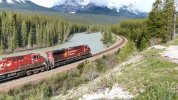
Incidentally, this brochure about rail applications for the QSK50 has an entertaining major error in the caption for one of the pictures - https://mart.cummins.com/imagelibrary/data/assetfiles/0032208.pdf - see if you can spot it

So it is Sweden (maybe) but they spell litres the North American way.A news article in June Modern Railways says the Class 99 diesel engine will be a Cummins QSK50 rated at 1800kW (2413hp). The article says it's a V12, but according to Cummins the QSK50 is a V16...
Incidentally, this brochure about rail applications for the QSK50 has an entertaining major error in the caption for one of the pictures - https://mart.cummins.com/imagelibrary/data/assetfiles/0032208.pdf - see if you can spot it
So quite a bit less diesel power than a Class 66 (2460kW at the engine), but more tractive effort (500kN vs 409kN). 6000kW under the wires. These are going to be pretty impressive locomotives!the Class 99 diesel engine will be a Cummins QSK50 rated at 1800kW (2413hp)
The location of the Cummins brochure photo on page 3 is 'Morant's Curve' east of Lake Louise, AB in Western Canada (named after a photographer who took a lot of publicity shots there for Canadian Pacific years ago). The loco in the photo is a GE/Wabtec product (an AC4400CW or ES44AC) - definitely not powered by a QSK50 !So it is Sweden (maybe) but they spell litres the North American way.
They didn’t photoshop out the number board on the far side, which identifies it as an ES44AC.The location of the Cummins brochure photo on page 3 is 'Morant's Curve' east of Lake Louise, AB in Western Canada (named after a photographer who took a lot of publicity shots there for Canadian Pacific years ago). The loco in the photo is a GE/Wabtec product (an AC4400CW or ES44AC) - definitely not powered by a QSK50 !
Thanks - the number is 8792? (also zooming in a lot shows the radiator 'wings' to be the ES44 version - my usual 'spotting' differentiator, as they change thickness part way along)They didn’t photoshop out the number board on the far side, which identifies it as an ES44AC.
At 6MW on electric, they'll be most powerful locos on the NR network. Some of the Chunnel shuttle locos are more powerful at 7MW, but they are essentially captive to that system.So quite a bit less diesel power than a Class 66 (2460kW at the engine), but more tractive effort (500kN vs 409kN). 6000kW under the wires. These are going to be pretty impressive locomotives!
(By comparison, the Class 93 is a lightweight: 1300kW with battery assist on diesel, and 4000kW under the wires. I wonder how they will compare on running costs?)
So how fast will they be able to pull heavy stone trains up electrified gradients like Shap, Beattock, Lickey etc.?At 6MW on electric, they'll be most powerful locos on the NR network.
Is the OHLE upto the job? Might they be restricted to only one each way between feeders on tjw WCML. Would the ECML cope at all with a 6MW loco?So how fast will they be able to pull heavy stone trains up electrified gradients like Shap, Beattock, Lickey etc.?
EDIT: On a 1% gradient, a 1000T intermodal will need a drawing force of 10T=100kN to maintain speed. So these should be able to keep to line speed.
A 2000T train on a 2% gradient will need 400kN. Which at 6MW is 15m/s = 33mph. (Ignoring rolling and wind resistance and transmission losses.) Lickey is 2.65%.
An 11 car Pendolino is about the same power rating (and 2 x 5-car IET is probably only a bit less) so I'd guess they'd be OK, and they're not due until 2025 by which time hopefully the ECML power upgrades will be completed?Is the OHLE upto the job? Might they be restricted to only one each way between feeders on tjw WCML. Would the ECML cope at all with a 6MW loco?
Dunno. But at least NR have a reason now to start upgrading the wires if necessary. And it's a lot cheaper to add OHLE capacity rather than quadding the WCML over Shap if they want to add more paths to a congested railway.Is the OHLE upto the job?
For which freight flows, and how many freights per hour?And a good reason to bring forward any plans to electrify Kidderminster to Dorridge up the Old Hill bank.
I understood from the Class 93 thread that the Wentloog-Daventry Tesco service is often routed that way, instead of up the Lickey incline. I can't quote it, as that thread is closed to further entries.For which freight flows, and how many freights per hour?
Not many, Old Hill tunnel is severely route restricted. Standard containers on Mega Frets are restricted to 5 or 15 mph on the Up line and I don't think standard containers can be conveyed on anything but a low deck flat wagon. Restricted what can be sent up that route. Think the down line won't even accept standard containers on Mega Frets as if the Tesco liner can't go down the Lickey Bank it goes via Crewe and Shrewsbury.For which freight flows, and how many freights per hour?
Well spotted.They didn’t photoshop out the number board on the far side, which identifies it as an ES44AC.
I understood from the Class 93 thread that the Wentloog-Daventry Tesco service is often routed that way, instead of up the Lickey incline.
I doubt it would make any real difference - irrespective of the length of the electrification, you still have to provide (considerable) power to it, so an isolated length of electrification for a few miles of gradient would be pretty expensive to implement.I'd rephrase to say the Class 99 could add to the business case to electrify steep gradients, where there are no wires at present, and where slow freights use up capacity in the network. The Dore South curve would fit that description on the MML.