• Our new ticketing site is now live! Using either this or the original site (both powered by TrainSplit) helps support the running of the forum with every ticket purchase! Find out more and ask any questions/give us feedback in this thread!

Freight train derailment caught on live stream - Pennsylvania, USA

DelW

Established Member
Joined
15 Jan 2015
Messages
5,934
Yes. I've visited that area twice, and not seen any mid-train helpers, but rear (and sometimes front as well) manned helpers were commonplace on the heavier trains.

Anyone know if the train in question had helpers on the rear or not?
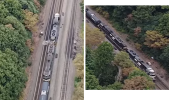
There was a drone video on YouTube (which I can't now find), taken soon after the event, which showed two engines on the rear. As far as I could tell, they looked like the usual manned helper set of two SD70ACEs back to back. I assume that they were the engines that removed everything downhill of the derailed cars quite early on in the clean up operations.
 
Sponsor Post - registered members do not see these adverts; click here to register, or click here to log in
R

RailUK Forums

ac6000cw

Established Member
Joined
10 May 2014
Messages
3,882
Location
Cambridge, UK
There was a drone video on YouTube (which I can't now find), taken soon after the event, which showed two engines on the rear. As far as I could tell, they looked like the usual manned helper set of two SD70ACEs back to back. I assume that they were the engines that removed everything downhill of the derailed cars quite early on in the clean up operations.
This video maybe?:


The description on that video outlines what I also suspect caused the string-lining (unintentional emergency brake application in the rear part of the train, which stops quickly, with the front part still moving due to momentum and the lead locos still pulling hard until the brake application propagates all the way along):
In the afternoon of August 11, 2026, Norfolk Southern 33A departed Altoona, PA with a long cut of steel slabs on the head end of the train. While the train was organized relatively correctly, with all the weight at the front and empties on the rear, it was disproportionate. As it rounded the Horseshoe Curve, at approximately 3:23 PM, the emergency brakes applied, sending a shockwave through the train. The empty, rear half of the train stopped almost immediately, while the heavy steel kept rolling. This short chain reaction ended up string lining 12 cars through the apex of the curve.

I was trackside once (at the summit of CSX's ex-B&O Sandpatch Grade) when a train went into emergency braking - I can still recall the sound of it propagating along the train as a series of load 'Pssts' as each car vented the brake line - to help the application propagate as fast as possible - followed by the noise of the heavy braking and slack run-in, then everything went quiet. Unfortunately when it happened the train was traversing a crossover between the two main tracks, so it stopped blocking them both for over an hour... see my video (from 19 years ago), from the 2:12 point:


Re. the CTE stuff, this is an interesting thread on Trainorders.com (in UP-speak, note the use of SD40-2 equivalent powered axle counts e.g. a C44AC counts as 12 equivalent axles) - https://www.trainorders.com/discussion/read.php?1,1708016

(UP C44AC = GE AC4400CW, C45AC = ES44AC, not mentioned but I think my namesake would be a C60AC on UP)
 
Last edited:

najaB

Veteran Member
Joined
28 Aug 2011
Messages
33,588
Location
Scotland
I can still recall the sound of it propagating along the train as a series of load 'Pssts' as each car vented the brake line - to help the application propagate as fast as possible - followed by the noise of the heavy braking and slack run-in, then everything went quiet.
This delay could easily be mitigated by electronically activated brakes, but US railways have declined to move to this system as I suppose it's cheaper to pick up the occasional derailed train instead.
 

Taunton

Veteran Member
Joined
1 Aug 2013
Messages
12,218
This delay could easily be mitigated by electronically activated brakes, but US railways have declined to move to this system as I suppose it's cheaper to pick up the occasional derailed train instead.
This makes it sound like buffoon railway management can't be bothered with something "easily" achieved. In fact, with 2 million freight cars readily interchanged nationwide (and into Canada/Mexico) you would need to fit these electronics to all of them - that freight derailed at Horseshoe was not a single commodity unit train, but assembled from all types of car. Keeping that lot adequately maintained and reliably coupled is a considerable challenge.

To contrast, the early BR Southern Region built many 4-SUB EMUs with straight air brakes, immediately followed by many 4-EPB, same body style but with electro-pneumatic brakes, now wired between units. The new ongoing standard, a considerable advance, yet it was never worthwhile to convert the almost-new SUB units to this style.
 

najaB

Veteran Member
Joined
28 Aug 2011
Messages
33,588
Location
Scotland
This makes it sound like buffoon railway management can't be bothered with something "easily" achieved. In fact, with 2 million freight cars readily interchanged nationwide (and into Canada/Mexico) you would need to fit these electronics to all of them - that freight derailed at Horseshoe was not a single commodity unit train, but assembled from all types of car. Keeping that lot adequately maintained and reliably coupled is a considerable challenge.
Had they started twenty years ago a significant number of the fleet could already have been fitted. And I stand to be corrected, but I don't believe that every car in the consist would need to be fitted. There would still be a continuous air hose, it just means that the brake application doesn't have to make its way all the way down the train but could start from multiple places, non-fitted cars would continue to work as they currently do.
 

DelW

Established Member
Joined
15 Jan 2015
Messages
5,934
This video maybe?:


The description on that video outlines what I also suspect caused the string-lining (unintentional emergency brake application in the rear part of the train, which stops quickly, with the front part still moving due to momentum and the lead locos still pulling hard until the brake application propagates all the way along):
Yes, that looks like the one. It's quite blurry when zoomed in on the rear locos, but they definitely look like EMD style radiators, so I assumed it was a manned helper pair.

I agree on the likely sequence, the audio from the VRF cam suggests the air being dumped before any mechanical noises start.
 

Gag Halfrunt

Member
Joined
23 Jul 2019
Messages
969
Had they started twenty years ago a significant number of the fleet could already have been fitted. And I stand to be corrected, but I don't believe that every car in the consist would need to be fitted. There would still be a continuous air hose, it just means that the brake application doesn't have to make its way all the way down the train but could start from multiple places, non-fitted cars would continue to work as they currently do.

You would need to bridge the gaps created by non-equipped cars, because they will not have the trainline cable that carries the braking commands.


AdamWW

Established Member
Joined
6 Nov 2012
Messages
5,900
You would need to bridge the gaps created by non-equipped cars, because they will not have the trainline cable that carries the braking commands.


Presumably one could design a system in which an equipped car detecting an air brake application then transmits an electrical braking signal to other connected cars which are so equipped, reducing overall propagation time.
 

najaB

Veteran Member
Joined
28 Aug 2011
Messages
33,588
Location
Scotland
You would need to bridge the gaps created by non-equipped cars, because they will not have the trainline cable that carries the braking commands.
From the article you linked:
When first developed, electric control ECP brakes needed a number of wires along the train to control solenoids on each wagon to release the brakes, and were not considered economic for freight. This has changed with the introduction of electronic controls, allowing data to be transmitted by two-conductor wire or radio from the locomotive to a microprocessor on each car, where locally powered valves hold the desired pressure in each brake cylinder
Since there's still a continuous brake pipe, the system would fail safe since the brakes would still apply in the 'traditional' way as the pressure drops along the train.
 

ac6000cw

Established Member
Joined
10 May 2014
Messages
3,882
Location
Cambridge, UK
Yes, that looks like the one. It's quite blurry when zoomed in on the rear locos, but they definitely look like EMD style radiators, so I assumed it was a manned helper pair.
They're definitely both EMDs - I think the one nearest the train is an SD70ACU (rebuilds of ex-UP SD9043MACs, 80ft long, with three radiator fans) - and the other maybe an SD70ACe (74ft long, with two radiator fans). Enlarged screen captures from 'Rudy's Rail Adventures' YT video attached.

== Doublepost prevention - post automatically merged: ==

This delay could easily be mitigated by electronically activated brakes, but US railways have declined to move to this system as I suppose it's cheaper to pick up the occasional derailed train instead.
Had they started twenty years ago a significant number of the fleet could already have been fitted. And I stand to be corrected, but I don't believe that every car in the consist would need to be fitted. There would still be a continuous air hose, it just means that the brake application doesn't have to make its way all the way down the train but could start from multiple places, non-fitted cars would continue to work as they currently do.
I think the best chance there's been to roll out ECP braking on a large scale was in the aftermath of the 2013 Lac-Mégantic disaster in Canada (and some other oil-train derailments in the US). IIRC, the US federal safety regulators proposed making ECP braking mandatory on crude oil trains, but after much 'discussion' that proposal was dropped, I think in part because the railroads were in the midst of spending billions on implementing PTC at the time.
 

Attachments

  • Altoona Helpers 1.png
    Altoona Helpers 1.png
    441.7 KB · Views: 13
Last edited:

zwk500

Veteran Member
Joined
20 Jan 2020
Messages
18,398
Location
Northampton
I think the best chance there's been to roll out ECP braking on a large scale was in the aftermath of the 2013 Lac-Mégantic disaster in Canada (and some other oil-train derailments in the US). IIRC, the US federal safety regulators proposed making ECP braking mandatory on crude oil trains, but after much 'discussion' that proposal was dropped, I think in part because the railroads were in the midst of spending billions on implementing PTC at the time.
According to this DOT Factsheet: https://www.phmsa.dot.gov/sites/phm...6536/ecp-brakes-ria-fact-sheet-dec-4-2017.pdf, ECP brakes are required on trains transporting flammable liquids. It estimated combined costs of fitting the brakes to be between $375-491m, for benefits of $131-197m, interestingly.

There's also this DOT Slide deck from 2006: https://r2.ieee.org/dcnova-vts/wp-content/uploads/sites/30/2020/01/060817_ECP_Brakes.pdf

Slide 12 is perhaps the most interesting one:
Why hasn’t this been done already?
  • ECP brakes are a major capital investment (on the order of $6 billion for all locomotives and cars.
  • The majority of costs will fall on car owners (most cars are privately owed by shippers or leasing companies); however, the majority of benefits will flow to the railroad
  • Moving from conventional to ECP brakes will be logistically difficult, and small railroads will face significant costs downstrea
  • All North American freight railroads will eventually need to convert.
This slide deck estimated costs of $40k per loco and $4k per car, giving a 3-year payback time for a unit train. Compared to the later factsheet, the ratio of costs and benefits seems to have fallen off somewhat!
 

ac6000cw

Established Member
Joined
10 May 2014
Messages
3,882
Location
Cambridge, UK
According to this DOT Factsheet: https://www.phmsa.dot.gov/sites/phm...6536/ecp-brakes-ria-fact-sheet-dec-4-2017.pdf, ECP brakes are required on trains transporting flammable liquids. It estimated combined costs of fitting the brakes to be between $375-491m, for benefits of $131-197m, interestingly.
According to - https://www.phmsa.dot.gov/news/phms...ndate-after-ria-finds-costs-outweigh-benefits and https://www.federalregister.gov/doc...olled-pneumatic-brake-system-requirements-for - that rule was repealed/rescinded before it became mandatory.

I wasn't aware when I wrote post #41 of the 2015 'Fixing America’s Surface Transportation (FAST) Act' which introduced the ECP braking mandate for 'unit trains transporting flammable liquid(s)' - thanks for the info :).

Personally, I agree with najaB's comment above - if the railroads had started fitting ECP braking to unit trains (e.g. coal, grain and oil) 20 years ago, which generally run in a merry-go-round fashion with relatively captive equipment, it would slowly create a sizeable pool of ECP-fitted equipment and lots of real-world experience with it (costs, operational and maintenance). A bit like the situation, decades ago, when dynamic braking on new locos was an extra-cost option, but now it's standard equipment, resulting in dynamic braking being the norm for many braking purposes, and having sufficient dynamic braking available often being a requirement for trains descending long, steep gradients. (The payback of course was the ability to operate longer, heavier trains plus savings on friction brake maintenance, even more so after radio-controlled locos made it possible to distribute the braking forces along the train).
 

Top