
-
Our new ticketing site is now live! Using either this or the original site (both powered by TrainSplit) helps support the running of the forum with every ticket purchase! Find out more and ask any questions/give us feedback in this thread!
You are using an out of date browser. It may not display this or other websites correctly.
You should upgrade or use an alternative browser.
You should upgrade or use an alternative browser.
Four weekly pay - Impacts and origins
- Thread starter D6130
- Start date
Sponsor Post - registered members do not see these adverts; click here to register, or click here to log in
R
RailUK Forums
That must be a nuisance given that most rent/mortgate and most bills are done by calendar month!....or four-weekly.
Falcon1200
Established Member
That must be a nuisance given that most rent/mortgate and most bills are done by calendar month!
I found it a benefit as once every year I had a mortgage-free pay!
Merle Haggard
Established Member
That must be a nuisance given that most rent/mortgate and most bills are done by calendar month!
It's not a nuisance - one payment every year has none of those outgoings!
Quite. It is monthly income with four-weekly outgoings that can cause a problem.It's not a nuisance - one payment every year has none of those outgoings!

WesternLancer
Veteran Member
- Joined
- 12 Apr 2019
- Messages
- 15,065
I suspect that historically - when such conventions were established - it was considered that anyone on salaried jobs (paid monthly) would never really have the hand to mouth financial existence that this would cause any sort of problem. You'd be middle class and tradespeople who provided goods would run an account for you with an expectation of credit being extended.That must be a nuisance given that most rent/mortgate and most bills are done by calendar month!
All lower paying jobs being paid weekly by cash - and people like the rent collector would thus come weekly
Merle Haggard
Established Member
I suspect that historically - when such conventions were established - it was considered that anyone on salaried jobs (paid monthly) would never really have the hand to mouth financial existence that this would cause any sort of problem. You'd be middle class and tradespeople who provided goods would run an account for you with an expectation of credit being extended.
All lower paying jobs being paid weekly by cash - and people like the rent collector would thus come weekly
I'm very hazy here but it might be relevant.
The Truck Act demanded that people who 'worked by sweat of brow' (I think that was the definition - in effect, labouring people) had to be paid in cash.
Certainly on BR, grades below MS could insist on being paid in cash when I started, so not that long ago.
WesternLancer
Veteran Member
- Joined
- 12 Apr 2019
- Messages
- 15,065
interesting - thanks - and of course many people, esp what would be termed 'working class' - would I suspect not have a bank account anyway - not sure when bank accounts typically became 'free' in the UK - ie no bank charges to actually run the account if you remained in credit.I'm very hazy here but it might be relevant.
The Truck Act demanded that people who 'worked by sweat of brow' (I think that was the definition - in effect, labouring people) had to be paid in cash.
Certainly on BR, grades below MS could insist on being paid in cash when I started, so not that long ago.
Sometime in the 1970s perhaps? or would it have been before that.

SargeNpton
Established Member
- Joined
- 19 Nov 2018
- Messages
- 1,725
I started in 1976 on BR as a clerical officer and had to have a bank account into which my pay was automatically paid in every four weeks. No cash option was offered.Certainly on BR, grades below MS could insist on being paid in cash when I started, so not that long ago.
Only those with "blue collar" jobs got paid weekly in cash.
Merle Haggard
Established Member
I started in 1976 on BR as a clerical officer and had to have a bank account into which my pay was automatically paid in every four weeks. No cash option was offered.
Only those with "blue collar" jobs got paid weekly in cash.
I started in '69, as a CO, and was automatically paid cash, but I was soon persuaded into being paid 4 weekly. The persuasion took the form of 'emotional blackmail'; 'married men with children are risking their lives transporting your cash' etc. I was, however, given to understand that I did have the right to insist on being paid cash.
Perhaps the change to bank transfer was a change to the BR conditions of employment, because I can't find any employment act between 1969 and 1970 that changed things.
== Doublepost prevention - post automatically merged: ==
interesting - thanks - and of course many people, esp what would be termed 'working class' - would I suspect not have a bank account anyway - not sure when bank accounts typically became 'free' in the UK - ie no bank charges to actually run the account if you remained in credit.
Sometime in the 1970s perhaps? or would it have been before that.
It was hard before about 1970 to open a bank account. From what I remember, you had to be 'recommended' by someone who was in a 'professional' job.
As an aside, I did have a bank account from 1968 and when you went into a bank branch then, cashiers were sitting behind desks with no glass screens or protection. The desks had drawers for cash and deposited cheques. If you asked to see a statement - which could only be done at the branch holding your account - the cashier went around the back somewhere and produced it - the 'office copy' - for you to look at. They would, I think I recollect, address you by name. All the result of bank accounts being restricted to 'professional people'. Not sure how I managed to get one ...
Last edited:

D6130
Established Member
That's interesting. I started on BR in 1975 as a clerical officer....and I was paid in cash until 1980.I started in 1976 on BR as a clerical officer and had to have a bank account into which my pay was automatically paid in every four weeks. No cash option was offered.
Only those with "blue collar" jobs got paid weekly in cash.
WesternLancer
Veteran Member
- Joined
- 12 Apr 2019
- Messages
- 15,065
Interesting to read - thanksIt was hard before about 1970 to open a bank account. From what I remember, you had to be 'recommended' by someone who was in a 'professional' job.
As an aside, I did have a bank account from 1968 and when you went into a bank branch then, cashiers were sitting behind desks with no glass screens or protection. The desks had drawers for cash and deposited cheques. If you asked to see a statement - which could only be done at the branch holding your account - the cashier went around the back somewhere and produced it - the 'office copy' - for you to look at. They would, I think I recollect, address you by name. All the result of bank accounts being restricted to 'professional people'. Not sure how I managed to get one ...
SargeNpton
Established Member
- Joined
- 19 Nov 2018
- Messages
- 1,725
Were you paid weekly or four-weekly?That's interesting. I started on BR in 1975 as a clerical officer....and I was paid in cash until 1980.
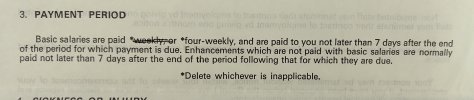
Extract from my 1976 BR employment contract to say that I would be paid every four weeks. No mention there that it would go straight into the bank account though.
A long time ago, so I can only assume I had to fill in a separate form with my bank details.
Attachments
Last edited:

martin2345uk
Established Member
Are there many TOCs/FOCs that do monthly pay?
Falcon1200
Established Member
It is monthly income with four-weekly outgoings that can cause a problem.
Even worse when, as with my Mum (a teacher) salary was always paid on the same day of the week, not month, resulting sometimes in 5 weeks without a payday!
I started on BR in 1975 as a clerical officer....and I was paid in cash until 1980.
I started on BR, also as a Clerical Officer, in 1978, and while my first week's pay was cash (£37.50 - I thought I was a King!) it was 4-weekly afterwards, through to retirement in 2016 (and my railway pension is also 4-weekly). IMHO a much better arrangement.
70014IronDuke
Established Member
- Joined
- 13 Jun 2015
- Messages
- 4,068
I started in '69, as a CO, and was automatically paid cash, but I was soon persuaded into being paid 4 weekly. The persuasion took the form of 'emotional blackmail'; 'married men with children are risking their lives transporting your cash' etc. I was, however, given to understand that I did have the right to insist on being paid cash.
Perhaps the change to bank transfer was a change to the BR conditions of employment, because I can't find any employment act between 1969 and 1970 that changed things.
== Doublepost prevention - post automatically merged: ==
This is fascinating. I too started in '69, effectively as a 'Technical Assistant' - later 'Technical Officer' - so in that respect, your equivalent on the technical side, but actually as a sponsored university student. There was no way I could necessarily get to my 'home station' every month to collect cash, so as I remember it, I had no choice but to accept salary via a bank account.
In order to recompense for this, AIRI, we were awarded an additional £1 per annum to pay for bank charges. Since, at the time, the Midland Bank (remember them?) had decided not to charge student accounts any charges, I was up by about 17 shillings a year after tax -oh the joy!

I think I was paid monthly, but I could not swear to that in court.
Ha ha! Shades of George Orwell - as in "The Road to Wigan Pier".It was hard before about 1970 to open a bank account. From what I remember, you had to be 'recommended' by someone who was in a 'professional' job.
As an aside, I did have a bank account from 1968 and when you went into a bank branch then, cashiers were sitting behind desks with no glass screens or protection. The desks had drawers for cash and deposited cheques. If you asked to see a statement - which could only be done at the branch holding your account - the cashier went around the back somewhere and produced it - the 'office copy' - for you to look at. They would, I think I recollect, address you by name. All the result of bank accounts being restricted to 'professional people'. Not sure how I managed to get one ...
Yes, I don't know how they managed in even the year before my intake for the lies of me - certainly two years prior.
I started in 1972 as a trainee technician in the S&T department. Wages grade, paid in cash weekly (starting at £10.35/week) with no bank option - that was a privilege for salaried staff and 'established status' wages grades.
The four weekly bank option arrived after a few years. I took it up immediately, but it wasn't particularly popular then.
The four weekly bank option arrived after a few years. I took it up immediately, but it wasn't particularly popular then.
Falcon1200
Established Member
Wages grade, paid in cash weekly (starting at £10.35/week) with no bank option - that was a privilege for salaried staff and 'established status' wages grades.
Something I recall from my first BR job was that we made up and paid the wages of the local Permanent Way gang, and I, a 19-year old trainee Clerical Officer, was paid more that those weatherbeaten men with a lifetime of railway service.

Only thing that’s slightly annoying about getting paid every 4 weeks is the year when you get 14 paydays, as you end up with a massive tax bill the following year. Fortunately it doesn’t happen too often and should only happen twice in the average career.
My old job was 4 weekly, my current one is 27th of each month (although that can vary too as if the 27th happens to fall on a weekend you get paid on the Friday instead)
The period between getting paid just before Christmas and January always feels like an absolute killer though!
Annual leave is a bit weird too in that when I started it the allowance used to run based on your individual start date (so 1st Jan - 1st Jan or whatever), then they suddenly decided nope everyone is 1st April - 1st April which probably simplified HR but at the same time you cause a bit of a staffing issue as everyone scrambles to use up all their remaining annual leave in the last few days at the same point every year! (again we used to be allowed to carry forward 5 days but they've changed that policy now too!)
I'm quite strategic with a credit card in that any non essential purchases I fancy I'll stick them on the credit card the day after the statement for the month comes through which then essentially gives me 60 or so days to pay it off rather than 30 (paid off in full every time of course!)
The period between getting paid just before Christmas and January always feels like an absolute killer though!
Annual leave is a bit weird too in that when I started it the allowance used to run based on your individual start date (so 1st Jan - 1st Jan or whatever), then they suddenly decided nope everyone is 1st April - 1st April which probably simplified HR but at the same time you cause a bit of a staffing issue as everyone scrambles to use up all their remaining annual leave in the last few days at the same point every year! (again we used to be allowed to carry forward 5 days but they've changed that policy now too!)
I'm quite strategic with a credit card in that any non essential purchases I fancy I'll stick them on the credit card the day after the statement for the month comes through which then essentially gives me 60 or so days to pay it off rather than 30
(paid off in full every time of course!)Snow1964
Established Member
Yes Truck Act of 1831 said payment has to be in cash, prior to that some businesses paid in tokens etc, which could only be used in the firms shop etc, so completely tied to unscrupulous employer.I'm very hazy here but it might be relevant.
The Truck Act demanded that people who 'worked by sweat of brow' (I think that was the definition - in effect, labouring people) had to be paid in cash.
Certainly on BR, grades below MS could insist on being paid in cash when I started, so not that long ago.
There was a Payment of Wages Act 1960, that allowed payment by cheque rather than cash.
Tend to be able to still spot organisations that based their monthly (or 4 weekly) payment on cheques, because they pay 4-6 days before end of month or period, because they had to allow for cheques to clear and people to get cash, rather than paying on last day.
They were all repealed by Wages Act 1986, after which most employers moved all new employees and requested existing employees to move to bank transfer credit.
The 1980s also saw ATMs installed outside most bank branches, so could get your cash outside bank counter hours.
What typical outgoings are four-weekly? Everything I have to pay regularly (apart from a few annual things) are monthly. Getting paid four-weekly would properly mess up my budgeting spreadsheet.Quite. It is monthly income with four-weekly outgoings that can cause a problem.
SuspectUsual
Established Member
- Joined
- 11 Jul 2018
- Messages
- 6,717
What typical outgoings are four-weekly? Everything I have to pay regularly (apart from a few annual things) are monthly. Getting paid four-weekly would properly mess up my budgeting spreadsheet.
Why?
You know which month will be the double-income one and that's your income line sorted, the outgoings stay as they are.
As others have said, a month with a "bonus" pay day is great, and the 8 years I worked for a company that paid 4 weekly the month with the extra pay day was always July or August, which was nice for managing holidays etc. Complete chance of course
It would mess up the way I use it. I have four columns - date of payment going out, payee, value, sum of remaining payments that month. At any time I can look at column 4, look at my bank balance and know how much spare money there is in the account that month. That wouldn't work if I didn't get paid monthly.Why?
You know which month will be the double-income one and that's your income line sorted, the outgoings stay as they are.
As others have said, a month with a "bonus" pay day is great, and the 8 years I worked for a company that paid 4 weekly the month with the extra pay day was always July or August, which was nice for managing holidays etc. Complete chance of course

Tetchytyke
Veteran Member
Many public transport season tickets are issued 4-weekly not monthly, and my childcare provider always used to invoice 4-weekly.What typical outgoings are four-weekly?
As @Ediswan says, that's really really annoying on a monthly income, as there's always one month a year where two bills are due in the same month.
It depends how close to the wire you have to budget.You know which month will be the double-income one and that's your income line sorted, the outgoings stay as they are.
If you are financially able to treat your 4-weekly pay as a monthly pay and the simply enjoy/bank/save the 'bonus' payment, it's great. But if you're not then it really isn't.
This is a big problem for people who receive Universal Credit on top of their wages. UC is calculated monthly in arrears but, in one month a year, you get two wages paid. This can really screw up your UC, for some people it can even tip them off the benefit meaning they have to re-apply. The DWP have never really shown any interest in sorting this out.
WesternLancer
Veteran Member
- Joined
- 12 Apr 2019
- Messages
- 15,065
such a foolish decision in terms of managing a workplace and staff deployment - everyone needing to take their unused leave at the same time across the whole organisation - and to boot it being close to the financial year end when you seem to always have more work to get done - and more reporting info to provide even if you don't necessarily work in a role that relates to finance, for a large range of staffAnnual leave is a bit weird too in that when I started it the allowance used to run based on your individual start date (so 1st Jan - 1st Jan or whatever), then they suddenly decided nope everyone is 1st April - 1st April which probably simplified HR but at the same time you cause a bit of a staffing issue as everyone scrambles to use up all their remaining annual leave in the last few days at the same point every year! (again we used to be allowed to carry forward 5 days but they've changed that policy now too!)
Carrying forward leave is the one sop to that to try to make it work better.
I can see why when all the record keeping was done without computers to help having everyone working to the same system probably made more sense, but with a computer to help you manage that it would seem to me to be completely unnecessary - having everyone's annual lave work on the anniversary of their joining date makes loads of sense.
Worth noting that the rail industry "calendar" isn't quite the same either. Weeks generally start on a Sunday, time starts at 02:00am not midnight
The railway uses "periods" - 4 week accounting blocks for pretty much everything - especially accountancy, ticketing and reconciliation.
The railway uses "periods" - 4 week accounting blocks for pretty much everything - especially accountancy, ticketing and reconciliation.
Merle Haggard
Established Member
Worth noting that the rail industry "calendar" isn't quite the same either. Weeks generally start on a Sunday, time starts at 02:00am not midnight
The railway uses "periods" - 4 week accounting blocks for pretty much everything - especially accountancy, ticketing and reconciliation.
The LMS changed from monthly to 4-week period for loco allocations/works visits from about 1926, presumably it was all part of the new company's emphasis on costing and possibly was applied to all accounting.. On the sheets I have it seemed that either someone did't fully grasp the system or it was initially unconventional because the week-end or period-end date was a Sunday not Saturday.
The railway periods were based on the calendar year from P1 to P13, with occasional 5 week P13s to correct the drift caused by 28 x 13 being 364 and also leap years.
At some time in the late 1980s (I can't recollect exactly) and probably by government/DT intervention ii was changed to financial year (April to March) and the conversion involved carrying on after P13 to P15.

Could be worse, you could be paid precisely 3 times in a year, as student finance maintenance payments are made. Goodness knows how we expect young people to learn to budget and manage their finances when they're paid so irregularly.
I tend to invoice weekly and get paid 28 days later. The client could pay me earlier, but they don't. They wait until day 28.
I tend to invoice weekly and get paid 28 days later. The client could pay me earlier, but they don't. They wait until day 28.

I thought you didnt lose out over 12 months.This is a big problem for people who receive Universal Credit on top of their wages. UC is calculated monthly in arrears but, in one month a year, you get two wages paid. This can really screw up your UC, for some people it can even tip them off the benefit meaning they have to re-apply. The DWP have never really shown any interest in sorting this out.